Black Mass Export Ban: Securing Critical Minerals for India's Battery Ecosystem
Restricting raw battery scrap exports secures vital feedstock for India's clean energy ambitions, but refining capacity bottlenecks remain a critical hurdle.
Nov, 2026
•11 min read
Overview
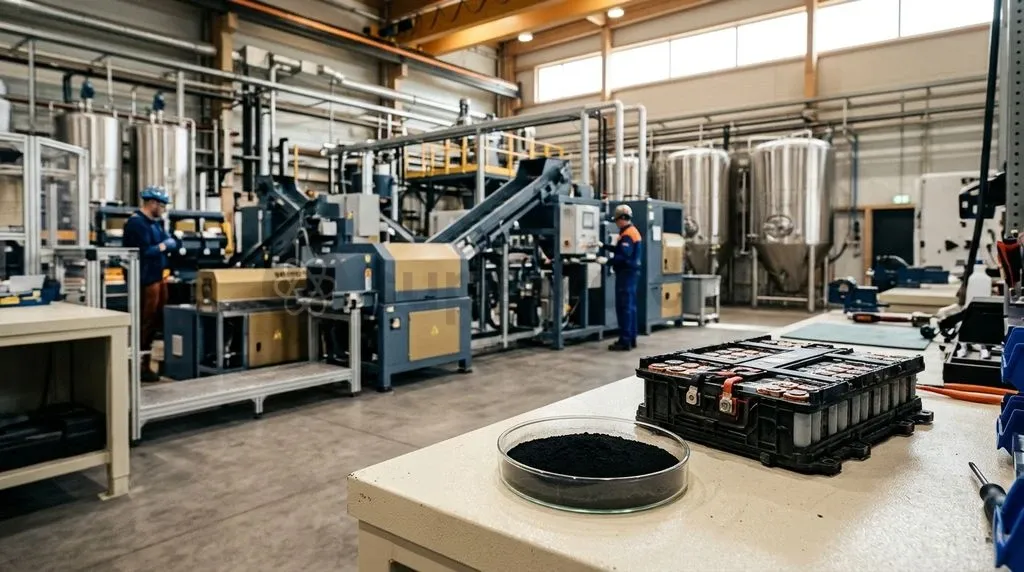
India has banned the export of raw lithium-ion battery scrap to protect domestic clean-energy supply chains. On 10 November 2026, the Directorate General of Foreign Trade prohibited outbound shipments of lithium-ion battery black mass under ITC (HS) Code 85491400 via Notification No. 49/2026-27. As of November 2026, the country faces near-total reliance on foreign imports for raw battery precursors like lithium, nickel, and cobalt.
Local dismantling units have expanded rapidly, but recyclers previously shipped mineral-rich black mass powder to foreign refiners. This trade pattern starved domestic chemical processors of essential feedstock. The revised trade policy directly aligns secondary resource recovery with India's manufacturing ambitions under the National Programme on Advanced Chemistry Cell Battery Storage. Retaining scrap within national borders helps build a captive supply loop, though closing the domestic chemical refining gap remains essential.
Why in the News: The Proposed Export Curb on Battery 'Black Mass'
A targeted policy shift has halted outbound shipments of discarded battery material. The Directorate General of Foreign Trade amended the export policy for lithium-ion battery waste under ITC (HS) Code 85491400 from 'Free' to 'Prohibited' on 10 November 2026. This intervention was notified via DGFT Notification No. 49/2026-27, imposing an immediate restriction on outbound shipments of shredded battery scrap.
As of November 2026, the targeted ITC (HS) Code 85491400 governs two distinct waste categories:
- Primary Cells and Batteries: Unsorted waste and scrap of primary cells, primary batteries, and electric accumulators.
- Spent Non-Toxic Accumulators: Spent batteries devoid of lead, cadmium, or mercury.
The curbs address an escalating structural tension between scrap shredders and capital-intensive chemical refiners. According to the Ministry of Commerce and Industry, domestic hydrometallurgical refining plants previously experienced acute feedstock shortages because pre-processors exported bulk black mass overseas to processing hubs in China, South Korea, and the European Union. By restricting raw waste exports, the government has anchored secondary critical mineral retention as an active pillar of industrial policy.
Discuss with Superkalam
Recall the exact ITC (HS) classification code and the DGFT notification number that placed black mass exports under the 'Prohibited' category.
Ask NowWhat Exactly Is Black Mass and Why Is It in Such High Demand?
Black mass is the dark, powdery concentrate left after spent battery packs undergo mechanical shredding. It contains the active materials stripped from battery cathodes and anodes, according to a press release from the Press Information Bureau. This residue is an ultra-rich intermediate feedstock that bypasses the energy-intensive extraction required for virgin ores.
The powder concentrates the strategic chemical elements powering modern electric mobility:
- Cathode and Anode Elements: High concentrations of battery-grade lithium, cobalt, nickel, manganese, and refined graphite.
- High Ore Grades: Yields concentrations that surpass natural subterranean mineral deposits.
- Bulk Pack Weight: Black mass constitutes approximately 40% to 50% of the total dry weight of a dismantled electric vehicle lithium-ion battery pack.
Mining virgin lithium or cobalt involves severe ecological disturbance. Consequently, global manufacturers treat black mass as a high-grade urban ore.
How Black Mass Is Produced: From Spent Lithium-Ion Cells to Valuable Powder
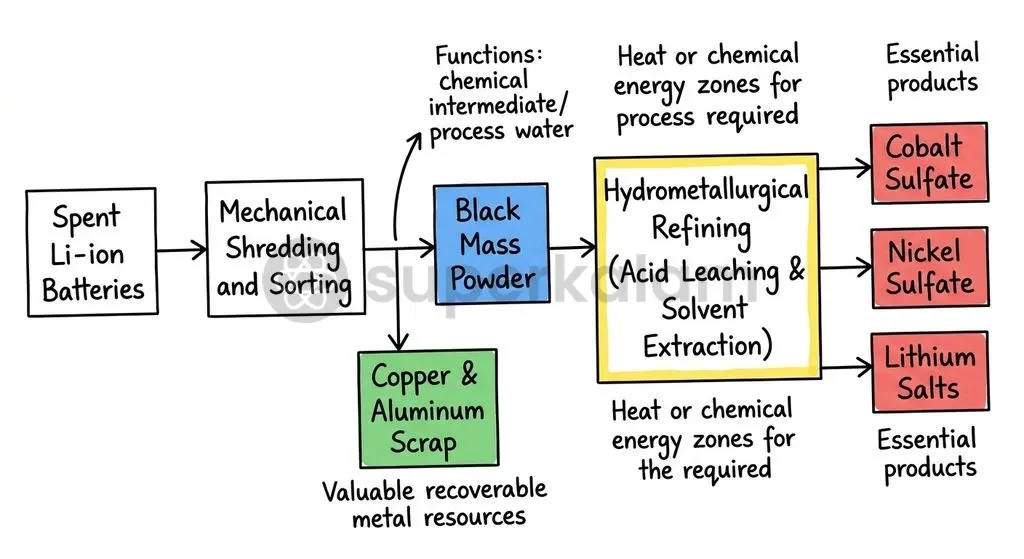
Turning an explosive, spent battery into stable industrial powder requires precise thermal and mechanical isolation. Technicians completely discharge end-of-life battery cells to prevent electrical short circuits. Modules are then shredded within specialised hammer mills operating under protective, inert atmospheric controls.
The industrial recovery sequence splits into two distinct processing stages:
- Mechanical Pre-Treatment and Physical Separation: The discharged cells undergo multi-stage mechanical shredding to separate the structural casing from interior foils. Magnetic separators isolate ferrous casings, while air-classification and eddy-current separators detach copper and aluminium foils. The remaining cathode and anode coatings are sieved and collected as unrefined black mass powder.
- Advanced Metallurgical Refining: The harvested black mass must undergo deep chemical extraction to yield battery-ready materials. Processors utilise either pyrometallurgy or hydrometallurgy to separate mixed elements into individual, ultra-pure chemical salts.
The technological and capital divergence across these recovery stages defines India's current industrial bottleneck:
| Dimension | Mechanical Pre-Treatment (Shredding) | Hydrometallurgical Refining | Pyrometallurgical Smelting |
|---|---|---|---|
| Primary Output | Raw black mass concentrate | Refined metal sulphates and battery-grade lithium salts | Molten metal alloy (matte) containing nickel and cobalt |
| Lithium Recovery Efficiency | Zero chemical extraction (contained as unseparated powder) | Exceeds 90% recovery via liquid acid leaching | Very low; lithium is predominantly lost to the slag phase |
| Capital Expenditure (Capex) | Relatively low; accessible to micro and small enterprises | High initial capex requiring corrosion-resistant chemical infrastructure | Extremely high capex; requires industrial-scale furnaces and blast plants |
| Environmental Emissions | Risk of toxic dust, solvent vapour, and hydrofluoric acid gas | Liquid acid effluents requiring advanced effluent treatment plants (ETP) | High greenhouse gas emissions and sulphur dioxide exhaust |
Discuss with Superkalam
Explain why hydrometallurgical processing is considered superior to pyrometallurgical smelting for recovering critical elements from black mass.
Ask NowWhy India Needs Domestic Refining: Supply Chain Security and Strategic Autonomy
India holds negligible reserves of primary battery minerals, leaving its clean mobility push exposed to external geopolitical disruptions. The Ministry of Mines has documented that India relies entirely on overseas suppliers for its primary supplies of lithium, nickel, and cobalt. Secondary recovery via closed-loop urban mining represents an indispensable pathway to domestic resource security, according to the Report of the Committee on Identification of Critical Minerals. Allowing unprocessed black mass to leave domestic shores directly undermined this objective, converting raw domestic scrap into foreign industrial leverage.
Domestic manufacturing schemes depend entirely on dependable access to upstream precursor chemicals:
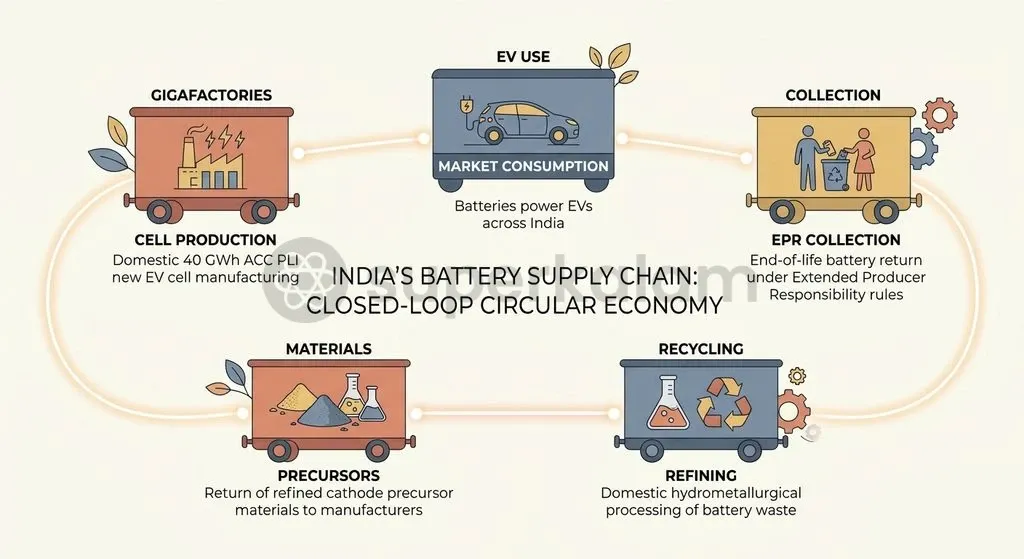
- Scale of the Incentive: The Ministry of Heavy Industries manages the Production Linked Incentive (PLI) Scheme for the National Programme on Advanced Chemistry Cell (ACC) Battery Storage, backed by an outlay of ₹18,100 crore.
- Target Manufacturing Capacity: As of 2026, the government has awarded 40 GWh of cumulative manufacturing capacity across four beneficiary firms.
- Precursor Chemical Links: A NITI Aayog strategy paper notes that these gigafactories must achieve backward integration with domestic precursor cathode active material (pCAM) producers who rely on black mass-derived refined mineral salts.
Extended Producer Responsibility (EPR): Where Existing Rules Fall Short
Statutory recycling targets have spurred aggressive cell collection, yet loopholes have historically bypassed domestic refiners. The Ministry of Environment, Forest and Climate Change notified the statutory Battery Waste Management Rules, 2022 on 22 August 2022 under the Environment (Protection) Act, 1986. These rules established an Extended Producer Responsibility (EPR) regime covering automotive, industrial, portable, and electric vehicle batteries. Under Schedule II, the Central Government instituted steep, mandatory material recovery targets for electric vehicle batteries: 70% in FY 2024-25, 80% in FY 2025-26, and 90% for FY 2026-27 and onwards.
Producers must also integrate minimum quantities of domestically recovered materials into newly manufactured batteries, starting at 5% in FY 2027-28 and climbing to 20% by FY 2030-31. The Central Pollution Control Board (CPCB) oversees compliance through a centralised online portal that generates and monitors tradable EPR certificates. Failure to meet statutory targets triggers punitive Environmental Compensation (EC) levies administered by the CPCB.
A significant implementation loophole disrupted this framework prior to the export restriction. As reported by the Centre for Science and Environment on 12 November 2026, pre-processors frequently shredded waste cells to claim collection credits on the portal before shipping the unrefined black mass abroad to overseas buyers, short-circuiting domestic supply chains.
| Breakdown Stage in the EPR Chain | Operational Reality | Consequence for Domestic Policy |
|---|---|---|
| 1. Scrap Collection & Shredding | Spent EV cells collected and mechanically crushed | Generates CPCB EPR credits, fulfilling the primary collection quota |
| 2. Feedstock Outflow | Unrefined black mass exported overseas to foreign processors | Starves domestic hydrometallurgical facilities of critical feedstock |
| 3. Downstream Market Impact | Zero chemical extraction of lithium or nickel occurs domestically | Creates recycled content deficits ahead of mandatory FY 2027-28 rules |
Discuss with Superkalam
How might an Indian battery gigafactory beneficiary under the ACC PLI Scheme adapt its procurement strategy following the export ban on black mass?
Ask NowEnvironmental and Economic Trade-offs: Banning Exports vs. Building Processing Capacity
An export ban prevents mineral flight, but domestic hydrometallurgical refining plants cannot yet absorb total national scrap volumes. Industrial trade data reported in Business Standard reveals that India's domestic battery processing landscape remains heavily tilted toward low-capital mechanical dismantling. Restricting exports without simultaneously scaling chemical refining infrastructure risks creating localised stockpiles of hazardous black mass that domestic processors cannot readily absorb.
The domestic processing landscape faces distinct structural friction points:
- Refining Deficit: While small-scale shredding units have proliferated rapidly across industrial clusters, the domestic market suffers from severe capacity deficits in advanced hydrometallurgical refining.
- Technical Complexity: Achieving purity levels above 99% requires hydrometallurgical leaching with sulphuric, hydrochloric, or organic acids combined with multi-stage solvent extraction.
- Stockpile Accumulation: Halting outbound trade without matching chemical infrastructure risks stranding reactive black mass within local warehouses.
To bridge this processing gap, the Union Cabinet approved a ₹1,500-crore Incentive Scheme under the National Critical Minerals Mission in September 2025. This initiative sets targeted industrial milestones:
- Creation of at least 270 kilo tonnes of annual recycling capacity.
- Recovery of approximately 40 kilo tonnes of critical minerals each year.
Global Precedents: How Other Nations Protect and Process Critical Mineral Waste
Major manufacturing economies increasingly treat battery scrap as strategic mineral reserves rather than ordinary industrial waste. The European Union established sweeping trade safeguards for battery waste under Regulation (EU) 2023/1542. The European Parliament and Council placed stringent prohibitions on exporting untreated battery scrap and intermediate black mass to non-OECD jurisdictions, ensuring secondary critical minerals remain within European manufacturing borders. This measure protects regional supply chains against geopolitical disruptions while reinforcing strict waste-shipment standards.
Key global practices show clear patterns:
- Export Prohibitions: Barring untreated mass from exiting trade borders keeps critical materials within local manufacturing systems.
- Direct Capital Subsidies: East Asian economies fund chemical separation hubs directly to guarantee domestic precursor supply.
- Strategic Input Reclassification: Trade rules treat end-of-life battery scrap as a protected strategic input instead of mere municipal refuse.
Discuss with Superkalam
Analyse the structural loop between the Battery Waste Management Rules EPR portal credits and the pre-ban export of unrefined shredded waste.
Ask NowEthical and Governance Dimensions: Informal Scrap Markets and Worker Safety
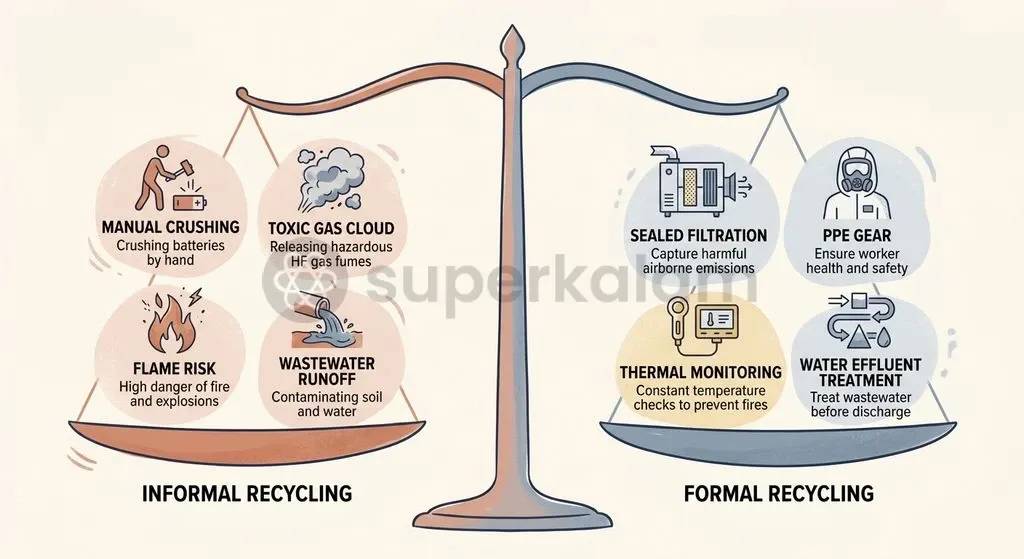
Informal scrap aggregation hubs in urban peripheries routinely handle lithium-ion accumulators without adequate environmental or occupational safeguards. Research published in the Journal of Loss Prevention in the Process Industries demonstrates that unscientific battery crushing and wet mechanical shredding carry acute risks of destructive thermal runaway fires and uncontrollable toxic emissions. Workers in these unauthorised facilities rarely possess basic personal protective gear or fire-suppression equipment.
The chemical breakdown of battery electrolytes introduces severe environmental and public health hazards:
- Hydrofluoric Acid (HF) Gas Generation: When moisture interacts with fluorinated electrolyte salts—principally lithium hexafluorophosphate (LiPF6)—during crude shredding, it releases corrosive and toxic hydrofluoric acid vapour.
- Groundwater Aquifer Leaching: CPCB technical guidelines indicate that unlined, informal storage and acid-washing of black mass wash toxic heavy metals such as nickel, cobalt, and manganese directly into surrounding soils and aquifers.
- Violations of Labour Dignity: Informal workers, often including marginalised migrant labourers, dismantle explosive battery packs manually using basic chisels and hammers. This exposure violates core constitutional protections for just and humane conditions of work under Article 42 of the Directive Principles of State Policy.
Discuss with Superkalam
Weigh the trade-off between the low-capex shredding sector losing lucrative export markets and the strategic imperative of subsidising capital-heavy domestic chemical refining.
Ask NowThe Way Forward: Creating a Closed-Loop Battery Ecosystem in India
Closing India's battery loop requires linking regulatory compliance directly to refined metal production. The Central Pollution Control Board must refine the digital EPR credit mechanism to reward actual metal extraction rather than mere mechanical crushing. Under the current portal setup, pre-processors obtain compliance credits upon shredding battery scrap, creating a disincentive for complex chemical refining. The Ministry of Environment, Forest and Climate Change should split EPR certification into two distinct tiers: Pre-processing Collection Credits and End-Point Refined Metal Credits, releasing higher financial values only when battery-grade salts are verifiably produced.
Accelerating capital deployment under the National Critical Minerals Mission remains critical to resolving domestic processing bottlenecks:
- Shared Processing Infrastructure: The Ministry of Mines and state industrial development boards should establish common-user hydrometallurgical processing clusters equipped with centralised effluent treatment plants.
- Co-location with Gigafactories: Co-locating state-backed refining facilities near planned gigafactories under the ACC PLI scheme will cut logistics costs and minimise hazardous material transport.
- Insulation from Price Shocks: Captive domestic recycling will insulate clean energy transitions from volatile global commodity markets.
Key Takeaways
- On 10 November 2026, the DGFT prohibited the export of lithium-ion battery black mass under ITC (HS) Code 85491400 via Notification No. 49/2026-27 to secure domestic critical mineral supplies.
- Black mass constitutes 40% to 50% of an EV battery pack's dry weight and concentrates vital energy-transition minerals, including lithium, cobalt, nickel, and manganese.
- India depends almost entirely on external imports for primary battery-grade lithium, cobalt, and nickel, highlighting the strategic importance of secondary recovery.
- Under the Battery Waste Management Rules, 2022, mandated EV battery material recovery targets scale to 90% for FY 2026-27 and onwards, alongside minimum domestic recycled content quotas starting in FY 2027-28.
- The domestic industry faces a capital imbalance, characterised by abundant low-cost mechanical shredding units alongside a deficit in advanced hydrometallurgical refining plants.
- .
Mains Question
The Directorate General of Foreign Trade's prohibition on black mass exports highlights the transition of secondary critical minerals from waste management to strategic industrial policy. In this context, evaluate the role of urban mining in securing India's clean energy supply chains. (10 Marks)
Evaluate NowMains Question
"Statutory recycling obligations under the Extended Producer Responsibility (EPR) regime often fail to guarantee domestic resource retention in the absence of harmonised trade curbs." Critically examine this statement with reference to the Battery Waste Management Rules, 2022. (15 Marks)
Evaluate NowPractice MCQs
QUESTION 1
Regarding 'black mass' derived from spent lithium-ion battery scrap, consider the following statements:
- It comprises active materials recovered from both the cathodes and anodes of discarded battery cells.
- In terms of concentration, it can yield higher grades of strategic elements than natural subterranean mineral deposits.
- It constitutes approximately 40% to 50% of the total dry weight of a dismantled electric vehicle battery pack.
Which of the statements given above are correct?
QUESTION 2
With reference to the processes involved in critical mineral recovery from lithium-ion battery waste, consider the following statements:
- Mechanical pre-treatment involves chemical leaching to extract separated battery-grade lithium salts.
- Hydrometallurgical refining achieves over 90% lithium recovery through liquid acid leaching.
- In pyrometallurgical smelting, lithium is predominantly lost to the slag phase rather than recovered into the molten alloy.
Which of the statements given above is/are correct?
QUESTION 3
Under the Battery Waste Management Rules, 2022 notified by the Ministry of Environment, Forest and Climate Change, consider the following statements:
- Mandatory material recovery targets for electric vehicle batteries are set to reach 90% for FY 2026-27 and onwards.
- Producers are mandated to integrate a minimum percentage of domestically recovered materials into newly manufactured batteries starting from FY 2027-28.
- The Central Pollution Control Board levies Environmental Compensation on entities failing to meet statutory Extended Producer Responsibility targets.
Which of the statements given above are correct?
QUESTION 4
In November 2026, the Directorate General of Foreign Trade (DGFT) amended the export policy for lithium-ion battery black mass under ITC (HS) Code 85491400 from 'Free' to 'Prohibited'. What was the primary domestic industrial objective behind this move?
QUESTION 5
Consider the following statements regarding the production of Advanced Chemistry Cells (ACC) in India:
- The Production Linked Incentive (PLI) Scheme for ACC Battery Storage is managed by the Ministry of Heavy Industries with an outlay of ₹18,100 crore.
- Beneficiary gigafactories require backward integration with precursor cathode active material (pCAM) producers who use refined mineral salts.
Which of the statements given above is/are correct?
Related Blogs

India Forex Reserves (As of November 2026): Components, RBI Management, Import Cover and Why It Matters
Nov, 2026
•15 min read

Regional Benches of Supreme Court vs National Court of Appeal: Solving Apex Pendency
Nov, 2026
•10 min read
ISRO NVS-03 Launch: NavIC L1 Upgrade and Strategic Autonomy
Nov, 2026
•9 min read


