Mid-Course College Fee Hikes: Supreme Court Ruling Explained
By curbing arbitrary mid-degree fee escalations, the Supreme Court reconciles private institutional autonomy under Article 19(1)(g) with student protections.
Oct, 2026
•11 min read
Overview
On 14 October 2026, the Supreme Court of India ruled that tuition and institutional fees for professional courses in self-financing institutions must be determined and notified for the entire duration of the programme prior to student admissions. The judgment establishes that mid-course fee revisions are impermissible except under narrow, extraordinary conditions, checking arbitrary escalations by private unaided colleges.
By invalidating open-ended prospectus clauses, the Court held that financial predictability at the threshold of admission is an indispensable safeguard under public law. Educational institutions cannot exploit administrative delays or inflation to disrupt an enrolled student's financial planning mid-stream.
Why in the News: The Supreme Court Verdict on Mid-Course Fee Hikes
On 14 October 2026, the Supreme Court of India delivered a landmark judgment in Dr. B.C. Roy Engineering College & Anr. v. The State of West Bengal & Ors. (2026 INSC 1120). As of October 2026, the bench authoritatively settled the regulatory vacuum surrounding sudden fee increases imposed on ongoing student cohorts.
The Court struck down a 37.5% mid-course tuition fee increase alongside an added development fee levied on the 2023–27 B.Tech batch of Dr. B.C. Roy Engineering College. Under the ruling, the Court issued specific directives:
- Refund or adjustment: The college must refund excess collections or adjust them against subsequent semester dues.
- Strict exceptions only: Mid-stream escalations remain permissible only under narrow and exceptional situations, such as unexpected expenditure surges or mandatory statutory shifts.
- Cohort insulation: Enrolled students remain shielded from sudden financial shocks once an academic session begins.
Discuss with Superkalam
Recall the margin by which professional course fees exceed general academic programmes according to the NSSO data cited by the Court.
Ask NowThe Core Conflict: College Autonomy versus Student Predictability
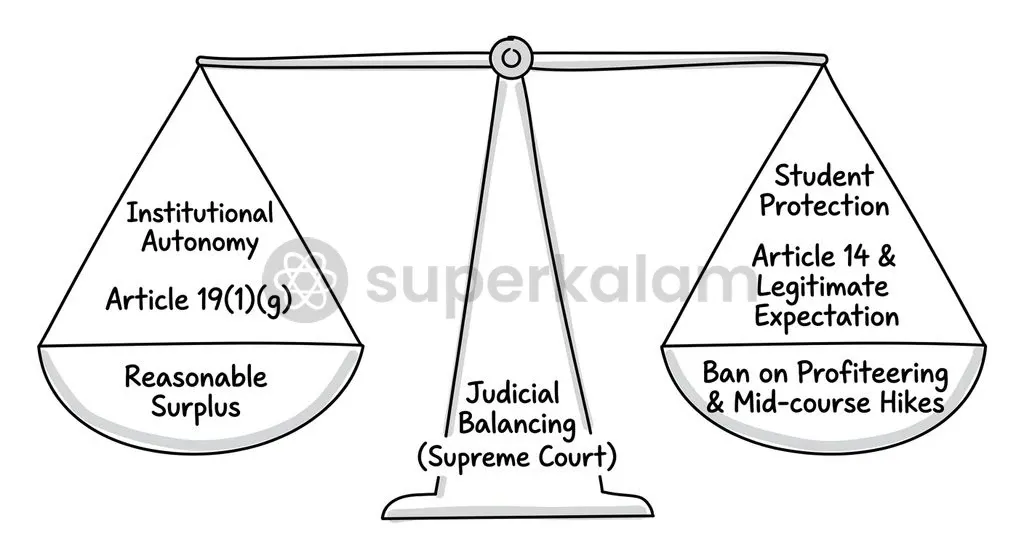
Private unaided professional colleges routinely operate under intense financial pressures driven by faculty payroll, infrastructure upgrades, laboratory maintenance, and broader operational inflation. Under Article 19(1)(g) of the Constitution, private promoters possess the fundamental right to establish and administer educational institutions. This autonomy includes generating an operational surplus for institutional expansion and sustained excellence, provided it does not degenerate into commercial exploitation.
| Dimension | Private Unaided Colleges | Enrolled Students |
|---|---|---|
| Constitutional Basis | Article 19(1)(g): Right to practise an occupation | Article 14: Guarantee against arbitrary state action |
| Financial Objectives | Generate reasonable surplus for expansion and quality standards | Maintain predictable household budgets and manageable student debt |
| Operational Realities | Absorb sudden shifts in operational overheads and inflation | Prevent lock-in traps and arbitrary mid-degree cost escalations |
Conversely, admitted students and their families enter higher education with rigid household budgets, education loans, and predetermined savings plans. According to National Sample Survey Office (NSSO) data cited by the Supreme Court in Dr. B.C. Roy Engineering College, professional course fees are reported to be 711% higher than fees for general academic programmes.
When an institution abruptly inflates fees midway through a degree, the power asymmetry leaves students trapped. They cannot withdraw without forfeiting accumulated academic credits, entrance ranks, and sunk tuition expenses.
The Supreme Court balanced these competing imperatives by ruling that institutional viability cannot be achieved through unilateral, mid-stream fee hikes. Under Article 14, students possess a valid shield, establishing advance fee certainty without compromising institutional solvency.
Administrative Law Shield: Promissory Estoppel and Legitimate Expectations
The legal dispute began when students challenged the mid-stream escalation before the Calcutta High Court. On 15 January 2026, a Single Judge dismissed the student petitions in Gourab Kumar Sadhu & Ors. v. State of West Bengal & Ors. (2026 SCC OnLine Cal 390). The Single Judge held that an open-ended prospectus clause stating that fees were "subject to change from time to time as per Government decision" was legally binding on admitted students.
On 23 March 2026, a Division Bench of the Calcutta High Court reversed that decision in Debajyoti Dey & Ors. v. State of West Bengal & Ors. (2026 SCC OnLine Cal 2382). The Division Bench ruled that the State Government's fee enhancement notification dated 16 October 2023 could not be applied retrospectively to students already admitted in earlier cycles, drawing on the administrative law doctrine of promissory estoppel.
| Doctrine / Principle | Application in High Court Ruling | Treatment by the Supreme Court (2026 INSC 1120) |
|---|---|---|
| Doctrine of Retrospectivity | Held that government notifications cannot retrospectively burden ongoing batches. | Affirmed operative relief but shifted primary focus to statutory certainty. |
| Promissory Estoppel | Applied to hold the college strictly to the prospectus fee schedule promised at admission. | Decoupled the final verdict from estoppel; anchored it in regulatory statutory compliance. |
| Legitimate Expectation | Considered secondary to contractual terms specified within the college prospectus. | Elevated as a substantive shield: open-ended disclaimers cannot override threshold financial clarity. |
| Statutory Advance Certainty | Treated as general guidance subordinate to executive notifications. | Established as a binding mandate: total course fee must be fixed prior to admissions. |
When the matter reached the Supreme Court in Dr. B.C. Roy Engineering College, the apex bench affirmed the operative relief protecting the students. The Court decoupled its judgment from the High Court's reliance on retrospectivity and promissory estoppel. Instead, the Supreme Court grounded its ruling in the broader statutory framework of fee regulation and the doctrine of legitimate expectation.
Under administrative law, the doctrine of legitimate expectation prevents public and private bodies performing public functions from acting arbitrarily or reneging on procedural representations. The Supreme Court held that self-financing colleges cannot rely on unilateral prospectus disclaimers to defeat a student's reasonable expectation of financial liability disclosed at the point of admission.
Discuss with Superkalam
Explain why the Supreme Court preferred the administrative law doctrine of 'legitimate expectation' over 'promissory estoppel' in deciding the fee hike challenge.
Ask NowThe Constitutional Balance: Article 19(1)(g) and the Ban on Profiteering
The constitutional framework governing private educational institutions operates under a calibrated doctrine: education is an occupation under Article 19(1)(g), but it remains categorically distinct from ordinary commerce, trade, or business. Private trusts enjoy managerial freedom to run colleges. Even so, the State retains extensive regulatory power under Article 19(6) to impose reasonable restrictions in the public interest.
This balance rests on three constitutional pillars articulated across several decades of Supreme Court jurisprudence:
- Right to a Reasonable Surplus: Private unaided institutions can generate a reasonable financial surplus for institutional growth, infrastructure, and pedagogical improvements.
- Strict Prohibition of Capitation Fees: Charging arbitrary levies, under-the-table fees, or unapproved capital charges violates fundamental fairness and statutory norms.
- Absolute Bar on Commercial Profiteering: The Supreme Court reiterated in Dr. B.C. Roy Engineering College that higher education is a fiduciary public trust that must never be converted into a commercial marketplace.
When colleges impose unexpected mid-course fee hikes, they disrupt this constitutional balance. A fee increase introduced after students are enrolled breaches the non-profiteering standard. It turns educational autonomy under Article 19(1)(g) into an arbitrary financial demand prohibited by Article 14.
Judicial Precedents: From TMA Pai to Inamdar and Modern Dental College
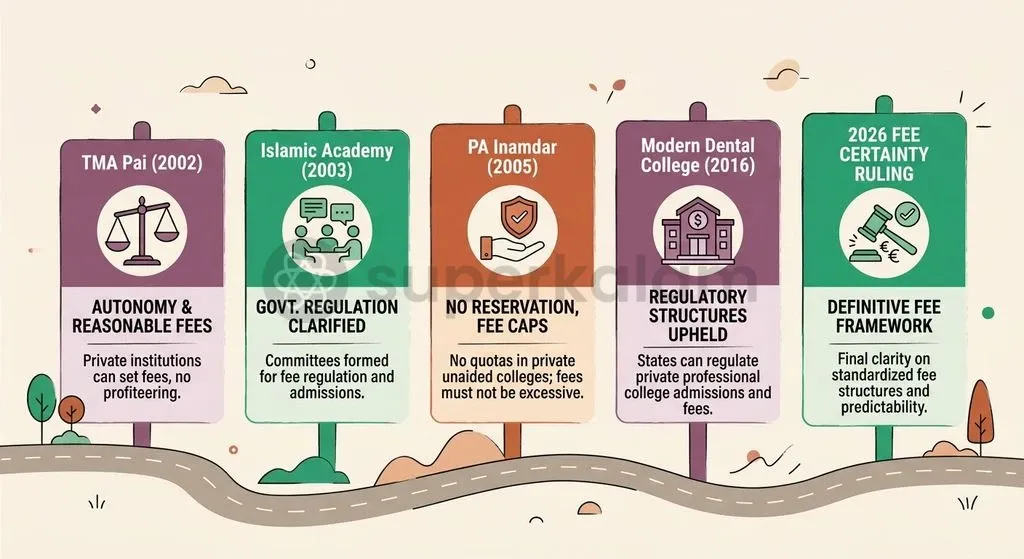
The 2026 ruling builds upon a coherent continuum of Constitution Bench decisions delineating private higher education regulation in India.
| Landmark Precedent | Bench Strength | Core Constitutional Principle Established |
|---|---|---|
| T.M.A. Pai Foundation (2002) | 11-Judge Bench | Recognised autonomy under Article 19(1)(g) while outlawing capitation fees and commercialisation. |
| Islamic Academy of Education (2003) | 5-Judge Bench | Mandated State Fee Regulatory Committees to fix fee ceilings for a three-year cycle. |
| P.A. Inamdar (2005) | 7-Judge Bench | Affirmed oversight committees; classified education as a noble occupation rather than commerce. |
| Modern Dental College (2016) | 5-Judge Bench | Upheld statutory fee regulation using the doctrine of proportionality under Article 19(6). |
The modern legal regime originated with the eleven-judge Constitution Bench in T.M.A. Pai Foundation v. State of Karnataka ((2002) 8 SCC 481). The Court held that private unaided educational institutions enjoy an autonomy protected under Article 19(1)(g) to devise their own admission procedures and fee structures. The bench explicitly outlawed capitation fees, emphasising that institutions must not engage in profiteering.
To operationalise these principles, a five-judge Constitution Bench in Islamic Academy of Education v. State of Karnataka ((2003) 6 SCC 697) directed the creation of specialised regulatory machinery. The Court mandated that every State government establish a Fee Regulatory Committee headed by a retired High Court judge to scrutinise fee proposals in advance.
In P.A. Inamdar v. State of Maharashtra ((2005) 6 SCC 537), a seven-judge Constitution Bench reaffirmed the constitutional validity of these State Fee Regulatory Committees. The bench reiterated that state oversight remains valid to prevent the exploitation of students during admissions.
The constitutional validity of state regulatory statutes was later challenged under Article 19(1)(g), leading to the five-judge Constitution Bench judgment in Modern Dental College & Research Centre v. State of Madhya Pradesh ((2016) 7 SCC 353). Applying the doctrine of proportionality, the Court held that state enactments regulating admission procedures and fixing fee structures do not violate managerial rights. Regulatory oversight serves the larger public interest by ensuring merit-based admissions, curbing profiteering, and widening access to higher education.
Discuss with Superkalam
If a self-financing medical college faces sudden, government-mandated laboratory compliance costs mid-way through a degree, how should it apply the Court's exception criteria?
Ask NowThe Regulatory Web: State Fee Committees and the National Medical Commission
Statutory bodies across India share regulatory responsibility over private educational fees, though implementation remains uneven across sectors:
- Technical Education: Under Regulation 7(7) of the All India Council for Technical Education (AICTE) Regulations, 1994, self-financing technical institutions must communicate their fee structure for the entire duration of the course in advance.
- National Policy Guidance: Paragraphs 18.13 and 18.14 of the National Education Policy (NEP) 2020 instruct higher education institutions to disclose all fees transparently and prohibit any arbitrary increases during a student's course duration.
- Medical Education: Section 10(1)(i) of the National Medical Commission Act, 2019 empowers the National Medical Commission (NMC) to frame binding fee guidelines for 50% of seats in private medical colleges and deemed-to-be universities.
Despite this statutory architecture, State Fee Regulatory Committees (SFRCs) frequently suffer from severe administrative lethargy. In Dr. B.C. Roy Engineering College, the Supreme Court highlighted that West Bengal experienced a seven-year freeze without fee revision between 2016 and 2023.
When authorities abruptly adjust fee schedules after years of inaction, institutions attempt to shift accumulated operational deficits onto ongoing batches through retroactive notifications. The Court made clear that bureaucratic delays cannot justify mid-course fee escalations on enrolled students.
Ethical Dimensions: Education as Public Trust versus Commercialization
Beyond the legal mechanics of administrative law, mid-course fee hikes raise fundamental ethical questions central to public governance. The relationship between an educational institution and an enrolled student is fundamentally fiduciary, grounded in mentorship and social development. When institutions unilaterally raise tuition fees, they transform this relationship into an unequal commercial transaction.
From an ethical perspective, mid-course fee revisions exploit an acute asymmetry of bargaining power. Once admitted, a student faces severe lock-in effects:
- Sunk financial investments made toward admission, hostel deposits, and entrance exam preparation cannot be recovered.
- Academic credits cannot be easily transferred to equivalent professional institutions without significant administrative hurdles.
- Withdrawing midway means abandoning years of academic effort and forfeiting competitive entrance examination ranks.
Subjecting students to mid-stream fee hikes forces families into unmanageable private debt or triggers distress dropouts, directly undermining educational equity. The Supreme Court emphasised that higher education must be guarded against degrading into an unregulated marketplace where students are treated as captive consumers.
Discuss with Superkalam
Analyse the structural power asymmetry that creates a 'lock-in trap' for students once enrolled in professional programmes.
Ask NowWay Forward: Transparent Cost Audits and Predictable Fee Frameworks
To prevent recurring litigation while safeguarding the financial viability of private colleges, systemic reforms must target the roots of administrative delay and informational ambiguity:
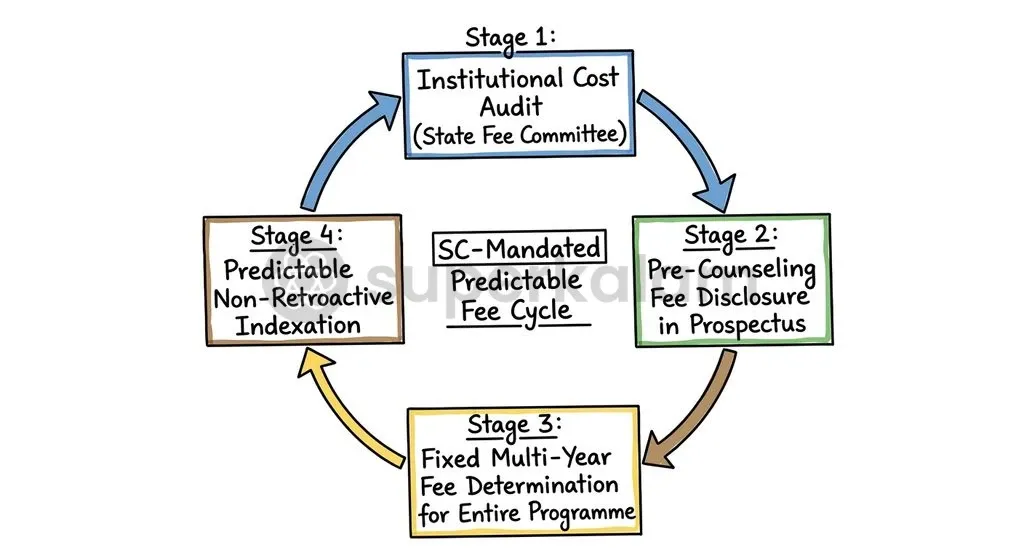
- Permanent Institutional Oversight: The Supreme Court directed that State Fee Regulatory Committees must function as standing, continuing institutions rather than convening sporadically after multi-year gaps. Standing committees can evaluate balance sheets periodically, ensuring adjustments apply incrementally across new admission cycles rather than through sudden retrospective jumps.
- Forward-Looking Cost Indexation: State regulatory bodies must formulate predictable forward-looking indexation formulas. By pegging annual adjustments for incoming batches to objective cost indices, institutions can plan for operational inflation without burdening students already midway through their degrees.
- Binding Upfront Disclosures: Regulatory authorities must mandate transparent multi-year cost disclosures across all entrance counselling portals before seat allocation. Every college must publish an all-inclusive fee schedule covering tuition, laboratory, and developmental charges for the full course duration. Once a candidate accepts an allotment, the fee schedule must remain legally binding through graduation.
Key Takeaways
- On 14 October 2026, the Supreme Court ruled in Dr. B.C. Roy Engineering College v. State of West Bengal that professional course fees in private unaided colleges must be determined and notified for the entire duration of the course prior to admissions.
- Mid-course fee hikes are impermissible under public law, except under narrow and extraordinary circumstances such as mandatory statutory shifts or unforeseen expenditure surges.
- The apex court set aside a 37.5% mid-course tuition fee increase imposed on the 2023–27 B.Tech batch, ordering immediate refunds or adjustments.
- The judgment anchored student protections in the administrative law doctrine of legitimate expectation and statutory compliance, overriding unilateral prospectus disclaimers.
- Drawing on T.M.A. Pai (2002), Islamic Academy (2003), P.A. Inamdar (2005), and Modern Dental College (2016), the Court reiterated that higher education is an occupation subject to an absolute ban on profiteering and capitation fees.
- Structural reforms require State Fee Regulatory Committees to operate as active, continuing institutions that establish transparent multi-year fee schedules and forward-looking indexation formulas.
Mains Question
"Higher education is an occupation under Article 19(1)(g) but remains a fiduciary public trust categorically distinct from ordinary commerce." In light of the Supreme Court's verdict in Dr. B.C. Roy Engineering College (2026), elucidate the constitutional and regulatory mechanisms balancing institutional autonomy with student protection against mid-course fee hikes. (15 Marks)
Evaluate NowMains Question
Open-ended prospectus clauses stating fees are 'subject to change' often collide with the administrative law doctrine of legitimate expectations. Examine how the judiciary has reconciled this conflict in the context of professional education. (10 Marks)
Evaluate NowPractice MCQs
QUESTION 1
Regarding the constitutional principles governing private unaided educational institutions in India, consider the following statements:
- Private promoters possess the fundamental right under Article 19(1)(g) to establish and administer educational institutions.
- Private unaided institutions are legally entitled to generate an operational surplus for institutional expansion and quality standards.
- The Supreme Court has placed higher education on the same constitutional footing as ordinary commercial trade and business. Which of the statements given above is/are correct?
QUESTION 2
Consider the following statements regarding the Supreme Court's ruling in Dr. B.C. Roy Engineering College & Anr. v. The State of West Bengal & Ors. (2026):
- The Court held that tuition and institutional fees must be determined and notified for the entire duration of the programme prior to admission.
- Mid-course fee revisions are completely prohibited without any exceptions under any circumstances.
- The Court grounded its decision primarily on the administrative law doctrine of legitimate expectation rather than promissory estoppel. Which of the statements given above is/are correct?
QUESTION 3
With reference to landmark judicial precedents concerning the regulation of private higher education in India, consider the following pairs:
- T.M.A. Pai Foundation (2002) — Outlawed capitation fees while recognising autonomy under Article 19(1)(g)
- Islamic Academy of Education (2003) — Mandated State Fee Regulatory Committees to fix fee ceilings for three-year cycles
- Modern Dental College (2016) — Upheld statutory fee regulation applying the doctrine of proportionality under Article 19(6) How many of the pairs given above are correctly matched?
QUESTION 4
According to National Sample Survey Office (NSSO) data cited by the Supreme Court in the Dr. B.C. Roy Engineering College case, how much higher are fees for professional courses compared to general academic programmes?
QUESTION 5
Consider the following statements regarding the legal mechanisms evaluated in the mid-course fee hike dispute:
- The Single Judge of the Calcutta High Court upheld the fee hike based on open-ended prospectus disclaimers.
- The Division Bench of the Calcutta High Court applied the doctrine of promissory estoppel against retrospective application of fee increases.
- The Supreme Court ruled that open-ended prospectus clauses can validly override the requirement of threshold financial clarity. Which of the statements given above is/are correct?