Meta-I4C Child Safety Reporting: How the New System Works
Meta will send suspected online child sexual abuse cases directly to India's I4C portal, cutting overseas routing and speeding domestic action.
Sep, 2026
•9 min read

Overview
As of September 2026, social media intermediary Meta has partnered with the Indian Cyber Crime Coordination Centre to report domestic child sexual abuse material directly to national enforcement authorities. This direct pipeline shifts India away from overseas clearinghouses toward domestic detection and suppression of digital exploitation.
Operating under the Ministry of Home Affairs, the initiative integrates platform-level automated detection with statutory reporting mandates under the Information Technology Act, 2000 and the Protection of Children from Sexual Offences Act, 2012. Reconciling technical traceability mandates with constitutional privacy safeguards remains vital for its long-term viability.
Why Is Meta's Child Safety Collaboration with I4C in the News?
Meta agreed in September 2026 to report child safety cases directly to the National Cybercrime Reporting Portal managed by the Indian Cyber Crime Coordination Centre. This arrangement makes Meta the first major tech intermediary to establish a direct reporting pipeline with Indian law enforcement agencies.
Prior to this agreement, Meta routed suspected Child Sexual Abuse Material originating globally and from India primarily to the National Center for Missing and Exploited Children, a non-profit clearinghouse based in the United States, under American statutory reporting obligations. That overseas routing caused operational delays in transferring actionable leads to Indian state police forces.
The transition delivers several direct operational advantages:
- Domestic reporting pipeline: Eliminates international intermediary routing by channelling verified tip-offs straight into India's central clearinghouse.
- Reduced procedural latency: Replaces multi-week cross-border queues with immediate digital transfers to state authorities.
- Targeted enforcement: Enables state police forces to initiate prompt field investigations, secure perishable digital evidence, and protect minor victims from ongoing harm.
Discuss with Superkalam
Which Ministry oversees the Indian Cyber Crime Coordination Centre (I4C), and in what year was it made an Attached Office?
Ask NowWhat Is the Indian Cyber Crime Coordination Centre (I4C)?
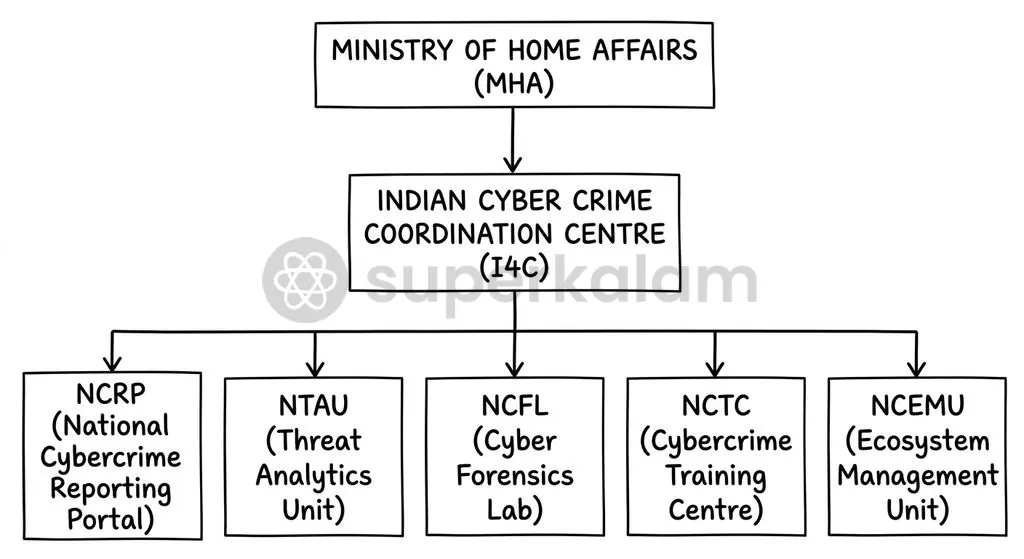
The Indian Cyber Crime Coordination Centre functions as the nodal coordination body under the Ministry of Home Affairs for tackling cybercrime across India. Approved in October 2018 with an outlay of ₹415.86 crore, I4C was inaugurated in January 2020 and designated as an Attached Office of the MHA with effect from July 1, 2024.
Under List II (Entries 1 and 2) of the Seventh Schedule, 'Police' and 'Public Order' are State subjects. While I4C operates as a national technological clearinghouse, State and Union Territory police forces carry out formal investigations and arrests.
To manage complex threats, the Indian Cyber Crime Coordination Centre coordinates operations through five specialised operational verticals:
- National Cybercrime Reporting Portal (NCRP): Centralised citizen interface for lodging cybercrime complaints, with dedicated modules for reporting offences against women and children.
- National Cybercrime Threat Analytics Unit (NTAU): Multi-agency intelligence unit analysing emerging cyber threat vectors, infrastructure, and modus operandi.
- National Cybercrime Forensic Laboratory (NCFL): High-tech digital forensics facility assisting state police investigators with recovery, extraction, and analysis of digital evidence.
- National Cybercrime Training Centre (NCTC): Capacity-building arm delivering specialised training modules to police officers, prosecutors, and judicial officers.
- National Cybercrime Ecosystem Management Unit (NCEMU): Focal point for forging strategic partnerships with academic institutions, industry bodies, and major tech platforms.
How Meta and Law Enforcement Coordinate to Flag Child Sexual Abuse Material
Commercial tech platforms identify abusive media by matching uploaded files against shared repositories of perceptual cryptographic hashes. Algorithms such as PhotoDNA and PDQ assign unique numerical identifiers to known images. This enables automated systems to recognise identical or altered copies without manual human review.
The domestic workflow moves across four sequential operational stages:
- Automated Detection: Platform algorithms match public content against established perceptual hash databases.
- Ingestion by I4C: Meta transmits encrypted incident metadata and file indicators directly to the NCRP.
- Triage and Enrichment: The National Cybercrime Threat Analytics Unit enriches leads with local IP and telecom metadata.
- State Enforcement Action: I4C routes actionable investigative dockets to State Special Juvenile Police Units for field operations.
Under Section 188 of the Bharatiya Nagarik Suraksha Sanhita, 2023, designated state police units receive these dockets to secure search warrants, seize local devices, and safeguard minor victims. This structured coordination connects automated corporate telemetry directly with jurisdictional police enforcement.
Discuss with Superkalam
How does perceptual cryptographic hashing enable platforms to flag abusive media without requiring manual human inspection of every file?
Ask NowLegal and Institutional Architecture Governing Child Online Safety in India
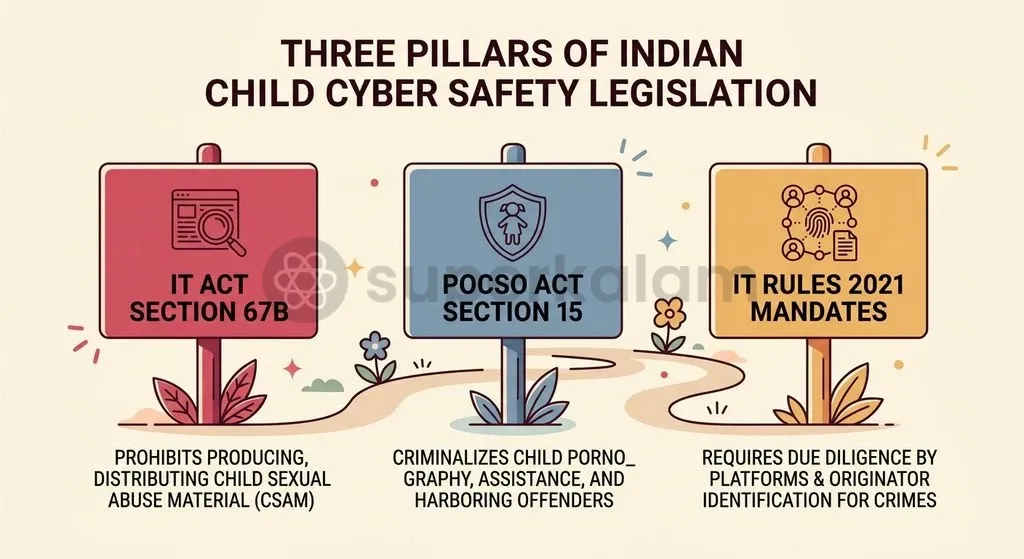
Indian jurisprudence categorises the generation, dissemination, and possession of Child Sexual Abuse and Exploitation Material as non-bailable criminal offences across multiple statutory codes.
The Supreme Court of India in September 2024 ruled that viewing, possessing, or downloading CSAM is a punishable offence under Section 15 of the POCSO Act and Section 67B of the IT Act, while explicitly directing that the term Child Sexual Abuse and Exploitation Material (CSAEM/CSEAM) replace "child pornography" across all official and judicial records.
The bench also clarified that digital intermediaries cannot claim statutory immunity under Section 79 of the Information Technology Act, 2000 unless they strictly observe due diligence obligations, including mandatory reporting under Sections 19 and 20 of the POCSO Act.
| Statute / Rule | Key Legal Provision | Statutory Mandate / Penal Consequence |
|---|---|---|
| Information Technology Act, 2000 | Section 67B | Penalises publishing, transmitting, creating, collecting, browsing, or downloading CSAEM with up to 5 years imprisonment and fine on first conviction, and up to 7 years on subsequent conviction. |
| POCSO Act, 2012 | Section 15 | Criminalises the storage, possession, and non-deletion or failure to report CSAEM to the Special Juvenile Police Unit or cybercrime portal. |
| IT Rules, 2021 | Rule 3(1)(b)(ii)-(iii) | Mandates intermediaries to exercise due diligence and cause users not to host, upload, or share content harmful to children. |
| IT Rules, 2021 | Rule 3(2)(b) | Obligates intermediaries to remove or disable access to non-consensual sexually explicit content within 2 hours of receiving a complaint. |
| IT Rules, 2021 | Rule 4(2) | Requires significant social media intermediaries providing messaging to identify the first originator of information under lawful order. |
Key Challenges: End-to-End Encryption, Cross-Border Jurisdictions, and Reporting Delays
The technical architecture of end-to-end encryption creates an operational deadlock between individual communications privacy and the state's duty to protect vulnerable populations. In end-to-end encrypted messaging systems, only communicating endpoints hold cryptographic keys. This prevents intermediaries and network providers from inspecting plaintext message payloads for abusive media.
To overcome detection blind spots on private networks, Rule 4(2) of the IT Rules, 2021 mandates that significant messaging intermediaries identify the first originator of information upon receipt of a judicial or lawful government order.
WhatsApp LLC and Meta challenged this provision before the Delhi High Court. They contended that mandatory traceability undermines end-to-end security architectures and breaches the fundamental right to privacy affirmed in Justice K.S. Puttaswamy v. Union of India (2017). The Union Government argued in response that Rule 4(2) requires identifying the originator rather than decrypting message contents, maintaining that informational privacy must be balanced against child safety and national security imperatives.
Regulatory regimes abroad are exploring alternative mechanisms:
- Client-Side Scanning Frameworks: Technology Notices authorised under Section 121 of the UK Online Safety Act 2023 permit device-level scanning against known hash registries prior to encryption. Security researchers caution that this approach introduces systemic vulnerabilities into consumer devices.
- Cross-Border Jurisdictional Friction: Cyber investigations face prolonged administrative delays under Mutual Legal Assistance Treaties (MLATs) and Letters Rogatory, requiring months of diplomatic processing to obtain foreign server logs.
From a constitutional standpoint, resolving this deadlock requires testing intermediary regulations against the four-prong proportionality standard laid down in Puttaswamy. The state holds a legitimate aim under Articles 15(3) and 21 and a rational nexus through law enforcement investigations. However, satisfying the necessity prong and the balancing prong requires exploring targeted alternatives before imposing universal traceability mandates that compromise general encryption standards.
Discuss with Superkalam
If a state police department receives an enriched CSAEM docket from I4C, what specific statutory powers under the BNSS, 2023 allow them to seize digital devices?
Ask Now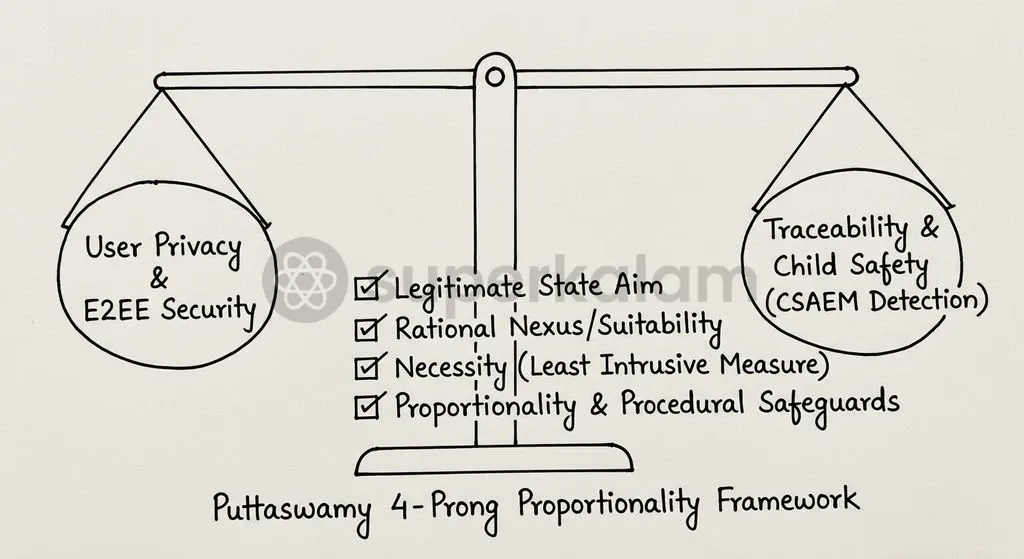
Ethical and Governance Dimensions of Digital Child Protection
Safeguarding minors in networked digital spaces requires balancing corporate fiduciary obligations against universal human rights principles.
Key governance imperatives frame this intersection:
- Balancing Agency and Safety: As articulated in General Comment No. 25 (2021) by the UN Committee on the Rights of the Child, states and commercial enterprises must protect children from violence while safeguarding their emerging digital agency and privacy rights.
- Fiduciary Duty of Care: Platforms that engineer engagement-driven networks bear an ethical duty of care toward vulnerable users, obligating them to build proportional safety mechanisms directly into their core design.
- Surveillance Safeguards: Preventing child protection architectures from expanding into mass surveillance requires strict data minimisation, independent judicial oversight, and algorithmic transparency to prevent discriminatory content moderation practices.
The Road Ahead: Balancing Privacy, Platform Accountability, and Child Protection
Building an effective child-safe internet ecosystem requires synchronised structural reforms across law enforcement, platform engineering, and institutional governance.
- Upgrading Digital Forensics: Expanding regional units of the National Cybercrime Forensic Laboratory to provide State Special Juvenile Police Units with rapid forensic extraction tools.
- Strengthening Intermediary Due Diligence: Enforcing automated compliance workflows under Rule 3(2)(b) of the IT Rules, 2021 to ensure rapid content takedown within statutory timelines.
- Adopting Privacy-Preserving Detection Technologies: Investing in non-intrusive safety techniques—such as on-device risk classification and perceptual metadata hashing—that detect abuse patterns without breaking end-to-end encryption.
- Institutionalising Cross-Border Workflows: Establishing streamlined multilateral agreements to bypass legacy Letters Rogatory delays when collecting digital evidence from foreign service providers.
- Promoting Digital Hygiene: Integrating comprehensive cyber safety and reporting curricula into primary education through the National Commission for Protection of Child Rights and school boards.
Discuss with Superkalam
Analyse the key differences in procedural delay and operational efficiency between routing cyber leads through overseas clearinghouses versus direct domestic ingestion.
Ask NowKey Takeaways
- Meta entered a direct partnership with the Indian Cyber Crime Coordination Centre (I4C) in September 2026 to report domestic CSAEM incidents directly via the National Cybercrime Reporting Portal.
- I4C operates as an Attached Office under the Ministry of Home Affairs (designated July 1, 2024) across seven operational verticals, managing central coordination while State police execute investigations under Seventh Schedule powers.
- The Supreme Court ruled in September 2024 that downloading, possessing, or viewing CSAEM constitutes a criminal offence under Section 15 of the POCSO Act and Section 67B of the IT Act, mandating the use of the term 'CSAEM/CSEAM' over 'child pornography'.
- Intermediary safe harbour protections under Section 79 of the IT Act are conditional on strict compliance with due diligence rules and mandatory reporting obligations under Sections 19 and 20 of the POCSO Act.
- Resolving the conflict between Rule 4(2) traceability mandates and end-to-end encryption requires testing state action against the four prongs of the Puttaswamy proportionality doctrine.
Mains Question
The institutional transition from foreign clearinghouses to a domestic reporting pipeline under the Indian Cyber Crime Coordination Centre (I4C) marks a significant evolution in tackling online child sexual abuse. Examine how this mechanism enhances enforcement efficiency while addressing federal policing boundaries. (10 Marks)
Evaluate NowMains Question
"Mandatory traceability requirements under Rule 4(2) of the IT Rules, 2021 highlight an unresolved tension between informational privacy and the state's obligation to protect vulnerable demographics." Critically analyse this statement in light of the constitutional proportionality standard. (15 Marks)
Evaluate NowPractice MCQs
QUESTION 1
With reference to the Indian Cyber Crime Coordination Centre (I4C), consider the following statements:
- It functions as an Attached Office under the Ministry of Electronics and Information Technology (MeitY).
- It directly undertakes formal field investigations and arrests across all States and Union Territories.
- The National Cybercrime Threat Analytics Unit (NTAU) is one of its specialized operational verticals.
Which of the statements given above is/are correct?
QUESTION 2
Regarding the legal architecture governing Child Sexual Abuse and Exploitation Material (CSAEM) in India, consider the following statements:
- The Supreme Court of India ruled that viewing, possessing, or downloading CSAEM is a punishable offence under Section 15 of the POCSO Act.
- Intermediaries enjoy blanket statutory immunity under Section 79 of the Information Technology Act, 2000, irrespective of their compliance with POCSO Act reporting mandates.
- Rule 3(2)(b) of the IT Rules, 2021 obligates intermediaries to remove non-consensual sexually explicit content within 2 hours of complaint receipt.
Which of the statements given above are correct?
QUESTION 3
Consider the following statements regarding the technical identification and enforcement workflow for online abusive media:
- Algorithms like PhotoDNA and PDQ utilize perceptual cryptographic hashes to detect matching media without manual review.
- Under the direct domestic reporting framework, encrypted incident metadata is transmitted directly to the National Cybercrime Reporting Portal.
- Designated state police units act on intelligence dockets under Section 188 of the Bharatiya Nagarik Suraksha Sanhita, 2023.
Which of the statements given above are correct?
QUESTION 4
Which of the following bodies is responsible for delivering specialized training modules to police officers, prosecutors, and judicial officers as an operational vertical of I4C?
QUESTION 5
With reference to the IT Rules, 2021, Rule 4(2) mandates significant social media intermediaries providing messaging services to: