MEE-TR 2026: Evaluating India's Tiger Reserves Beyond Headcounts
Beyond predator headcounts, the 6th MEE-TR cycle audits administrative capacity and governance across 58 tiger reserves to measure true ecological resilience.
Sep, 2026
•7 min read

Overview
The 6th cycle of Management Effectiveness Evaluation of Tiger Reserves evaluates all 58 tiger reserves across India. It measures how institutional governance, administrative processes, and community co-management deliver ecological security across more than 85,000 square kilometres of critical wildlife habitat.
Jointly executed by the National Tiger Conservation Authority and the Wildlife Institute of India, this quadrennial diagnostic assessment moves beyond basic species headcounts. Instead, it audits the operational health of protected areas. By assessing resource inputs, staff capacity, anti-poaching networks, and human-wildlife conflict mechanisms, the framework pinpoints institutional bottlenecks. The goal is clear: ensure recorded tiger numbers rest on resilient, well-funded administrative foundations.
Why Is the 6th Cycle of MEE-TR in the News?
The Ministry of Environment, Forest and Climate Change launched the Inception Workshop for the 6th Cycle of Management Effectiveness Evaluation of Tiger Reserves on 25 September 2026. During the launch, the Union Environment Minister released the Technical Manual for MEE-TR 2026 to guide the nationwide operational rollout.
Key structural highlights of the 2026 rollout include:
- Coverage: The assessment encompasses all 58 Tiger Reserves across India, covering more than 85,000 square kilometres of protected forests.
- Institutional Mandate: Jointly led by the National Tiger Conservation Authority (NTCA), a statutory body under the Wildlife (Protection) Act, 1972, and the Wildlife Institute of India (WII).
- New Assessment Criteria: For the first time, solid waste management acts as an independent evaluation criterion to curb tourism-driven habitat degradation.
What Is Management Effectiveness Evaluation (MEE) in Protected Areas?
Management Effectiveness Evaluation assesses how successfully protected areas achieve conservation goals through sound design, funding allocation, and day-to-day governance. Rather than focusing exclusively on predator counts, MEE audits whether reserves are properly planned, funded, and staffed.
India adapted its evaluation methodology directly from the global framework created by the IUCN World Commission on Protected Areas (WCPA):
- Systematic Diagnostic Approach: Tracks administrative efficiency and institutional health across every stage of reserve management.
- Independent Regional Expert Committees (RECs): Audits are conducted by panels of retired forest officers, wildlife scientists, and domain specialists who carry out rigorous on-ground verifications.
- Evidence-Based Scrutiny: Replaces subjective feedback with measurable benchmarks spanning staff readiness, equipment availability, and field patrolling.
Discuss with Superkalam
Which international framework forms the structural basis for India's Management Effectiveness Evaluation of Tiger Reserves?
Ask NowHow the MEE Framework Works: From Context to Conservation Outcomes
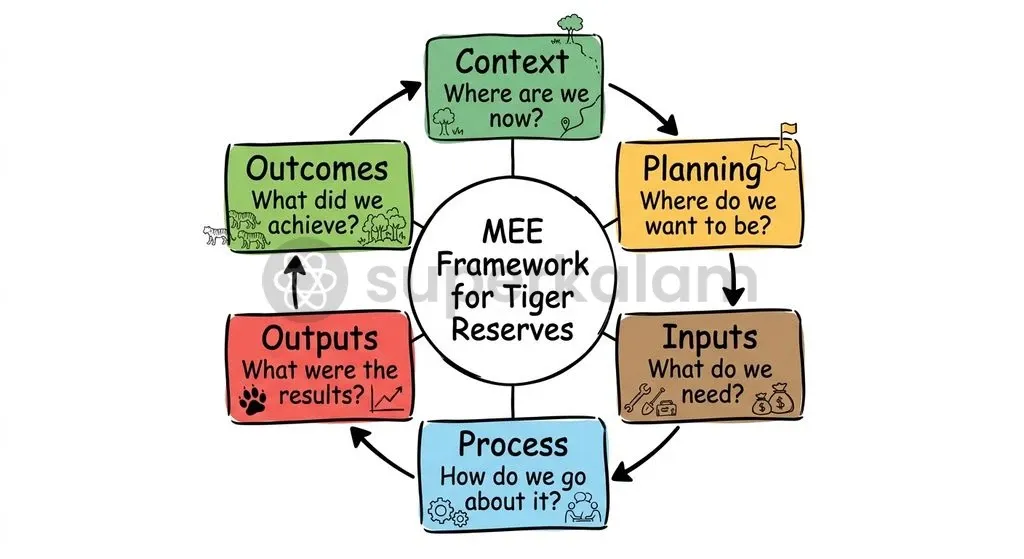
The National Tiger Conservation Authority structures assessments around six continuous management elements adapted from the IUCN-WCPA framework. These elements track the conservation trajectory from baseline statutory design to final ecological and social impacts:
- Context: Assessment of total conservation values, legal threats, and policy vulnerability.
- Planning: Quality, statutory approval, and execution of the Tiger Conservation Plan (TCP).
- Inputs: Allocation of human resources, financial budgets, staff equipment, and infrastructure.
- Process: Daily management practices, patrolling routines, anti-poaching protocols, and maintenance.
- Outputs: Tangible delivery of targets such as kilometres patrolled, enclosures removed, and funds spent.
- Outcomes: Long-term ecological stability, prey-predator dynamics, and conflict mitigation success.
Under this structure, Independent Regional Expert Committees score reserves across critical governance indicators:
- Tiger Conservation Plans (TCP): Verification of legal status and operational execution of mandatory core and buffer management plans.
- Protection Infrastructure: Assessment of wireless communications, anti-poaching camps, specialised weapons, and all-terrain patrolling assets.
- Personnel and Resourcing: Measurement of frontline field staff strength, veterinary support, and timely budget utilisation.
- Community Interfaces: Review of voluntary village relocation schemes from core critical tiger habitats and the active functioning of Eco-Development Committees (EDCs).
- Tourism Regulation: Implementation of carrying-capacity norms, visitor management systems, and local waste containment measures.
The final composite score categorises reserves into four distinct performance bands: Excellent (score 90% and above), Very Good (75% to 89%), Good (60% to 74%), and Fair (50% to 59%).
Discuss with Superkalam
Explain how a protected area can support high predator density while simultaneously experiencing severe administrative vulnerabilities.
Ask NowMEE vs All India Tiger Estimation: Why Management Quality Is Not a Headcount
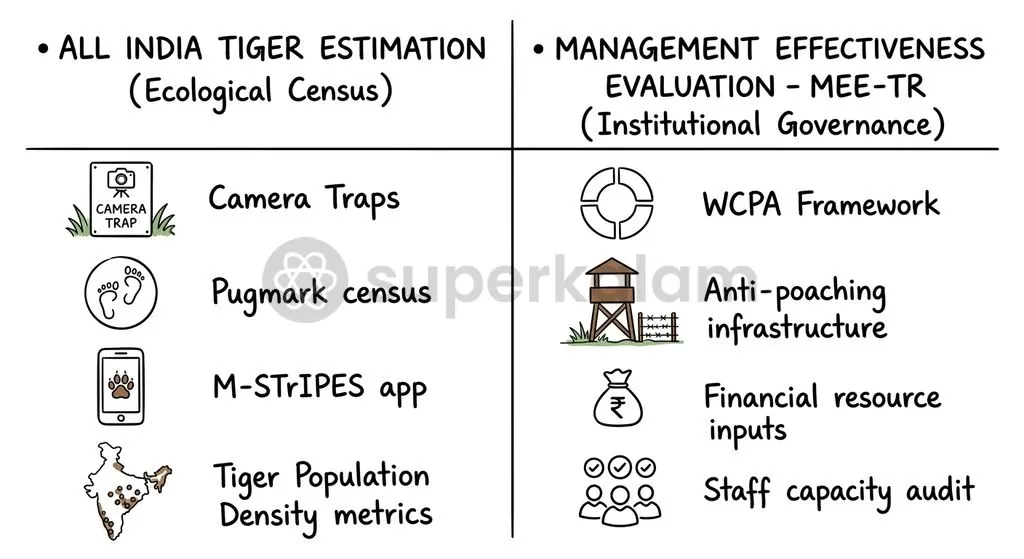
The All India Tiger Estimation measures species abundance, whereas the Management Effectiveness Evaluation audits the institutional and administrative health of tiger reserves. Conflating the two exercises creates analytical distortions in evaluating long-term conservation viability.
Biological censuses provide valuable data on immediate predator numbers. However, they do not measure administrative capacity, staff readiness, or funding constraints. A protected habitat can maintain high tiger density due to natural prey abundance while suffering from severe governance gaps, such as unresolved human-wildlife conflict or understaffed beats.
| Dimension | Management Effectiveness Evaluation (MEE-TR) | All India Tiger Estimation (AITE) |
|---|---|---|
| Primary Focus | Governance and administrative quality | Species population and density |
| Executing Bodies | NTCA and Wildlife Institute of India (WII) | NTCA, WII, and State Forest Departments |
| Evaluation Base | 6 IUCN-WCPA elements (Inputs, Planning, Outcomes) | Camera traps, pugmark tracks, and line transects |
| Core Indicators | Staff vacancies, fund flow, anti-poaching, TCP compliance | Tiger counts, co-predator presence, prey base density |
| Assessment Unit | Institutional systems across all tiger reserves | Metapopulation numbers across tiger landscapes |
| Primary Value | Diagnoses structural management bottlenecks | Tracks demography and territorial occupancy |
Discuss with Superkalam
Analyse the structural factors responsible for the improvement of the national MEE mean score from 70% in the 4th cycle to 78.01% in the 5th cycle.
Ask NowKey Findings from Past Cycles and What to Watch in the 6th Cycle
The National Tiger Conservation Authority recorded an overall national mean score of 78.01% across 51 tiger reserves during the 5th MEE-TR cycle in 2022. This performance marked a clear improvement compared to the 70% mean score recorded during the 4th cycle in 2018.
Top-performing reserves showed that sound co-management and disciplined field administration directly boost conservation success. In the 5th cycle, Periyar Tiger Reserve in Kerala achieved the highest national score of 94.38%, followed by Satpura Tiger Reserve in Madhya Pradesh and Bandipur Tiger Reserve in Karnataka, each scoring 93.18%.
- National Mean Score: 78.01% in the 5th cycle, up from 70% in the 4th cycle.
- Top Reserve: Periyar Tiger Reserve, Kerala (94.38%).
- Joint Second: Satpura (Madhya Pradesh) and Bandipur (Karnataka) (93.18%).
- Performance Bands: 90%+ (Excellent), 75-89% (Very Good), 60-74% (Good), 50-59% (Fair).
The 6th cycle expands field scrutiny to encompass newly notified reserves within India's 58-reserve network. Furthermore, the 2026 exercise integrates local sociological and ecological experts as well as local youth directly into field evaluation teams, embedding community observation alongside technical auditing.
Persistent Challenges in Tiger Reserve Management Across India
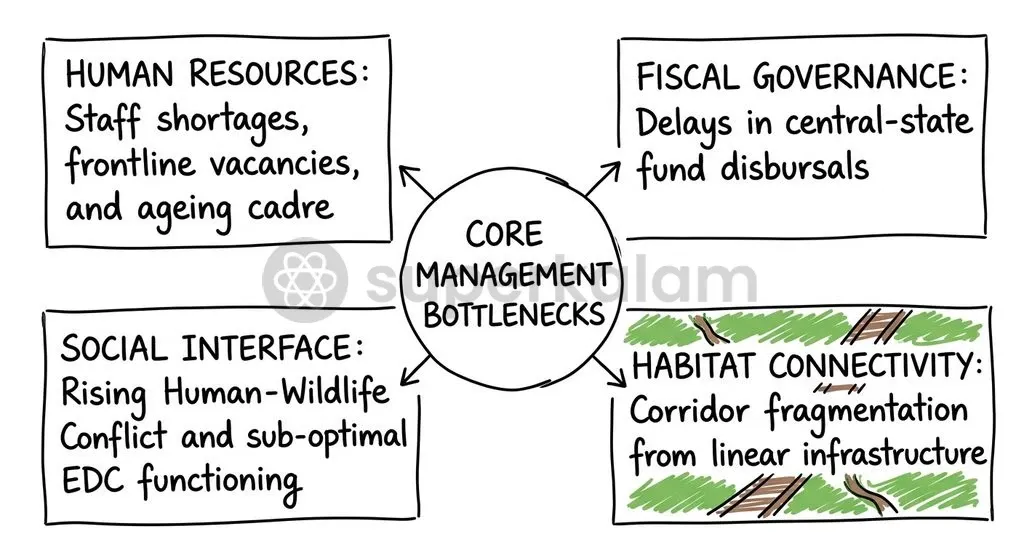
Structural bottlenecks in underperforming reserves stem primarily from frontline staff vacancies, delayed fund disbursements, and acute habitat fragmentation across regional corridors. These systemic constraints regularly emerge in independent regional evaluations as primary drivers of management vulnerability.
Administrative friction between central and state funding channels frequently disrupts field operations. Delays in releasing funds directly compromise frontline wages, infrastructure repairs, anti-poaching camps, and veterinary interventions.
- Human Resource Deficits: Ageing frontline staff profiles coupled with persistent vacancies at forest guard levels.
- Ecological Fragmentation: Severed dispersal corridors that restrict gene flow between isolated tiger populations.
- Social Friction: Stalled voluntary village relocations and underfunded Eco-Development Committees.
- Edge Effects: Unregulated linear infrastructure projects exacerbating human-wildlife conflict along reserve buffers.
Ecological degradation outside core habitats presents an equally acute threat. When external dispersal corridors become degraded or blocked, reserves turn into isolated ecological islands. This undermines natural metapopulation dynamics and increases local conflict.
Discuss with Superkalam
Evaluate whether incorporating local community youth into protected area auditing teams can effectively bridge the trust deficit between forest departments and local populations.
Ask NowWay Forward: Strengthening Community Involvement and Habitat Corridors
Strengthening tiger reserve governance requires institutionalising Eco-Development Committees, securing contiguous wildlife corridors, and integrating local youth into statutory field evaluations. Management assessments must trigger concrete structural reforms rather than remaining static auditing exercises.
State forest departments must prioritise filling frontline staff vacancies and setting up dedicated welfare mechanisms for field guards. Securing timely, predictable budget releases is critical to maintaining operational momentum across vulnerable landscapes.
Integrating corridor protection into broader district planning frameworks is essential for long-term metapopulation survival. By combining transparent administrative evaluations under MEE-TR 2026 with active community co-management, India can sustain both ecological integrity and institutional resilience across its tiger landscapes.
Key Takeaways
- The Ministry of Environment, Forest and Climate Change launched the 6th Cycle of MEE-TR on 25 September 2026, covering all 58 Tiger Reserves spanning over 85,000 square kilometres.
- India's MEE framework is adapted from the global IUCN-WCPA system, assessing six continuous elements: Context, Planning, Inputs, Processes, Outputs, and Outcomes.
- MEE-TR evaluates institutional and administrative governance quality, differing fundamentally from the All India Tiger Estimation (AITE), which measures biological counts and density.
- The 5th MEE-TR cycle recorded a national mean score of 78.01%, with Periyar Tiger Reserve securing the highest rating at 94.38%.
- The 2026 Technical Manual introduces solid waste management as an independent criterion and integrates local youth and community experts into field evaluation teams.
Mains Question
"High predator densities in protected areas do not necessarily indicate administrative resilience or sound institutional governance." In this context, evaluate the utility of the Management Effectiveness Evaluation of Tiger Reserves (MEE-TR) as a diagnostic conservation tool. (10 Marks)
Evaluate NowMains Question
The Management Effectiveness Evaluation (MEE) framework tracks the conservation trajectory of protected areas from statutory planning to tangible ecological outcomes. Elucidate how the six continuous management elements and Independent Regional Expert Committees facilitate evidence-based governance in India's tiger reserves. (15 Marks)
Evaluate NowPractice MCQs
QUESTION 1
With reference to the Management Effectiveness Evaluation of Tiger Reserves (MEE-TR) in India, consider the following statements:
- It is a quadrennial diagnostic assessment jointly executed by the National Tiger Conservation Authority and the Wildlife Institute of India.
- The evaluation framework is adapted from the global standards established by the IUCN World Commission on Protected Areas.
- Solid waste management has been introduced as an independent evaluation criterion for the first time in the 6th cycle.
Which of the statements given above are correct?
QUESTION 2
Consider the following statements regarding the framework and outcomes of the Management Effectiveness Evaluation of Tiger Reserves (MEE-TR):
- The assessment framework evaluates reserve governance across six continuous elements ranging from Context to Outcomes.
- Under the MEE scoring bands, a tiger reserve scoring between 75% and 89% is categorised as 'Excellent'.
- In the 5th MEE-TR cycle, Periyar Tiger Reserve achieved the highest score nationally.
Which of the statements given above is/are correct?
QUESTION 3
Consider the following statements regarding the differences between the Management Effectiveness Evaluation of Tiger Reserves (MEE-TR) and the All India Tiger Estimation (AITE):
- While AITE evaluates species demography and density, MEE-TR audits institutional governance and administrative processes.
- Both MEE-TR and AITE primarily rely on camera trapping and line transect data to establish management efficacy.
- Independent Regional Expert Committees comprising retired forest officers and scientists conduct the field audits for MEE-TR.
Which of the statements given above is/are correct?
QUESTION 4
In the context of Protected Area management in India, the elements 'Context, Planning, Inputs, Process, Outputs, and Outcomes' are integral components of which of the following?
QUESTION 5
With reference to the institutional arrangements and recent developments in the 6th cycle of MEE-TR (2026), consider the following statements:
- The evaluation covers all 58 tiger reserves across India spanning more than 85,000 square kilometres.
- The National Tiger Conservation Authority (NTCA) is an executive body created by an executive notification of the Union Cabinet.
- The 6th cycle integrates local youth directly into field evaluation teams alongside technical experts.
Which of the statements given above is/are correct?