Medical Device Pricing in India: MRP Rules vs Trade Margin Caps
Balancing affordable care with medtech growth requires shifting from rigid MRP ceilings to transparent trade margin caps across healthcare supply chains.
Sep, 2026
•9 min read

Context
India's medical technology ecosystem needs a shift from formulaic retail price caps to trade margin rationalisation. Precision engineering devices operate through institutional procurement rather than consumer-facing pharmacy counters.
Blanket ceiling prices on maximum retail prices (MRPs) distort supply chains and can trigger the withdrawal of advanced therapeutic technologies. They also fail to curb private hospital markups. Regulating trade margins from the first point of sale protects patients from catastrophic health spending, aligns healthcare oversight with Article 21 mandates, and protects incentives under the National Medical Devices Policy.
Why in the News: The Push to Regulate Medical Device Markups
Pricing regulators are moving to restructure how medical consumables and implants are billed in India. As of August 2026, the Parliamentary Standing Committee on Health and Family Welfare presented its 176th Report. It recommended that the gap between landed cost or ex-factory price and the Maximum Retail Price (MRP) should not exceed 20 percent.
To enforce this without distorting supply, the committee proposed an objective 100-point Medical Device Price Regulation Score (MDPRS). The index evaluates unregulated devices across three operational dimensions:
- Disease burden: The clinical prevalence of conditions requiring the device.
- Procedure volume: Total annual surgical and diagnostic utilisation rates.
- Financial exposure: The out-of-pocket financial burden imposed on patients.
Discuss with Superkalam
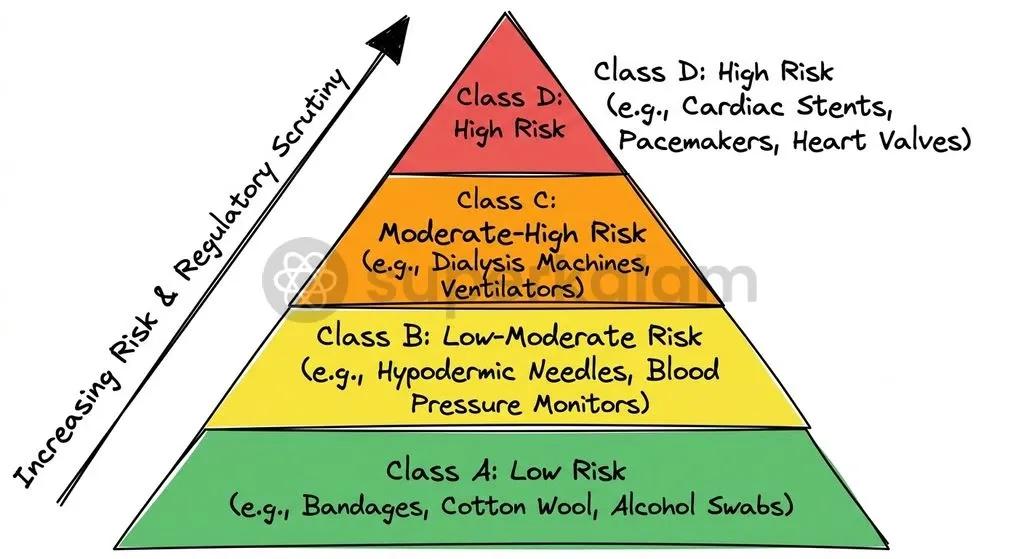
Recall the four risk classification tiers (Class A through Class D) defined under the Medical Devices Rules, 2017.
Ask NowHow Medical Devices Are Currently Regulated in India
Medical devices in India are statutorily regulated as 'drugs' under Section 3(b)(iv) of the Drugs and Cosmetics Act, 1940. This legacy classification treats precision diagnostic hardware and surgical implants under the same legal regime created for chemical formulations.
Technical risk classification occurs under the Medical Devices Rules, 2017, which split devices into four distinct tiers:
- Class A: Low risk (e.g., surgical dressings, alcohol swabs).
- Class B: Low-to-moderate risk (e.g., hypodermic needles, blood pressure monitors).
- Class C: Moderate-to-high risk (e.g., bone fixation plates, hemodialysis machines).
- Class D: High risk (e.g., coronary stents, implantable cardiac pacemakers).
Pricing control rests with the National Pharmaceutical Pricing Authority (NPPA) under the Drugs (Prices Control) Order, 2013. The NPPA fixes ceiling prices for scheduled formulations in the National List of Essential Medicines. For non-scheduled medical devices, manufacturers may take an annual retail price hike of up to 10 percent.
The regulator has also used emergency powers. Under Paragraph 19 of the DPCO, 2013, the NPPA invoked extraordinary public interest provisions to enforce direct price caps on coronary stents in February 2017 and knee implants in August 2017.
| Regulatory Dimension | Pharmaceuticals | Medical Devices |
|---|---|---|
| Statutory Basis | Drugs and Cosmetics Act, 1940 | Regulated as 'drugs' under Section 3(b)(iv) |
| Product Nature | Standardised chemical molecules with identical bioequivalence | Engineering-driven products with iterative hardware generations |
| Procurement Channel | Retail chemists and consumer-facing dispensaries | Business-to-business (B2B) institutional hospital procurement |
| Pricing Discretion | Strict DPCO cost-plus or market-based ceiling formula | Non-scheduled devices capped at a 10% annual MRP increase |
| Classification Model | Therapeutic categories and schedule listings | Risk-based Class A, B, C, and D tiers (MDR, 2017) |
Discuss with Superkalam
Explain how Trade Margin Rationalisation differs from traditional blanket retail price capping in preventing hospital markup inflation.
Ask NowThe Flaw in Traditional MRP: Why Blanket Ceiling Prices Backfire
Blanket MRP caps fail when applied to medical devices because hardware evolves through iterative engineering cycles rather than generic chemical replication. Rigid retail price ceilings generate several critical market distortions:
- Extreme SKU diversity: Medical devices encompass thousands of distinct stock keeping units (SKUs) with variable dimensions, specialised metallurgy, and rapid turnover. Treating precision surgical tools like uniform chemical tablets ignores inventory holding costs and research spending.
- Supply flight on cutting-edge hardware: Uniform ceiling prices compress margins on advanced therapeutic options. When the NPPA imposed blanket price caps on coronary stents in 2017, global manufacturers withdrew newer, bioabsorbable stent variants due to commercial unviability.
- Bypassing hospital procurement intermediaries: Patients rarely buy advanced medical devices over the counter. Healthcare facilities select and buy them through business-to-business transactions. Because hospitals act as purchasing intermediaries, arbitrary MRP ceilings fail to prevent private providers from extracting deep wholesale discounts while billing patients at printed ceilings.
How Trade Margin Rationalisation (TMR) Works in Practice
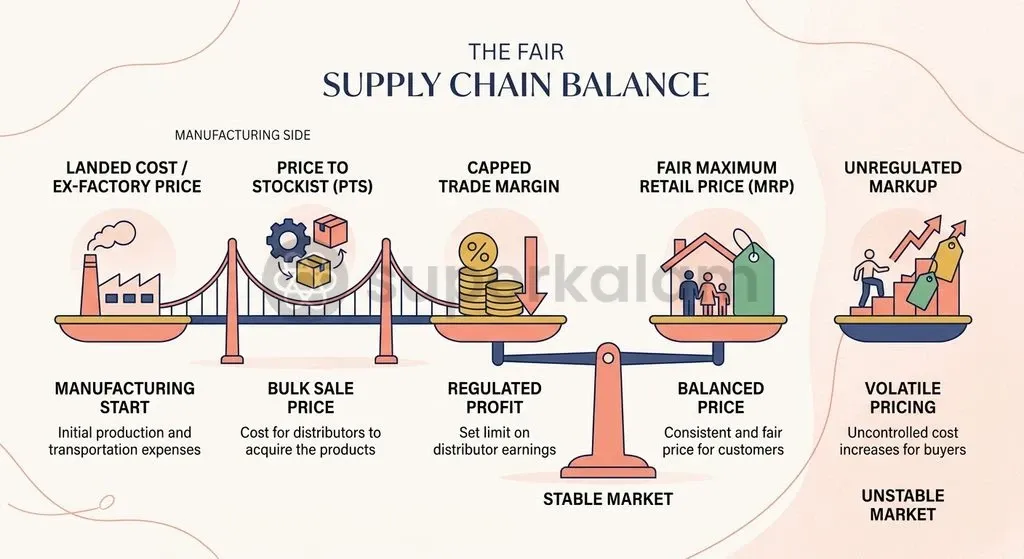
Trade Margin Rationalisation regulates prices by capping the markup between the first point of sale and the final price billed to the patient. Under NITI Aayog guidelines, the trade margin is the difference between the Price to Stockist (PTS)—or landed cost for imports—and the Maximum Retail Price (MRP), divided by the Price to Stockist.
The formula establishes a clear distribution ceiling:
$$\text{Trade Margin (%)} = \left( \frac{\text{MRP} - \text{Price to Stockist}}{\text{Price to Stockist}} \right) \times 100$$
The NPPA tested this approach in July 2021 during the pandemic. The regulator capped trade margins at 70 percent at the first point of sale across five diagnostic devices: pulse oximeters, blood pressure monitors, nebulisers, digital thermometers, and glucometers. This lowered consumer prices immediately without causing supply shortages.
Trade Margin Rationalisation offers three structural advantages over rigid price ceilings:
- Supply Continuity: Manufacturers recover production and import expenses, preventing product shortages.
- Innovation Protection: Differentiated pricing remains viable for advanced SKUs without requiring case-by-case administrative price controls.
- Elimination of Artificial Markups: Hospitals cannot force manufacturers to artificially inflate printed MRPs to generate institutional margins.
Discuss with Superkalam
How would you apply the NITI Aayog Trade Margin formula to assess whether an imported medical implant complies with a 70 percent margin cap?
Ask NowThe Human Cost: Out-of-Pocket Health Expenses and Medical Ethics
Inflated device markups directly fuel catastrophic household health expenditure across the country. Key factors driving this vulnerability include:
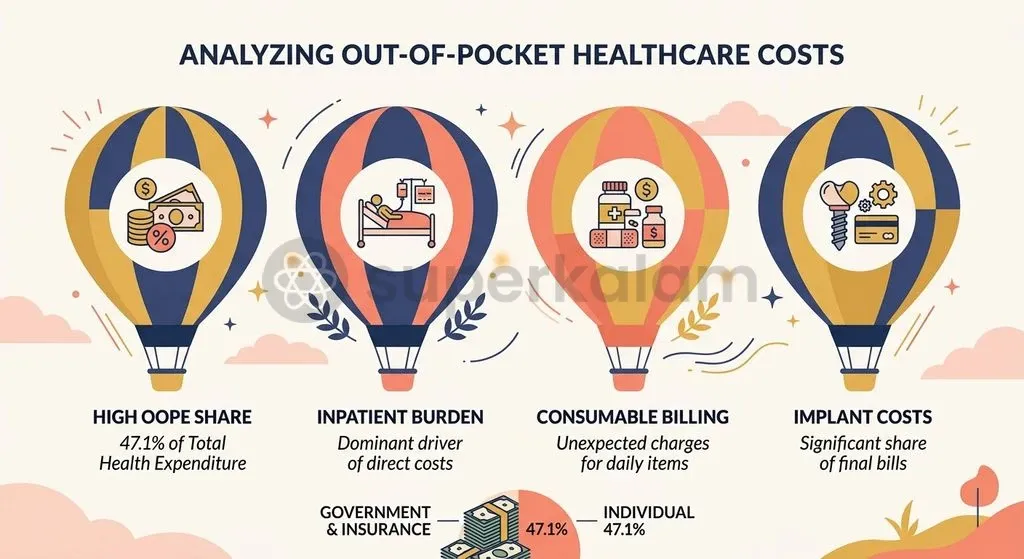
- Heavy out-of-pocket reliance: According to the National Health Accounts Estimates for 2019-20, out-of-pocket expenditure (OOPE) accounted for 47.1 percent of Total Health Expenditure in India. Consumables and surgical implants make up a large part of inpatient hospital bills.
- Severe information asymmetry: Patients cannot evaluate technical implant specifications during emergencies, enabling hospitals to exploit wholesale-to-retail gaps. Media reporting on Maharashtra Food and Drug Administration findings showed markups of up to 2,841 percent on intravenous (IV) infusion sets between wholesale procurement rates and patient bills.
- Constitutional obligations: Unregulated markups conflict with judicial mandates. The Supreme Court held in Paschim Banga Khet Mazdoor Samity v. State of West Bengal (1996) that the state bears a constitutional obligation under Article 21 to provide timely medical care.
To check commercial malpractice, the Department of Pharmaceuticals notified the Uniform Code for Pharmaceutical and Medical Device Marketing Practices (UCPMP) 2024. This code creates binding standards against commercial inducements offered to healthcare professionals.
The Innovation Dilemma: Balancing Patient Affordability with Domestic Manufacturing
India relies heavily on external supply for medical technology. The Parliamentary Standing Committee on Health and Family Welfare noted in its 138th Report that India relies on imports for 70 to 80 percent of its medical device requirements, especially in advanced electro-medical and imaging systems. Rigid cost-plus ceiling prices risk discouraging capital investment and technology transfers.
To build domestic capacity, the Union Cabinet approved the National Medical Devices Policy, 2023, aiming to expand the domestic sector from $11 billion to $50 billion by 2030 across six strategic pillars. The policy is supported by the Production Linked Incentive (PLI) Scheme for Medical Devices, providing Rs 3,420 crore across four critical segments between FY 2022-23 and FY 2026-27.
| Policy Imperative | Key Metric / Target | Core Regulatory Mechanism |
|---|---|---|
| Affordability Imperative | 47.1% OOPE in total health spending | Trade margin caps and Article 21 health access |
| Hospital Oversight | Markups up to 2,841% documented | UCPMP 2024 and unbundled hospital billing |
| Industrial Growth Driver | $50 billion by 2030 sector target | Rs 3,420 crore PLI Scheme support |
| Import Substitution | Reducing 70 to 80 percent import reliance | Domestic manufacturing incentives and tariff alignment |
Excessive retail price suppression risks undermining domestic manufacturing incentives. A calibrated trade margin framework provides predictability for investors, ensuring fair domestic returns while preventing predatory institutional markups.
Discuss with Superkalam
Analyse why treating medical hardware identically to chemical formulations under the Drugs and Cosmetics Act creates regulatory distortions.
Ask NowInternational Approaches to Medical Technology Pricing
Major global healthcare systems regulate medical technology through value assessments, functional categories, and pooled procurement rather than rigid retail price ceilings.
- Australia: Reimburses private healthcare devices via the Prescribed List under the Private Health Insurance Act 2007. The framework categorises devices by clinical function and sets statutory minimum reimbursement rebates.
- Japan: The Central Social Insurance Medical Council (Chuikyo) under the Ministry of Health, Labour and Welfare categorises devices into functional classes. It uses a Foreign Price Adjustment (FPA) benchmark to align domestic reimbursements with international reference prices.
- China: Uses National Volume-Based Procurement (VBP) and digital Sunshine Procurement platforms. In November 2020, its national tender secured price reductions exceeding 90 percent on coronary stents by trading hospital volume access for lower prices.
- Germany: Applies the German Diagnosis-Related Groups (G-DRG) prospective payment system for inpatient devices. High-cost devices undergo Health Technology Assessment (HTA) and qualify for dedicated NUB innovation payments to support early clinical adoption.
The Way Forward: A Sustainable Pricing Framework for India
Reforming India's medical device ecosystem requires separating device oversight from drug regulations and establishing targeted pricing mechanisms across different product classes.
- Statutory Decoupling: Enact the Draft New Drugs, Medical Devices and Cosmetics Bill to establish an independent Medical Devices Technical Advisory Board (MDTAB), formally separating device governance from chemical pharmaceutical rules.
- Phased Rollout of Trade Margin Rationalisation: Implement a tiered TMR framework starting with high-volume Class A and Class B consumables, capping margins at the first point of sale (Price to Stockist) as validated by the NPPA's 2021 model.
- Institutionalising the 100-Point MDPRS: Operationalise the Parliamentary Standing Committee's Medical Device Price Regulation Score to evaluate non-scheduled devices based on clinical necessity, procedure volumes, and out-of-pocket impact before imposing pricing interventions.
- Transparent Hospital Billing and UCPMP Enforcement: Require private healthcare providers to unbundle hospital bills, separating professional procedure fees from device acquisition costs, while strictly enforcing the UCPMP 2024 to prevent unethical distributor kickbacks.
- Strengthening Health Technology Assessment (HTAIn): Institutionalise evidence-based cost-effectiveness studies to determine reimbursement ceilings under public insurance schemes like Ayushman Bharat PM-JAY.
Key Takeaways
- Medical devices in India remain regulated as drugs under Section 3(b)(iv) of the Drugs and Cosmetics Act, 1940, creating misaligned price controls for engineering products.
- Traditional MRP ceiling price caps often fail because medical devices operate on high-mix, low-volume institutional procurement rather than direct retail chemist purchases.
- Trade Margin Rationalisation (TMR) caps the markup between the first point of sale (Price to Stockist) and the Maximum Retail Price, lowering patient costs while preserving supply continuity.
- High markups by hospital intermediaries drive catastrophic out-of-pocket expenditure, which accounted for 47.1 percent of Total Health Expenditure in 2019-20.
- The Parliamentary Standing Committee's 176th Report recommended a maximum 20 percent margin gap between landed cost and MRP, alongside a 100-point Medical Device Price Regulation Score.
- Balancing price regulation with the $50 billion target under the National Medical Devices Policy, 2023 requires structural reforms, transparent billing, and dedicated statutory oversight via MDTAB.
Mains Question
'Blanket retail price caps on medical devices often create market distortions and supply withdrawal, whereas Trade Margin Rationalisation (TMR) balances patient affordability with innovation.' Examine. (10 Marks)
Evaluate NowMains Question
The 176th Report of the Parliamentary Standing Committee on Health and Family Welfare recommended capping trade margins on medical devices at 20 percent. In light of India's 70 to 80 percent import reliance and the targets of the National Medical Devices Policy, 2023, critically analyse the challenges of regulating medical device pricing in India. (15 Marks)
Evaluate NowPractice MCQs
QUESTION 1
With reference to the regulation of medical devices in India, consider the following statements:
- Medical devices are statutorily regulated as 'drugs' under Section 3(b)(iv) of the Drugs and Cosmetics Act, 1940.
- Under the Medical Devices Rules, 2017, Class D devices represent the lowest risk category such as surgical dressings.
- For non-scheduled medical devices under the DPCO, 2013, manufacturers are permitted an annual retail price hike of up to 10 percent.
Which of the statements given above are correct?
QUESTION 2
Consider the following statements regarding Trade Margin Rationalisation (TMR) and price controls in India's medical device sector:
- Under NITI Aayog guidelines, trade margin is calculated as the difference between the Maximum Retail Price (MRP) and Price to Stockist (PTS), divided by the Price to Stockist.
- In July 2021, the NPPA capped trade margins at 70 percent at the first point of sale across five diagnostic devices including pulse oximeters and glucometers.
- Direct price caps on coronary stents and knee implants were enforced by invoking Paragraph 19 of the Drugs (Prices Control) Order, 2013.
Which of the statements given above is/are correct?
QUESTION 3
With reference to the 176th Report of the Parliamentary Standing Committee on Health and Family Welfare, consider the following statements:
- It recommended that the gap between the landed cost/ex-factory price and the Maximum Retail Price should not exceed 20 percent.
- It proposed a 100-point Medical Device Price Regulation Score (MDPRS) to evaluate unregulated devices.
- The MDPRS evaluates devices across disease burden, procedure volume, and financial exposure.
Which of the statements given above is/are correct?
QUESTION 4
Consider the following statements regarding the medical devices industry and healthcare expenditure in India:
- According to the National Health Accounts Estimates for 2019-20, out-of-pocket expenditure (OOPE) accounted for 47.1 percent of Total Health Expenditure in India.
- India currently relies on imports for 70 to 80 percent of its medical device requirements.
- The National Medical Devices Policy, 2023 aims to expand the domestic medical devices sector to $50 billion by 2030.
Which of the statements given above are correct?
QUESTION 5
Which landmark judgment of the Supreme Court of India established that the state bears a constitutional obligation under Article 21 to provide timely medical care to citizens?