Lakhpati Didi Scheme: Can It Break Rural India's Income Trap?
Moving beyond defensive credit to create viable rural enterprises tests the structural capacity of India's self-help groups and value chains.
Oct, 2026
•11 min read
Overview
The Lakhpati Didi initiative marks a decisive structural pivot in India's rural development architecture. It transitions millions of women from basic microcredit consumers into sustainable, market-linked micro-entrepreneurs.
Under the Deendayal Antyodaya Yojana - National Rural Livelihoods Mission (DAY-NRLM), the programme targets creating households earning at least ₹1,00,000 net annually across multiple production cycles. This design moves rural families beyond low-margin subsistence trades.
While the initiative addresses the constitutional directive under Article 39 for securing adequate means of livelihood, its long-term success hinges on overcoming systemic bottlenecks in forward market linkages, credit absorption, and intra-household care burdens.
Why in the News: The Push to Create Six Crore Lakhpati Didis by 2029
Rural women's entrepreneurship has shifted to the centre of national economic planning. During the Interim Budget 2024-25 presentation, the Union Government enhanced the national target for creating Lakhpati Didis from 2 crore to 3 crore, as reported by the Ministry of Finance. As of September 2026, the Ministry of Rural Development scaled this national target further to 6 crore women by March 2029, spurred by the milestone of approximately 3.5 crore Lakhpati Didis achieved by mid-2026.
This policy expansion rests on three institutional pillars:
- Institutional Mobilisation: Under the DAY-NRLM framework, the government has mobilised over 10.08 crore rural women into approximately 92 lakh Self-Help Groups (SHGs) across the country, according to the Ministry of Rural Development.
- Productive Capital Focus: Realising sustainable rural poverty alleviation requires converting defensive survival credit into offensive productive capital to permanently raise rural baseline earnings.
- Constitutional Alignment: Anchoring household income to female-led collectives directly advances the directive principles under Article 39 of the Constitution to secure equal livelihood opportunities for all citizens.
Discuss with Superkalam
Can you recall the four specific verification parameters required for an SHG member's household to qualify as a Lakhpati Didi?
Ask NowWhat Is a Lakhpati Didi? Unpacking the ₹1 Lakh Sustainable Income Threshold
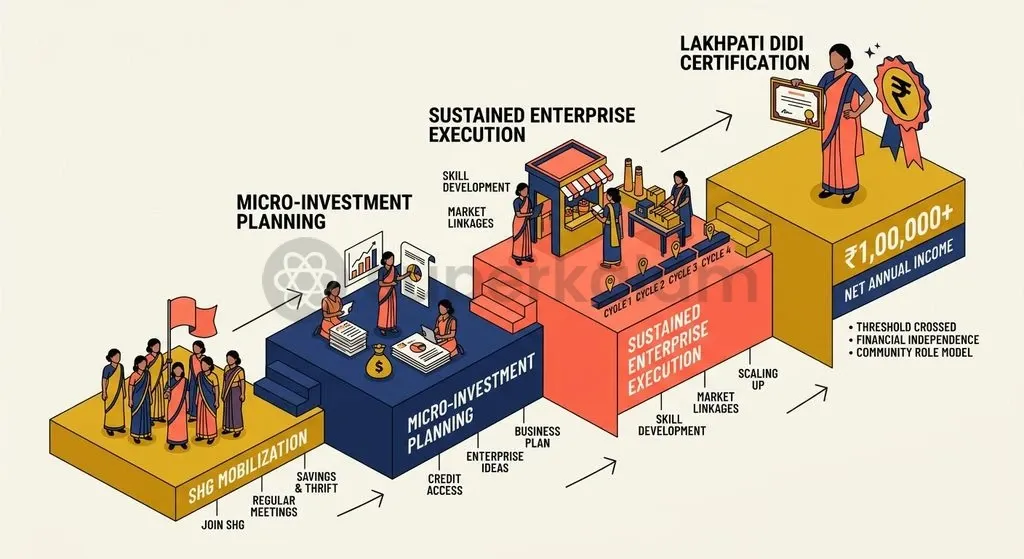
Under DAY-NRLM, a Lakhpati Didi is officially defined as an SHG member whose household achieves a net annual income of at least ₹1,00,000, according to the Ministry of Rural Development. This benchmark must be sustained over at least four agricultural seasons or business cycles, with an average monthly income exceeding ₹10,000.
Importantly, this economic benchmark evaluates aggregate household net income rather than isolated individual female wages, as detailed in the Ministry of Rural Development's Action Plan. This deliberate design positions the woman SHG member as the central financial anchor and enterprise catalyst for the entire domestic unit.
| Criterion | Threshold and Verification Parameter |
|---|---|
| Income Target | Net annual household income ≥ ₹1,00,000 |
| Monthly Cadence | Average monthly income exceeding ₹10,000 |
| Temporal Stability | Sustained over at least 4 agriculture or business cycles |
| Institutional Base | Active member of a DAY-NRLM Self-Help Group (SHG) |
This four-cycle duration requirement prevents transient windfalls or seasonal spikes from being misclassified as genuine economic graduation. By mandating sustained performance across multiple years, DAY-NRLM anchors structural livelihood stability rather than temporary, debt-fuelled cash injections.
The Shift from Consumption Credit to High-Value Enterprise
For decades, rural microfinance operated primarily as a defensive liquidity tool. Traditional SHG credit mechanisms were structured around consumption smoothing, emergency medical outlays, and breaking the predatory hold of local moneylenders.
An evaluation by the International Initiative for Impact Evaluation (3ie) affirmed this foundation, finding that DAY-NRLM participation increased beneficiary household income by 19% over baseline, boosted domestic savings by 28%, and cut reliance on informal loans by 20%.
Poverty mitigation, however, differs fundamentally from enterprise capitalisation. The Lakhpati Didi model pivots rural lending toward balance-sheet asset formation. Data on loan deployment published by the Ministry of Rural Development demonstrates this shift: over 68% of SHG credit is now directed into productive farm and livestock assets, comprising 43.9% in agriculture and 24.2% in livestock rearing.
To facilitate this productive transition, the policy landscape has introduced substantial financial enhancements:
- Enhanced Collateral-Free Credit: The Reserve Bank of India and the Ministry of Rural Development doubled the ceiling for collateral-free bank loans to women's SHGs from ₹10 lakh to ₹20 lakh.
- Capitalisation Support: Eligible groups receive a Revolving Fund of ₹20,000 to ₹30,000 alongside a Community Investment Fund of up to ₹2.50 lakh per SHG to finance member micro-investment plans.
- Interest Subvention Structure: The central government covers the spread between commercial lending rates and 7% per annum on bank credit up to ₹3,00,000, ensuring operational affordability for new enterprises.
Institutional credit disbursed to SHGs under DAY-NRLM surpassed ₹13.28 lakh crore by mid-2026. The programme maintained a Non-Performing Asset rate of 1.85%, supported by Community-Based Recovery Mechanisms operating across 62,946 bank branches. Under the Financial Inclusion 2.0 roadmap, the government plans to channel an additional ₹10 lakh crore in SHG bank credit alongside ₹1 lakh crore in direct individual enterprise loans to women members over five years.
Discuss with Superkalam
Why does evaluating net income across four continuous production cycles offer a more reliable indicator of poverty alleviation than single-season earnings?
Ask NowBeyond Papads and Pickles: Breaking the Saturation of Traditional Trades
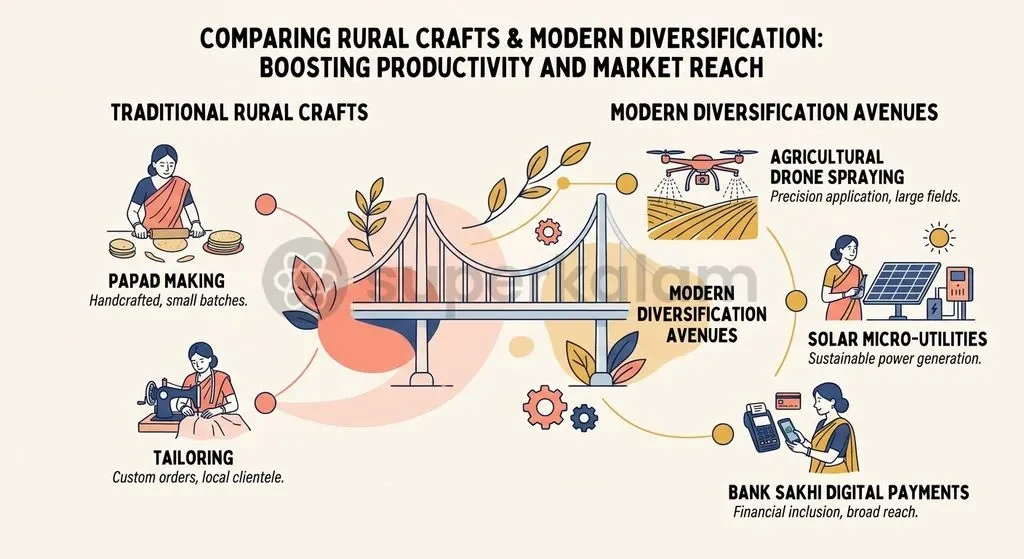
A structural limitation of early rural self-employment drives was market overcrowding. Directing millions of rural women into identical, low-entry-barrier trades—predominantly papad manufacturing, pickle curing, and basic garment stitching—frequently triggered severe localised supply gluts.
These traditional segments suffer from thin margins, extreme local competition, and predatory price capture by wholesale aggregators. Escaping this low-productivity trap requires diversifying SHG activities into modern agri-tech, rural logistics, and digital services.
A prime operational example of this diversification is the Namo Drone Didi scheme, approved with an outlay of ₹1,261 crore from 2023-24 to 2025-26 to deliver 15,000 agricultural drones to women SHGs. Under this framework, the central government provides Central Financial Assistance covering 80% of the drone package cost up to ₹8.0 lakh, while the remaining outlay is financed via the Agriculture Infrastructure Fund at a 3% interest subvention.
| Parameter | Scheme Specification |
|---|---|
| Total Outlay | ₹1,261 crore (15,000 drones across women SHGs) |
| Capital Subsidy | 80% Central Financial Assistance (up to ₹8.0 lakh) |
| Debt Component | Financed via Agriculture Infrastructure Fund (AIF) |
| Interest Relief | 3% interest subvention on the loan balance |
| Operational Efficiency | 1 acre sprayed in 7 to 8 minutes (ADRTC Bangalore) |
This intervention transforms rural women into precision agricultural service providers. An economic study by ADRTC Bangalore demonstrated that agricultural drones complete foliar spraying over one acre of cropland in just 7 to 8 minutes, creating a highly viable custom-hiring enterprise model for fertilisation and pest control.
Concurrently, rural women are leading the digital financial revolution. More than 1.44 lakh SHG members have been trained and deployed as Business Correspondent Sakhis (Bank Sakhis), executing doorstep direct benefit transfers and formal cash transactions across underserved panchayats.
Comparison: Subsistence Self-Help Groups vs Market-Linked Value Chain Collectives
To grasp how the Lakhpati Didi model changes rural political economy, aspirants must analyse the structural differences between defensive microcredit and value-chain integration.
| Parameter | Traditional Subsistence SHG Model | Market-Linked Lakhpati Didi Enterprise |
|---|---|---|
| Primary Financial Objective | Consumption smoothing, emergency distress mitigation, and micro-savings. | Sustainable net household income exceeding ₹1,00,000 across four continuous cycles. |
| Credit Architecture | Small, short-tenure internal loans drawn from pooled personal savings and revolving funds. | Large institutional credit tranches, collateral-free limits up to ₹20 lakh, and individual capital loans. |
| Economic Activities | Localised, low-capital traditional crafts, tailoring, and basic home-scale food processing. | High-value secondary agriculture, commercial livestock, precision drone spraying, and digital finance. |
| Value Chain Position | Price-taker at local village weekly haats; vulnerable to predatory middlemen. | Integrated into regional Farmer Producer Organisations, institutional public procurement, and digital networks. |
| Digital Tracking | Paper ledgers, offline social audits, and periodic manual MIS updates. | Real-time monitoring via the SHE-LEAPS application under the national LokOS digital platform. |
Discuss with Superkalam
How can the custom-hiring enterprise model established under the Namo Drone Didi scheme be applied to solve peak-season farm labour shortages in your home state?
Ask NowStructural Bottlenecks: Credit Absorption, Asset Ownership, and Market Linkages
Despite substantial capital disbursements, structural friction threatens to trap rural enterprises below their operational scale. These constraints stem from institutional bottlenecks and rural market configurations.
First, credit absorption capacity remains uneven. While aggregate credit to SHGs has expanded rapidly, secondary enterprise scaling requires individual equity capital. Group-liability mechanisms excel at enforcing repayment discipline on small, collective consumption loans, but they often restrict individual members seeking higher-risk capital for commercial expansion.
Second, the absence of independent land and fixed-asset ownership limits women's economic independence. Although SHG loans up to ₹20 lakh are legally collateral-free, commercial machinery and agro-processing facilities require physical premises and grid connections. In patriarchal rural setups where land titles remain overwhelmingly registered to male heads of households, women entrepreneurs face friction when attempting to secure industrial power connections, cold-storage allocations, or commercial lease agreements.
Third, forward market linkages remain vulnerable to middleman capture. Rural micro-enterprises struggle to maintain batch-to-batch quality standardisation, branded packaging, and cold-chain compliance.
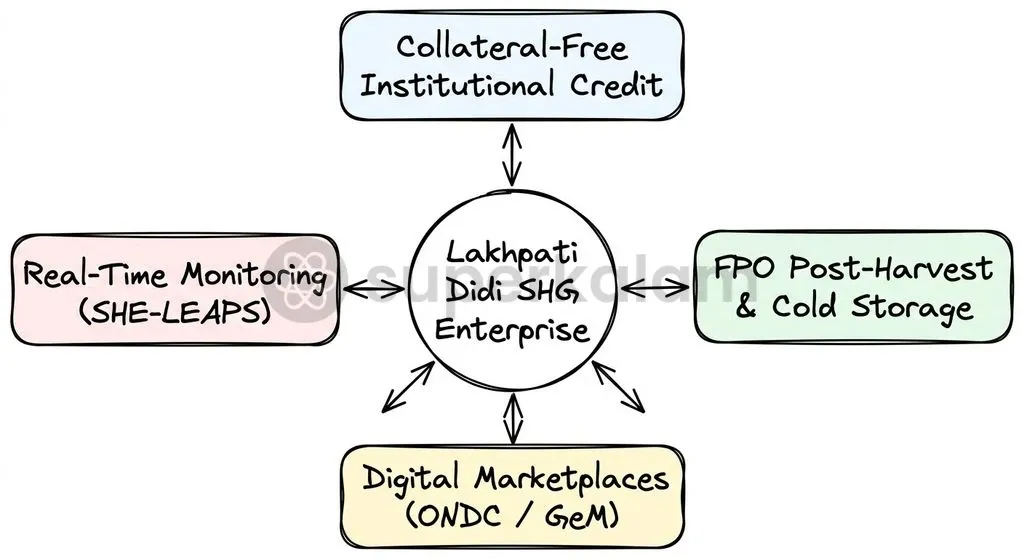
To counteract local retail bottlenecks, the Ministry of Rural Development has integrated SHG producers directly with institutional platforms, including:
- Government e-Marketplace (GeM): Permitting women's collectives to bid directly for government department procurement quotas.
- Open Network for Digital Commerce (ONDC): Bypassing concentrated e-commerce platforms to link rural clusters with urban retail consumers.
- eSARAS Portal: A dedicated marketing interface designed to display and dispatch authentic rural artisanal and agricultural items nationwide.
On the administrative front, real-time enterprise health tracking has presented operational challenges. To resolve gaps in lifecycle monitoring, the Ministry of Rural Development launched the SHE-LEAPS application under the LokOS platform in June 2026 across 34 States and Union Territories, establishing a digital mechanism to track enterprise stability and revenue flows in real time.
Discuss with Superkalam
Analyse why traditional SHG microcredit focused primarily on consumption smoothing rather than fixed asset capitalisation, and what changed under DAY-NRLM.
Ask NowWay Forward: Building Resilient Rural Enterprises Through Forward Linkages
Transforming three to six crore rural women into resilient micro-entrepreneurs requires moving beyond loan disbursement targets to comprehensive market integration. Financial inclusion provides the launchpad, but long-term enterprise survival demands systemic support across four fronts:
- Aggregating Through Farmer Producer Organisations (FPOs): Micro-enterprises cannot independently afford cold-chain infrastructure or industrial sorting machinery. The operational guidelines under the Central Sector Scheme for 10,000 FPOs mandate preferential equity participation for women farmers and SHG federations, creating an ideal vehicle to aggregate produce and build bargaining power.
- Deepening Technological Up-skilling: The success of the Namo Drone Didi model proves that rural women can run high-tech agro-services. Similar programmes should be extended into climate-smart interventions, such as solar-powered cold-room operations, micro-irrigation maintenance, and decentralised bio-fertiliser production.
- Institutional Public Procurement Quotas: State and central departments should establish mandatory procurement minimums for certified Lakhpati Didi enterprises, particularly for mid-day meal supplies, hospital linen, and anganwadi nutritional supplements.
- Dedicated Enterprise Incubation Hubs: Block-level livelihood resource centres must provide continuous hand-holding in accounting, food safety licensing, digital tax compliance, and ONDC catalogue management to safeguard early-stage enterprises from operational failure.
Key Takeaways
- The Core Definition: A Lakhpati Didi is an SHG member whose household achieves a net annual income of at least ₹1,00,000, maintained over at least four agricultural or business cycles, with a monthly run-rate exceeding ₹10,000.
- The Policy Evolution: The central target was expanded from 2 crore to 3 crore in Interim Budget 2024-25, and subsequently scaled to 6 crore women by March 2029 under DAY-NRLM guidelines.
- Capital Upgrades: Institutional credit access is supported by collateral-free borrowing limits enhanced to ₹20 lakh, interest subvention bringing effective rates to 7% on loans up to ₹3 lakh, and a historic NPA rate of just 1.85%.
- Diversification from Saturated Trades: Programmes like the ₹1,261-crore Namo Drone Didi scheme and Bank Sakhi networks successfully pivot women away from low-margin home crafts into high-productivity agri-logistics and digital banking.
- Institutional Market Bridges: Long-term income sustainability depends on reducing middleman intervention by integrating SHG enterprises directly with GeM, ONDC, eSARAS, and women-led FPOs.
Mains Question
'Poverty mitigation through defensive microcredit differs fundamentally from enterprise capitalisation.' In the light of the Lakhpati Didi initiative under DAY-NRLM, examine how the transition from consumption smoothing to productive asset formation alters rural livelihoods. (10 Marks)
Evaluate NowMains Question
"The transition of rural women from price-taking microcredit consumers to market-linked entrepreneurs under the Lakhpati Didi scheme addresses constitutional imperatives under Article 39, yet faces severe structural bottlenecks." Critically analyse. (15 Marks)
Evaluate NowPractice MCQs
QUESTION 1
With reference to the official criteria for defining a 'Lakhpati Didi' under the Deendayal Antyodaya Yojana - National Rural Livelihoods Mission (DAY-NRLM), consider the following statements:
- The benchmark assesses aggregate net annual household income rather than individual female earnings.
- The qualifying income threshold must be sustained over at least four agricultural seasons or business cycles.
- The monthly income cadence mandates an average household income exceeding ₹25,000. Which of the statements given above are correct?
QUESTION 2
Consider the following statements regarding institutional credit enhancements for Self-Help Groups (SHGs) under the DAY-NRLM framework:
- The limit for collateral-free bank credit to women's SHGs has been doubled from ₹10 lakh to ₹20 lakh.
- Eligible groups receive a Revolving Fund of ₹20,000 to ₹30,000 and a Community Investment Fund of up to ₹2.50 lakh per SHG.
- The central government provides an interest subvention covering the spread between commercial lending rates and 7% per annum on bank credit up to ₹3,00,000. Which of the statements given above is/are correct?
QUESTION 3
Regarding the financial and operational design of the 'Namo Drone Didi scheme', consider the following statements:
- Central Financial Assistance provides an 80% capital subsidy on the drone package cost, capped at ₹8.0 lakh.
- The remaining loan balance for drone acquisition is financed through the Agriculture Infrastructure Fund with a 3% interest subvention.
- According to ADRTC Bangalore, precision spraying using agricultural drones requires approximately 30 to 45 minutes per acre of cropland. Which of the statements given above is/are correct?
QUESTION 4
Under the DAY-NRLM architecture, the real-time monitoring and digital tracking of market-linked SHG enterprises is conducted primarily through which of the following digital platforms?
QUESTION 5
Consider the following statements regarding the deployment of Self-Help Group (SHG) credit as reported by the Ministry of Rural Development:
- Over 68% of SHG credit is deployed into productive farm and livestock assets.
- Agriculture accounts for 43.9% of credit deployment, while livestock rearing absorbs 24.2%.
- The non-performing asset (NPA) rate for DAY-NRLM institutional bank credit stands above 10% due to unsecured lending. Which of the statements given above is/are correct?
Discuss with Superkalam
Given the trade-off between group-liability credit discipline and individual enterprise risk capital, which model should rural development policy prioritise for secondary-stage scaling?
Ask Now