Kolkata Durga Puja Crowd Crush: Physics, NDMA Norms, and State Liability
Beyond administrative lapses, urban crowd disasters expose the critical need to treat religious gathering safety as a strict constitutional duty of care.
Oct, 2026
•10 min read
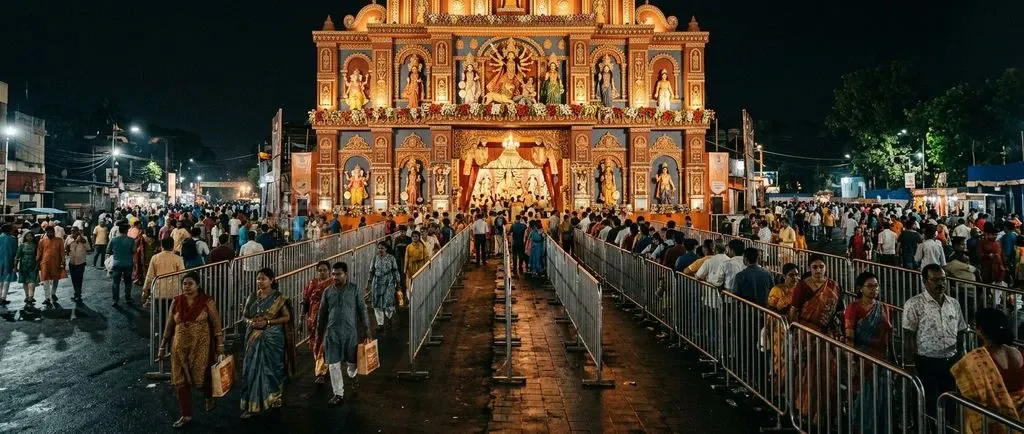
Context
Mass religious gatherings in India often turn fatal because of architectural failures in crowd dynamics. They do not stem from spontaneous public panic. Urban authorities must replace reactive policing with rigorous crowd flow engineering.
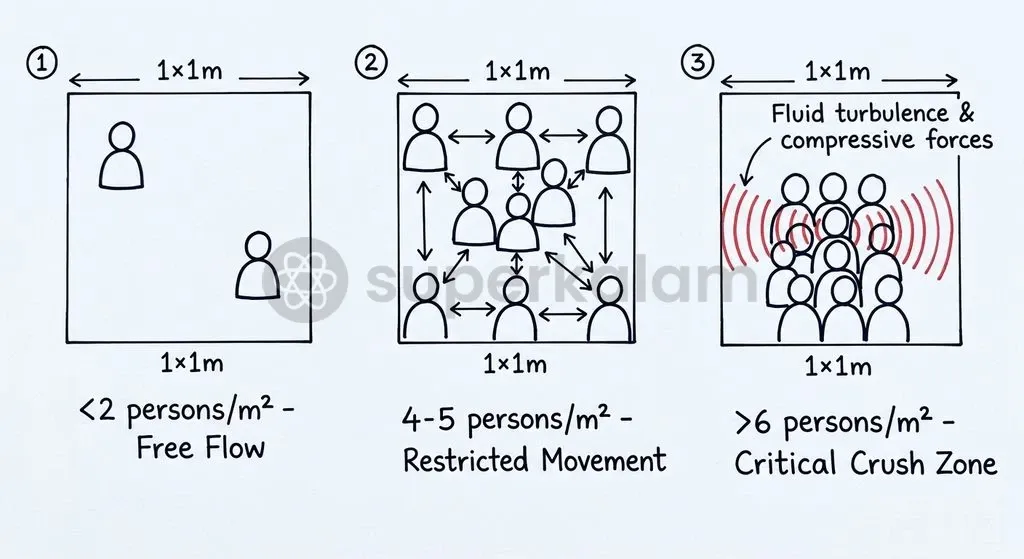
When assemblies exceed physical spatial limits, human crowds undergo a fluid phase transition. This generates compressive forces that crush chests and cause fatal asphyxiation within minutes. Calling these disasters stampedes falsely blames victims for their own deaths. The term absolves temple trusts, event organisers, and municipal licensing authorities of statutory duties. As of October 2026, enforcing capacity caps and spatial zoning remains an urgent governance imperative under Indian disaster management frameworks.
Why in the News: The Kolkata Durga Puja Rush and Panic
Public safety at mass religious gatherings is back under national scrutiny. On 17 October 2026, a lethal crowd crush occurred at the Chorbagan Sarbojanin Durga Puja pandal in north Kolkata.
According to a Kolkata Police official briefing and reportage by The Times of India, 19 people died and 25 suffered injuries (as reported on 19 October 2026). The disaster unfolded when a sudden evening downpour drove thousands of visitors seeking shelter into narrow, barricaded exit corridors.
This crisis exposed acute administrative lapses in crowd control. It prompted swift constitutional scrutiny under Article 21 of the Indian Constitution, which guarantees the fundamental right to life and bodily safety. In response to widespread crowding and the Chorbagan crush, the Kolkata administration temporarily halted visitor access at several major crowd-puller pandals to inspect entry bottlenecks (per Press Trust of India reports on 18 October 2026):
- Chetla Agrani
- Tala Pratyay
- Santosh Mitra Square
- Suruchi Sangha
The tragedy highlights a recurring governance failure. Regulatory bodies routinely permit mega-gatherings without enforcing physical carrying-capacity limits or designing fail-safe evacuation corridors.
What Happened: Anatomy of the Crowd Surge at the Pandal
Pedestrian gridlock turned fatal at the Chorbagan pandal when bad weather collided with unmanaged queue architecture. Heavy rain triggered sudden surges from both ingress pathways and open thoroughfares.
Visitors moving inward and those attempting to exit were forced into the same constricted bamboo passage. Because the layout lacked separate bypass lanes or surge-absorption holding areas, the converging pedestrian flows created a bidirectional bottleneck.
The physical failure unfolded across three compounding bottlenecks:
- Converging flows: Inward and outward visitor streams collided inside a single constricted bamboo passage.
- Missing bypass lanes: The layout lacked bypass channels and surge-absorption holding enclosures.
- Blind rear pressure: Crowds outside kept pushing forward, completely unaware of the lethal blockage ahead.
Preliminary post-mortem examinations from Kolkata Medical College and Hospital confirmed the severe compressive forces. Victims died of compressive asphyxiation, crushed chests, and fractured ribs piercing internal organs, rather than trampling injuries (as reported by the State Health Department on 19 October 2026). Physical pressure inside the corridor mounted rapidly as incoming crowds at the rear continued pushing forward.
Following the disaster, the Kolkata Police arrested seven individuals, including the puja committee secretary, vice-president, and structure contractor. Police registered a suo motu case under charges of culpable homicide not amounting to murder (per a Kolkata Police briefing on 18 October 2026).
This collapse echoed previous urban warnings. In October 2015, the Kolkata administration permanently closed the Deshapriya Park pandal after unmanaged crowds exceeding several hundred thousand overwhelmed physical barriers to view an 88-foot idol.
Discuss with Superkalam
What physical threshold of crowd density triggers the transition of a human crowd into an incompressible fluid mass?
Ask NowPhysics of Crowd Disasters: Why Experts Call It a 'Crush', Not a 'Stampede'
Crowd safety science demonstrates that fatal mass gatherings suffer from compressive fluid dynamics rather than collective psychological panic. Crowd dynamics researcher Prof. Dr G. Keith Still notes that using the word "stampede" is an inaccurate, victim-blaming misnomer. A stampede requires open space for individuals to run, whereas mass casualties occur in heavily confined corridors where individuals lose all physical agency.
At high pedestrian densities, the physical properties of a human assembly alter fundamentally. Research from Prof. G. Keith Still and the University of Suffolk Crowd Dynamics Group demonstrates that when crowd density exceeds 6 to 7 persons per square metre, the assembly ceases to act as discrete moving individuals:
- Incompressible fluid transition: The crowd behaves as a continuous, unyielding physical mass where individual movement is completely negated.
- Shockwave propagation: Lateral and longitudinal forces ripple through the crowd uncontrollably, lifting individuals off their feet and propelling them across distances without their consent.
- Compressive forces: Research by John J. Fruin in The Causes and Prevention of Crowd Disasters shows that compressive forces in such collapses exceed 4,000 to 4,500 Newtons (approximately 1,000 pounds).
- Traumatic asphyxiation: These forces physically prevent thoracic expansion, causing lethal compressive asphyxiation within three to five minutes while victims remain upright.
Discuss with Superkalam
How does framing a disaster as a 'stampede' alter administrative accountability compared to classifying it as a 'crowd crush'?
Ask NowComparing Crowd Crush vs Stampede: Victim Blaming vs Structural Failure
Administrative reports and popular media frequently mischaracterise crowd collapses as stampedes, framing the tragedy as an irrational dash by undisciplined citizens. This framing distorts investigative scrutiny by attributing structural engineering failures to personal misconduct.
| Dimension | Crowd Crush (Scientific Reality) | Stampede (Popular Misconception) |
|---|---|---|
| Physical Mechanism | Compressive thoracic asphyxiation caused by external lateral pressure | Blunt-force trauma and skeletal injuries resulting from trampling underfoot |
| Spatial Density | Critical compaction exceeding 6 to 7 persons per square metre | Low to moderate density where individuals have sufficient physical room to run |
| Individual Agency | Complete absence of agency; individuals are pushed by incompressible fluid shockwaves | Presumed presence of agency, with people actively choosing flight over order |
| Role of Panic | Panic is a secondary psychological consequence of physical suffocation | Panic is presumed to be the primary trigger initiating the disaster |
| Institutional Accountability | Direct result of structural design flaws, blocked exits, and lack of inflow control | Tends to exonerate event planners by laying blame on crowd psychology |
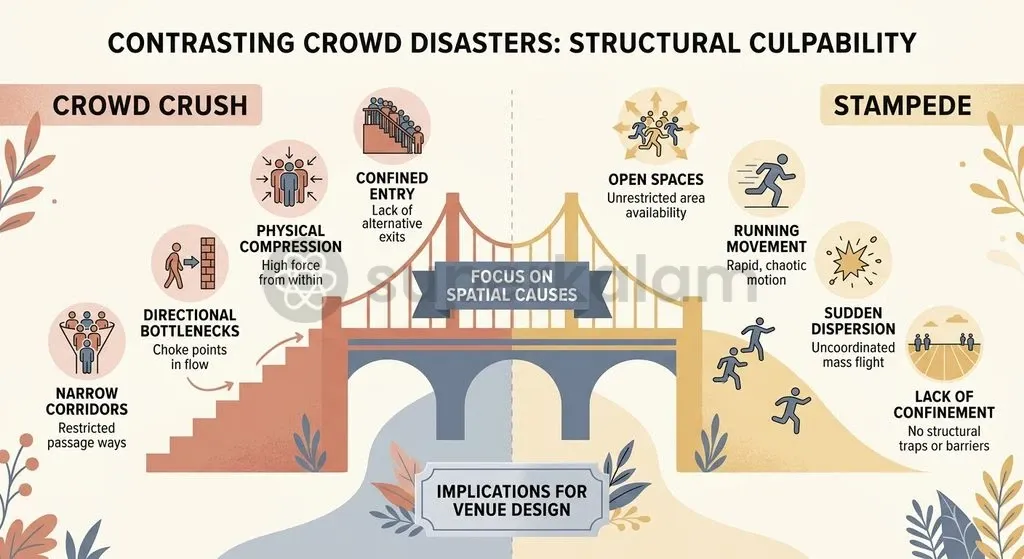
Replacing inaccurate colloquial terms with rigorous biomechanical definitions is essential for administrative and legal clarity. When state institutions classify a disaster as a crush, the regulatory gaze shifts correctly to venue layout permits, queue flow calculations, and municipal safety oversights.
Discuss with Superkalam
Suppose you are a District Magistrate granting permits for a high-footfall religious event. How would you apply the NDMA's four-tier spatial zoning framework to prevent bottlenecks?
Ask NowWhat NDMA Guidelines Mandate for Managing Large Religious Gatherings
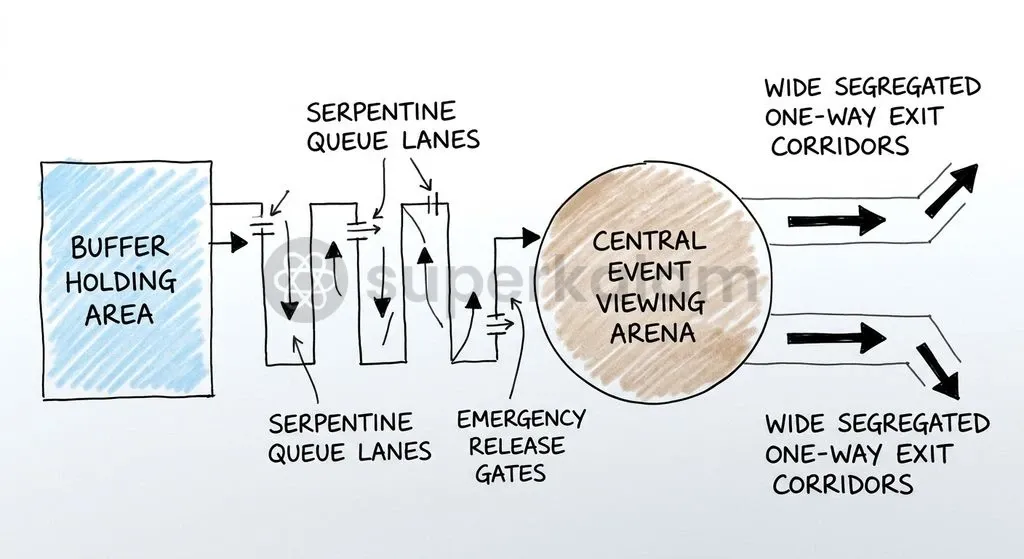
The National Disaster Management Authority formulated comprehensive instructions to eliminate structural vulnerabilities at festive assemblies. Under the NDMA Guidelines (Managing Crowds at Events and Venues of Mass Gathering, 2014), local authorities must enforce strict spatial zoning and directional controls across all stages of venue operation:
- Four-tier spatial zoning framework: Planners must partition festival zones into four distinct sectors: sterile zones for emergency services, holding zones for incoming surges, the core venue zone around the pandal, and dedicated exit dispersal zones.
- Segregated ingress and egress: Entry and exit corridors must remain physically separated to eliminate opposing pedestrian traffic, with exit capacities designed to equal or exceed incoming channel capacities.
- Serpentine queue barricading: Venues must implement serpentine or snake-line barricades to break kinetic momentum, slow transit velocity, and integrate lateral pressure-release gates at designated intervals.
- Buffer holding areas: Event organisers must construct outdoor waiting enclosures equipped with public address systems to absorb excess pedestrian flows before releasing visitors into restricted enclosures.
These statutory principles treat crowd management as an exercise in flow capacity. When event planners bypass these layout mandates, even minor external triggers such as localised rainfall produce fatal corridor blockages.
Discuss with Superkalam
Given the constitutional guarantee of Article 21, evaluate whether municipal authorities should have the power to shut down culturally significant pandals that exceed carrying capacity.
Ask NowLegal and Administrative Accountability: Gaps in Local Permissions and Policing
Enforcing crowd safety measures relies on a clear statutory architecture spanning police regulations, fire safety laws, and municipal licensing. In West Bengal, Section 23A of the West Bengal Fire Services Act, 1950 and the West Bengal Fire Services (Temporary Structures and Pandals) Rules, 2003 govern temporary installations. These provisions require all temporary pandals to secure mandatory safety clearances, deploy certified flame-retardant materials, and maintain unimpeded open margins.
Similarly, under the Kolkata Police Act, 1866, the Commissioner of Police exercises regulatory authority over mass assemblies and temporary pandals. The Act empowers the police leadership to establish maximum carrying-capacity thresholds and order the immediate closure of temporary installations that violate public safety rules.
Judicial precedent has firmly elevated these administrative responsibilities into non-negotiable constitutional duties. In Municipal Corporation of Delhi v. Association of Victims of Uphaar Tragedy (2011), the Supreme Court established critical principles of state liability:
- Non-delegable duty of care: Statutory regulatory authorities and venue operators bear an absolute, non-delegable duty to maintain public safety in mass assembly spaces.
- Strict liability under Article 21: The failure of public authorities to inspect structures and enforce safety standards constitutes an actionable infringement of the right to life under Article 21, attracting strict liability in public law.
Despite these statutory powers, ground enforcement often weakens during socio-religious festivals. Local administrations frequently issue temporary building permits without conducting scientific carrying-capacity audits or verifying clear evacuation routes.
Ethical Angle: The Administrative Duty of Care in Public Festivities
Managing mass congregations raises direct questions of administrative ethics and constitutional governance under GS Paper 4. Civil servants and police administrators frequently face acute ethical tensions when balancing popular religious sentiment against strict safety protocols. Overlooking structural non-compliance out of deference to powerful puja committees constitutes a failure of professional integrity.
The ethical framework of public administration rests upon the duty of care. Public officials hold a fiduciary responsibility toward vulnerable citizens who enter crowded public arenas trusting that safety measures are operational:
- Fiduciary responsibility: Citizens enter state-regulated assembly spaces on the legitimate expectation of physical safety.
- Human dignity over expedience: Permitting an unmonitored structural hazard prioritises administrative convenience over bodily integrity.
- Integrity against pressure: Administrators must enforce capacity norms impartially, without yielding to local socio-political influence.
Way Forward: Capacity Caps, Real-Time Monitoring, and Safe Route Engineering
Preventing recurrent crowd disasters across India requires moving from reactive crowd dispersal to preventative queue engineering. Disaster mitigation strategies must institutionalise scientific planning before mass festive assemblies occur:
- Queue modelling and capacity auditing: Event authorities must calculate static and dynamic carrying capacities using queue modelling based on Little's Law—matching crowd arrival rates with bottleneck discharge rates to keep corridor densities below 2 to 3 persons per square metre.
- Computer-vision surveillance: Control rooms should deploy real-time video analytics and thermal drone cameras to track pedestrian density. Automated alerts must trigger when densities exceed 4 persons per square metre, enabling dynamic diversions before fluid turbulence develops.
- Unified incident command: Under the Disaster Management Act, 2005, District Disaster Management Authorities must activate an Incident Command System (ICS), establishing a single chain of command linking executive magistrates, police officers, fire services, and medical teams.
- Time-slotted digital ticketing: Major festive sites should adopt digital darshan passes with staggered entry times, smoothing arrival spikes and preventing corridor surges during sudden weather shifts.
Key Takeaways
- Deadly crowd disasters at mass gatherings are crushes caused by compressive asphyxiation, not stampedes resulting from irrational human panic.
- When assembly density exceeds 6 to 7 persons per square metre, crowd mass behaves as an incompressible fluid where lateral physical forces exceed 4,000 Newtons.
- The NDMA 2014 Guidelines mandate a four-tier zoning system, unidirectional movement corridors, continuous serpentine barricades, and surge-absorbing holding areas.
- The Supreme Court held in MCD v. Association of Victims of Uphaar Tragedy (2011) that administrative failures to enforce safety rules violate Article 21, attracting strict liability.
- Regulatory authorities must implement queue modelling, drone monitoring, and an Incident Command System under the Disaster Management Act, 2005 to maintain densities below critical thresholds.
Mains Question
'Disasters at mass public gatherings are primarily failures of queue architecture and flow engineering rather than spontaneous public panic.' In light of the NDMA Guidelines on Crowd Management (2014), elucidate. (10 Marks)
Evaluate NowMains Question
Statutory authorities bear an absolute, non-delegable duty of care to ensure public safety during mass assemblies. In the context of judicial principles laid down in the Uphaar Tragedy judgment (2011) and municipal police regulations, critically examine the gaps in state liability and safety enforcement during large-scale festivities. (15 Marks)
Evaluate NowPractice MCQs
QUESTION 1
With reference to the physics of crowd disasters at mass gatherings, consider the following statements:
- When human crowd density surpasses critical thresholds of 6 to 7 persons per square metre, the assembly undergoes a fluid phase transition where individual agency is completely negated.
- Compressive forces during such crowd collapses can exceed 4,000 Newtons, leading to fatal compressive asphyxiation within minutes without trampling underfoot.
- A 'stampede' strictly describes a scenario in heavily confined spaces where panic acts as the direct biomechanical cause of suffocation. Which of the statements given above is/are correct?
QUESTION 2
Consider the following statements regarding the National Disaster Management Authority (NDMA) 2014 guidelines for managing mass religious gatherings:
- They mandate a four-tier spatial zoning framework comprising sterile, holding, core venue, and exit dispersal zones.
- They require exit capacities to be equal to or exceed incoming channel capacities to prevent bidirectional bottlenecks.
- They recommend serpentine or snake-line barricades equipped with lateral pressure-release gates to break kinetic momentum. Which of the statements given above are correct?
QUESTION 3
With reference to state liability and crowd safety regulation in India, consider the following statements:
- In Municipal Corporation of Delhi v. Association of Victims of Uphaar Tragedy (2011), the Supreme Court ruled that failure of public authorities to enforce safety norms constitutes an actionable infringement under Article 21.
- Under the Kolkata Police Act, 1866, the Commissioner of Police lacks the statutory power to order the closure of temporary pandals violating safety rules.
- The West Bengal Fire Services Act, 1950 mandates safety clearances and open margins for temporary structures. Which of the statements given above is/are correct?
QUESTION 4
Which of the following describes the primary physiological cause of death in human crowd crushes occurring in confined urban spaces?
QUESTION 5
Consider the following statements regarding the administrative measures following the October 2026 Chorbagan Sarbojanin pandal incident:
- The disaster occurred due to converging inward and outward pedestrian flows trapped in a single constricted passage during heavy rainfall.
- Kolkata Police invoked provisions of culpable homicide not amounting to murder against organizers and contractors.
- Visitor access was temporarily halted across several other major pandals, including Tala Pratyay and Suruchi Sangha, to inspect entry bottlenecks. Which of the statements given above are correct?