Kashi Tamil Sangamam 5.0: Dates, Theme and What the Fifth Edition Covers
Beyond civilisational symbolism, Sangamam tests whether executive cultural corridors can advance cooperative federalism or remain episodic public diplomacy.
Oct, 2026
•8 min read
Overview
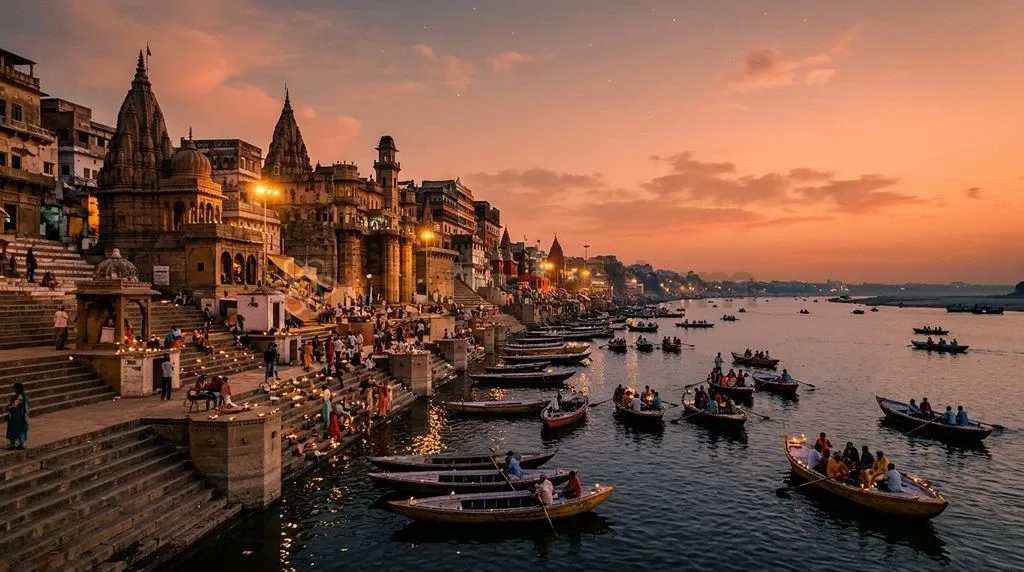
The Kashi Tamil Sangamam builds an active cultural bridge between Northern and Southern India under the Union government's Ek Bharat Shreshtha Bharat initiative. The programme invites delegates from Tamil Nadu to Varanasi for direct, people-to-people exchange. The Ministry of Education coordinates this corridor alongside Banaras Hindu University and IIT Madras.
This educational diplomacy grounds integration in organic civilisational continuity rather than top-down administrative uniformity. The upcoming fifth edition scheduled for late 2026 turns its attention to classical literature. It anchors national engagement in the ethical reflections of the Thirukkural.
Why in the News: The Trajectory Towards Sangamam 5.0
The Union Ministry of Education launched the official registration portal for Kashi Tamil Sangamam 5.0 on 22 October 2026. According to the Press Information Bureau, the fifth edition runs from 28 November to 12 December 2026 in Varanasi.
As of October 2026, the programme centres on the official theme Thirukkural Payilvom – Thirukkural Abhyas Karen, which translates to "Let us learn Thirukkural". This literary focus expands upon language foundations built in earlier editions, steering public discussions toward classical Tamil ethics.
Key operational components for the 2026 edition include:
- Youth Research Internships: The Central Institute of Classical Tamil and official portal guidelines confirm a competitive research initiative for the fifth edition. Under this scheme, 1,000 selected students from across 1,000 higher education institutions will undertake a one-month Thirukkural research internship supported by a ₹10,000 stipend.
- Thematic Delegate Cohorts: Official portal announcements from IIT Madras confirm that the itinerary will host approximately 1,400 delegates from Tamil Nadu. Organisers have arranged participants into seven thematic cohorts of 200 members across Varanasi, Prayagraj, and Ayodhya.
Ancient Roots: Tracing the Historical Link Between Kashi and Tamil Nadu
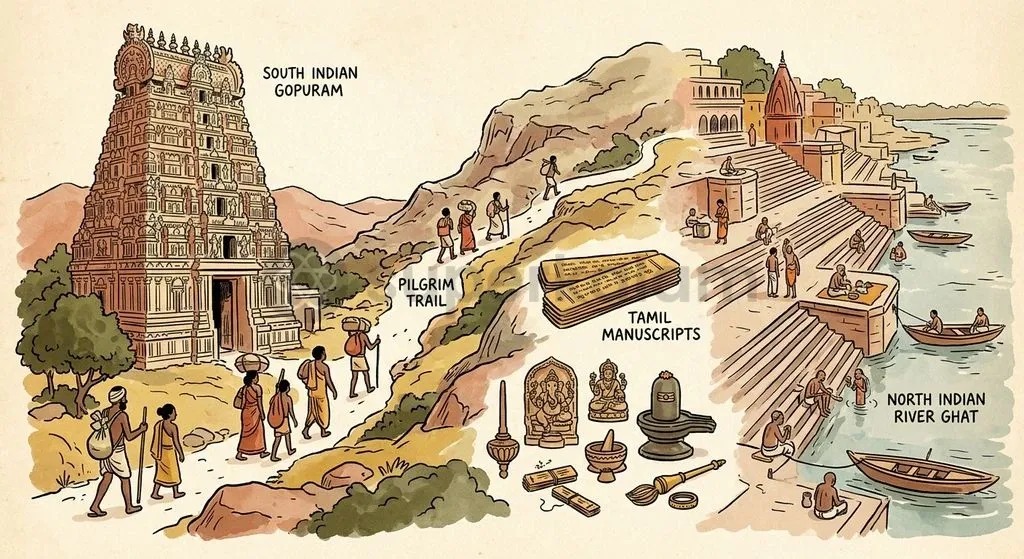
Civilisational ties between Varanasi and the Tamil country stretch back millennia. Reciprocal pilgrimages, shared temples, and literary scholarship kept this bond alive across generations. Tamil grammatical traditions recorded by the Central Institute of Classical Tamil venerate Sage Agastya as the father of the Tamil language and author of the ancient text Agattiyam.
Tradition recounts his journey from Varanasi to the southern Podhigai hills. This migration created an enduring model of cultural exchange between North and South. Historical records confirm deep, tangible bonds linking both regions:
- The Tenkasi Pandyan Heritage: In the 15th century, King Harikesari Parakrama Pandya established the Kasi Viswanathar Temple at Tenkasi in southern Tamil Nadu, as documented by the Archaeological Survey of India. After undertaking a northern pilgrimage to bring a consecrated Shiva lingam from Varanasi, the monarch founded the southern shrine so devotees unable to journey north could experience Kashi locally.
- Monastic Footholds on the Ghats: During the 17th century, Tamil Saivite philosopher-saint Kumaraguruparar Swamigal travelled to Varanasi. According to records maintained by the Dharmapuram Adheenam, he established the Kumaraswamy Mutt at Kedar Ghat, securing institutional roots for Tamil Shaiva Siddhanta in the northern holy city.
- Literary Fusion under Subramania Bharati: The Ministry of Culture notes that nationalist poet Mahakavi Subramania Bharati resided at Varanasi's Hanuman Ghat between 1898 and 1902. His immersion in Sanskrit, Hindi, and northern nationalist circles profoundly broadened his socio-political vision, shaping modern Indian patriotic literature.
Discuss with Superkalam
Which Tamil monarch founded the Kasi Viswanathar Temple at Tenkasi, and in which century did this take place?
Ask NowInstitutional Blueprint: Organising Ministries, Knowledge Partners, and Operational Setup
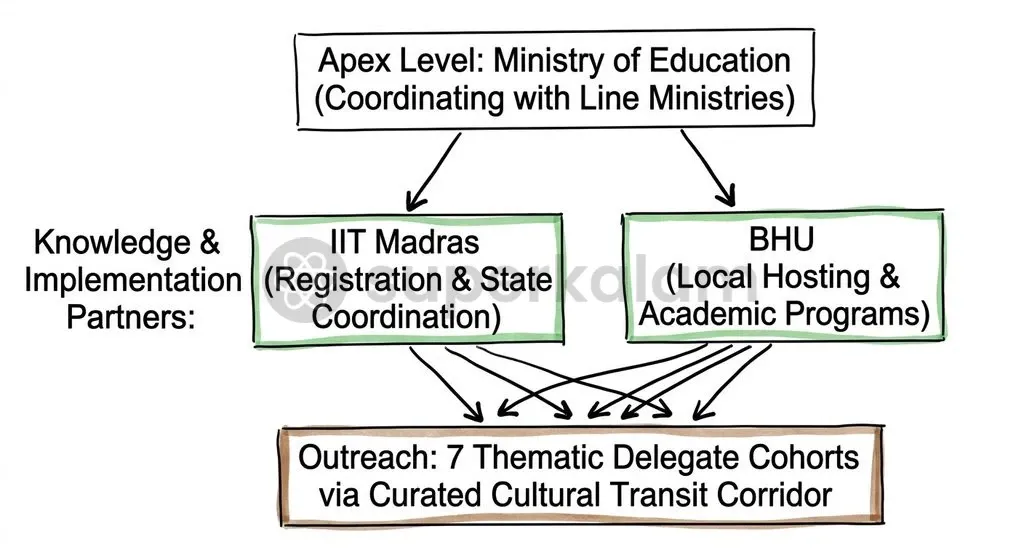
The Department of Higher Education within the Union Ministry of Education is the nodal administrative authority for the Kashi Tamil Sangamam. While the Ministry of Education steers overall policy, execution relies on multi-ministerial coordination involving the Ministries of Railways, Culture, Tourism, Textiles, and Information and Broadcasting.
Academic planning rests on an institutional partnership between technical and classical universities. IIT Madras serves as the knowledge partner and manages the digital participant portal, while Banaras Hindu University is the host academic institution in Varanasi. This division of responsibilities couples southern technological systems with northern academic resources.
Logistical arrangements structure participant interaction through immersive, multi-day exposure:
- Cohort Selection: Participants register through an open national portal administered by IIT Madras, categorised into dedicated thematic tracks such as literature, handlooms, arts, and entrepreneurship.
- Dedicated Transit: The Ministry of Railways operates special direct train services, moving delegates seamlessly from southern hubs directly into Uttar Pradesh.
- Curated Pilgrimage Itinerary: The cohorts undertake a structured eight-day circuit spanning academic seminars at Banaras Hindu University, visits to the Kashi Vishwanath Temple corridor, and site visits to Prayagraj and Ayodhya.
Comparing the Editions: Evolution from Sangamam 1.0 to Present
The Kashi Tamil Sangamam has evolved from a commemorative Azadi Ka Amrit Mahotsav celebration into a structured, theme-driven policy instrument. Successive iterations reflect a shift from basic cultural sightseeing toward targeted linguistic immersion and literary exchange.
| Edition | Timeline | Primary Strategic Theme | Technological & Logistical Milestones | Key Policy Emphasis |
|---|---|---|---|---|
| KTS 1.0 | Nov–Dec 2022 | Inaugural cultural corridor revival | Special pilgrim trains; academic roundtables across BHU faculties | Re-establishing civilisational memory under Azadi Ka Amrit Mahotsav |
| KTS 2.0 | Dec 2023 | Technology-enabled linguistic integration | Deployment of the Bhashini AI platform for real-time speech translation | Overcoming live language barriers in public proceedings |
| KTS 4.0 | Dec 2025 | Foundational linguistic training: Tamil Karkalam | 2,460-kilometre Sage Agastya Vehicle Expedition across 5 states | Introducing elementary Tamil language skills to northern institutions |
| KTS 5.0 (Preview) | Nov–Dec 2026 | Classical literary ethics: Thirukkural Payilvom | National research internships across 1,000 institutions | Transitioning from periodic delegate visits to nationwide youth research |
Discuss with Superkalam
Explain how the technological deployment of the Bhashini platform during KTS 2.0 addressed linguistic barriers in administrative and public discourse.
Ask NowConstitutional and Policy Anchors: Ek Bharat Shreshtha Bharat and Article 51A(f)
The Constitution of India provides normative anchors for initiatives that bridge regional divides. Foremost among these stands Article 51A(f) in Part IVA, which designates valuing and preserving the rich heritage of the nation's composite culture as a Fundamental Duty of every citizen. These duties remain non-justiciable moral commitments, yet they give clear direction to cultural policymaking.
Linguistic diversity and cultural protection also receive structural constitutional support:
- Article 29(1) safeguards cultural autonomy by guaranteeing that any section of citizens possessing a distinct language, script, or culture has the fundamental right to conserve it.
- Article 351 provides a unique directive to the Union to promote the spread of Hindi while ensuring that it assimilates forms, style, and vocabulary from Hindustani and Eighth Schedule languages, explicitly including Tamil.
- Classical Language Recognition: In October 2004, the Ministry of Culture formally notified Tamil as the first Classical Language of India, affirming statutory recognition of its ancient heritage.
On the policy front, the Sangamam operationalises the Ek Bharat Shreshtha Bharat programme, launched in October 2015 to create structured interstate exchanges. Section 4.18 of the National Education Policy 2020 mandates experiential study of Indian Knowledge Systems and linguistic unity, providing the curricular foundation for cross-regional student research.
Discuss with Superkalam
Analyse whether episodic cultural delegate tours alone can mitigate long-standing regional linguistic apprehensions without systemic school curriculum integration.
Ask NowCritical Assessment: Symbolic Pageantry Versus Ground-Level Integration
Critical observers note friction between high-profile state celebrations and enduring regional integration. Large delegate tours certainly create broad public interest. Yet analysts ask whether short visits yield deep institutional ties.
Several structural friction points warrant examination:
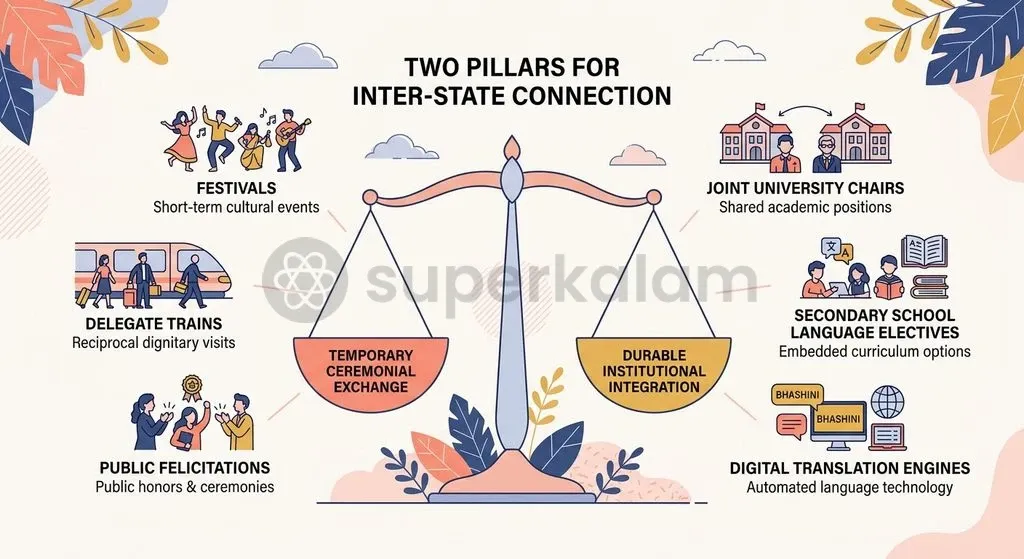
- Episodic Mobilisation vs Sustained Pedagogy: As observed in reporting by The Hindu in March 2026, transitioning from periodic ceremonial assemblies into durable cooperative cultural federalism requires systemic curriculum reforms, such as introducing Tamil language electives in Northern schools. Without sustained classroom instruction, public familiarity with southern classical traditions remains superficial.
- Institutional Depth vs Event Management: Educational researchers noted in a 2026 monograph on the Sangamam that long-term cross-fertilisation requires formal joint degree programmes and permanent academic chairs between Banaras Hindu University and IIT Madras, rather than transient cohort tours.
- Centre-State Asymmetries: State-sponsored cultural promotion can provoke regional wariness if perceived as unilateral federal messaging. Achieving genuine cooperative federalism requires active co-ownership, joint funding, and reciprocal institutional hosting by the government of Tamil Nadu.
The Way Forward: Institutionalising Long-Term Academic and Cultural Linkages
Policymakers must shift cultural corridor projects from episodic pageantry into permanent academic channels. Durable partnerships demand institutional roots across universities, tourism bodies, and language technology.
Concrete policy interventions can secure this trajectory:
- Bilateral Academic Consortia: Setting up joint postgraduate diplomas, reciprocal credit transfers, and dedicated Tamil-Sanskrit comparative philology centres between northern central universities and southern state institutions.
- Reciprocal Corridors: Co-hosting complementary conventions beyond Varanasi, such as a Kashi-Cauvery Sangamam based in Thanjavur or Madurai, to ensure two-way regional investment.
- Deepening Digital Translation Infrastructure: Deploying tools like the Bhashini language platform across secondary school classrooms and public administration, operationalising the linguistic assimilation envisioned under Article 351.
- Decentralised Economic Linkages: Linking Kanchipuram and Varanasi silk-weaving clusters through permanent commercial cooperatives, turning cultural fellowship into collaborative micro-enterprise development.
Discuss with Superkalam
Propose an institutional framework through which Banaras Hindu University and IIT Madras could transform the Sangamam into a permanent academic partnership.
Ask NowKey Takeaways
- The Union Ministry of Education launched registration for Kashi Tamil Sangamam 5.0 on 22 October 2026, scheduling the multi-cohort event from 28 November to 12 December 2026 under the theme Thirukkural Payilvom.
- Academic partnerships anchor the project, with IIT Madras as knowledge partner and portal administrator alongside Banaras Hindu University as local host.
- Historical links trace to antiquity through Sage Agastya's literary traditions, the 15th-century Tenkasi Viswanathar Temple built by King Parakrama Pandya, and the 17th-century Kumaraswamy Mutt founded by Kumaraguruparar Swamigal.
- The initiative derives constitutional direction from Article 51A(f) (duty to preserve composite culture), operating under the executive policy mandate of Ek Bharat Shreshtha Bharat and NEP 2020.
- Analysts emphasise that converting periodic flagship events into genuine cooperative federalism requires permanent school-level language electives and reciprocal university degree pathways.
Mains Question
"Transitioning cultural corridor initiatives from periodic ceremonial assemblies into durable cooperative cultural federalism requires systemic structural integration." In the context of the Kashi Tamil Sangamam, critically examine this statement. (15 Marks)
Evaluate NowMains Question
Elucidate the constitutional and institutional anchors that support cultural exchange programmes like the Kashi Tamil Sangamam under the Ek Bharat Shreshtha Bharat framework. (10 Marks)
Evaluate NowPractice MCQs
QUESTION 1
With reference to the historical and cultural links between Varanasi and Tamil Nadu, consider the following statements:
- Tamil grammatical tradition venerates Sage Agastya as the author of Agattiyam and recounts his journey from Varanasi to the southern Podhigai hills.
- In the 15th century, King Harikesari Parakrama Pandya established the Kasi Viswanathar Temple at Tenkasi after a northern pilgrimage.
- Kumaraswamy Mutt at Kedar Ghat in Varanasi was established by Mahakavi Subramania Bharati during his stay in the city. Which of the statements given above are correct?
QUESTION 2
Consider the following statements regarding the institutional and operational framework of the Kashi Tamil Sangamam:
- The Department of Higher Education under the Union Ministry of Education serves as the nodal administrative authority.
- Banaras Hindu University serves as the digital portal administrator and knowledge partner, while IIT Madras is the host academic institution in Varanasi.
- The initiative is implemented under the aegis of the Union Government's Ek Bharat Shreshtha Bharat programme. Which of the statements given above is/are correct?
QUESTION 3
Consider the following pairs regarding successive editions of Kashi Tamil Sangamam and their key milestones:
- KTS 2.0: Deployment of the Bhashini AI platform for real-time speech translation
- KTS 4.0: 2,460-kilometre Sage Agastya Vehicle Expedition across 5 states
- KTS 5.0: Focus on classical literary ethics under the theme 'Thirukkural Payilvom' How many of the pairs given above are correctly matched?
QUESTION 4
Which of the following constitutional provisions directs the Union to promote the spread of Hindi while ensuring that it assimilates forms, style, and vocabulary from Hindustani and Eighth Schedule languages, explicitly including Tamil?
QUESTION 5
With reference to Kashi Tamil Sangamam 5.0, consider the following statements:
- Its focal theme is 'Thirukkural Payilvom – Thirukkural Abhyas Karen'.
- It introduces a one-month research internship on Thirukkural supported by a stipend for selected higher education students.
- The delegate itinerary is restricted exclusively to the urban municipal limits of Varanasi. Which of the statements given above is/are correct?