Karnataka Bike-Taxi Case: Supreme Court Ruling on Urban Mobility
Executive inaction cannot extinguish gig livelihoods: why the Supreme Court intervened to protect two-wheeler transit under the Motor Vehicles Act.
Nov, 2026
•10 min read
Overview
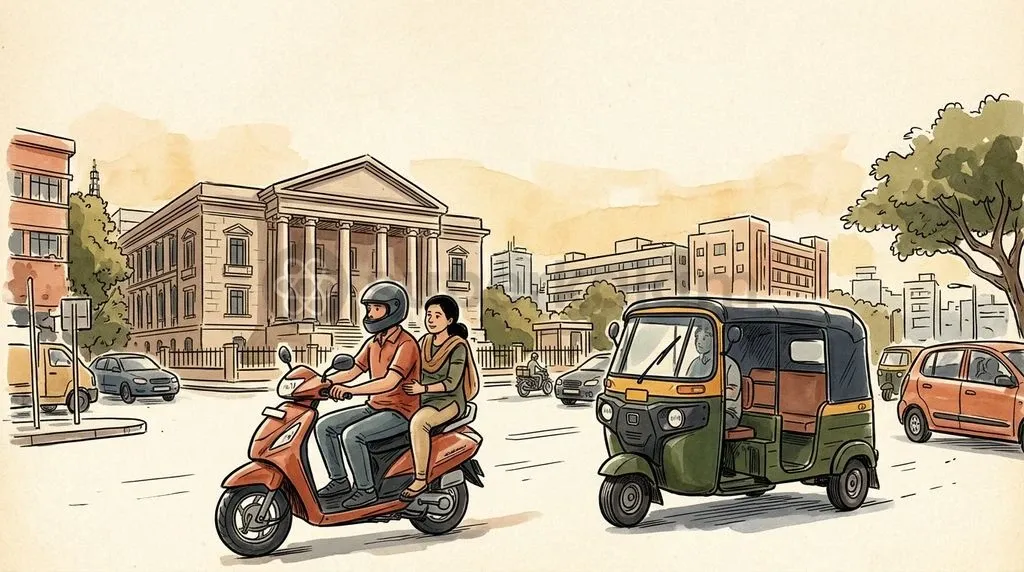
The Supreme Court of India affirmed that two-wheelers can operate as commercial contract carriages. The bench dismissed the Karnataka government's challenge against aggregator operations. It ruled that administrative inaction cannot justify blanket prohibitions that extinguish constitutionally protected livelihoods under Article 19(1)(g).
The dispute began when state authorities clamped down on app-based motorcycle cabs after revoking the Karnataka Electric Bike Taxi Scheme, 2021. In response, platform operators secured relief from a Division Bench of the Karnataka High Court, which ruled that the Motor Vehicles Act, 1988 does not bar motorcycles from passenger transit.
This litigation exposes structural friction under Entry 35 of the Concurrent List. States have frequently used broad powers under Section 67 of the Motor Vehicles Act to resist aggregator models authorised under Section 93. Constitutional courts intervened to resolve statutory obsolescence, balancing traditional transport protections against digital platform livelihoods.
Why in the News?
As of November 2026, the Supreme Court of India dismissed the Karnataka government's petition challenging a High Court verdict that permitted two-wheeler bike taxis to operate as commercial contract carriages. The bench upheld the ruling of the Karnataka High Court. It observed that public interest is served by sensible regulation rather than prohibition.
The legal controversy intensified after Karnataka revoked its pilot electric bike-taxi policy. That step left thousands of app-based gig workers vulnerable to transport department penalties and vehicle seizures.
By declining to stay the High Court mandate, the apex court affirmed that digital platform operations cannot remain stalled indefinitely due to executive delays in framing statutory rules under the Motor Vehicles Act, 1988.
The Core Flashpoint: Karnataka's Clampdown on Two-Wheeler Cabs
The Karnataka Transport Department triggered a fierce regulatory standoff by enforcing an outright ban on bike-taxi aggregators. This crackdown followed the formal revocation of its electric two-wheeler policy. The state government had initially notified the Karnataka Electric Bike Taxi Scheme in July 2021 to facilitate last-mile urban transit through battery-operated motorcycles.
On 6 March 2024, the state government formally revoked the 2021 scheme through an executive order. Officials cited concerns over passenger safety, commercial use of private white-plate vehicles, and violent clashes between auto-rickshaw drivers and bike-taxi riders. Following this revocation, enforcement squads launched punitive drives against platform drivers affiliated with major mobility companies.
Platform aggregators ANI Technologies (operating Ola), Uber India Systems, and Roppen Transportation Services (operating Rapido) filed writ appeals before the Karnataka High Court to contest the regulatory crackdown. The companies challenged an April 2025 single-judge verdict that had restricted their operations. They argued that executive enforcement penalised drivers without statutory justification.
Key triggers behind the state action included:
- Vehicle Registration Breaches: Platforms onboarded two-wheelers displaying non-transport personal registrations instead of commercial yellow plates.
- First-Mile Union Clashes: Traditional three-wheeler unions staged protests over fare undercut and unregulated commuter pick-ups.
- Executive Inaction: The state withdrew the 2021 scheme without notifying an alternative statutory regime.
Discuss with Superkalam
Which specific entry of the Seventh Schedule's Concurrent List governs mechanically propelled vehicles and vehicular taxation principles?
Ask NowAnatomy of the Dispute: Why Aggregators and States Reached an Impasse
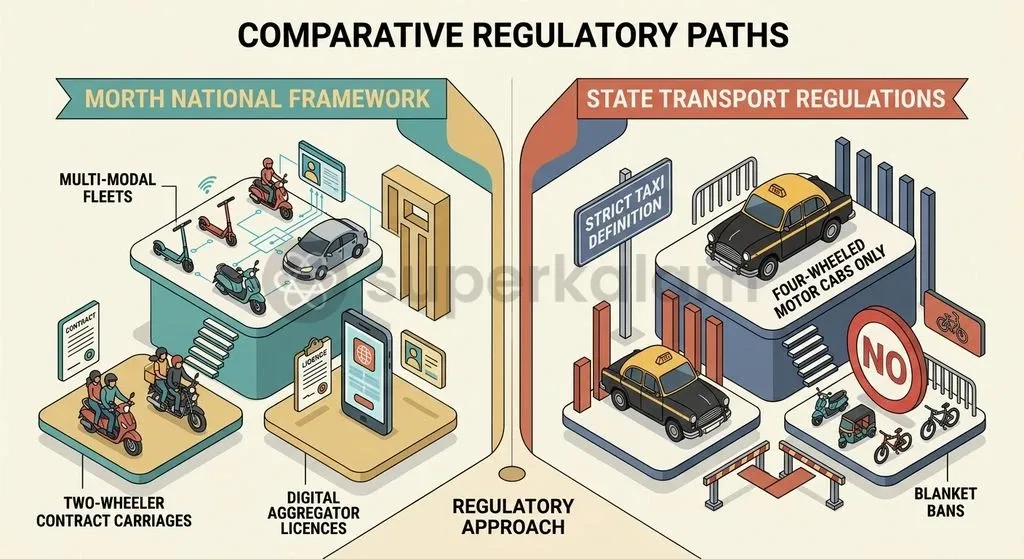
The Karnataka On-demand Transportation Technology Aggregators Rules of 2016 created an operational impasse by defining a taxi strictly as a four-wheeled motor cab. Because this regulatory definition omitted two-wheelers entirely, regional transport offices routinely rejected permit applications from motorcycle operators seeking commercial endorsements.
This administrative void placed commercial aggregators and transport authorities on a direct collision course over vehicle classifications, permit models, and safety compliance:
| Dimension | Aggregator Framework (MoRTH Guidelines) | State Regulatory Position (Karnataka Rules) |
|---|---|---|
| Vehicle Permissibility | Integrates two-wheelers, auto-rickshaws, and motor cabs for ride-hailing and pooling. | Restricted commercial aggregator licences primarily to four-wheeled motor cabs. |
| Statutory Licensing | Central aggregator norms framed under Section 93 of the Motor Vehicles Act, 1988. | Enforced licensing through state-level aggregators rules framed in 2016. |
| Propulsion Mandate | Agnostic between internal combustion engines and electric powertrains. | Attempted to permit only battery-operated electric two-wheelers before total withdrawal. |
| Permit Category | Contract carriage permits under Section 74 with attached safety conditions. | Denied contract carriage status to two-wheelers, treating them as non-transport personal assets. |
On 23 January 2026, a Division Bench of the Karnataka High Court resolved this deadlock. The court held that motorcycles fall squarely within the statutory framework of passenger transport and can be licensed as commercial contract carriages.
The High Court ruled that an outright administrative ban fails the test of reasonable restriction under Article 19(6) of the Constitution. The bench concluded that while the state retains the power to regulate vehicular safety, it cannot deploy executive inaction to extinguish a citizen's right to trade under Article 19(1)(g).
The Statutory Fault Line: The Motor Vehicles Act and Federal Friction
The Motor Vehicles Act of 1988 divides regulatory authority between central policy frameworks and state-level implementation under Entry 35 of the Seventh Schedule's Concurrent List. This constitutional architecture gives both Parliament and State Legislatures concurrent legislative competence over mechanically propelled vehicles and principles of vehicular taxation.
| Jurisdiction | Constitutional Authority | Statutory Powers & Levers Under MV Act |
|---|---|---|
| Central Government (Parliament) | Concurrent List Entry 35 | • Defines contract carriages under Section 2(7) and motorcycles under Section 2(27) • Issues national aggregator guidelines under Section 93 |
| State Government (Executive) | Concurrent List Entry 35 | • Directs Regional Transport Authorities under Section 67 • Controls fare fixation, conditions, and vehicle class prohibitions • Enforces state rules like the Karnataka Aggregators Rules (2016) |
The primary statutory ambiguity stems from the interaction between definitions and licensing provisions inside the Motor Vehicles Act, 1988:
- Definition of Contract Carriage: Section 2(7) defines a contract carriage as any motor vehicle carrying passengers for hire or reward under an express or implied contract.
- Definition of Motorcycle: Section 2(27) defines a motorcycle as a two-wheeled motor vehicle, which legally qualifies as a motor vehicle capable of hire unless expressly excluded by Parliament.
- Aggregator Licensing Mandate: Section 93, as amended by the Motor Vehicles (Amendment) Act, 2019, mandates that digital aggregators must obtain operating licences from State Governments while complying with Central Government guidelines.
- State Directional Control: Section 67 empowers State Governments to issue binding directions to Regional Transport Authorities regarding fare fixation, licensing conditions, and prohibitions on specific vehicle classes.
To harmonise digital mobility across states, the Ministry of Road Transport and Highways (MoRTH) notified the Motor Vehicle Aggregator Guidelines in November 2020 under Section 93. These guidelines expressly permit two-wheeler ride-pooling and commercial operations.
Karnataka resisted implementing the central guidelines by invoking Section 67 to protect conventional urban transit and manage vehicular congestion. This friction demonstrated how states can leverage discretionary licensing procedures to delay national policies governing platform economies.
Discuss with Superkalam
How does the statutory definition of a contract carriage under Section 2(7) of the Motor Vehicles Act, 1988 encompass two-wheeler motorcycles?
Ask Now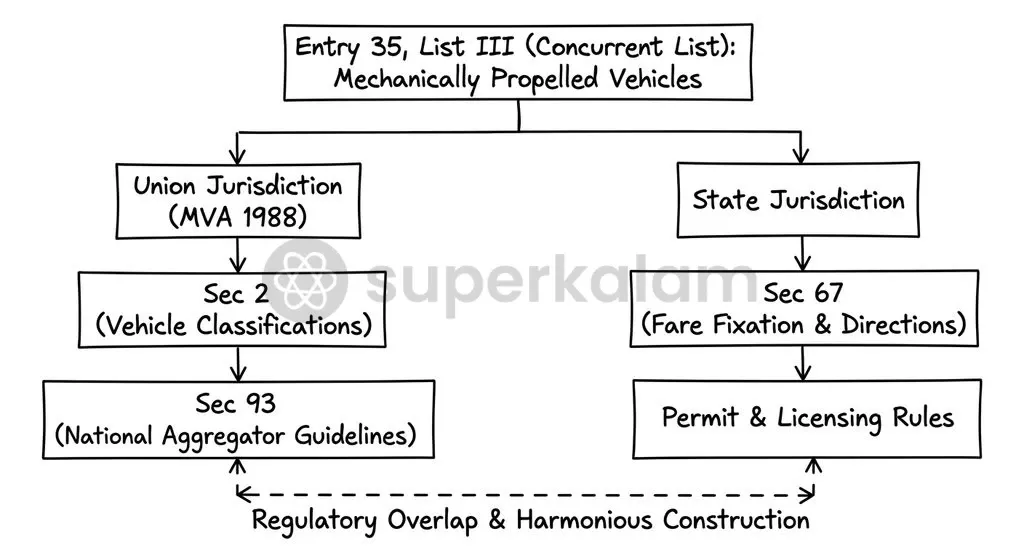
Judicial Gap-Filling: How the Supreme Court Addressed the Regulatory Vacuum
The Supreme Court of India intervened to prevent executive inaction from stifling technological innovation and arbitrary restrictions on transport operations across urban centres. When administrative agencies fail to notify statutory rules for emergent economic sectors, constitutional courts often employ the doctrine of judicial gap-filling to safeguard fundamental freedoms.
When hearing the state's appeal in November 2026, the Supreme Court bench emphasised that modern two-wheeler mobility provides affordable, GPS-monitored transit for urban commuters. The court pointed out that administrative bodies cannot cite absent guidelines as grounds for total bans.
Instead of issuing new administrative rules from the bench, the judiciary anchored its intervention in existing statutory provisions:
- Contract Carriage Permits: The judiciary affirmed that Regional Transport Authorities possess ample authority under Section 74(2) of the Motor Vehicles Act, 1988 to attach reasonable safety and regulatory conditions to motorcycle permits.
- Commercial Vehicle Standards: The bench noted that operating as a commercial carrier requires compliance with commercial registration norms and regular fitness certifications under Section 56 of the Act.
This judicial approach struck down administrative bans while preserving the state's legitimate authority to enforce transport safety standards.
Discuss with Superkalam
Why do State Governments rely on Section 67 of the Motor Vehicles Act to restrict aggregator models that are otherwise permitted under central MoRTH guidelines?
Ask Now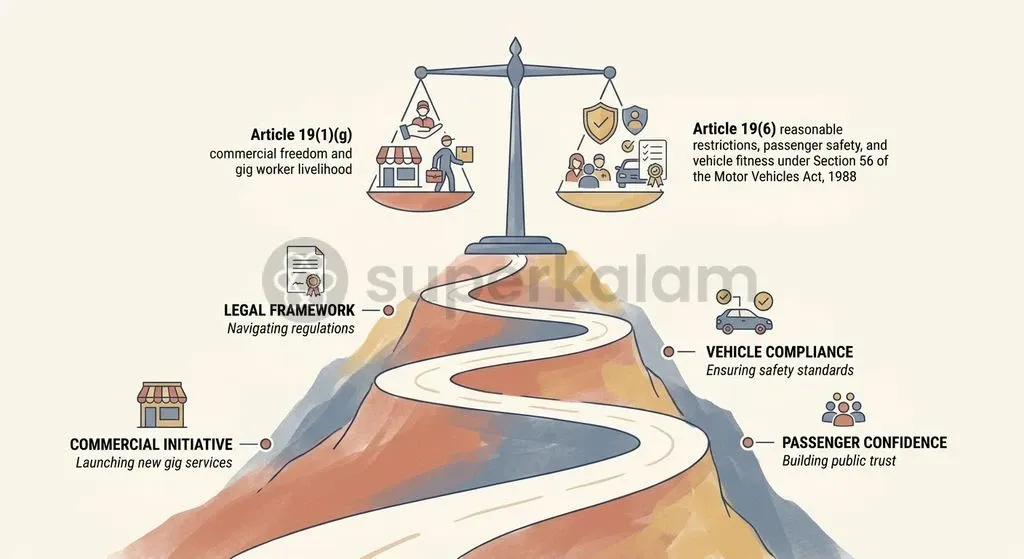
The Human Fallout: Gig Workers, Commuters, and Traditional Auto Unions
The Federation of Karnataka State Private Transport Association resisted app-based two-wheelers to protect conventional auto-rickshaw drivers from intense fare competition and passenger diversion. Traditional three-wheeler unions argued that aggregators operated unmetered services using private white-board vehicles, bypassing commercial permit fees and safety checks.
At the same time, the regulatory clampdown imperilled substantial platform employment across urban agglomerations. As reported by The Times of India on 20 November 2026, mobility bodies submitted that between 100,000 and 700,000 gig riders in Karnataka depend on bike taxis for full-time or supplemental livelihood. The policy uncertainty repeatedly disrupted daily earnings for these platform participants.
| Stakeholder Group | Primary Grievances & Constraints | Core Operational Interests |
|---|---|---|
| Auto-Rickshaw Unions | Revenue losses, high permit costs, and fixed fare structures | Protection from unmetered market competition and preserved local transit share |
| Gig Platform Workers | Vehicle impoundment, absence of welfare benefits, and regulatory uncertainty | Flexible supplementary income and asset monetisation under legal status |
| Urban Commuters | Public transit gaps and last-mile connectivity shortfalls | Affordable point-to-point transit and rapid multimodal metro integration |
Urban commuters also experienced transit gaps, particularly around major transit corridors. Urban mobility analytics reported by The Times of India on 20 November 2026 suggest that bike-taxi trips predominantly span short commutes between 4 and 8 kilometres, connecting passengers to Namma Metro and suburban bus networks.
To address the broader precarity confronting platform labour, the Karnataka Government introduced the Karnataka Platform-based Gig Workers (Social Security and Welfare) Bill to institute an aggregator-financed welfare board. This state-level proposal aligns with the Code on Social Security, 2020, which formally defines gig and platform workers under Sections 2(35) and 2(61) and establishes social security frameworks under Section 114.
Discuss with Superkalam
Weigh the merits of protecting traditional three-wheeler auto-rickshaw livelihoods against the consumer demand for affordable, app-based motorcycle transit in congested urban centres.
Ask NowPolicy Blueprint: Overcoming Statutory Obsolescence in Urban Mobility
The Ministry of Road Transport and Highways designed draft aggregator guidelines to modernise urban transport regulations through adaptive licensing and mandatory safety safeguards. Released in 2025, the updated draft aggregator framework updates the 2020 guidelines by requiring real-time vehicle tracking, structured grievance redressal mechanisms, and expanded driver safety measures.
This national reform agenda mirrors early policy blueprints. In December 2016, the Committee on Taxi Policy Guidelines to Promote Urban Mobility constituted by MoRTH specifically recommended that State Governments permit and encourage two-wheeler contract carriage permits to solve urban congestion.
A sustainable regulatory model requires transitioning away from discretionary, permit-based restrictions toward predictable governance:
- Responsive Vehicle Classification: State transport departments must amend outdated regional rules to recognise two-wheelers as valid contract carriages under Section 2(7) of the Motor Vehicles Act, 1988.
- Standardised Safety Mandates: Regional transport authorities can mandate yellow commercial registration plates, GPS tracking, and commercial fitness inspections under Section 56 without prohibiting platform services.
- Balanced Labour Protections: State policies should balance platform flexibility with statutory protections, reflecting NITI Aayog's 2022 projections that India's platform workforce will expand to 23.5 million workers by 2029-30.
Coordinated policy implementation across central and state authorities will eliminate legal uncertainty. This balance safeguards commuter safety, traditional livelihoods, and platform employment.
Key Takeaways
The Supreme Court ruling on Karnataka bike taxis establishes vital precedents regarding statutory interpretation, regulatory federalism, and the constitutional protection of platform livelihoods.
- The Supreme Court and Karnataka High Court confirmed that motorcycles qualify as contract carriages under Section 2(7) and Section 2(27) of the Motor Vehicles Act, 1988.
- Blanket bans on bike taxis by administrative authorities violate the guarantee of freedom of trade under Article 19(1)(g) and fail the proportionality test under Article 19(6).
- Transport regulation falls under Entry 35 of the Concurrent List, creating persistent jurisdictional friction between MoRTH national guidelines and state-level licensing rules under Section 67 and Section 93.
- The controversy illustrates judicial gap-filling, where constitutional courts maintain market access and protect gig workers when executive authorities delay statutory updates.
- Future mobility governance requires transparent aggregator licensing, safety compliance under Section 56, and platform welfare measures aligned with the Code on Social Security, 2020.
Mains Question
"Administrative inaction cannot be deployed as a ground to enforce blanket prohibitions that extinguish constitutionally protected livelihoods under Article 19(1)(g)." In light of the Supreme Court's ruling on two-wheeler contract carriages, elucidate how the judiciary balances technological innovation with regulatory vacuums. (10 Marks)
Evaluate NowMains Question
"The friction between central aggregator norms and state-level transport restrictions underscores the federal fault lines inherent in Entry 35 of the Concurrent List." Critically examine this statement with reference to the provisions of the Motor Vehicles Act, 1988. (15 Marks)
Evaluate NowPractice MCQs
QUESTION 1
With reference to the regulatory framework governing digital mobility aggregators in India, consider the following statements:
- Section 93 of the Motor Vehicles Act, 1988 mandates that digital aggregators must obtain operating licences from State Governments while complying with Central Government guidelines.
- The Motor Vehicle Aggregator Guidelines issued by MoRTH in November 2020 explicitly prohibit two-wheelers from operating as commercial contract carriages.
- Mechanically propelled vehicles and vehicular taxation principles fall under Entry 35 of the Concurrent List in the Seventh Schedule of the Constitution. Which of the statements given above is/are correct?
QUESTION 2
Consider the following statements regarding the statutory definitions under the Motor Vehicles Act, 1988:
- Section 2(7) defines a contract carriage as any motor vehicle carrying passengers for hire or reward under an express or implied contract.
- Section 2(27) defines a motorcycle as a two-wheeled motor vehicle, legally qualifying it as a vehicle capable of hire unless expressly excluded by Parliament.
- Section 67 empowers the Central Government to directly issue permits to contract carriages, overriding State Regional Transport Authorities. Which of the statements given above is/are correct?
QUESTION 3
Regarding the judicial interpretation in the Karnataka bike-taxi dispute, consider the following statements:
- The Supreme Court observed that executive delays in framing statutory rules cannot justify indefinite administrative bans on digital platform operations.
- The High Court of Karnataka held that an outright administrative ban on motorcycle cabs fails the test of reasonable restriction under Article 19(6) of the Constitution.
- Regional Transport Authorities possess powers under Section 74(2) of the Motor Vehicles Act, 1988 to attach reasonable safety and regulatory conditions to contract carriage permits. Which of the statements given above are correct?
QUESTION 4
Why did commercial aggregators face an administrative impasse in obtaining commercial endorsements for two-wheeler bike taxis under the Karnataka On-demand Transportation Technology Aggregators Rules, 2016?
QUESTION 5
Consider the following statements regarding the regulatory friction between central guidelines and state transport rules:
- State Governments have invoked powers under Section 67 of the Motor Vehicles Act, 1988 to restrict aggregator models authorized under central guidelines.
- The Ministry of Road Transport and Highways (MoRTH) issued the Motor Vehicle Aggregator Guidelines in November 2020 pursuant to powers under Section 93 of the Motor Vehicles Act. Which of the statements given above is/are correct?
Discuss with Superkalam
Formulate a policy framework that allows transport departments to integrate bike-taxis commercially while addressing passenger safety, commercial registration, and fare parity.
Ask Now