Judicial Activism vs Judicial Overreach: Constitutional Boundaries and Red Lines
When judges step in where executives stall, rights expand—but crossing into policy management strains separation of powers and democratic accountability.
Oct, 2026
•12 min read
Overview
Judicial activism becomes impermissible judicial overreach when an unelected court crosses the constitutional boundary. This happens when judges move from protecting enforceable fundamental rights into usurping executive policymaking, reallocating public revenues, or displacing unambiguous legislative statutes.
The Supreme Court of India exercises vital review powers under Article 32. Even so, interventions that disregard institutional capacity disrupt democratic accountability and risk institutional credibility. Constitutional equilibrium depends on the judiciary enforcing basic rights while exercising principled self-restraint before complex, polycentric administrative trade-offs.
Why the Border Between Judging and Governing Is Breaking Down
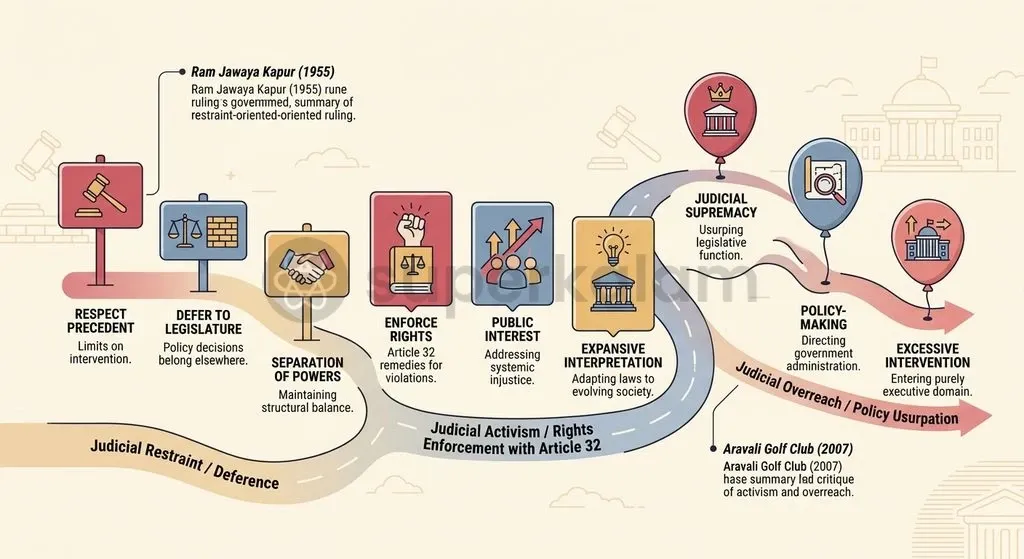
The Indian Constitution establishes a differentiated institutional architecture where no single branch exercises unfettered authority. In Rai Sahib Ram Jawaya Kapur v. State of Punjab (1955), the Supreme Court ruled that while India does not enforce a rigid separation of powers, the functions of different branches remain differentiated so that one organ cannot usurp functions belonging to another.
The Constitution Bench in Indira Nehru Gandhi v. Raj Narain (1975) subsequently affirmed that the separation of powers and checks and balances form an unamendable part of the Basic Structure of the Constitution.
| Institutional Arm | Legitimate Constitutional Role | Overreach Pathology |
|---|---|---|
| Legislature | Law-making, Budget allocations | Encroaching judicial review |
| Executive | Policy execution, Governance | Disregarding judicial mandates |
| Judiciary | Rights defence, Review power | Usurping executive management |
Executive inertia and legislative deadlock frequently push citizens to approach the judiciary. When governance fractures, the courts step in to fill administrative voids. Yet repeated judicial entries into fiscal planning, regulatory management, and statutory drafting create systemic institutional frictions.
Judicial activism represents a legitimate, rights-expanding mechanism to uphold constitutional mandates. In contrast, judicial overreach denotes an unconstitutional usurpation of authority that strips governance of democratic accountability. Preserving that boundary requires drawing objective operational lines rather than relying on individual judicial discretion.
Discuss with Superkalam
Recall the constitutional article that directs the State to take steps to separate the judiciary from the executive in the public services.
Ask NowDefining the Boundary: Constitutional Protection vs Policy Usurpation
The boundary between legitimate intervention and overreach hinges on the distinction between rights adjudication and administrative management. The directive principle in Article 50 directs the State to take steps to separate the judiciary from the executive in the public services of the State, establishing an institutional aspiration for non-interference. When courts invalidate state actions that violate Part III guarantees, they exercise legitimate constitutional review.
In Divisional Manager, Aravali Golf Course v. Chander Haas (2007), the Supreme Court issued a stern caution regarding judicial limits. The bench warned judges against acting like emperors. It ruled that judicial activism must not degenerate into judicial adventurism by taking over executive governance or creating administrative posts.
| Modality | Institutional Stance | Primary Focus |
|---|---|---|
| Judicial Restraint | Deference to statutory and constitutional text | Preserving institutional boundaries |
| Judicial Activism | Proactive constitutional vindication | Enforcing fundamental rights |
| Judicial Overreach | Direct administrative intervention | Usurping executive governance |
Contemporary flashpoints reveal the practical friction along this boundary:
- Gubernatorial Assent Timelines: In State of Punjab v. Principal Secretary to the Governor of Punjab (2023), the Supreme Court ruled under Article 200 that a Governor cannot indefinitely withhold assent to bills passed by an elected legislature and must promptly return non-money bills with a message for reconsideration.
- Re-passed Legislation Discretion: The Court reinforced this standard in State of Tamil Nadu v. Governor of Tamil Nadu (2025), ruling that once a State Legislature re-passes a returned bill, the Governor holds no discretion to withhold assent or reserve it for the President under the first proviso to Article 200.
- National Judicial Appointments Commission: In Supreme Court Advocates-on-Record Association v. Union of India (2015), a Constitution Bench struck down the 99th Constitutional Amendment Act and the NJAC Act, 2014 by a 4:1 majority, holding judicial primacy in appointments to be an inviolable component of judicial independence under Basic Structure.
Side-by-Side: Judicial Activism vs Judicial Overreach
Adjudication turns into overreach when courts substitute subjective judicial policy preferences for legislative mandates. Understanding this divergence requires comparing institutional characteristics, remedial scopes, and constitutional legitimacy.
| Dimension | Judicial Activism | Judicial Overreach |
|---|---|---|
| Constitutional Basis | Grounded in Article 32, Article 226, and Part III rights | Untethered from explicit constitutional text or statutory authority |
| Institutional Trigger | Clear breach of enforceable fundamental rights or statutory obligations | Perceived governance failure, public disquiet, or policy disagreement |
| Remedial Focus | Declaring illegality, striking unconstitutional acts, or ordering statutory compliance | Micro-managing administrative execution, framing broad regulatory guidelines |
| Fiscal Impact | Incidental budget effects resulting from rights enforcement | Direct reallocation of public revenues or imposition of fiscal priorities |
| Separation of Powers | Operates as a constitutional check and balance under basic structure norms | Violates institutional differentiation recognised in Ram Jawaya Kapur (1955) |
| Democratic Accountability | Enhances constitutional democracy by safeguarding minority rights | Aggravates the counter-majoritarian dilemma through unelected governance |
The Supreme Court highlighted the disciplined application of judicial restraint in Association for Democratic Reforms v. Election Commission of India (2024) 5 S.C.R. 415]. Dismissing petitions seeking 100% verification of Voter Verifiable Paper Audit Trail slips, the Court held that judges cannot operate on unfounded suspicion or usurp the administrative mandate of the Election Commission under Article 324.
By contrast, in Association for Democratic Reforms v. Union of India (2024), the Court struck down the Electoral Bond Scheme under Article 19(1)(a). The bench held that transparency and free and fair elections remain essential pillars of the Constitution, illustrating how striking down unconstitutional schemes represents justified rights protection rather than overreach.
Discuss with Superkalam
Explain in your own words how Fuller's 'spider-web' analogy illustrates the pitfalls of courts deciding multi-dimensional economic policies.
Ask NowThe Polycentric Trap: Why Courts Struggle with Executive Policy Decisions
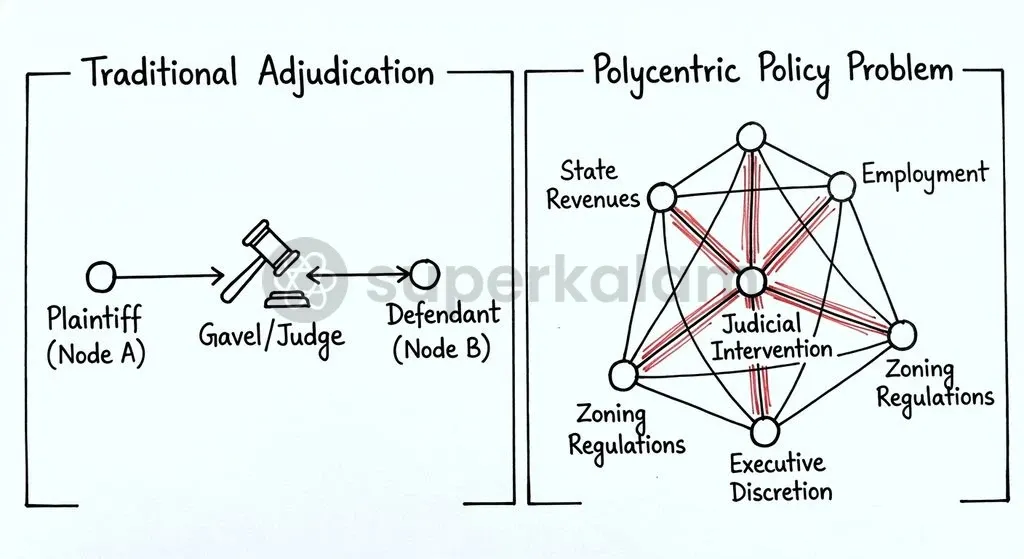
Adjudicative procedures are ill-suited to resolve multi-dimensional policy questions with interdependent economic repercussions. Legal philosopher Lon L. Fuller established that adjudicative processes cannot resolve polycentric problems. Fuller likened polycentric disputes to a spider's web, where pulling a single strand distributes unforeseen tensions across the entire structure.
Adjudication assumes a bipolar dispute between two identifiable parties, resolved through formal legal claims and proofs. When courts address complex administrative questions, they alter single strands while remaining blind to the surrounding web:
- Judicial Directive: A court issues a binding order on an isolated administrative policy.
- Direct Impact: The order triggers sudden state revenue losses and immediate worker displacement.
- Downstream Repercussions: Authorities cut funding for essential public services, prompting broader commercial disruptions.
A classic instance arose in State of Tamil Nadu v. K. Balu (2016), where the Supreme Court invoked Article 142 to ban the sale of liquor within 500 metres of national and state highways. Designed to curb road accidents, the pan-India order inadvertently impacted state revenues, tourism, hospitality employment, and commercial zoning. The Court later had to issue multiple clarifications to mitigate unintended administrative consequences.
Institutional capacity constraints make sustained judicial oversight problematic:
- Courts lack investigative field machinery, macroeconomic modelling tools, and sector-specific domain experts.
- Adversarial litigation excludes unrepresented third parties who inevitably bear the downstream costs of judicial decrees.
- Judicial remedies lack the iterative flexibility that allows executive agencies to revise rules when ground conditions change.
The management of environmental governance through ad-hoc judicial panels illustrates this dilemma. The Supreme Court established the Central Empowered Committee in May 2002 under the T.N. Godavarman Thirumulpad proceedings to oversee forest administration. The body functioned for over two decades as a permanent court-appointed oversight apparatus.
The Ministry of Environment, Forest and Climate Change regularised it as a statutory body in September 2023 under Section 3(3) of the Environment (Protection) Act, 1986. This returned it to a structured statutory foundation.
Article 142 and the Limits of Doing Complete Justice
The constitutional grant of equity jurisdiction under Article 142 provides extraordinary remedial power that demands self-imposed limits. Article 142(1) empowers the Supreme Court to pass any decree or order necessary for doing complete justice in any cause or matter pending before it, enforceable across India. Originally intended as a curative reserve to address unprecedented hardships where legal technicalities obstruct justice, this provision has expanded into a vehicle for substantive rulemaking.
In Supreme Court Bar Association v. Union of India (1998), a Constitution Bench laid down strict limits on this authority. The Court affirmed that Article 142 is curative in nature. It cannot supplant substantive statutory law or build an entirely new edifice where an express legislative provision occupies the field.
| Case & Timeline | Legal Doctrine & Remedial Scope |
|---|---|
| SCBA v. Union of India (1998) | Clarified that Article 142 cannot supplant substantive statutory law |
| State of TN v. Balu (2016) | Imposed a nationwide highway liquor ban, engaging in direct economic regulation |
| Shilpa Sailesh (2023) | Permitted dissolution of marriage by bypassing statutory waiting periods |
Recent judgments illustrate the continuing tension between equitable relief and statutory provisions:
- In Shilpa Sailesh v. Varun Sreenivasan (2023), the Supreme Court held that its power under Article 142 allows it to grant divorce on the ground of irretrievable breakdown of marriage. The bench used equity jurisdiction to bypass statutory waiting periods mandated under Section 13B of the Hindu Marriage Act, 1955.
- The evolution of voting jurisprudence shows a similar expansion; while early rulings in NP Ponnuswami (1952) and Jyoti Basu (1982) classified voting as a statutory right, the Court in Anoop Baranwal v. Union of India (2023) recognised it as a constitutional right originating in Article 326, subject to statutory limits.
When Article 142 is deployed to bypass explicit statutes, it weakens the rule of law. If courts set aside legislative provisions to achieve what individual benches perceive as fair outcomes, legal certainty erodes.
Discuss with Superkalam
How might the Supreme Court apply its self-restraint doctrine in *ADR v. ECI (2024)* to a PIL demanding administrative changes to public examinations?
Ask NowThe Four Red Lines: A Clear Test for Where the Court Must Stop
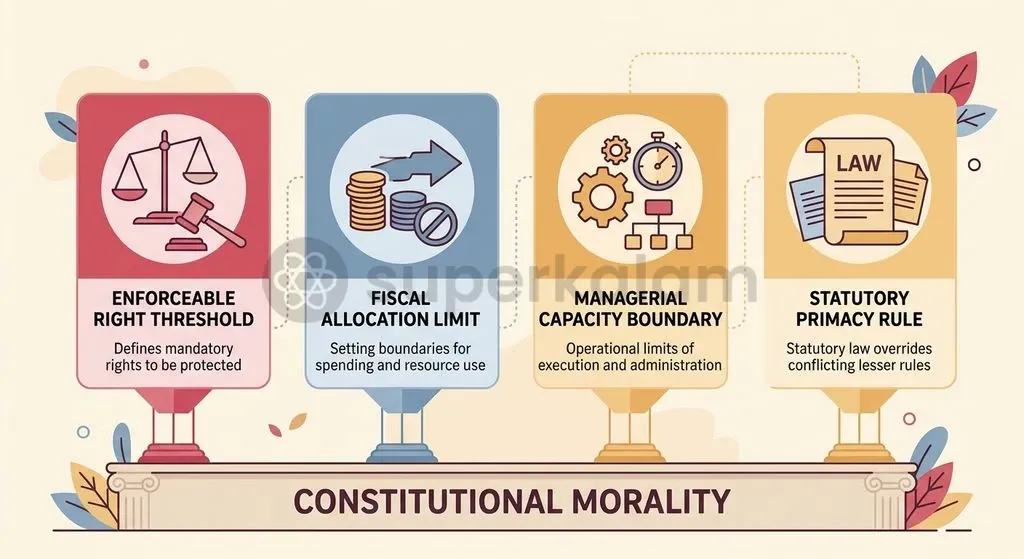
Judicial self-restraint requires objective operational criteria to separate permissible constitutional review from structural overreach. A four-pronged functional framework provides a clear standard for institutional restraint:
| Functional Red Line | Guiding Judicial Precedent |
|---|---|
| Absence of an Enforceable Rights Breach | State of Uttar Pradesh v. Jeet S. Bisht (2007) |
| Fiscal and Resource Allocation Dilemmas | Census Commissioner v. R. Krishnamurthy (2015) |
| Administrative and Managerial Incapacity | Almitra H. Patel v. Union of India (2000) |
| Displacement of Unambiguous Legislative Text | Union of India v. ADR (2002) |
- Absence of an Enforceable Rights Breach: The judiciary must decline jurisdiction when no violation of an identifiable constitutional or statutory right exists. In State of Uttar Pradesh v. Jeet S. Bisht (2007), the Supreme Court held that courts cannot issue writs based on general public disquiet or personal policy inclinations. The first duty of the court is establishing a justiciable cause of action grounded in law.
- Fiscal and Resource Allocation Dilemmas: Courts must defer to executive discretion whenever an issue involves competing budgetary priorities or macroeconomic spending. In Census Commissioner v. R. Krishnamurthy (2015), the Court affirmed that judges possess neither the financial expertise nor the public accountability to direct state expenditure trade-offs. Budgetary allocation belongs exclusively to the elected legislature.
- Administrative and Managerial Incapacity: The judiciary must avoid issuing continuing structural injunctions or establishing ongoing monitoring committees to run public administration. In Almitra H. Patel v. Union of India (2000), the Supreme Court recognised its institutional limitations regarding municipal solid waste management, holding that courts cannot direct day-to-day civic operations. The judicial branch lacks the executive machinery to implement continuous administrative programmes.
- Displacement of Unambiguous Legislative Text: Inherent judicial powers cannot be used to rewrite, circumvent, or contradict plain statutory provisions enacted by Parliament. In Union of India v. Association for Democratic Reforms (2002), the Court emphasised that judicial directions can fill legislative silence only where statutory gaps exist, but cannot override explicit legislation.
Restoring Institutional Balance: The Case for Principled Self-Restraint
Constitutional legitimacy requires unelected judges to exercise review powers with ethical discipline and democratic humility. Constitutional scholar Alexander Bickel articulated the counter-majoritarian dilemma, noting that when unelected judges strike down laws enacted by elected representatives, they exercise non-consensual power that strains democratic legitimacy. Judicial decisions gain moral authority from rigorous adherence to constitutional text and impartial legal reasoning.
In Manoj Narula v. Union of India (2014), the Supreme Court distinguished constitutional morality from public populism. The bench observed that constitutional morality demands institutional humility and adherence to systemic checks, whereas judicial populism bends to shifting public clamour and short-term headlines.
Ethical frameworks internal to the judiciary reinforce this institutional discipline:
- Restatement of Values of Judicial Life (1997): The Full Court of the Supreme Court adopted this code on May 7, 1997, mandating that judges maintain strict impartiality and avoid public statements on political disputes.
- Sub Judice Propriety: The ethical convention of sub judice propriety bars judges from making extra-judicial public pronouncements or expressing opinions on legal questions pending before the courts.
- Apprehension of Bias: In Ranjit Thakur v. Union of India (1987), the Supreme Court ruled that the standard for judicial recusal is whether a reasonable person would perceive a real danger or apprehension of bias, rather than proof of actual bias.
Judicial review remains an indispensable safeguard of constitutional supremacy. Yet the long-term authority of the courts depends on maintaining the boundary between rights enforcement and policy administration. By adhering to principled self-restraint and respecting the four functional red lines, the Supreme Court ensures that judicial intervention protects democracy without undermining institutional balance.
Discuss with Superkalam
Compare the judicial intervention in the Electoral Bond Scheme case with the highway liquor ban case to distinguish justified rights defence from policy overreach.
Ask NowKey Takeaways
- The Supreme Court established in Rai Sahib Ram Jawaya Kapur (1955) and Indira Nehru Gandhi (1975) that the separation of powers and checks and balances form an inviolable part of the Basic Structure.
- Judicial activism legitimately enforces fundamental rights under Article 32, whereas judicial overreach impermissibly enters executive administration and policy formulation.
- Lon Fuller's polycentricity doctrine demonstrates that courts cannot effectively resolve multi-stakeholder disputes that distribute complex economic and administrative consequences throughout society.
- In Supreme Court Bar Association (1998), the Court clarified that remedial powers under Article 142 cannot be used to bypass or supplant substantive statutory law.
- The four functional red lines require judicial restraint when there is no rights breach, when fiscal trade-offs are involved, when administrative capacity is lacking, or when explicit statutory language exists.
- The counter-majoritarian dilemma underscores that unelected courts preserve democratic legitimacy by upholding constitutional morality rather than succumbing to populist impulses.
Mains Question
'Judicial activism must not degenerate into judicial adventurism by taking over executive governance.' In light of the ruling in *Divisional Manager, Aravali Golf Course v. Chander Haas (2007)*, critically analyse the boundary separating legitimate rights enforcement from impermissible judicial overreach. (15 Marks)
Evaluate NowMains Question
Adjudication under Article 142 often struggles when confronted with 'polycentric problems' having multi-dimensional administrative and economic ramifications. Elucidate with reference to the highway liquor ban case (*State of Tamil Nadu v. K. Balu*). (10 Marks)
Evaluate NowPractice MCQs
QUESTION 1
With reference to the constitutional doctrine of Separation of Powers in India, consider the following statements:
- The Indian Constitution strictly enforces a rigid separation of powers between the organs of the State.
- In Rai Sahib Ram Jawaya Kapur v. State of Punjab (1955), the Supreme Court held that one organ of the state cannot usurp functions belonging to another.
- Separation of powers and checks and balances were recognized as part of the Basic Structure in Indira Nehru Gandhi v. Raj Narain (1975).
Which of the statements given above are correct?
QUESTION 2
Consider the following statements regarding Gubernatorial assent under Article 200 of the Constitution of India:
- A Governor cannot indefinitely withhold assent to bills passed by an elected legislature.
- Once a State Legislature re-passes a returned bill, the Governor retains the discretion to reserve it for the consideration of the President under the first proviso to Article 200.
Which of the statements given above is/are correct?
QUESTION 3
With reference to the concept of 'polycentric problems' in judicial adjudication, consider the following statements:
- The concept was formulated by legal philosopher Lon L. Fuller.
- Polycentric problems resemble a spider's web where pulling a single strand distributes unforeseen tensions across the whole structure.
- The Supreme Court's ban on liquor sales near highways in State of Tamil Nadu v. K. Balu is an example of an adjudicative intervention encountering polycentric repercussions.
Which of the statements given above is/are correct?
QUESTION 4
Which of the following constitutional provisions directs the State to take steps to separate the judiciary from the executive in the public services of the State?
QUESTION 5
Regarding the Central Empowered Committee (CEC), consider the following statements:
- It was originally constituted by the Supreme Court in May 2002 under the T.N. Godavarman Thirumulpad proceedings.
- It was regularised as a statutory body under Section 3(3) of the Environment (Protection) Act, 1986 in September 2023.
Which of the statements given above is/are correct?