JAXA MMX Mission: Phobos Sample Return and Mars Science Explained
By sampling Phobos to solve the mystery of Martian moon origins, JAXA's MMX mission charts the engineering blueprint for multilateral deep-space sample return.
Oct, 2026
•13 min read
Overview
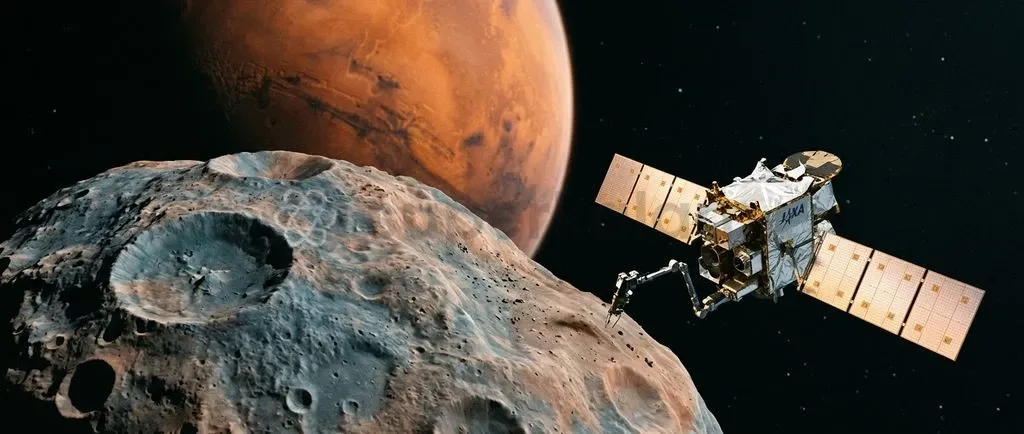
The Japan Aerospace Exploration Agency's Martian Moons eXploration mission targets Phobos to resolve a long-standing mystery. Planetary scientists want to know whether the Martian moons are captured asteroids or remnants of a giant proto-planetary collision.
By returning unweathered regolith containing ancient Martian crustal ejecta, the probe skips landing on Mars directly. Its microgravity flight operations and modular architecture offer direct engineering lessons for India's upcoming deep-space sample return missions.
Why Martian Moons eXploration (MMX) Is in the News
The Japan Aerospace Exploration Agency launched the Martian Moons eXploration spacecraft aboard an H3 Launch Vehicle from the Tanegashima Space Center on 20 October 2026.
According to JAXA's mission timeline, the spacecraft completed its initial critical operations phase on 21 October 2026.
| Stage | Date | Key Milestone |
|---|---|---|
| Launch | 20 October 2026 | Liftoff on H3 Flight 10 from Tanegashima Space Center |
| Insertion | August 2027 | Mars orbit insertion |
| Sampling | 2029 | Phobos landing and surface extraction |
| Earth Return | July 2031 | Landing capsule touchdown at Woomera, Australia |
As of October 2026, the spacecraft is on an interplanetary cruise trajectory to enter Martian orbit in August 2027. Touchdown and sampling operations on Phobos will run in 2029. The probe will subsequently return at least 10 grams of celestial surface regolith to Earth at the Woomera testing range in Australia in July 2031.
The mission advances interplanetary logistics. Rather than descending into Mars' deep gravity well, the probe investigates the planet's inner natural satellite. This approach aims to unlock the volatile distribution history of the terrestrial planets while scouting orbits for future deep-space human exploration.
Discuss with Superkalam
What launch vehicle and launch site were utilised for the MMX spacecraft's departure on 20 October 2026?
Ask NowThe Phobos Dilemma: Captured Asteroid or Giant Impact Ejecta?
MMX aims to resolve the contested origin of Phobos and Deimos. Planetary scientists have spent decades debating how Mars acquired its two low-density satellites. Settling this question will benchmark models of early accretion and orbital migration across the inner solar system.
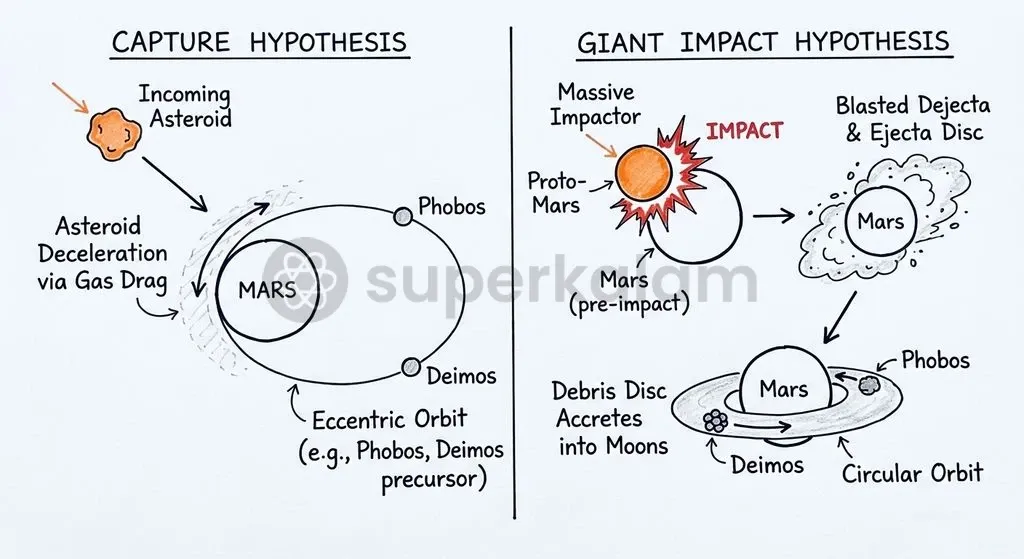
The first model, known as the capture hypothesis, posits that Phobos and Deimos are primitive, carbonaceous planetesimals from the outer asteroid belt or the outer solar system. Spectral reflectance observations show that both moons share low albedos and featureless, reddish spectra resembling carbonaceous C-type and D-type asteroids.
Mars may have trapped these bodies through gas drag or three-body gravitational interactions during the protoplanetary nebula phase. If so, their regolith preserves primordial chemical signatures from beyond the solar system's condensation boundary.
- Capture Hypothesis Path: Primitive bodies from the outer asteroid belt or outer solar system are trapped by Martian gravity during the nebula phase. Material remains unaltered and volatile-rich, retaining an origin beyond the frost line.
- Giant Impact Hypothesis Path: A massive collision hits proto-Mars, ejecting a debris disk into near-equatorial orbit. Debris coalesces into moons containing a mix of thermally processed Martian crust and impactor material.
The competing model, the giant impact hypothesis, posits a different evolutionary timeline. A massive proto-planetary body collided with early Mars, generating an equatorial circum-planetary debris disk from which both moons accreted. This mechanism naturally explains the low-inclination equatorial orbits of the moons, as gravitational capture rarely produces coplanar paths without fine-tuned physical damping.
| Feature | Capture Hypothesis | Giant Impact Hypothesis |
|---|---|---|
| Proposed Origin | Intact asteroid from outer belt | Accretion from circum-Martian debris disk |
| Material Composition | Volatile-rich C-type or D-type carbonaceous matter | Mixed Martian crustal silicates and impactor material |
| Thermal History | Primitive, largely unaltered by planetary melting | Thermally processed and devolatilised by impact energy |
| Orbital Mechanics | Requires high orbital circularisation damping | Naturally produces coplanar, near-circular orbits |
| Exam Relevance | Clarifies outer-body orbital migration dynamics | Models planetary impact dynamics and satellite formation |
MMX will also execute dedicated close flybys of Mars' smaller outer moon, Deimos, which has a mean diameter of roughly 12.4 kilometres. Comparing high-resolution spectral and morphological datasets between the two bodies will confirm whether both moons share a unified evolutionary origin or arrived through disparate capture events.
Why Pristine Regolith Matters: Tracing Water and Volatiles Across the Frost Line
Determining Phobos' volatile inventory clarifies how water and prebiotic organic building blocks migrated across the solar system's frost line into the inner terrestrial planets. That boundary marks the precise heliocentric distance beyond which volatile compounds—such as water, ammonia, and methane—condense into solid ice grains. If Phobos consists of captured outer-system material, its interior regolith holds an uncorrupted chemical ledger of the volatile reservoir that seeded early Earth and early Mars with prebiotic elements.
- Meteorite impact strikes Mars: High-energy impacts excavate the planetary surface over geological epochs.
- Crustal ejecta reaches orbit: Debris escapes the Martian gravity well into circum-planetary space.
- Phobos sweeps debris field: Orbiting within the debris path for 4.5 billion years, the moon accumulates ejected material.
- Enriched regolith formed: Phobos surficial soils retain a record of unweathered Martian crust.
Beyond its native composition, Phobos is an involuntary cosmic archive of Martian surface history. Phobos orbits deep within the Martian gravity well at an average altitude of approximately 6,000 kilometres above the surface. Consequently, it continually sweeps up debris ejected from the planet by major meteorite collisions.
Dynamical modelling by JAXA's Institute of Space and Astronautical Science indicates that several hundred parts per million—and locally up to 1,000 parts per million—of Phobos' surficial regolith consists of unweathered Martian crustal grains ejected across 4.5 billion years of impact events.
This natural accumulation allows MMX to conduct an indirect, multi-epoch sampling of the Martian crust. Sampling Phobos circumvents the massive propulsion systems, heat shields, and deep gravity-well ascent vehicles required to lift samples directly off the surface of Mars. A scoop of Phobos dirt provides planetary scientists with unweathered Martian geochemical specimens collected without entering the planet's atmospheric descent corridor.
Discuss with Superkalam
Explain why Mars' tidal gravitational forces prevent a spacecraft from entering a standard Keplerian closed orbit around Phobos.
Ask NowSample Return vs In-Situ Analysis: The Engineering Hurdle of Low-Gravity Extraction
Operating a spacecraft around Phobos presents a distinct astrodynamics problem due to the asymmetric gravity field generated by Mars and its moon. Traditional Keplerian orbital mechanics break down near Phobos because Mars exerts dominant tidal gravitational forces across the moon's surface.
| Gravitational Factor | Phobos Dynamic Environment | Operational Impact on Spacecraft |
|---|---|---|
| Tidal Forces | Mars exerts dominant gravitational pull across Phobos | Precludes traditional closed Keplerian orbits |
| Trajectory Design | Spacecraft operates within Quasi-Satellite Orbits (QSOs) | Requires relative positioning between 100 km and sub-km |
| Thruster Margins | Microgravity combined with steep gravity gradients | Slight thrust errors cause heliocentric escape or impact |
The MMX spacecraft cannot enter a true closed orbit around Phobos. It operates instead within Quasi-Satellite Orbits, maintaining relative trajectories at altitudes ranging from 100 kilometres down to sub-kilometre ranges. In these non-Keplerian orbital regimes, small thruster misalignments can send an orbiter escaping into heliocentric space or crashing into the satellite.
Surface extraction in Phobos' microgravity requires an entirely different engineering approach than previous asteroid missions:
- Stable Landing Architecture: Asteroid missions like Hayabusa2 and OSIRIS-REx used brief touch-and-go manoeuvres, firing a projectile or puffing compressed nitrogen during an instant of contact before backing away. MMX executes a controlled soft landing on extended legs, resting on the surface for multiple hours to perform direct drilling operations.
- Dual Redundant Sampling: The Exploration Module carries JAXA's robotic Core Sampler, engineered to penetrate up to 2 centimetres into consolidated regolith to extract stratified sub-surface cores. In addition, the mission incorporates Honeybee Robotics and NASA's pneumatic P-Sampler, built into the landing footpads to harvest loose surface grains via high-pressure gas bursts.
- Precursor Surface Scouting: To mitigate landing hazards, the French space agency (CNES) and the German Aerospace Center (DLR) developed the 25-kilogram rover IDEFIX. Released from an altitude of 40 to 100 metres above Phobos, IDEFIX will conduct a 100-day mobile reconnaissance campaign, analysing surface soil properties and regolith mechanics before the main spacecraft touches down.
- High-Velocity Direct Return: Once the samples are secured inside the Sample Return Capsule within the Return Module, the probe will fire its engines for Earth insertion. The capsule will separate shortly before atmospheric arrival, executing a direct ballistic atmospheric re-entry at roughly 12 kilometres per second without requiring prior orbital insertion burns.
| Mission Parameter | Hayabusa2 (JAXA) | OSIRIS-REx (NASA) | MMX (JAXA / Multi-Agency) |
|---|---|---|---|
| Target Body | Asteroid Ryugu (C-type) | Asteroid Bennu (B-type) | Phobos (Martian Moon) |
| Gravitational Environment | Microgravity asteroid | Microgravity asteroid | Microgravity within strong Martian gravity gradient |
| Sampling Technique | Touch-and-go with tantalum bullet | Touch-and-go with nitrogen gas burst (TAGSAM) | Stable landing with core drill (C-Sampler) and pneumatic blast (P-Sampler) |
| Surface Duration | Seconds | Seconds | Multi-hour anchored surface operations |
| Precursor Scout | MINERVA-II rovers & MASCOT lander | Optical mapping from orbit | 25 kg wheeled rover (IDEFIX) operating for 100 days |
In-situ geochemical mapping is handled by NASA's MEGANE spectrometer, an instrument developed by the Johns Hopkins Applied Physics Laboratory. MEGANE evaluates gamma rays and neutrons excited by cosmic rays, measuring absolute elemental abundances of iron, silicon, potassium, thorium, and hydrogen across Phobos' crust.
Discuss with Superkalam
Weigh the scientific trade-offs between executing an indirect sample return from Phobos versus undertaking a direct surface landing on Mars.
Ask NowPhobos as a Deep-Space Staging Ground: Stepping Stone for Human Mars Missions
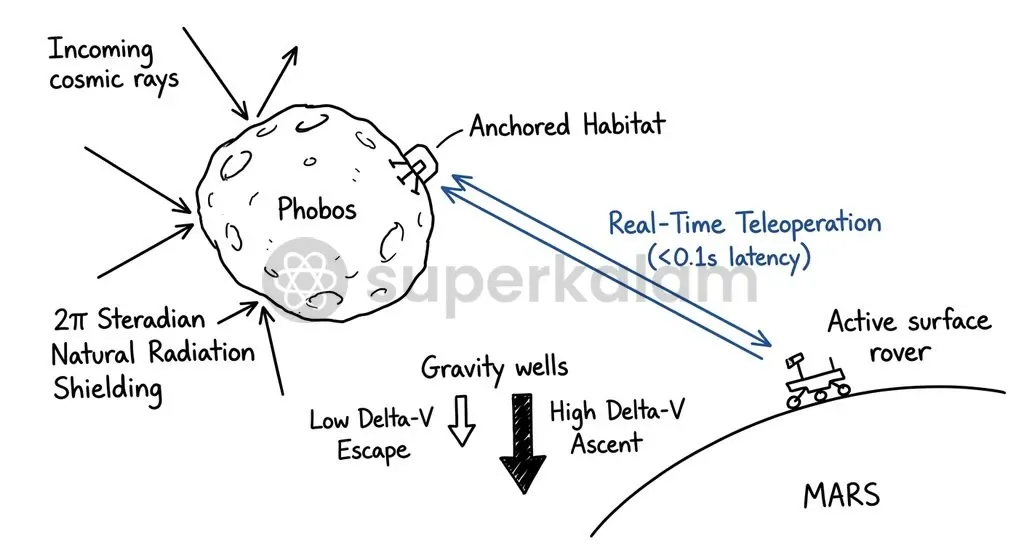
Phobos provides a strategic logistical anchor for long-term human exploration architectures targeting the inner solar system. Landing large crewed spacecraft directly onto the Martian surface exposes missions to deep gravitational debt. Lifting habitats, ascent vehicles, and crew out of Mars' gravity well demands massive propulsive capabilities and high propellant masses.
According to NASA mission architecture studies, Phobos occupies a low-delta-V gravity well that requires approximately 3.3 kilometres per second of propulsive velocity change for a complete round-trip arrival and departure sequence. This low velocity threshold allows mission planners to position fuel reserves, life-support hardware, and emergency habitats on Phobos with substantially lower propellant mass penalties than a direct surface landing entails.
Operational deployment to Phobos offers critical environmental and tactical advantages for human spaceflight:
- Passive Radiation Shielding: Interplanetary galactic cosmic rays and solar proton events represent severe biological hazards for deep-space crews. Because Phobos is a solid celestial body, occupying an orbital base against its surface shields astronauts from roughly 50% of isotropic cosmic radiation by blocking a 2π steradian solid angle of sky.
- Ultra-Low Latency Teleoperation: Real-time robotic control on the Martian surface is impossible from Earth, where communication latency ranges from 4 to 24 minutes each way. Astronauts stationed on Phobos experience one-way communication delays under 0.1 seconds, enabling direct, joystick-level teleoperation of complex rovers, drilling rigs, and construction robots across the Martian landscape.
- In-Situ Resource Utilisation (ISRU) Potential: If the mission verifies the presence of hydrated silicates or trapped water ice within Phobos' regolith, the moon can turn into an orbital propellant depot. Extracting water and splitting it into liquid hydrogen and oxygen propellant would transform Phobos into an interplanetary refuelling stop for deep-space transport architectures.
India-Japan Space Architecture: Lessons from LUPEX to ISRO's Mars Exploration Roadmap
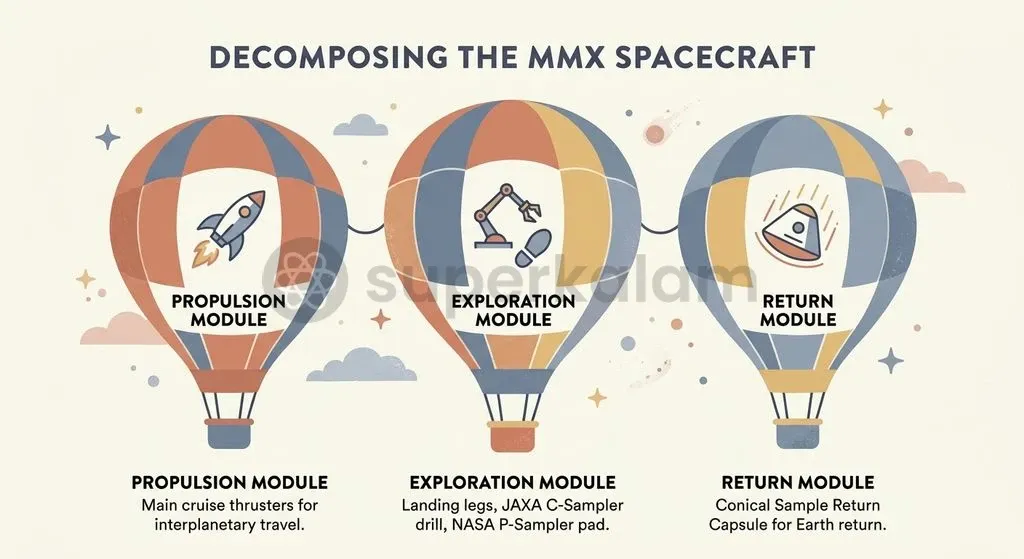
The Indian Space Research Organisation has integrated sample recovery and planetary exploration into its strategic goals. The multi-module architecture of MMX cleanly separates interplanetary transit, surface operations, and atmospheric re-entry into distinct spacecraft stages. This design mirrors ISRO's planned exploration systems.
On 10 March 2025, India's Union Cabinet sanctioned financial approval for the joint ISRO-JAXA Lunar Polar Exploration mission, also designated Chandrayaan-5. Under this framework, JAXA supplies the launch vehicle and the advanced mobile lunar rover, while ISRO engineers the primary lunar landing module.
| Spacecraft Element | JAXA MMX Module | ISRO Chandrayaan-4 / Mars Concepts |
|---|---|---|
| Interplanetary / Transit | Propulsion Module | Propulsion Module (Orbit Raising) |
| Lander / Surface Operations | Exploration Module | Lander Module (Hazard Avoidance) |
| Ascent / Sample Re-entry | Return Module + SRC | Ascender Module & Re-entry Capsule |
This bilateral cooperation provides technical models for ISRO's approved Chandrayaan-4 lunar sample return architecture and future Mars Lander Mission. Both agencies are transitioning away from monolithic space probes toward modular, multi-element orbital stacks.
MMX validates autonomous hazard detection systems, terminal optical navigation, and low-gravity surface sampling mechanisms under real operational conditions. These specific operational domains will inform ISRO's second-generation interplanetary payloads as Indian space science expands beyond initial orbital scouts like the Mars Orbiter Mission toward active sample extraction.
Discuss with Superkalam
Drawing from the MMX framework, propose how international space agencies can collaboratively structure modular deep-space sample return architectures.
Ask NowWay Forward: Building Multilateral Deep-Space Sample Return Paradigms
Planetary sample retrieval in the coming decades requires collaborative international models rather than isolated national programmes. Operating spacecraft within complex gravitational environments demands significant tracking resources, specialised analytical payloads, and multi-regime propulsion systems that single national agencies can rarely support alone.
The MMX mission establishes a practical working framework for multilateral collaboration. Combining Japanese engineering, European robotic mobility, and American spectrometer systems into a unified flight profile creates a sustainable operational template for high-risk deep-space missions.
For India's emerging deep-space programmes, assimilating these operational methodologies requires three clear priorities:
- Sample Curation Facilities: Establishing sovereign biological and chemical containment labs to process pristine extraterrestrial soils.
- Autonomous Orbital Operations: Mastering precision autonomous docking in deep space across non-Keplerian orbital regimes.
- Bilateral Risk Sharing: Entering targeted technology-sharing agreements with established international space partners.
Key Takeaways
- Mission Profile: JAXA launched the MMX spacecraft on an H3 Launch Vehicle on 20 October 2026, targeting Mars orbit insertion in August 2027, Phobos surface landing in 2029, and sample recovery at Woomera, Australia in July 2031.
- The Origin Debate: The mission seeks to resolve whether Phobos and Deimos are captured carbonaceous asteroids from the outer solar system or fragments coalesced from a giant impact on proto-Mars.
- Natural Martian Archive: Because Phobos sweeps through Mars' orbital field, dynamic models demonstrate that its regolith contains up to several hundred parts per million of unweathered Martian crustal ejecta, providing an indirect Martian sample return mechanism.
- Operational Complexity: MMX avoids brief touch-and-go sampling by executing a multi-hour soft landing in Quasi-Satellite Orbits, deploying the CNES/DLR rover IDEFIX and using dual coring and pneumatic extraction tools.
- Indian Strategic Synergy: The multi-module profile of MMX offers key engineering insights for ISRO's Chandrayaan-4 sample return profile and the joint ISRO-JAXA Chandrayaan-5/LUPEX mission sanctioned by the Union Cabinet in March 2025.
Mains Question
"By collecting pristine regolith from Phobos rather than descending onto Mars directly, deep-space sample return missions can circumvent major astrodynamical and technological bottlenecks." Examine. (10 Marks)
Evaluate NowMains Question
The competing 'capture' and 'giant impact' hypotheses regarding the Martian moons represent distinct pathways in planetary accretion and volatile migration across the solar system's frost line. Elucidate how the MMX mission's Dual Redundant Sampling architecture and regolith analysis aim to resolve this scientific dilemma. (15 Marks)
Evaluate NowPractice MCQs
QUESTION 1
With reference to the Japan Aerospace Exploration Agency's Martian Moons eXploration (MMX) mission, consider the following statements:
- The mission avoids descending directly into Mars' deep gravity well by landing on its inner natural satellite, Phobos.
- The spacecraft operates within standard Keplerian closed orbits around Phobos during its surface operations.
- The probe is engineered to return at least 10 grams of regolith to Earth.
Which of the statements given above is/are correct?
QUESTION 2
Regarding the competing hypotheses explaining the origin of the Martian moons, consider the following statements:
- The capture hypothesis suggests Phobos and Deimos are primitive, carbonaceous planetesimals originating from beyond the solar system's condensation boundary.
- The giant impact hypothesis naturally accounts for the low-inclination, coplanar equatorial orbits of the moons.
- Spectral observations of Phobos reveal high-albedo characteristics distinct from C-type and D-type asteroids.
Which of the statements given above is/are correct?
QUESTION 3
Consider the following statements regarding the regolith and operational environment of Phobos:
- Phobos acts as a natural collector, sweeping up Martian crustal ejecta deposited by high-energy meteorite impacts over geological history.
- Unweathered Martian crustal grains can account for up to 1,000 parts per million in localized surficial regolith on Phobos.
- Surface exploration is supported by IDEFIX, a 25-kilogram rover developed by CNES and DLR that performs mobile reconnaissance prior to the main spacecraft's touchdown.
Which of the statements given above are correct?
QUESTION 4
Which of the following describes the sampling architecture planned for the MMX mission, distinguishing it from the Hayabusa2 and OSIRIS-REx missions?
QUESTION 5
Consider the following statements regarding the trajectory and timeline of the MMX mission:
- The MMX spacecraft was launched aboard an H3 Launch Vehicle from the Tanegashima Space Center.
- The Return Module performs multiple orbital braking burns around Earth before releasing the Sample Return Capsule.
- The Sample Return Capsule is scheduled to land at the Woomera testing range in Australia.
Which of the statements given above is/are correct?