International Big Cat Alliance: Seven Species and Treaty Status
By turning domestic tiger success into a global treaty architecture, India redefines South-South environmental diplomacy across ninety-six range states.
Oct, 2026
•8 min read
Overview
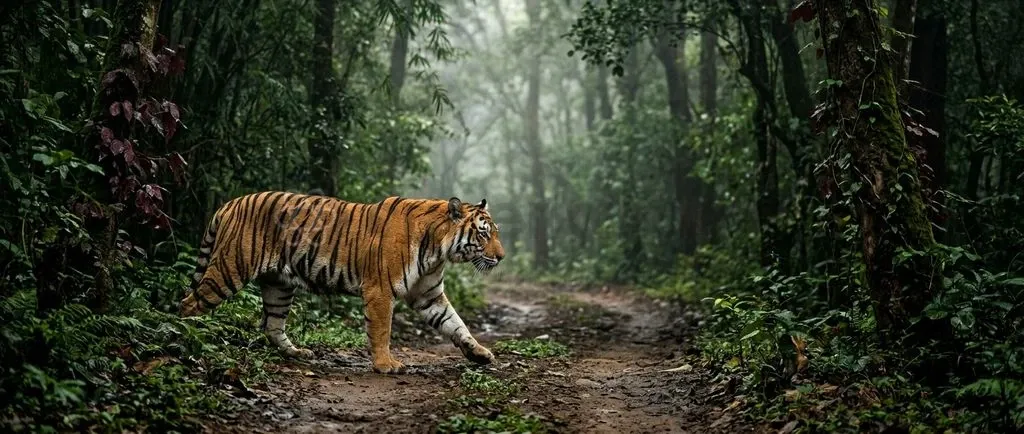
The International Big Cat Alliance is an India-led intergovernmental treaty organisation. It works to secure seven apex felid species across ninety-six range states. Its institutional design draws on the International Solar Alliance, deploying joint anti-poaching frameworks, ecological corridor protection, and technical capacity-building.
Formalised as a legal entity in early 2025, the alliance bridges domestic ecological practice with South-South diplomatic cooperation across Asia, Africa, and Latin America. India anchors the institutional architecture by providing ₹150 crore in initial five-year budgetary support. It also houses the permanent Secretariat in New Delhi and exports indigenous monitoring tools like M-STrIPES to partner nations.
Why in the News: India Moves to Formalize the Big Cat Alliance
The International Big Cat Alliance established its permanent Secretariat in New Delhi following the signing of a formal Headquarters Agreement with the Government of India. As of October 2026, the alliance encompasses twenty-nine member countries, five observer nations, and eleven additional range states that have formally consented to join.
Key diplomatic and operational steps anchor this legal transition:
- Headquarters activation: The permanent Secretariat office opened at 55 Lodhi Estate in New Delhi on 12 October 2026.
- Diplomatic immunity: Personnel and Secretariat assets received statutory safeguards under the United Nations (Privileges and Immunities) Act, 1947.
This institutionalisation cements the alliance as an autonomous treaty body rather than an ad-hoc conservation scheme.
Discuss with Superkalam
Which five founding range states deposited the initial instruments of ratification to bring the IBCA Framework Agreement into legal force?
Ask NowFrom Project Tiger to Global Stage: How the IBCA Came to Be
Project Tiger provided India with the ecological credibility to launch the International Big Cat Alliance during the fifty-year commemoration of the programme in Mysuru. Key institutional milestones marked its evolution:
- April 2023: Prime Minister Narendra Modi mooted the alliance in Mysuru to curb transnational poaching syndicates and address fragmented habitats across shared geographical borders.
- 29 February 2024: The Union Cabinet approved the alliance's establishment, designating New Delhi as the permanent institutional seat.
- 23 January 2025: The formal Framework Agreement entered into force after five founding range nations deposited their instruments of ratification: Nicaragua, Eswatini, India, Somalia, and Liberia.
The Ministry of External Affairs is the official depository for all subsequent accessions and approvals.
Treaty Architecture: Borrowing the International Solar Alliance Playbook
The International Big Cat Alliance replicates the treaty architecture of the International Solar Alliance to build a Southern-led intergovernmental conservation body. External Affairs Minister S. Jaishankar highlighted this strategy at the 3rd Voice of Global South Summit, noting that India deliberately designs plurilateral treaty institutions outside traditional Western-dominated multilateral bodies to aggregate bargaining power for developing countries.
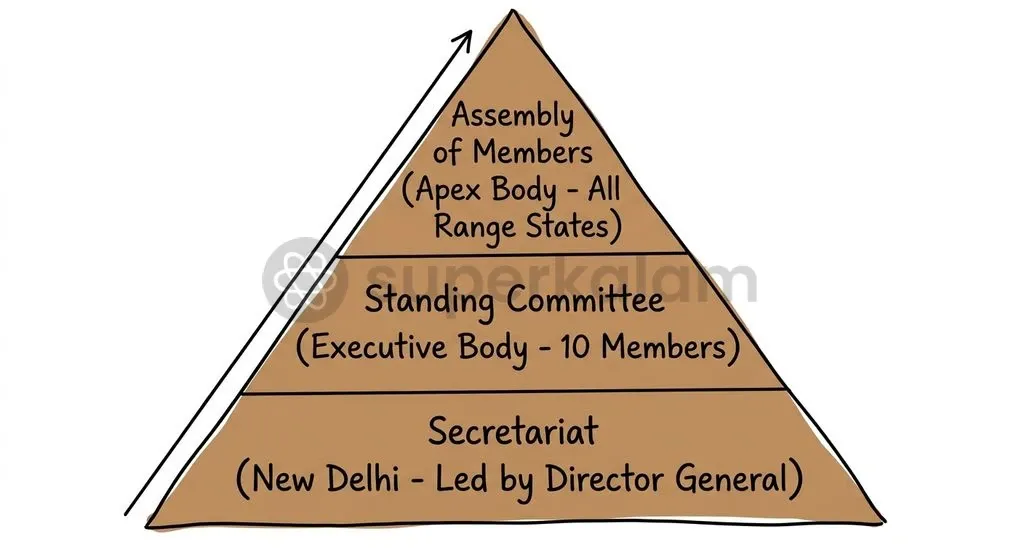
The governing structure mirrors the institutional organs of the International Solar Alliance to balance democratic member representation with swift operational execution:
- Assembly of Members: The apex ministerial decision-making body responsible for overall strategic direction, budgetary approval, and membership expansion.
- Standing Committee: A ten-member steering body constituted by the Assembly on 16 June 2025, operating under a two-year mandate to supervise programme execution.
- Secretariat: An administrative headquarters based in New Delhi, directed by a Director General, managing day-to-day operations and cross-border project rollouts.
| Structural Dimension | International Solar Alliance (ISA) | International Big Cat Alliance (IBCA) |
|---|---|---|
| Institutional Model | Treaty-based Intergovernmental Organisation | Treaty-based Intergovernmental Organisation |
| Host Country & Seat | India (Gurugram, Haryana) | India (New Delhi) |
| Legal Status in India | UN (Privileges and Immunities) Act, 1947 | UN (Privileges and Immunities) Act, 1947 |
| Target Membership | Global (focus on solar-resource-rich states) | Up to 96 big cat range states |
| Core Delivery Mechanism | De-risking clean energy finance & aggregated demand | Wildlife forensics, anti-poaching tech, corridor protection |
Discuss with Superkalam
How does the IBCA borrow and adapt the institutional and treaty architecture pioneered by the International Solar Alliance?
Ask NowBeyond the Seven Species: Fixing Real Protection Gaps Across Range States
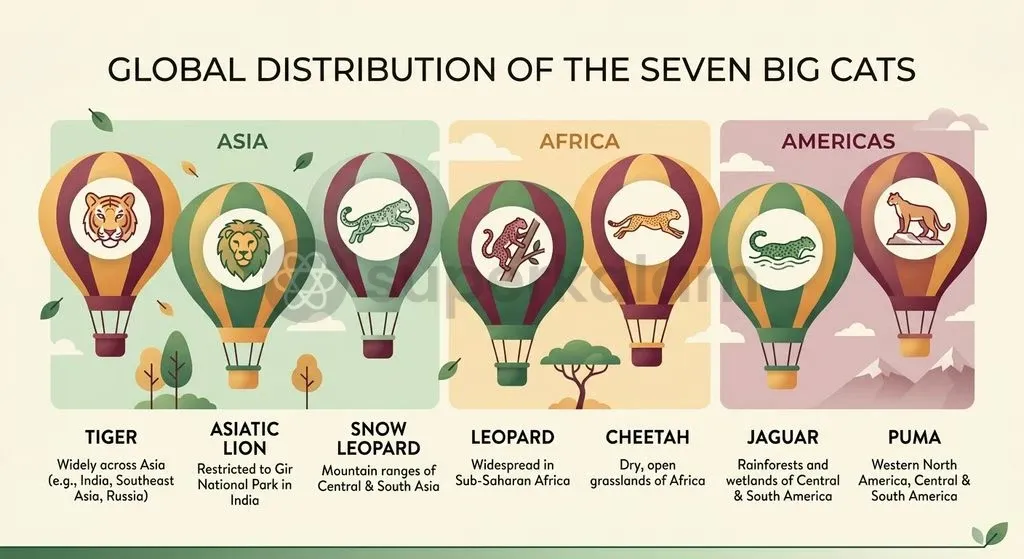
Seven apex felids fall under the conservation mandate of the International Big Cat Alliance across Asia, Africa, and the Americas. These species comprise the tiger, Asiatic lion, leopard, snow leopard, cheetah, jaguar, and puma. India hosts five of these species in wild habitats, providing the operational grounding for the alliance's biological field interventions.
The inclusion of the jaguar and puma deliberately broadens the alliance's scope beyond traditional Afro-Asian wildlife initiatives to encompass Neotropical and Nearctic zones across Latin America and North America. This intercontinental reach addresses two critical ecological vulnerabilities:
- Transboundary Corridor Disruption: Linear transport infrastructure, agricultural encroachment, and border fences cause severe genetic isolation of populations, leaving isolated gene pools vulnerable to disease and inbreeding depression.
- Cross-Border Wildlife Trafficking: Transnational cartels trade big cat skins, bones, and live cubs across poorly regulated borders, demanding shared criminal intelligence between range and transit countries.
Funding and Enforcement: Can IBCA Overcome Multilateral Pitfalls?
Sustainable financing remains the foremost operational challenge for the International Big Cat Alliance across its multi-continental footprint. To establish administrative momentum, the Government of India committed ₹150 crore (~$18 million) in initial budgetary support over a five-year period to cover basic infrastructure and operational outlays.
Heavy reliance on Indian sovereign budgetary allocations creates vulnerability if member states fail to diversify the revenue pool through voluntary contributions. The Framework Agreement permits co-financing arrangements via multilateral development banks, corporate sponsorships, and philanthropic foundations to insulate field operations from unilateral budgetary cycles.
Institutional overlap is a second structural hurdle. The alliance manages this through distinct intergovernmental channels:
- Global Tiger Forum (GTF): The New Delhi-headquartered GTF has coordinated intergovernmental tiger policies across 14 range states since 1993, while the IBCA operates across 96 range states and seven distinct felids. Rather than competing, the GTF entered into a structured partnership with the IBCA to coordinate tiger-specific programmes.
- CITES and Specialist Bodies: While CITES regulates cross-border commercial trade through legal appendices, the IBCA provides frontline rangers with anti-poaching technical capacity and forensic equipment. Even so, overlapping mandates with the CITES Big Cat Task Force and the Global Snow Leopard and Ecosystem Protection Program risk causing administrative burdens. Resource-constrained member states require harmonised reporting standards to avoid compliance fatigue.
Discuss with Superkalam
If a developing range country faces severe cross-border felid poaching, how could IBCA's technical frameworks and Indian digital exports like M-STrIPES be deployed to assist it?
Ask NowWildlife Diplomacy: What India Stands to Gain on the Global Stage
India converts its domestic ecological outcomes into international soft power by leading global megafauna preservation through the International Big Cat Alliance. Host to 3,682 wild tigers—representing over 75 percent of the global wild tiger population according to the 2022 national census—India approaches conservation diplomacy from an established position of technical competence.
The Ministry of External Affairs leverages this credibility by deploying technical expertise through South-South cooperation frameworks:
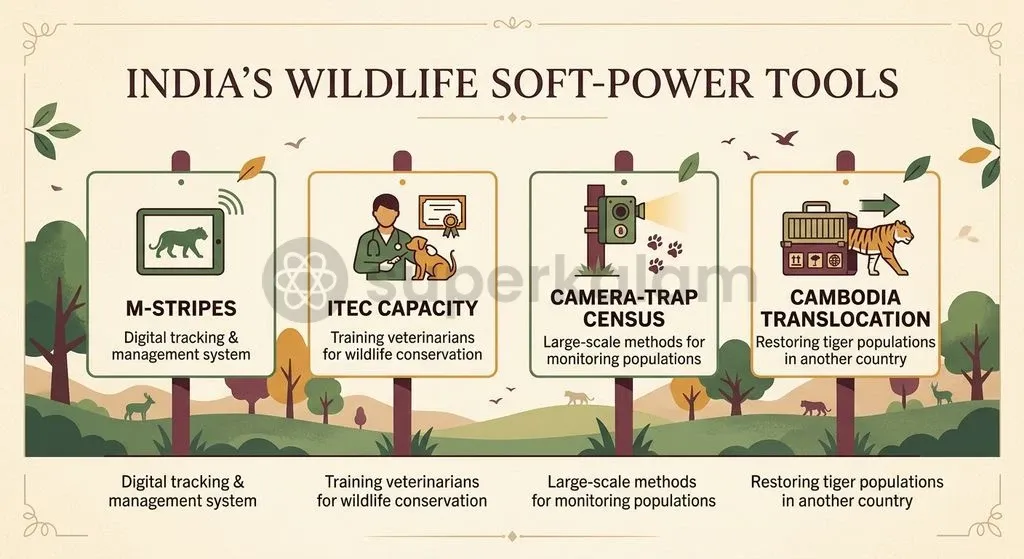
- Digital Monitoring Exports: Partner countries receive access to India's proprietary M-STrIPES monitoring software and camera-trapping census methodology to strengthen baseline field reporting.
- Veterinary and Field Training: Range state wildlife biologists and foresters undergo specialised training under the Indian Technical and Economic Cooperation framework.
- Bilateral Species Restoration: India concluded a bilateral memorandum of understanding with Cambodia to translocate wild tigers and rebuild breeding populations within the Cardamom Rainforest landscape.
The Union Budget 2026–27 announced that India will host the first Global Big Cat Summit in New Delhi, bringing together ministers and heads of state from over 90 range countries. This mega-summit consolidates India's role as a norm-setter in biodiversity management across the Global South.
Way Forward: Turning Diplomatic Momentum into On-Ground Conservation
The International Big Cat Alliance must transition from diplomatic accession milestones to verifiable wildlife enforcement on the ground. Treaty ratifications create legal platforms, but wild felid populations depend on protected landscape corridors and rapid-response anti-poaching networks.
Key priorities for operationalisation include:
- Broadening the financial base: Member nations, international philanthropic funds, and multilateral climate adaptation facilities must provide predictable co-financing to operationalise habitat programmes in under-resourced range states.
- Harmonising institutional coordination: The Secretariat should formalise coordination mechanisms with the Global Snow Leopard and Ecosystem Protection Program and the CITES Big Cat Task Force to prevent duplicate reporting and concentrate administrative efforts on frontline enforcement.
- Securing transboundary corridors: Expanding cross-border ecological corridors between contiguous range states is essential. This requires harmonising national protection laws, sharing real-time forensic intelligence, and facilitating transboundary genetic exchange. Done right, the International Big Cat Alliance can deliver enduring ecological dividends across the Global South.
Discuss with Superkalam
Compare the mandate of the IBCA with existing bodies like CITES and the Global Tiger Forum to identify points of convergence and potential institutional friction.
Ask NowKey Takeaways
- The International Big Cat Alliance officially entered into force as an intergovernmental, treaty-based organisation on 23 January 2025, with its Secretariat in New Delhi.
- The alliance protects seven big cat species: tiger, Asiatic lion, leopard, snow leopard, cheetah, jaguar, and puma, extending its operational scope across 96 range states in Asia, Africa, and the Americas.
- India committed ₹150 crore in initial five-year funding and granted the alliance legal immunities under the United Nations (Privileges and Immunities) Act, 1947.
- The institutional structure follows the International Solar Alliance model, establishing plurilateral treaty bodies driven by the Global South outside traditional Western arrangements.
- India leverages its domestic conservation success—housing 3,682 wild tigers (over 75% globally per the 2022 census)—to export monitoring systems like M-STrIPES and provide ITEC-backed technical training.
Mains Question
"By deploying plurilateral treaty institutions like the International Solar Alliance and the International Big Cat Alliance, India is pioneering a new template of South-South wildlife diplomacy and governance." Elucidate. (10 Marks)
Evaluate NowMains Question
Despite establishing a dedicated treaty architecture for apex felids, the International Big Cat Alliance faces critical challenges regarding multi-species conservation, institutional overlap, and financial sustainability. Critically examine. (15 Marks)
Evaluate NowPractice MCQs
QUESTION 1
Consider the following statements regarding the International Big Cat Alliance (IBCA):
- It is a treaty-based intergovernmental organisation headquartered in New Delhi.
- Its conservation mandate covers seven apex felid species, all of which are found in wild habitats in India.
- The Framework Agreement entered into force following ratification by five founding range nations. Which of the statements given above is/are correct?
QUESTION 2
With reference to the governance and institutional architecture of the International Big Cat Alliance (IBCA), consider the following statements:
- The Secretariat personnel and assets are granted statutory safeguards under the United Nations (Privileges and Immunities) Act, 1947.
- The Standing Committee functions as the apex ministerial decision-making organ responsible for overall strategic direction.
- The Ministry of External Affairs of India acts as the official depository for instruments of ratification and accession. Which of the statements given above is/are correct?
QUESTION 3
Which among the following groups of five nations deposited their instruments of ratification enabling the Framework Agreement of the International Big Cat Alliance to formally enter into force in January 2025?
QUESTION 4
Consider the following statements regarding the institutional intersections and financing of the International Big Cat Alliance (IBCA):
- The Government of India has committed ₹150 crore as initial five-year budgetary support for the alliance.
- The Global Tiger Forum (GTF) was dissolved and subsumed under the IBCA to eliminate institutional redundancy.
- The Framework Agreement permits co-financing arrangements involving multilateral development banks and philanthropic organisations. Which of the statements given above is/are correct?
QUESTION 5
Which of the following big cat species covered under the mandate of the International Big Cat Alliance (IBCA) extends its biological conservation focus specifically to the Neotropical and Nearctic biogeographical zones?