Indo-Pacific Regional Dialogue: Decoding IPOI and MAHASAGAR
As maritime friction rises across critical chokepoints, New Delhi bridges diplomatic vision and naval strategy to secure the Indian Ocean commons.
Oct, 2026
•8 min read
Overview
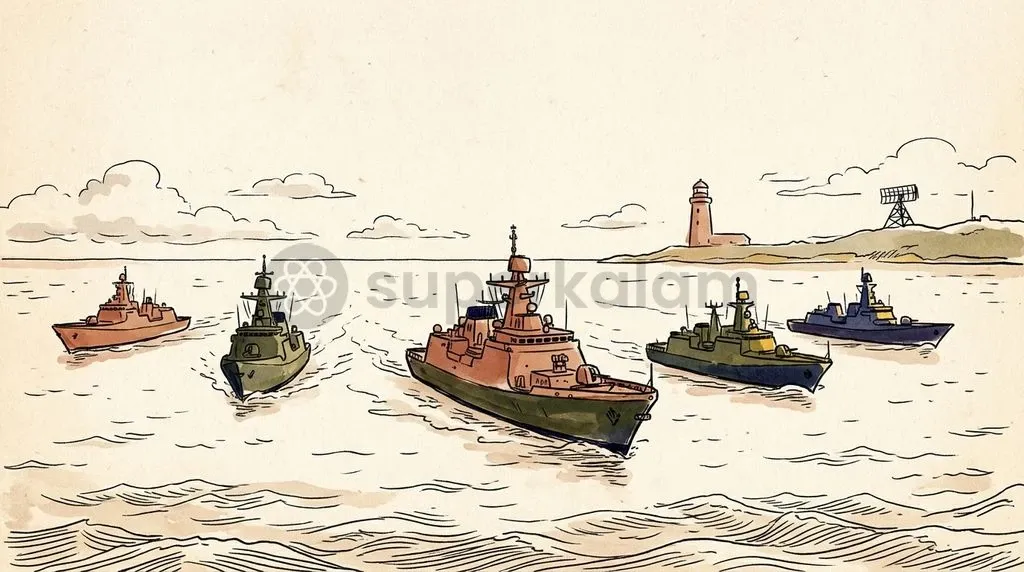
The Indo-Pacific Regional Dialogue is the apex international outreach conference of the Indian Navy. It translates broad diplomatic frameworks like the Indo-Pacific Oceans Initiative and the MAHASAGAR doctrine into concrete maritime security architecture.
According to the Press Information Bureau, the dialogue bridges high-level strategy and technical cooperation across eighteen regional partner nations. As of October 2026, Indian naval diplomacy focuses on sea-lane protection, non-traditional security threats, and shared maritime domain awareness across the Indo-Pacific.
Why is the Indo-Pacific Regional Dialogue in the News?
The Indian Navy will conduct the 2026 edition of the Indo-Pacific Regional Dialogue from 03 to 05 November 2026 at the Manekshaw Centre in New Delhi. According to the Press Information Bureau, this annual strategic conference is the navy's principal forum for maritime outreach. As scheduled by the Ministry of Defence, the Defence Minister will deliver the special inaugural address to open the three-day international summit.
The central theme of the 2026 assembly is 'Science, Technology and Academic Cooperation in the Indo-Pacific', as announced by the Ministry of Defence. This priority directly addresses Pillar 6 of the Indo-Pacific Oceans Initiative. It anchors high-level research partnerships across regional scientific institutions to align operational naval requirements with emerging technology.
The conference schedule includes high-level diplomatic and operational engagements:
- Perspectives from the Flag Bridge, hosting a dedicated naval leadership exchange
- Sahyog Ka Samvaad, convening an ambassadorial panel
- Technical working sessions, bringing together scholars, naval officers, and diplomats to address structural risks across the Indian and Pacific Oceans
What is the Indo-Pacific Regional Dialogue (IPRD)?
The Indo-Pacific Regional Dialogue is the annual apex-level strategic outreach conference of the Indian Navy. The National Maritime Foundation is the chief organiser and primary knowledge partner for the forum, according to the Press Information Bureau. The platform reviews evolving regional geopolitics and oceanic resource governance.
Operating as a Track-1.5 strategic forum, the dialogue brings government officials and non-governmental experts together. The National Maritime Foundation notes that this structure convenes naval commanders, diplomats, ocean scientists, and industry leaders. Participants review commercial shipping patterns, oceanic conservation, and security challenges outside formal diplomatic protocol.
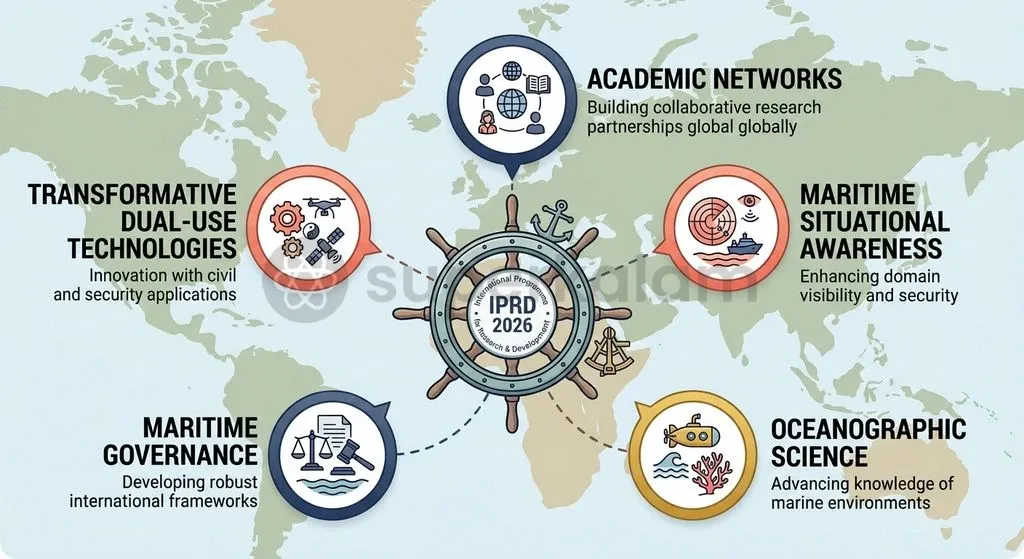
The 2026 edition convenes maritime delegations from eighteen partner nations across the Indo-Pacific. Deliberations unfold across five distinct thematic sessions:
- Building regional academic networks and collaborative research linkages
- Advancing maritime situational awareness and protecting critical seabed infrastructure
- Deepening oceanographic science and meteorological data sharing
- Strengthening multilateral maritime governance and legal regimes
- Harnessing transformative dual-use commercial technologies for maritime monitoring
Discuss with Superkalam
Which seven operational pillars constitute the Indo-Pacific Oceans Initiative (IPOI), and which countries lead them?
Ask NowDecoding the Pillars: What are IPOI and MAHASAGAR?
Prime Minister Narendra Modi launched the Indo-Pacific Oceans Initiative at the 14th East Asia Summit in Bangkok in November 2019. The framework promotes an open, inclusive, and rules-based maritime order across the Indo-Pacific basin. Partner countries lead specific functional tracks rather than joining a rigid military alliance.
According to the Ministry of External Affairs, the initiative comprises seven interconnected operational pillars:
- Maritime Security, led by India
- Maritime Ecology, led by Australia
- Maritime Resources, co-led by France and Indonesia
- Capacity Building and Resource Sharing
- Disaster Risk Reduction and Management, led by India
- Science, Technology and Academic Cooperation
- Trade, Connectivity and Maritime Transport, led by Japan
Parallel to this multilateral track, India expanded its regional maritime policy through the MAHASAGAR doctrine. Prime Minister Modi announced this framework in Mauritius in March 2025 as 'Mutual and Holistic Advancement for Security and Growth Across Regions'. It builds upon the 2015 SAGAR policy, elevating regional outreach from capacity-building assistance to structured institutional partnerships.
The Indian Navy operationalises this vision through its dedicated MAHASAGAR outreach initiative, titled 'Maritime Heads for Active Security and Growth for All in the Region'. Inaugurated in November 2023, the forum convenes naval leadership from ten Indian Ocean littoral states:
- Bangladesh
- Comoros
- Kenya
- Madagascar
- Maldives
- Mauritius
- Mozambique
- Seychelles
- Sri Lanka
- Tanzania
Discuss with Superkalam
How does a Track-1.5 forum like the IPRD bridge the gap between high-level diplomatic doctrines and operational naval coordination?
Ask NowHow IPRD Translates Maritime Visions into Practical Action
The Indo-Pacific Regional Dialogue supplies analytical depth to broad political doctrines. Diplomatic declarations often define normative goals without technical standards. Deliberations at the summit convert these declarations into shared operational procedures for naval forces and maritime law enforcement.
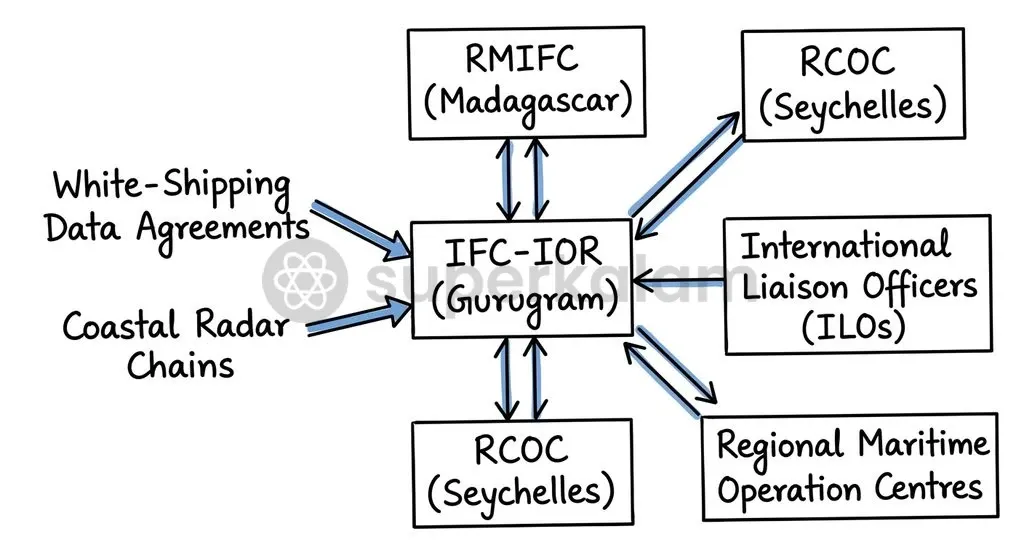
Data exchange underpins this collaborative architecture. The Information Fusion Centre – Indian Ocean Region, launched by India at Gurugram in December 2018, implements conference recommendations. The facility processes white-shipping data to generate shared maritime intelligence across key transit corridors. International Liaison Officers from over a dozen partner nations work on site, speeding up verification during suspicious vessel contacts.
Surveillance links connect India's Gurugram centre with partner hubs across the western Indian Ocean:
- Madagascar coordination, linking operations directly with the Regional Maritime Information Fusion Centre
- Seychelles liaison, maintaining operational ties with the Regional Coordination Operations Centre
- Joint monitoring registers, coordinating patrol schedules and updating shared vessel registries
Naval exercises supply the sea-going component of this diplomatic framework. As reported by the Ministry of Defence, the Indian Navy planned the simultaneous hosting of three major naval engagements at Visakhapatnam in February 2026:
- International Fleet Review
- Exercise MILAN
- IONS Conclave of Chiefs
These coordinated maritime engagements demonstrated regional interoperability and reinforced India's role as a dependable security partner across the Indian Ocean commons.
Discuss with Superkalam
Compare the strategic utility of bilateral assistance under SAGAR with the multilateral institutional outreach established under MAHASAGAR.
Ask NowKey Maritime Frameworks Compared: SAGAR, MAHASAGAR, and IPOI
India's maritime strategy employs overlapping frameworks to engage regional island nations, littoral states, and external partner nations. Each framework addresses distinct geopolitical challenges, operating across varied functional and diplomatic scales.
| Feature | SAGAR (2015) | MAHASAGAR (2025 Expansion) | IPOI (2019) |
|---|---|---|---|
| Primary Scope | Bilateral capacity building and humanitarian assistance | High-level multilateral outreach and comprehensive regional growth | Global and regional plurilateral collaboration across seven functional pillars |
| Geographic Focus | Immediate Indian Ocean littorals and island states | Broadened Indian Ocean littorals across East Africa and South Asia | Extended Indo-Pacific maritime continuum |
| Institutional Lead | Ministry of External Affairs | Indian Navy and Ministry of External Affairs | Plurilateral lead nations across specific thematic pillars |
| Strategic Mechanism | Consultative patrols, equipment transfer, and HADR support | Regular conclaves of naval chiefs and joint oceanic monitoring | Sector-specific work programmes and collaborative technical projects |
Strategic Headwinds Facing India in the Indo-Pacific
Strategic competition continues to intensify across the Indian Ocean commons. Assessments by the National Maritime Foundation indicate that regional militarisation and foreign dual-use port infrastructure developments shift the local balance of power. These commercial and military facilities support persistent foreign deployments, complicating defensive calculations along primary transit passages.
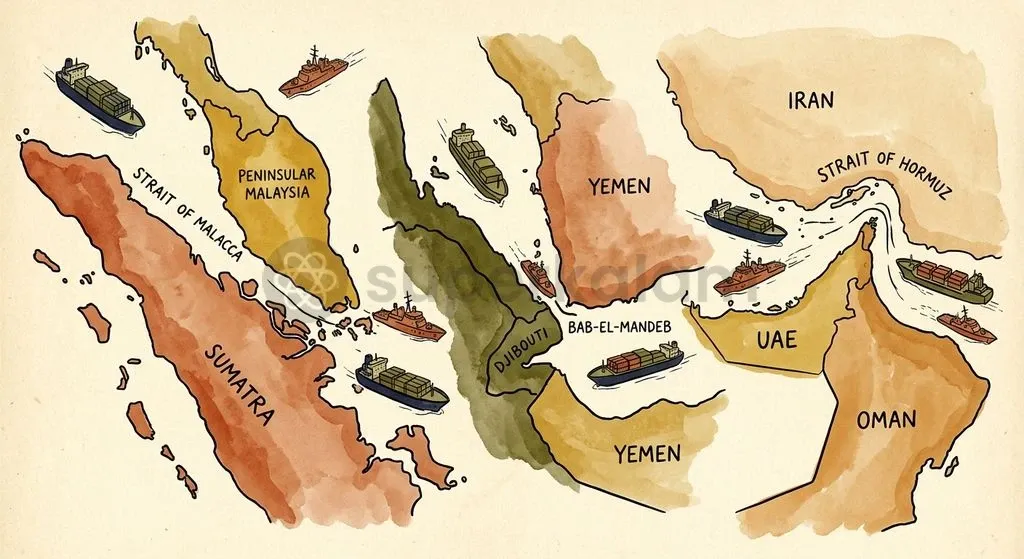
Securing vital Sea Lines of Communication remains an urgent operational priority. Global maritime commerce depends on narrow choke points, particularly the Strait of Malacca, the Bab-el-Mandeb, and the Strait of Hormuz. Disruptions along these passages threaten energy supplies and commercial trade, requiring continuous naval surface patrols.
Non-traditional security hazards further compound these maritime challenges across the Indian Ocean basin:
- Illegal, unreported, and unregulated fishing, depleting regional fish stocks and undermining littoral coastal economies
- Maritime terrorism and piracy, targeting commercial vessels in poorly policed coastal waters
- Marine ecological pollution, including commercial oil spills and hazardous plastic accumulations across fragile reef ecosystems
- Asymmetric drone attacks, threatening merchant shipping routes in contested maritime choke points
Discuss with Superkalam
Given foreign dual-use port infrastructure and non-traditional threats across major maritime choke points, evaluate whether India's current maritime domain awareness architecture is sufficient to ensure sea-lane security.
Ask NowKey Takeaways
- The Indian Navy hosts the Indo-Pacific Regional Dialogue 2026 from 03 to 05 November 2026 in New Delhi, focusing on science, technology, and academic cooperation under Pillar 6 of the Indo-Pacific Oceans Initiative.
- The National Maritime Foundation serves as the primary knowledge partner and chief organiser of this apex-level Track-1.5 dialogue.
- Prime Minister Narendra Modi launched the Indo-Pacific Oceans Initiative in November 2019 at the 14th East Asia Summit, structuring cooperation across seven functional pillars led by partner nations.
- India's maritime doctrine evolved from the 2015 SAGAR vision into MAHASAGAR in March 2025, while the Indian Navy operationalises naval leadership outreach across ten Indian Ocean littorals.
- Practical maritime domain awareness is anchored by the Information Fusion Centre – Indian Ocean Region in Gurugram, linking real-time surveillance with regional fusion hubs in Madagascar and Seychelles.
Mains Question
'The transition from the SAGAR policy to the MAHASAGAR doctrine signifies a shift from bilateral assistance towards institutionalised, multilateral maritime governance.' Elucidate. (10 Marks)
Evaluate NowMains Question
Assess how the Indo-Pacific Oceans Initiative (IPOI) and dialogue mechanisms like the Indo-Pacific Regional Dialogue (IPRD) translate normative maritime principles into operational maritime security architecture. Examine the challenges confronting these frameworks in the Indian Ocean commons. (15 Marks)
Evaluate NowPractice MCQs
QUESTION 1
Regarding the Indo-Pacific Oceans Initiative (IPOI), consider the following statements:
- It was launched by India at the 14th East Asia Summit in Bangkok in November 2019.
- Under its functional framework, Australia leads the Maritime Ecology pillar while Japan leads the Trade, Connectivity and Maritime Transport pillar.
- It operates as a rigid military alliance requiring mutual collective defence commitments among all participating nations.
Which of the statements given above is/are correct?
QUESTION 2
Consider the following statements concerning the Indo-Pacific Regional Dialogue (IPRD):
- It serves as the apex-level international strategic outreach conference of the Indian Navy.
- The National Maritime Foundation acts as its chief organiser and primary knowledge partner.
- It operates strictly as a formal Track-1 inter-governmental diplomatic negotiation forum that excludes non-governmental experts.
Which of the statements given above is/are correct?
QUESTION 3
With reference to India's maritime doctrines and initiatives, consider the following statements:
- The MAHASAGAR doctrine announced in Mauritius in March 2025 stands for 'Mutual and Holistic Advancement for Security and Growth Across Regions'.
- The Indian Navy's MAHASAGAR outreach initiative convenes naval leadership exclusively from South Asian Association for Regional Cooperation (SAARC) countries.
- MAHASAGAR represents an institutional expansion of India's 2015 SAGAR policy from capacity-building assistance to structured partnerships.
Which of the statements given above is/are correct?
QUESTION 4
Consider the following operational mechanisms associated with India's maritime domain awareness:
- Processing white-shipping data at the Information Fusion Centre – Indian Ocean Region (IFC-IOR) in Gurugram.
- Hosting International Liaison Officers from partner nations to accelerate verification of suspicious vessel contacts.
- Direct operational liaison links connecting the Gurugram centre with regional coordination centres in Madagascar and Seychelles.
How many of the above mechanisms are utilised to enhance maritime intelligence and surveillance?
QUESTION 5
Which one of the following pillars of the Indo-Pacific Oceans Initiative (IPOI) is co-led by France and Indonesia?