Indigenous Atomic Clocks: India's Push for NavIC Autonomy
Overcoming past foreign clock failures aboard early NavIC orbiters, India's quest for sovereign atomic time anchors border defence and digital markets.
Nov, 2026
•11 min read

Overview
India is accelerating the domestic manufacturing of space-grade rubidium atomic clocks to secure independent control over the Navigation with Indian Constellation (NavIC) network. This initiative safeguards critical defence assets and civilian digital infrastructure against foreign export controls and component failures.
Satellite positioning depends on nanosecond-level timekeeping, where a discrepancy of a single nanosecond generates thirty centimetres of ranging error. Following the operational failure of imported European clock modules aboard first-generation orbiters, domestic development shifted from an experimental objective to an urgent strategic necessity. Indigenising precision frequency standards shields India's sovereign infrastructure from geopolitical export embargoes under regimes like the Wassenaar Arrangement.
These high-precision atomic devices now provide stable timing anchors across orbital navigation, telecommunication networks, high-frequency financial trading, and national power grids.
Why in the News? The Push to End Reliance on Foreign Timekeepers
India is actively removing foreign dependencies across its strategic timing infrastructure. As of November 2026, the Indian Space Research Organisation (ISRO), research institutions, and private deep-tech startups have accelerated the domestic development of rubidium atomic standards to insulate critical systems from external supply disruptions.
Two concurrent breakthroughs have driven this national priority to the forefront:
- Orbital Flight Qualification: India achieved practical spaceflight validation when the NVS-01 navigation satellite launched aboard a GSLV-F12 rocket, carrying an indigenous rubidium atomic clock engineered by the Space Applications Centre.
- Statutory Timing Mandate: Under Section 52 of the Legal Metrology Act, 2009, the Ministry of Consumer Affairs notified the Legal Metrology (Indian Standard Time) Rules, 2026, establishing Indian Standard Time as the compulsory reference for all digital, administrative, and financial systems.
Building sovereign, space-qualified atomic clocks is no longer merely an aerospace milestone. It forms the core foundation of national cyber resilience and economic sovereignty.
What Is an Atomic Clock and Why Does Precision Timing Matter?
Atomic clocks measure time by locking an electronic oscillator to the invariable resonance frequency of electron transitions between atomic hyperfine energy states. Conventional quartz oscillators drift because of physical wear and thermal swings, whereas atomic transitions stay constant over decades. This quantum stability offers the absolute benchmark required for telecommunications, metrology, and orbital navigation.
Satellite navigation is fundamentally an exercise in hyper-accurate chronometry. Because electromagnetic radio signals travel at the speed of light (~300,000 kilometres per second), even an infinitesimal timing drift disrupts positional accuracy. According to the Space Applications Centre, a timing discrepancy of just 1 nanosecond produces approximately 30 centimetres of ranging error.
| Timing Parameter | Nominal Metric | Operational Effect |
|---|---|---|
| **Clock Discrepancy** | 1 nanosecond ($10^{-9}$ s) | Baseline temporal shift |
| **Signal Velocity** | ~300,000 km/s | Speed of light propagation |
| **Spatial Drift** | ~30 cm | Resulting ground ranging error |
(Mathematical relationship between time bias and spatial ranging accuracy)
Triangulating a position on Earth requires solving for four distinct mathematical unknowns: latitude (X), longitude (Y), altitude (Z), and the local receiver clock bias. Constellation receivers must therefore maintain a simultaneous line of sight to a minimum of four distinct satellites to calculate exact coordinates. If a satellite's onboard clock drifts without immediate correction, user devices on Earth cannot compute accurate navigation fixes.
Space agencies utilise a clear hierarchy of atomic frequency standards based on physical traits and operational constraints:
- Hydrogen Masers: Deliver unmatched short-term frequency stability, making them the premier choice for master ground stations, though their physical bulk limits orbital use.
- Caesium Standards: Provide exceptional long-term absolute accuracy without frequency drift, serving as primary metrological definitions.
- Rubidium Clocks: Offer the optimal balance of compact dimensions and low mass, making them the ideal workhorse for satellite payloads.
Discuss with Superkalam
Recall the exact ranging error that occurs when an onboard satellite clock drifts by just one nanosecond.
Ask Now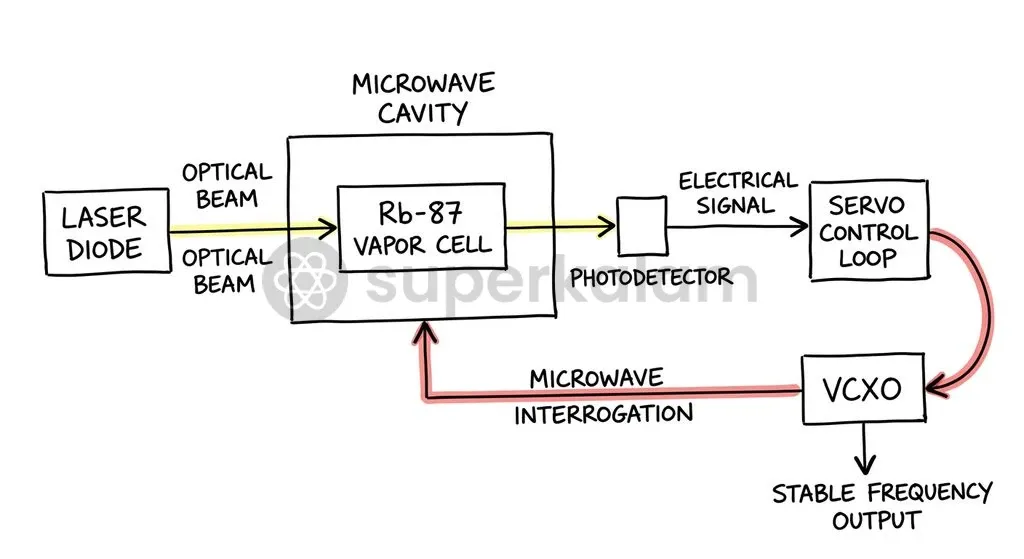
Procuring space-qualified frequency standards from international vendors carries sharp strategic vulnerabilities:
- Export Restrictions on Dual-Use Goods: Ultra-stable frequency standards, rubidium vapour instruments, and chip-scale atomic clocks (CSACs) are classified as dual-use goods due to their critical role in missile guidance, electronic warfare, and secure defence communications.
- Multilateral Regimes: Foreign suppliers face stringent licensing controls and export barriers under regimes such as the Wassenaar Arrangement.
- Supply Denial Risks: Geopolitical tensions risk supply cut-offs, threatening constellation upkeep during diplomatic emergencies.
These friction points proved that relying on foreign vendors exposes India's navigation network to technological denial. Developing domestic design, fabrication, and testing capabilities became essential to guarantee unrestricted operational availability for the armed forces and civil aviation.
Imported vs Indigenous Atomic Clocks: Key Differences at a Glance
The Space Applications Centre (SAC) has developed indigenous rubidium frequency standards that match foreign performance while eliminating critical supply vulnerabilities for the NavIC constellation. ISRO engineers qualified an integrated Atomic Clock Monitoring Unit (ACMU) to manage clock redundancy and drive the 10.23 MHz Master Timing Reference aboard the satellite bus. This indigenous unit delivers substantial fiscal and logistical benefits compared to earlier imported alternatives.
| Parameter / Dimension | Imported Standards (Spectratime / Safran) | Indigenous ISRO Standard (Space Applications Centre) |
|---|---|---|
| **Primary Deployment** | IRNSS-1A through IRNSS-1I (First Generation) | NVS-01 and upcoming second-generation NavIC satellites |
| **Procurement Status** | Subject to foreign export licences and Wassenaar controls | Completely sovereign design, fabrication, and orbital qualification |
| **Subsystem Integration** | Proprietary foreign telemetry and timing modules | Custom-built Atomic Clock Monitoring Unit (ACMU) providing 10.23 MHz reference |
| **Cost Implications** | High foreign exchange outlay and costly export licensing | Generates savings of **approximately ₹3 crore per navigation satellite** |
| **Strategic Redundancy** | Vulnerable to single-vendor component supply embargoes | Full domestic lifecycle support and maintenance pipeline |
Discuss with Superkalam
Explain why satellite navigation receivers require simultaneous signals from a minimum of four satellites rather than three.
Ask NowFrom Lab to Launchpad: The Hard Climb of Space-Qualifying Hardware
Deep-tech startup QuPrayog achieved Technology Readiness Level 4 for an optical rubidium-87 clock prototype incubated at the IISER Pune quantum foundation. Incubated under the I-HUB Quantum Technology Foundation, this milestone demonstrated an operational laboratory-scale Rubidium-87 atomic clock. Technology Readiness Level 4 (TRL 4) signifies basic component and breadboard validation within a controlled laboratory environment, confirming that the underlying quantum physics package works as designed.
The prototype developed by QuPrayog incorporates Coherent Population Trapping (CPT) optical interrogation techniques. Traditional atomic clocks rely on bulky microwave cavities to excite atoms, which restricts physical miniaturisation. CPT optical interrogation relies on laser fields to trap alkali atoms in non-absorbing quantum states, eliminating the heavy microwave cavity and laying the groundwork for chip-scale atomic clocks.
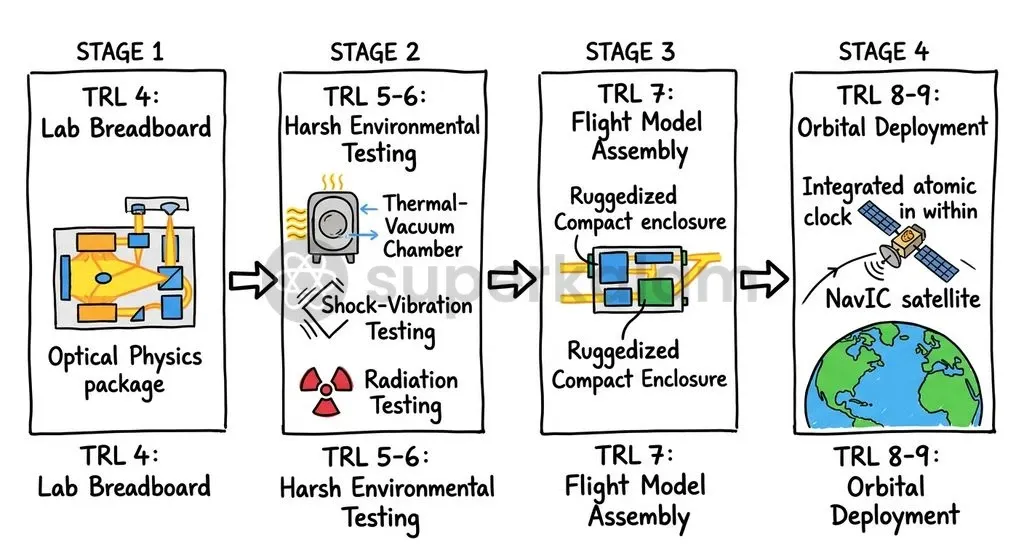
Bridging the vast engineering gap between a TRL 4 benchtop unit and a space-qualified TRL 8 or TRL 9 flight payload requires overcoming severe environmental hurdles. Space-qualified payloads face hostile orbital conditions that rapidly destroy standard electronic components:
- Thermal Vacuum Cycles: Satellite hardware must operate continuously through severe temperature swings spanning from -20°C to +60°C inside the vacuum of space.
- Radiation Hardening: Cosmic radiation and high-energy solar particles cause single-event upsets in control circuitry, necessitating dedicated radiation shielding and fault-tolerant electronics.
- Vibrational and Shock Hardening: Instruments must survive intense dynamic mechanical stresses and acoustic vibration during rocket launch ascent.
- Component Micro-Fabrication: Domestic scaling requires overcoming bottlenecks in manufacturing leak-tight micro-machined alkali vapour cells, narrow-linewidth vertical-cavity surface-emitting lasers (VCSELs), and high-attenuation magnetic shielding.
Discuss with Superkalam
Apply the concept of dual-use export controls under the Wassenaar Arrangement to explain how dependency on foreign high-tech hardware impacts a nation's military readiness.
Ask NowBeyond Satellites: What Domestic Clocks Mean for Defence, 5G, and Finance
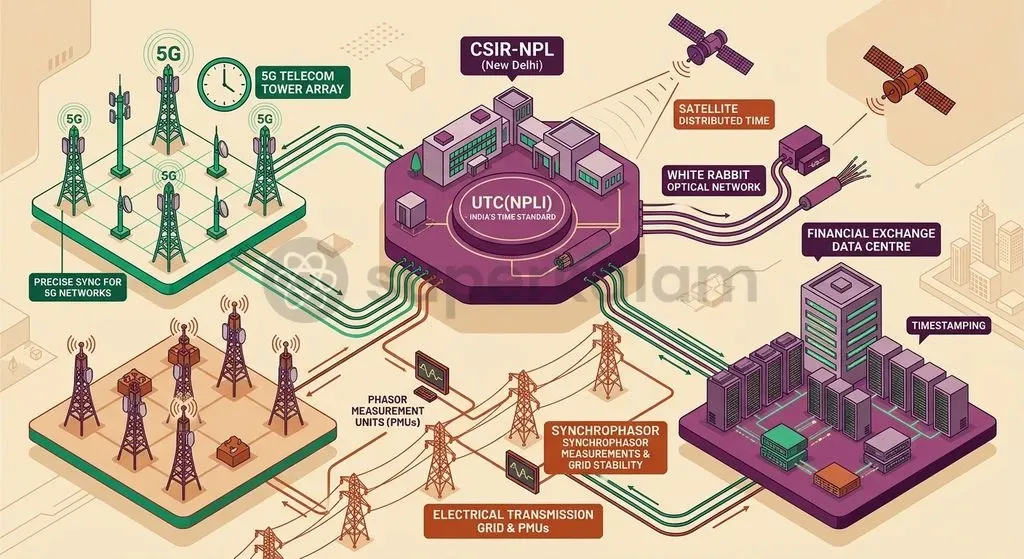
The CSIR-National Physical Laboratory (CSIR-NPL) maintains Indian Standard Time as a vital anchor for national defence systems, telecommunications networks, and digital financial registries. Operating as the statutory custodian of national measurement standards, CSIR-NPL synthesises the national timescale UTC(NPLI) using an ensemble bank of high-precision Caesium clocks and active Hydrogen Masers.
Disseminating unassailable precision time across terrestrial infrastructure protects the economy against satellite signal disruption and malicious electronic spoofing.
| Sector / Tier | Network Layer | Precision Synchronisation Requirement |
|---|---|---|
| **National Primary Reference** | CSIR-NPL Master Clock Bank | UTC(NPLI) via Caesium standards and Hydrogen Masers |
| **Terrestrial Dissemination** | White Rabbit Optical Network | Real-time link to Regional Reference Standards Labs |
| **Telecom Infrastructure** | 5G / 6G TDD Mobile Networks | **Sub-microsecond phase synchronisation** (<1 µs) |
| **Power Transmission** | Grid Phasor Measurement Units | Sub-millisecond current and voltage phase angles |
| **Financial Exchanges** | SEBI High-Frequency Trading | **1 µs synchronisation** with ±1 millisecond accuracy |
Modern cellular architecture relies entirely on precise temporal coordination. Time Division Duplex (TDD) mechanisms used across 5G and emerging 6G mobile networks demand sub-microsecond phase synchronisation between neighbouring radio base stations. Without precise timing locks, adjacent cell towers bleed across allocated frequency bands, creating cross-link data corruption and breaking down beamforming arrays.
Electrical utility operators face similar precision requirements across the power grid. Wide-area monitoring systems deploy Phasor Measurement Units (PMUs) synchronised to atomic frequency sources to capture current and voltage waveforms at sub-millisecond rates. These synchronised readings enable grid dispatchers to detect phase angle discrepancies across states, isolating transmission line imbalances before they trigger cascading blackouts.
Capital markets also depend on sub-millisecond precision. The Securities and Exchange Board of India (SEBI) requires all stock exchanges and clearing institutions to lock trading systems to recognised atomic clocks with microsecond precision and ±1 millisecond accuracy. Transparent transaction timestamps prevent front-running, maintain verifiable audit trails in algorithmic high-frequency trading, and protect systemic market integrity.
To distribute this timing reference without relying solely on satellite downlinks, the Department of Consumer Affairs partnered with CSIR-NPL to build White Rabbit Technology (WRT) optical networks. This ground-based fibre architecture directly interconnects Regional Reference Standards Laboratories with leading commercial and financial exchanges.
Discuss with Superkalam
Analyse the engineering and physical environmental differences between operating an atomic clock at Technology Readiness Level 4 on a laboratory benchtop versus Technology Readiness Level 9 in orbit.
Ask NowWay Forward: Scaling QuPrayog and the National Quantum Ecosystem
The National Quantum Mission provides ₹6,003.65 crore between 2023 and 2031 to scale indigenous quantum sensing, metrology standards, and advanced atomic timing hardware. Moving this hardware from isolated university laboratories into serial production requires structured coordination between the public sector, research institutions, and private industry:
- Bridging the TRL Valley of Death: Dedicated funding mechanisms must assist deep-tech ventures in graduating prototypes from laboratory validation (TRL 4) to flight demonstration (TRL 8/9). Institutional testbeds provided by ISRO and the Department of Science and Technology can lower environmental qualification costs for private startups.
- Fabrication Infrastructure: India needs specialised foundry facilities to fabricate micro-machined alkali vapour cells and space-grade semiconductor lasers. Building domestic cleanroom lines prevents recurring supply-chain chokepoints for critical optical components.
- Civil-Military Technology Transfers: Research platforms developed under space programmes should be packaged into ruggedised, chip-scale atomic clocks for field deployability across defence communications, airborne radars, and tactical naval vessels.
- Industry Procurement Mandates: Enforcing compliance with the Legal Metrology (Indian Standard Time) Rules, 2026 across cloud data centres, private telecom operators, and banking networks will generate steady domestic demand for commercial timing units.
Building indigenous atomic clocks is a structural transformation for India's technological sovereignty. Mastered precision chronometry transforms the nation from an insecure consumer of restricted foreign technology into an independent, self-reliant technological power.
Key Takeaways
- Atomic clocks track time by locking electronic oscillators to the invariable resonance frequency of atomic electron transitions between hyperfine energy states.
- Satellite positioning systems require nanosecond time precision because radio signals travel at light speed; a 1-nanosecond discrepancy creates approximately 30 centimetres of ranging error.
- Constellation positioning requires simultaneous signals from a minimum of four satellites to calculate three-dimensional spatial coordinates (X, Y, Z) and correct receiver clock bias.
- The operational failure of imported European rubidium clocks aboard first-generation IRNSS satellites demonstrated the strategic hazard of relying on foreign supply chains.
- ISRO successfully validated its indigenous rubidium atomic clock in space aboard the NVS-01 satellite, while the indigenously developed ACMU saves approximately ₹3 crore per navigation satellite.
- Domestic atomic frequency standards secure critical civilian operations beyond space, anchoring 5G telecommunication phase timing, electrical grid Phasor Measurement Units, and SEBI-regulated financial transaction ledgers.
Mains Question
"Relying on foreign vendors for dual-use space hardware exposes sovereign satellite navigation systems to technological denial and mission failure." In light of the operational setbacks faced by IRNSS-1A and multilateral export controls under the Wassenaar Arrangement, examine the strategic imperative behind developing indigenous rubidium atomic frequency standards for NavIC. (10 Marks)
Evaluate NowMains Question
From laboratory breadboard validation at Technology Readiness Level 4 to flight qualification aboard orbital platforms, transitioning quantum precision timing devices involves multifaceted engineering hurdles. Elucidate the technical challenges of space-qualifying indigenous atomic standards and discuss their wider systemic importance under the Legal Metrology (Indian Standard Time) Rules, 2026. (15 Marks)
Evaluate NowPractice MCQs
QUESTION 1
With reference to atomic clocks and satellite navigation systems, consider the following statements:
- A timing discrepancy of one nanosecond in an atomic clock generates approximately 30 centimetres of ground ranging error.
- In a satellite navigation system, user receivers require a simultaneous line of sight to a minimum of three satellites to calculate a three-dimensional position fix and receiver clock bias.
- Hydrogen masers offer superior short-term frequency stability, while rubidium atomic standards are preferred for spaceborne payloads due to their compact dimensions and lower mass. Which of the statements given above are correct?
QUESTION 2
Consider the following statements regarding India's development of indigenous atomic clocks:
- The NVS-01 navigation satellite was launched aboard a GSLV-F12 rocket carrying an indigenous rubidium atomic clock developed by the Space Applications Centre.
- Under the Legal Metrology Act, 2009, the Legal Metrology (Indian Standard Time) Rules, 2026, established Indian Standard Time as the compulsory reference for all digital, administrative, and financial systems.
- The indigenous Atomic Clock Monitoring Unit developed by ISRO drives a 10.23 MHz Master Timing Reference aboard the satellite bus. Which of the statements given above are correct?
QUESTION 3
With reference to quantum clock technologies and space qualification, consider the following statements:
- Coherent Population Trapping (CPT) optical interrogation uses laser fields to eliminate bulky microwave cavities, aiding miniaturisation into chip-scale atomic clocks.
- Technology Readiness Level 4 (TRL 4) denotes full flight-qualified orbital validation under real spaceflight conditions.
- Space-grade atomic frequency standards must withstand operational thermal swings between -20°C and +60°C in a vacuum environment. Which of the statements given above is/are correct?
QUESTION 4
Which one of the following multilateral export control regimes controls the transfer of ultra-stable frequency standards and rubidium vapour instruments as dual-use goods?
QUESTION 5
Consider the following statements regarding the strategic and operational implications of atomic clocks in NavIC:
- Failure of imported European rubidium atomic clocks from Spectratime (Safran) impaired the operational capacity of the IRNSS-1A satellite.
- Deploying indigenous atomic clock standards saves approximately ₹3 crore per navigation satellite compared to imported units. Which of the statements given above is/are correct?
Discuss with Superkalam
Evaluate the strategic and economic rationale of mandating Indian Standard Time across all digital and financial systems via the Legal Metrology Rules, 2026.
Ask Now