India-Venezuela Oil Imports: Why the US Wants India Back in the Market
Venezuela's vast crude reserves promise vital energy diversification for India, but secondary sanctions and refinery bottlenecks restrict long-term expansion.
Oct, 2026
•9 min read
Overview
India's recent surge in Venezuelan crude oil purchases is a tactical, refinery-specific opening rather than a structural shift. Secondary sanctions risks, elevated ocean freight costs, and rigid domestic refinery configurations constrain wider adoption.
Average monthly imports jumped sharply from 64.027 thousand metric tonnes in fiscal year 2025-26 to 1,047.148 thousand metric tonnes during April–May of fiscal year 2026-27. Venezuela holds more than 300 billion barrels of proven crude reserves, offering potential geographic diversification away from the Persian Gulf. Yet commercial bottlenecks, currency clearing restrictions, and cheaper Russian barrels prevent this supplier from permanently reshaping India's import basket.
Why Venezuela Oil Is Back in the News for India
Official import figures show that India's average monthly crude intake from Venezuela expanded sixteen-fold. Inbound volumes rose from 64.027 thousand metric tonnes (TMT) in fiscal year 2025-26 to 1,047.148 TMT across April and May of fiscal year 2026-27. This procurement rebound followed high-level bilateral discussions on energy partnerships and joint upstream ventures.
Three strategic factors drive New Delhi's interest in reviving transatlantic shipments:
- Heavy Import Dependence: As of June 2026, external suppliers cover more than 85% of domestic consumption.
- Persian Gulf Choke Points: Nearly 50% of Indian crude inflows transit the narrow Strait of Hormuz choke point, leaving supply chains vulnerable to Middle Eastern conflicts.
- Vast Resource Base: Venezuela holds the largest proven oil deposits on earth, exceeding 300 billion barrels across the Orinoco Heavy Oil Belt.
Tapping these reserves spreads geographic supply risk. However, current inflows reflect opportunistic spot purchases by coastal refiners rather than an institutionalised procurement shift.
Discuss with Superkalam
Recall the API gravity range and sulphur content of Venezuela's Merey 16 crude blend.
Ask NowHow US Sanctions Halted India-Venezuela Crude Flows
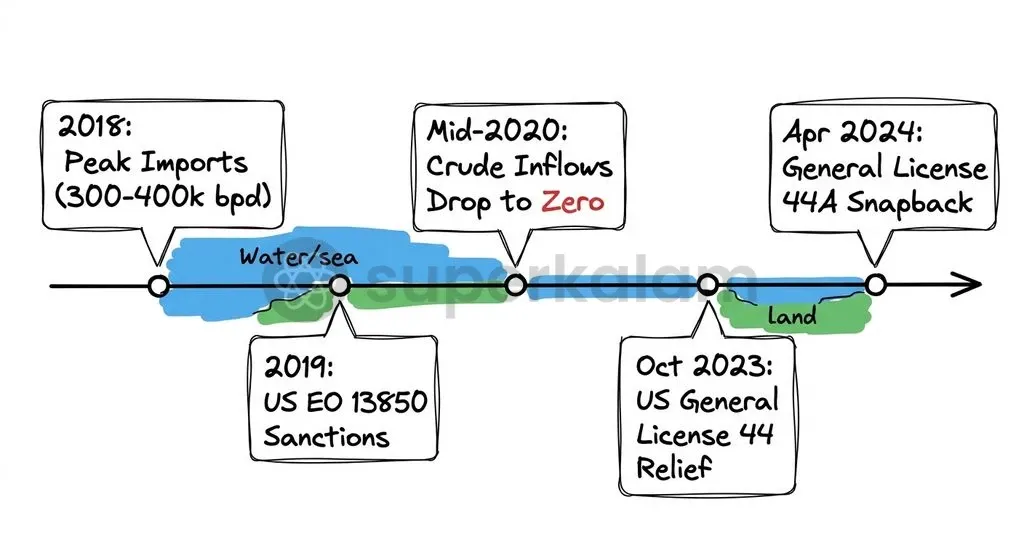
Executive Order 13850 issued by the United States government in 2019 abruptly severed this energy corridor. Before these sanctions, India ranked as the second-largest global buyer of Venezuelan crude oil behind China. Between 2017 and 2019, Indian refiners imported between 300,000 and 400,000 barrels per day (bpd), providing Caracas with essential hard currency.
- Pre-2019 Baselines: Indian imports held steady at 300,000–400,000 bpd.
- 2019 US Sanctions: Executive Order 13850 targeted transactions with Petróleos de Venezuela, S.A. (PDVSA).
- Mid-2020 Collapse: Threat of US financial exclusion caused direct crude imports to fall to zero.
- Asset Freeze: State upstream capital stalled, leaving roughly $1 billion PSU equity trapped.
Secondary sanctions forced Indian refiners to stop lifting PDVSA cargoes. By mid-2020, direct imports collapsed to zero.
This disruption hit India's long-term upstream equity assets directly. Indian Public Sector Undertakings (PSUs) had maintained an operational presence in Venezuela since 2008, investing nearly USD 1 billion into domestic extraction projects.
These ventures include the San Cristóbal project in the Orinoco belt and the Carabobo-1 joint venture. With crude export flows frozen, these assets turned illiquid, trapping public capital abroad.
Why the US Softened Sanctions on Caracas
The US Department of the Treasury shifted its stance in October 2023 by issuing General License 44. Administered through the Office of Foreign Assets Control (OFAC), this temporary waiver lifted prohibitions on Venezuela's oil and gas sectors. The six-month window aimed to incentivise democratic electoral roadmaps between Caracas and domestic opposition parties.
Washington's sanctions regime subsequently underwent three key regulatory shifts:
- Six-Month Conditional Waiver: General License 44 permitted transactions with PDVSA from October 2023 to encourage political dialogue.
- Orderly Wind-Down Order: On 17 April 2024, OFAC issued General License 44A, establishing an orderly 45-day wind-down of authorised petroleum operations as electoral benchmarks stalled.
- Selective Bilateral Engagement: Washington granted individual corporate exemptions while deploying diplomatic outreach to redirect Indian refining demand away from discounted Russian crude.
American diplomacy then targeted Indian refiners directly. In October 2026, US Secretary of State Marco Rubio reportedly visited Mumbai and Jamnagar to encourage refiners to lift Venezuelan crude, seeking to stabilise world supply and offer alternatives to discounted Russian crude. This tactical engagement shows how supply constraints soften unilateral sanctions.
Discuss with Superkalam
Explain how the Nelson Complexity Index determines whether a refinery can run heavy, sour crudes without operational bottlenecks.
Ask NowWhy Heavy Merey Crude Cannot Go to Every Indian Refinery
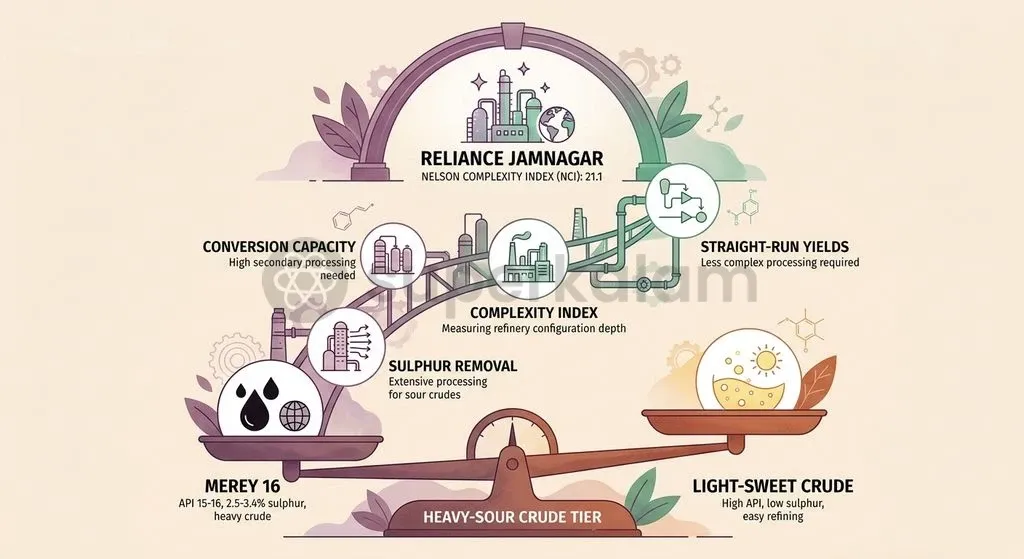
Venezuela's flagship export blend, Merey 16, creates severe operational hurdles for most domestic processing units. Merey 16 is an extra-heavy, sour crude with an API gravity of 15°–16° and high sulphur content between 2.5% and 3.4%. API gravity measures petroleum density relative to water, while sour crude carries high sulphur concentrations that corrode standard refinery metallurgy.
| Parameter / Feature | Merey 16 (Venezuela) | Standard Indian PSU Setup |
|---|---|---|
| API Gravity (Density) | API: 15°–16° (Extra-Heavy) | Configured for Medium/Sweet crude |
| Sulphur Concentration | 2.5%–3.4% (Sour) | Limited desulphurisation capability |
| Secondary Unit Demands | Requires high delayed-coking capacity | Prone to coker bottlenecks and metallurgical wear |
Processing viscous residue requires deep-conversion secondary units, including delayed cokers and hydrocrackers. Reliance Industries' Jamnagar complex handles this grade easily, operating with a Nelson Complexity Index of 21.1, the highest globally. High NCI configurations allow refiners to upgrade low-value heavy pitch into premium transport fuels.
| Crude Blend Metric | Venezuelan Merey 16 | Russian Urals | Indian Strategic Need |
|---|---|---|---|
| API Gravity (Density) | 15°–16° (Extra-Heavy) | ~31°–32° (Medium) | Requires heavy-coking capacity |
| Sulphur Content (%) | 2.5% – 3.4% (Sour) | ~1.3% – 1.7% (Medium Sour) | Requires intensive desulphurisation |
| Compatible Indian Units | Jamnagar (RIL), Vadinar (Nayara) | Pan-India PSU & Private Refiners | Broad domestic fungibility |
| Key Processing Asset | Advanced Delayed Coking Units | Atmospheric Distillation Units | Protection against coker bottlenecks |
Refinery delivery figures highlight this technical division. Between April and August 2026, Reliance Industries reportedly took 74.3% of total imports from Venezuela across its Special Economic Zone and Domestic Tariff Area units in Jamnagar. During that same window, Indian Oil Corporation's Paradip facility took 11.7%, Mundra coastal terminals took 11.3%, and Nayara Energy's Vadinar refinery accounted for 2.7%.
Kpler projected imports to hit 465,000 bpd in October 2026, with all scheduled tankers discharging exclusively at Sikka port for private Saurashtra refineries. Conventional inland PSU refineries cannot run Merey 16 without risking rapid unit fouling.
Freight Costs and the Shadow of Discounted Russian Oil
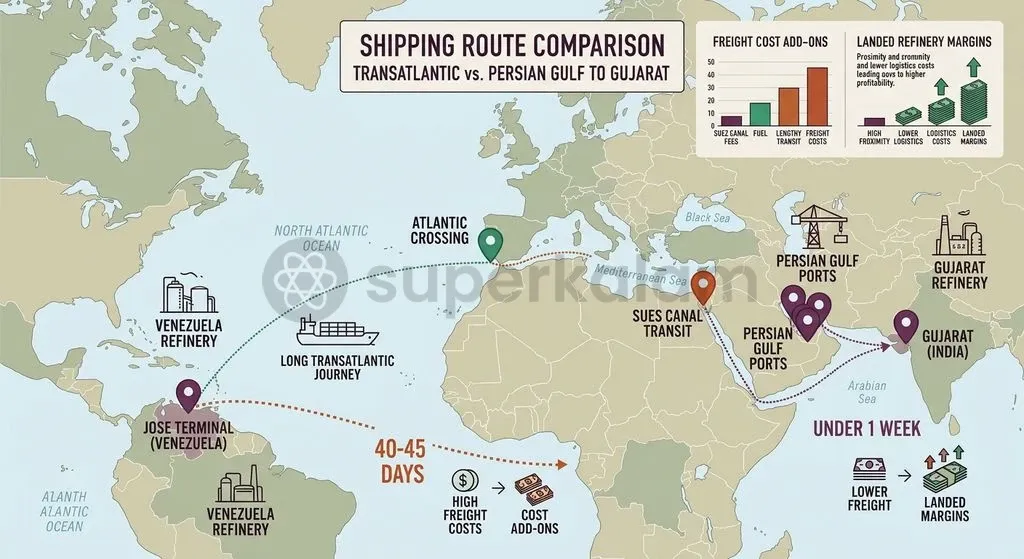
Maritime logistics erode the nominal discounts offered on Venezuelan crude. A tanker voyage from Jose Terminal in Venezuela to India's west coast takes around 45 days across the Atlantic and Indian Oceans. In contrast, shipments from Persian Gulf terminals like Ras Tanura reach Gujarat in less than one week.
These extensive sailing distances introduce severe shipping cost penalties:
- Ocean Tanker Freight: Long-haul chartering added roughly $33 per barrel to landed costs in late 2026.
- Eroded Price Headroom: This freight surcharge consumed the attractive $16 per barrel discount that Merey 16 carried against the international ICE Brent benchmark.
- Working Capital Lock-in: Cargoes spend upwards of six weeks afloat, raising inventory carrying charges and exposing buyers to prompt price volatility.
- Insurance Premia: Vessels traversing extended Atlantic channels occasionally face elevated maritime insurance rates tied to secondary compliance screening.
Russian crude imports continue to crowd out transatlantic volumes. From 2023 to 2026, Russia accounted for between 35% and 56% of total Indian crude receipts.
Russian Urals crude has a medium-gravity profile that processes cleanly across coastal and inland PSU units. Because Urals moves over shorter shipping routes from Baltic and Black Sea ports, it yields superior margins, keeping Venezuelan crude at a competitive disadvantage.
Discuss with Superkalam
Analyse the trade-off between the nominal price discount of Venezuelan crude and the landed costs imposed by maritime freight and 45-day voyage times.
Ask NowPayment Bottlenecks and Secondary Sanctions Under Policy Volatility
Secondary sanctions from the US Treasury prevent Indian state-owned refiners from signing multi-year contracts with Caracas. Most global crude transactions clear through Western correspondent banks using US dollars. This exposes buyers to profound payment settlement hurdles, as clearing houses routinely halt transactions tied to PDVSA.
- Clearance Bottlenecks: PDVSA commercial invoices routed to Western clearing banks face immediate halts due to OFAC sanctions risks.
- Capital Impasse: State refiners cannot route direct payments without risking exclusions from dollar payment networks.
- Dividend Freezes: Accumulated enterprise distributions remain trapped in local accounts rather than repatriated to New Delhi.
Public sector undertakings face strict statutory audits and ministerial oversight. Consequently, they avoid unilateral regulatory exposure to foreign jurisdictions. Unlike private firms that can deploy third-party trading intermediaries, state-run oil marketing companies risk losing access to commercial paper and Western maritime insurance if penalised.
Dividend repatriation reflects this deadlock. ONGC Videsh Ltd (OVL) has faced prolonged delays in retrieving dividends exceeding USD 500 million from its stake in the San Cristóbal venture.
Strict Venezuelan exchange controls and US banking restrictions keep these earnings frozen. While private refiners conduct opportunistic spot transactions under brief waiver windows, public refiners remain sidelined by compliance hazards.
Balancing Energy Security, Diversification, and Strategic Autonomy
India requires a balanced, multi-layered energy policy to capture value from Latin American crude without triggering sanctions or compromising strategic autonomy. Opportunistic spot purchases alone leave refiners exposed to volatile overseas regulations.
A coherent road map requires concrete operational and diplomatic adjustments:
- Leveraging Private Coking Capacity: The government should facilitate private refiners, primarily Reliance and Nayara, in utilising their high NCI infrastructure to process heavy Venezuelan crude during pricing windows, freeing up lighter Middle Eastern and domestic crude for state-owned refineries.
- Structuring Government-to-Government Debt Swaps: New Delhi should negotiate dedicated crude-for-dividend repatriation mechanisms with Caracas, enabling ONGC Videsh Ltd to recover its trapped $500 million in accumulated receivables through physical oil off-take.
- Establishing Non-Dollar Bilateral Clearing: Developing local currency settlements or rupee-bolívar transaction channels would insulate baseline petroleum commerce from Western clearing banks and secondary OFAC actions.
- Safeguarding Upstream Sovereign Assets: Active diplomatic representation must be maintained to preserve India's nearly USD 1 billion upstream equity stake in the San Cristóbal and Carabobo-1 blocks, ensuring assets remain viable whenever broader multilateral sanctions ease.
- Evaluating Deep-Conversion PSU Upgrades: Public sector refiners must selectively invest in secondary delayed-coking and residue-upgrading units, expanding their technical tolerance for heavy-sour crude baskets over the coming decade.
Discuss with Superkalam
Evaluate whether India should risk secondary sanctions exposure to diversify its crude basket away from Persian Gulf choke points.
Ask NowStrategic Dimensions of Bilateral Petroleum Trade
- Import Volatility: Average monthly crude imports from Venezuela rebounded from 64.027 TMT in fiscal year 2025-26 to 1,047.148 TMT in April–May of fiscal year 2026-27, driven by selective spot purchasing.
- Refining Mismatch: Venezuela's Merey 16 crude is extra-heavy and sour (API 15°–16°, 2.5%–3.4% sulphur), confining over 70% of imports to Reliance Jamnagar's ultra-complex coking units (NCI 21.1) and bypassing conventional PSU plants.
- Commercial Headwinds: An ocean transit of around 45 days from the Atlantic adds roughly $33 per barrel in tanker freight, largely wiping out Merey 16's $16 per barrel discount against Brent crude.
- Russian Competition: Russia remained India's dominant supplier between 2023 and 2026, delivering 35% to 56% of national imports with superior margins, lower transit times, and wide PSU compatibility.
- Trapped Sovereign Capital: US secondary sanctions and clearing blocks leave ONGC Videsh Ltd unable to repatriate over USD 500 million in accumulated project dividends from the San Cristóbal joint venture.
Mains Question
"India's recent surge in Venezuelan crude oil purchases represents a tactical, refinery-specific opening rather than an institutionalised procurement shift." Critically analyse this statement in light of secondary sanctions and domestic refining constraints. (15 Marks)
Evaluate NowMains Question
Examine how unilateral sanctions regimes and maritime logistics shape India's pursuit of energy security and strategic autonomy, with specific reference to Venezuelan oil imports. (10 Marks)
Evaluate NowPractice MCQs
QUESTION 1
With reference to Venezuelan crude oil and its refining dynamics in India, consider the following statements:
- Merey 16 is an extra-heavy, sour crude grade with an API gravity of 15°–16° and high sulphur content.
- Reliance Industries' Jamnagar refinery has a Nelson Complexity Index of 21.1, allowing it to process heavy pitch into transport fuels.
- Standard Indian Public Sector Undertaking (PSU) inland refineries can seamlessly substitute Russian Urals with Venezuelan Merey 16 without secondary unit bottlenecks. Which of the statements given above is/are correct?
QUESTION 2
Regarding the geopolitical and regulatory factors governing India's energy trade with Venezuela, consider the following statements:
- Executive Order 13850 issued by the United States government in 2019 led to Indian direct crude imports from Venezuela dropping to zero by mid-2020.
- General License 44 issued by the US OFAC established a permanent exemption for Petróleos de Venezuela, S.A. (PDVSA) from US sanctions.
- Indian public sector undertakings have invested nearly USD 1 billion in upstream projects in Venezuela, including the San Cristóbal and Carabobo-1 projects. Which of the statements given above is/are correct?
QUESTION 3
Consider the following statements regarding the logistics and economics of Indian crude imports:
- A tanker voyage from Jose Terminal in Venezuela to India's west coast takes roughly 45 days.
- In late 2026, ocean tanker freight added around $33 per barrel, which exceeded the $16 per barrel discount of Merey 16 against ICE Brent.
- Russian Urals crude carries an extra-heavy density profile similar to Merey 16, resulting in identical domestic refining constraints. Which of the statements given above is/are correct?
QUESTION 4
Which of the following ports and refining complexes accounted for the vast majority (nearly three-fourths) of India's Venezuelan crude imports between April and August 2026?
QUESTION 5
With reference to the strategic motivations behind India's interest in Venezuelan crude oil, consider the following statements:
- India relies on external suppliers for more than 85% of its domestic crude consumption.
- Nearly 50% of Indian crude inflows transit the Strait of Hormuz.
- Venezuela possesses proven crude oil reserves exceeding 300 billion barrels, primarily in the Orinoco Heavy Oil Belt. Which of the statements given above are correct?