India's Three-Stage Nuclear Programme: PHWRs, Thorium and U-233
With scarce domestic uranium and vast monazite reserves, India's quest for energy autarky hinges on mastering fast breeder reactors in Stage 2.
Sep, 2026
•9 min read
Context
India’s quest for long-term energy self-reliance depends on transitioning from scarce domestic uranium to vast coastal thorium reserves. This multi-decadal journey relies entirely on mastering commercial-scale fast breeder reactors in Stage 2. Because naturally occurring Thorium-232 is purely fertile, it cannot sustain a fission chain reaction on its own. It requires an external fissile trigger created in earlier stages.
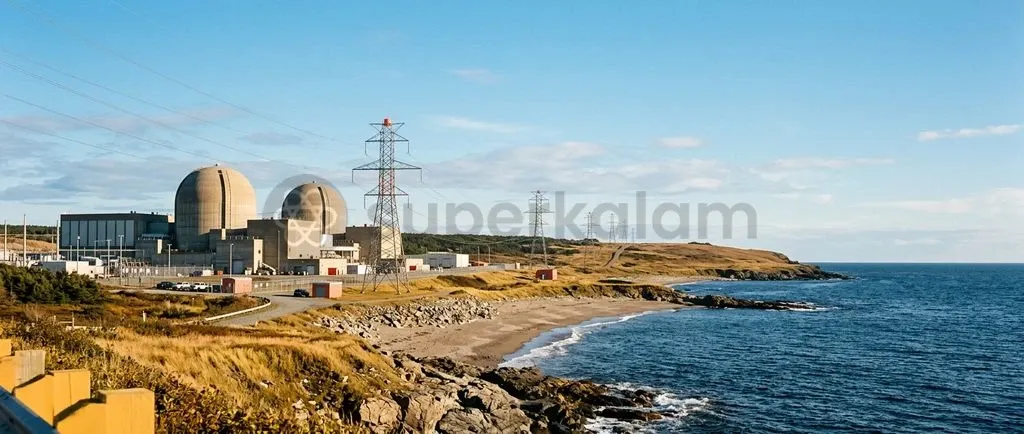
Dr Homi J. Bhabha engineered a sequential three-stage fuel cycle to convert domestic uranium into fissile plutonium. This plutonium then breeds Uranium-233 inside thorium blankets. As of April 2026, the criticality of the 500 MWe Prototype Fast Breeder Reactor at Kalpakkam bridges India's established heavy-water fleet with its ultimate thorium-powered future.
Why India’s Nuclear Strategy Is at a Crossroads
India's clean energy ambitions face a fundamental geological mismatch between scarce uranium resources and vast thorium reserves. According to the Department of Atomic Energy in parliamentary disclosures, India accounts for less than 2% of global uranium reserves but holds approximately 25% of global thorium resources. The Atomic Minerals Directorate for Exploration and Research (AMD) has established approximately 13.15 million tonnes of monazite, containing around 1.18 million tonnes of thorium oxide.
Commercial extraction of these coastal placer deposits remains strictly controlled under statutory oversight:
- Prescribed Substance Status: Monazite is legally classified as a prescribed substance under the Atomic Energy Act, 1962.
- Exclusive State Handling: Mineral extraction and processing are regulated exclusively through Indian Rare Earths Limited (IREL).
- Fertile Physics Barrier: Naturally occurring Thorium-232 is purely fertile, meaning it cannot trigger or sustain nuclear fission without a pre-existing stockpile of fissile fuel.
Stage 2 Fast Breeder Reactors are the mandatory bridge to generate that fissile inventory. Without scaling these breeder reactors, India’s vast thorium reserves cannot generate commercial electricity.
Discuss with Superkalam
Recall the statute and designated public sector enterprise responsible for regulating the extraction and processing of monazite in India.
Ask NowThe 1950s Blueprint: Why Bhabha Bet on a Three-Stage Closed Cycle
Dr Homi J. Bhabha formulated India’s sequential Three-Stage Nuclear Power Programme in 1954 to overcome severe domestic uranium scarcity through an autarkic, closed fuel cycle. Rather than adopting an open fuel cycle where spent fuel is discarded as radioactive waste, the Department of Atomic Energy reprocesses all spent fuel to extract valuable fissile isotopes.
A closed fuel cycle extracts unburnt fissile material and transmutes fertile isotopes into fresh nuclear fuel:
- Thermal Fission Base (Stage 1): Natural uranium fuels heavy-water reactors to generate baseload electricity while transmuting fertile Uranium-238 into Plutonium-239.
- Fast Neutron Breeding (Stage 2): Fast breeder reactors consume Plutonium-239 while breeding additional Plutonium-239 from Uranium-238 blankets and breeding Uranium-233 from Thorium-232 blankets.
- Thorium Self-Sustenance (Stage 3): Thermal and molten salt reactors consume bred Uranium-233 alongside Thorium-232 to sustain an enduring fuel cycle independent of external uranium imports.
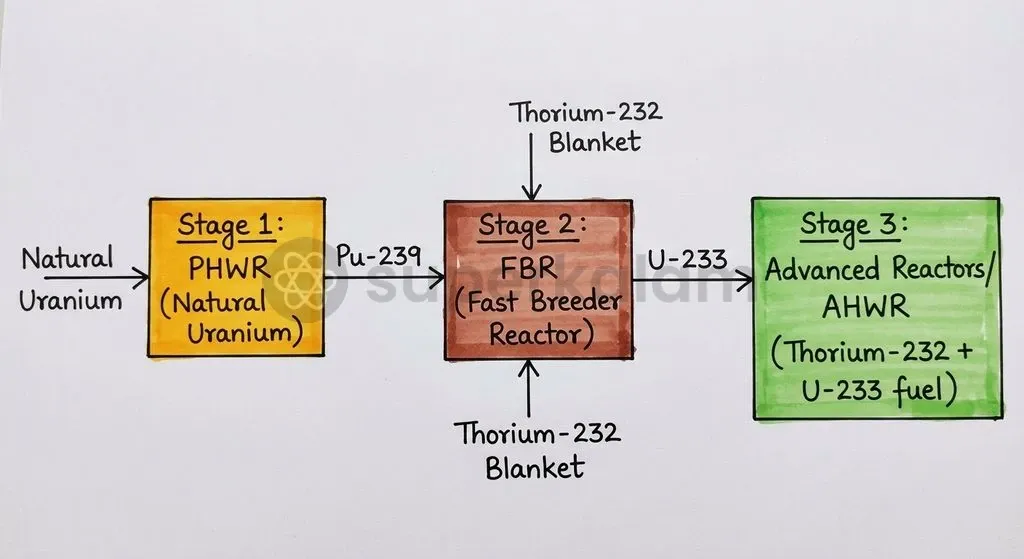
This sequential architecture ensures that every stage produces the exact fissile material required to commission the subsequent stage. The closed-cycle design maximises energy output from limited domestic uranium ore before tapping into the monazite sands.
Discuss with Superkalam
Explain the operational difference between a fertile isotope like Thorium-232 and a fissile isotope like Uranium-235.
Ask NowHow the Three Stages Connect: From Domestic Uranium to Advanced Thorium
The three-stage programme operates as a closed fuel cycle where each reactor type produces the fissile core for the next generation. In Stage 1, the Nuclear Power Corporation of India Limited operates Pressurised Heavy Water Reactors (PHWRs) fuelled by natural uranium. This natural ore contains 0.7% fissile Uranium-235 and 99.3% fertile Uranium-238. Heavy water (deuterium oxide, D2O) acts as both moderator and coolant, allowing un-enriched natural uranium to sustain fission.
During operation, fertile Uranium-238 captures neutrons to transmute into fissile Plutonium-239. This isotope is chemically separated from spent fuel inside dedicated reprocessing facilities.
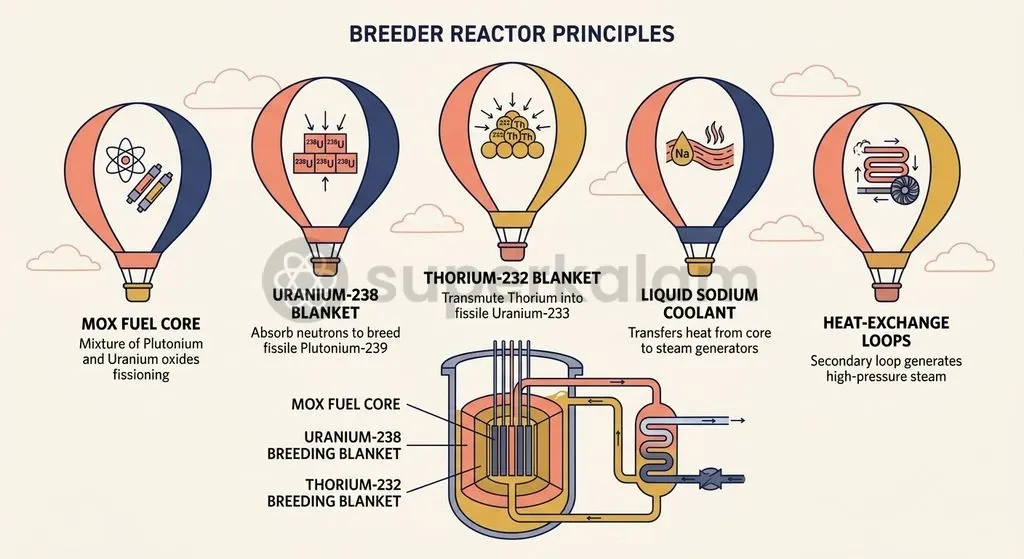
Stage 2 utilises this extracted Plutonium-239 alongside Uranium-238 as Uranium-Plutonium Mixed Oxide (MOX) fuel inside Fast Breeder Reactors (FBRs). These reactors operate without a neutron moderator. High-energy fast neutrons cause fission while simultaneously breeding more fissile material in surrounding blankets than the reactor consumes.
| Feature | Stage 1: PHWR | Stage 2: FBR | Stage 3: AHWR / MSBR |
|---|---|---|---|
| Primary Fuel | Natural Uranium (0.7% U-235) | Uranium-Plutonium MOX | Thorium-232 + Uranium-233 |
| Fertile Blanket | Uranium-238 in core | Dual blanket: U-238 and Th-232 | Thorium-232 |
| Bred Fissile Material | Plutonium-239 | Plutonium-239 and Uranium-233 | Uranium-233 |
| Coolant & Moderator | Heavy Water (D2O) coolant and moderator | Liquid Sodium coolant; no moderator | Heavy Water or Molten Salt |
| Operational Mandate | Electricity and initial Plutonium inventory | Rapid fissile breeding and Thorium irradiation | Commercial Thorium baseload grid power |
Stage 2 reactors carry a dual blanket structure. An inner or radial blanket of Uranium-238 multiplies the Plutonium-239 inventory, while a thorium blanket converts Thorium-232 into Uranium-233.
Once sufficient inventories of Plutonium-239 and Uranium-233 accumulate, Stage 3 can deploy Advanced Heavy Water Reactors (AHWRs) and Molten Salt Breeder Reactors (MSBRs). India already operates the 30 kW thermal KAMINI research reactor at Kalpakkam. It has functioned as the world's only operating Uranium-233 fuelled reactor since 1996.
Discuss with Superkalam
Analyse how the dual blanket configuration in Stage 2 Fast Breeder Reactors simultaneously addresses plutonium breeding and thorium utilization.
Ask NowThe Stage 2 Hurdle: Why Fast Breeder Reactors Are Difficult to Master
Fast Breeder Reactors present demanding mechanical and metallurgical hurdles that have delayed commercial deployment across global nuclear programmes. The Prototype Fast Breeder Reactor (PFBR) at Kalpakkam was engineered by the Indira Gandhi Centre for Atomic Research (IGCAR) and constructed by Bharatiya Nabhikiya Vidyut Nigam Limited (BHAVINI). It delivers an installed capacity of 500 MWe. The facility achieved first criticality on April 6, 2026, positioning India alongside Russia as one of only two nations operating a commercial-scale fast breeder reactor.
The primary technical bottlenecks in Stage 2 centre on materials and chemistry:
- Liquid Sodium Reactivity: Stage 2 FBRs require liquid sodium as a coolant due to its high thermal conductivity and low neutron moderation. However, liquid sodium reacts violently when exposed to air or water, requiring intermediate heat-transport loops and high-integrity boundary seals.
- High-Fluence Material Degradation: Unmoderated fast neutrons induce severe swelling and embrittlement in structural steel and fuel cladding. This requires specialised alloys capable of withstanding intense radiation damage over decades.
- Reprocessing Turnaround Times: Extracting Plutonium-239 and bred Uranium-233 from intensely radioactive spent MOX fuel demands advanced remote-handling infrastructure and precise chemical partitioning.
- Fissile Inventory Accumulation: Commercial Stage 3 deployment remains unviable until a series of operational FBRs run over multiple refueling cycles to accumulate sufficient fissile material.
Discuss with Superkalam
Evaluate the strategic trade-off between relying on imported uranium under NSG safeguards versus the multi-decade investment required for indigenous Fast Breeder Reactors.
Ask NowThe Geopolitical Shift: How the NSG Waiver Changed India’s Uranium Calculus
The 2008 Indo-US Civil Nuclear Agreement and subsequent Nuclear Suppliers Group (NSG) waiver reshaped India’s atomic energy landscape by ending 34 years of international nuclear isolation. India separated its facilities under this framework, placing civilian thermal reactors under IAEA safeguards while retaining an unsafeguarded strategic programme.
This diplomatic breakthrough unlocked several operational advantages:
- Global Fuel Access: India signed bilateral supply contracts with major uranium exporters, including Kazakhstan, Russia, Canada, and Australia.
- Higher Fleet Efficiency: Imported natural and low-enriched uranium resolved chronic domestic shortages, lifting plant load factors across the civilian PHWR fleet.
- Domestic Strategic Allocation: Foreign supplies freed scarce domestic uranium reserves exclusively for the unsafeguarded fast breeder programme.
The NSG waiver transformed natural uranium from an absolute resource barrier into an accessible international commodity. This change altered the immediate economic urgency of transitioning straight into Stage 3.
Economics and Safety: Thorium’s Real-World Promises Versus Technical Roadblocks
Thorium fuel cycles offer distinct physical and proliferation safeguards compared to traditional uranium-plutonium systems. Irradiated Thorium-232 inevitably creates trace quantities of Uranium-232, whose radioactive decay daughter, Thallium-208, emits intense 2.6 MeV gamma radiation. This high-energy gamma field makes clandestine diversion and weaponisation practically impossible while simplifying automated IAEA safeguards detection.
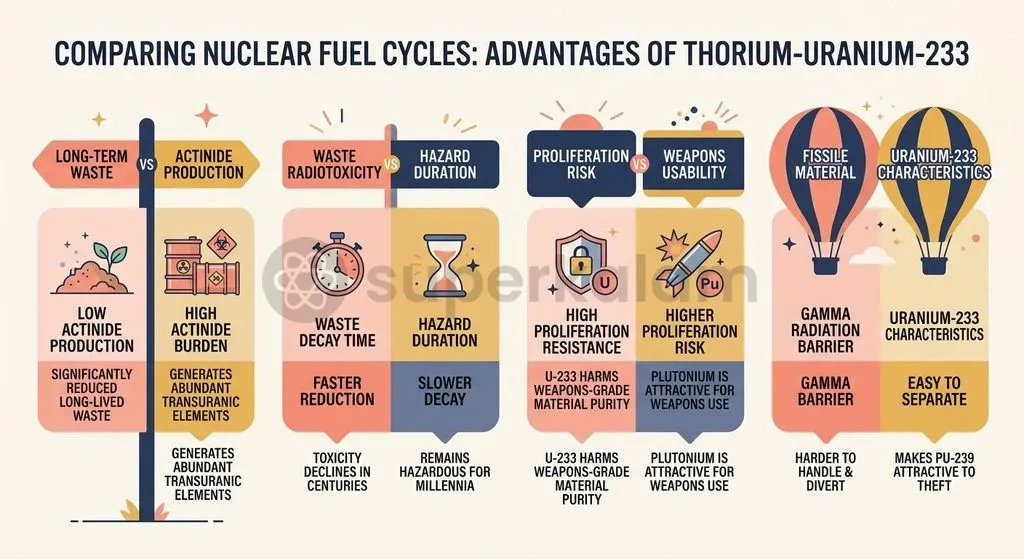
The thorium fuel cycle produces significantly fewer long-lived transuranic minor actinides, but presents steep economic trade-offs:
- Reduced Actinide Waste: Thorium fuel cycles generate negligible quantities of americium, curium, and neptunium, drastically shortening required deep-geological repository cooling periods.
- High Thermal Margins: Thorium dioxide exhibits superior thermal conductivity and higher melting points than standard uranium oxide, offering inherent passive safety margins against core meltdown events.
- Economic Inefficiencies: Fabricating fresh fuel containing recycled Uranium-233 requires heavily shielded, automated hot-cell facilities due to the hard gamma radiation from Uranium-232 decay products.
- Extended Commercial Timelines: Because Stage 2 breeder reactors must double their fissile inventory before seeding Stage 3, substantial commercial thorium electricity generation is realistically projected beyond 2040–2050.
Discuss with Superkalam
Propose a dual-track strategy for India's atomic energy sector that balances imported light-water technology with the domestic Stage 2 fast breeder rollout.
Ask NowWay Forward: A Dual-Track Strategy for India’s Clean Energy Future
India's transition to a thorium-based nuclear economy requires balancing near-term grid expansion with long-term technological mastery. To meet rising baseload demand while advancing towards its Net Zero 2070 targets, India must pursue a structured, two-pronged atomic strategy.
First, India should leverage international civil nuclear commerce to scale Stage 1 capacity rapidly. Expanding imported-uranium Light Water Reactors (LWRs) alongside standardised 700 MWe domestic PHWRs ensures immediate low-carbon baseload generation.
Second, the Department of Atomic Energy must maintain steady capital and engineering support for the commercial scale-up of Stage 2 FBRs. Operational data gathered from the newly critical 500 MWe PFBR at Kalpakkam will prove essential for standardising future commercial breeder designs. Accelerating research into Advanced Heavy Water Reactors and Molten Salt Breeder Reactors at BARC ensures that once sufficient fissile inventories materialise, Stage 3 commercial deployment can proceed without regulatory delay.
Key Takeaways
- India possesses less than 2% of global uranium reserves but approximately 25% of global thorium resources, primarily within 13.15 million tonnes of monazite sands.
- Naturally occurring Thorium-232 is fertile rather than fissile, requiring an external fissile trigger (Plutonium-239 or Uranium-233) bred in earlier stages to sustain nuclear fission.
- The 500 MWe Prototype Fast Breeder Reactor (PFBR) at Kalpakkam achieved first criticality on April 6, 2026, making India only the second country after Russia to operate a commercial-scale fast breeder reactor.
- Stage 2 Fast Breeder Reactors serve as the non-negotiable technological bridge, utilising liquid sodium coolant and fast neutrons to breed fissile Plutonium-239 and Uranium-233.
- The 2008 NSG waiver ended India's nuclear isolation, enabling uranium imports from Kazakhstan, Russia, Canada, and Australia to fuel civilian reactors while domestic uranium supplies the breeder programme.
- Commercial grid integration of Stage 3 thorium reactors is realistically targeted beyond 2040–2050, contingent on accumulating adequate fissile inventories through multiple Stage 2 operational cycles.
Mains Question
"India's clean energy ambitions face a fundamental geological mismatch between scarce uranium resources and vast thorium reserves." In this context, elucidate how Dr Homi Bhabha's three-stage nuclear programme bridges this resource constraint through a closed fuel cycle. (10 Marks)
Evaluate NowMains Question
"While the 2008 Nuclear Suppliers Group (NSG) waiver transformed uranium into an accessible international commodity, mastering Stage 2 Fast Breeder Reactors remains indispensable for India's atomic energy security." Critically examine this statement in light of the technical and operational challenges associated with commercial fast breeder deployment. (15 Marks)
Evaluate NowPractice MCQs
QUESTION 1
With reference to India's Three-Stage Nuclear Power Programme, consider the following statements:
- Pressurised Heavy Water Reactors (PHWRs) in Stage 1 use heavy water as both coolant and moderator to sustain fission with un-enriched natural uranium.
- Fast Breeder Reactors (FBRs) in Stage 2 operate with liquid sodium coolant and do not utilize a neutron moderator.
- Naturally occurring Thorium-232 is a fissile isotope capable of sustaining a chain reaction independently. Which of the statements given above is/are correct?
QUESTION 2
Regarding the statutory and regulatory framework governing nuclear minerals in India, consider the following statements:
- Monazite is legally classified as a prescribed substance under the Atomic Energy Act, 1962.
- Commercial extraction and processing of monazite placer deposits are regulated exclusively through Indian Rare Earths Limited (IREL). Which of the statements given above is/are correct?
QUESTION 3
Consider the following statements regarding the Prototype Fast Breeder Reactor (PFBR) and Stage 2 nuclear technology in India:
- The PFBR at Kalpakkam utilizes a dual blanket structure of Uranium-238 and Thorium-232.
- The KAMINI reactor at Kalpakkam serves as a 500 MWe commercial fast breeder reactor.
- Irradiated Thorium-232 inevitably generates trace Uranium-232, whose decay daughter Thallium-208 emits high-energy gamma radiation. Which of the statements given above is/are correct?
QUESTION 4
Consider the following statements regarding the geopolitical shift following the 2008 Nuclear Suppliers Group (NSG) waiver:
- India placed its strategic nuclear programme under IAEA safeguards while leaving civilian thermal reactors unsafeguarded.
- The waiver enabled India to sign bilateral fuel supply contracts with uranium exporters such as Kazakhstan, Russia, Canada, and Australia. Which of the statements given above is/are correct?
QUESTION 5
With reference to India's nuclear research infrastructure, the KAMINI reactor at Kalpakkam holds distinct significance because it is: