India-Switzerland Mobility Pact 2026: Key Agreements
India and Switzerland signed mobility and young-professional agreements in October 2026. Read the key provisions and migration-cooperation goals.
Oct, 2026
•9 min read
Context
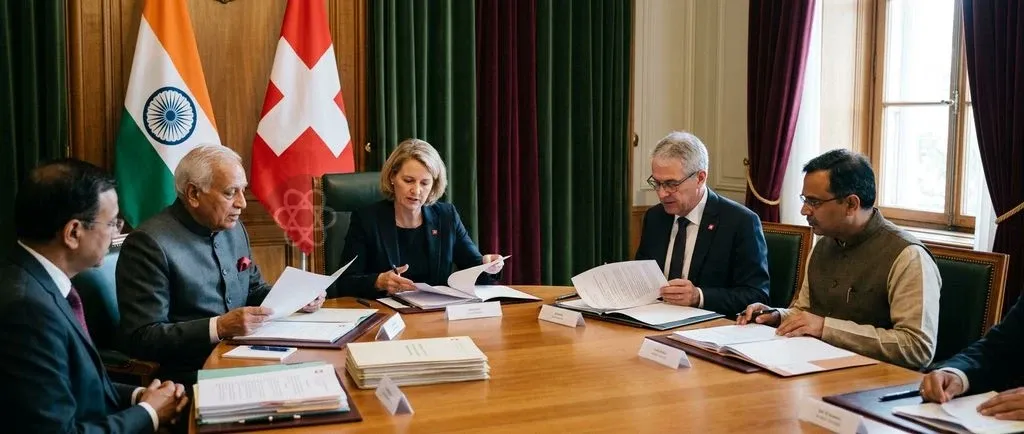
India and Switzerland signed a comprehensive Memorandum of Understanding on Migration and Mobility Partnership on 5 October 2026. The pact establishes streamlined legal pathways for students, researchers, and skilled professionals while instituting binding protocols on orderly return and verification.
The agreement builds upon the landmark India-EFTA Trade and Economic Partnership Agreement signed in March 2024. By creating predictable entry channels and bilateral quotas, the pact seeks to convert high-level commercial commitments into functional talent exchanges. Its operational success depends directly on navigating Switzerland's federal permit quotas and statutory domestic labour preferences.
Why in the News? India and Switzerland Finalise Mobility Framework
On 5 October 2026, India and Switzerland formally concluded a comprehensive Migration and Mobility Partnership Agreement during the State Visit of Swiss President Guy Parmelin to New Delhi. As of October 2026, this bilateral framework institutionalises safe, regular mobility for Indian professionals and students, as noted by the Ministry of External Affairs.
The formal agreement also operationalises a dedicated Young Professionals Scheme alongside binding institutional mechanisms against irregular migration. According to the Ministry of External Affairs, the framework establishes a balanced template connecting commercial commitments with regulated cross-border talent flows.
Discuss with Superkalam
What is the annual quota allocated under the Young Professionals Scheme in the India-Switzerland pact, and to what number can it be expanded?
Ask NowBackground: Evolution of India-EFTA and India-Switzerland Bilateral Ties
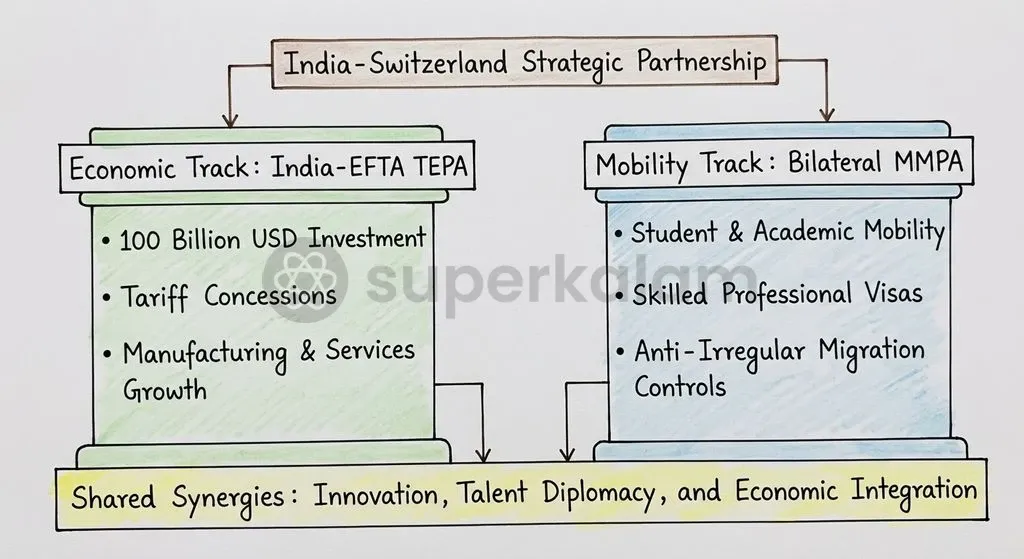
Bilateral economic relations between New Delhi and Bern expanded significantly following the signing of the India-EFTA Trade and Economic Partnership Agreement on 10 March 2024. The four-nation European Free Trade Association committed to promoting $100 billion in direct investment into India over 15 years, according to the Ministry of Commerce and Industry.
Core Pillars of India-EFTA Bilateral Integration
- Trade & Investment Pillar (TEPA, March 2024): Commits to a $100 billion investment target over 15 years and 1 million projected direct jobs.
- Human Capital Pillar (MMPA, October 2026): Introduces the Young Professionals Scheme (300–500 quota), multi-entry visas, renewable student pathways, and standardised readmission protocols.
The investment commitment under TEPA is projected to generate one million direct jobs across life sciences, infrastructure, manufacturing, and high technology. Switzerland represents India's largest trading partner within EFTA, with over 340 Swiss commercial entities operating across the Indian market.
Institutional cooperation has developed steadily over decades. The bilateral Social Security Agreement, in force since May 2011, ensures the totalisation of social security contribution periods, detachment provisions, and the cross-border export of pension benefits. The 2026 mobility pact builds directly on these foundational economic instruments.
What is the India-Switzerland Migration and Mobility Partnership Agreement?
The India-Switzerland Migration and Mobility Partnership Agreement is a formal bilateral framework designed to enable regular migration while curtailing irregular movements. The pact establishes clear administrative guidelines covering academic mobility, corporate transfers, and consular cooperation.
The agreement aligns immigration procedures with international standards, balancing market access with sovereign regulatory controls. Through structured institutional coordination, the framework allows designated categories of Indian nationals to access Swiss academic and employment sectors without circumventing national immigration laws.
Key Provisions: Easier Student Visas, Post-Study Work, and Skilled Professional Mobility
Academic exchanges and skilled labour mobility form the operational core of the bilateral agreement. Eligible Indian travellers can obtain multiple-entry visas valid for up to five years, permitting individual stays of up to six months per visit.
Under the educational provisions, Indian higher education students in Switzerland receive renewable one-year residence permits alongside simplified administrative pathways for advanced academic research. Furthermore, the accompanying Agreement on the Exchange of Young Professionals establishes an annual bilateral quota of 300 young professionals, expandable up to 500 candidates.
| Mechanism / Provision | Operational Details |
|---|---|
| Five-Year Visas | Multiple entry, up to 6 months per visit |
| Student Residence Permits | Renewable 1-year duration for higher education |
| Young Professionals Quota | 300 candidates annually (expandable to 500) |
| Nationality Verification | Strict 30 to 90-day processing window |
The two governments also concluded supplementary arrangements in science and innovation. India's Department of Science and Technology and the Swiss National Science Foundation signed a Letter of Intent for joint scientific consortia. In parallel, an Implementation Arrangement operationalised the Indo-Swiss Academia-Industry Training programme for early-stage technology startups.
A separate memorandum of understanding on transportation technologies covers electric vehicles, tunnelling, ropeways, and circular mobility systems.
Discuss with Superkalam
How does the bilateral Social Security Agreement of 2011 complement the modern Migration and Mobility Partnership Agreement?
Ask NowTackling Irregular Migration and Ensuring Safe Return Mechanisms
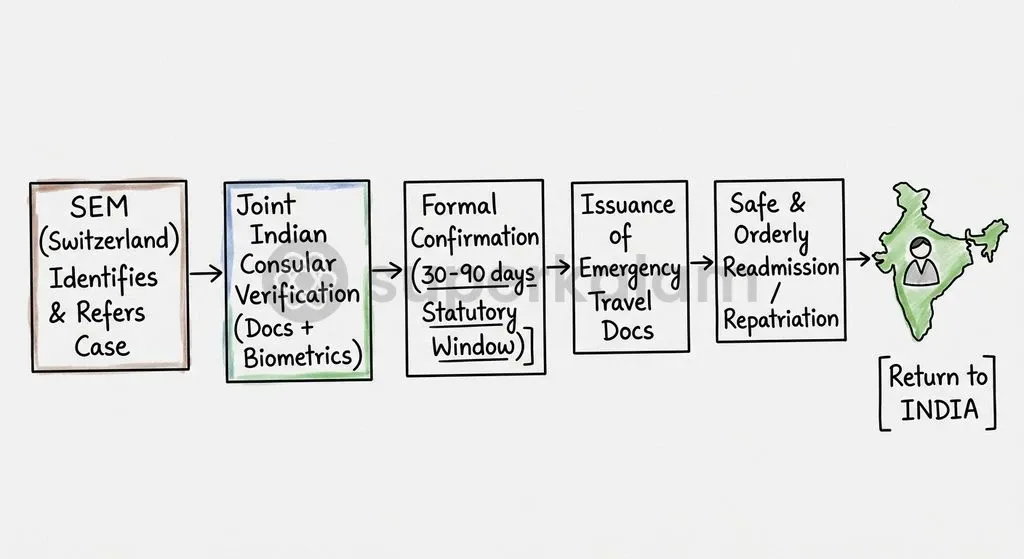
The mobility framework establishes legally binding institutional protocols to suppress irregular migration, document fraud, and human trafficking networks. Standardised readmission procedures ensure the orderly, verified repatriation of individuals who do not meet legal residency requirements.
Under the Young Professionals framework, consular authorities must complete the official verification of nationality and residency status within a strict 30 to 90 days timeline. This time-bound procedure reduces procedural delays. It also strengthens inter-agency coordination between Indian authorities and the Swiss State Secretariat for Migration.
How India's Swiss Pact Compares with Mobility Deals with UK, Germany, and France
India has concluded a series of bilateral Migration and Mobility Partnership Agreements across Europe to secure regular legal corridors for its professionals and students. The Swiss pact reflects this evolving diplomatic strategy while adapting to Switzerland's non-European Union status.
| Dimension | Switzerland (2026) | Germany (2022) | United Kingdom (2021) | France (Extended) |
|---|---|---|---|---|
| Agreement Type | Bilateral MMPA & Young Professionals Agreement | Comprehensive MMPA | Migration & Mobility Partnership | Bilateral Mobility & Talent Passports |
| Young Professional Quota | 300 annually, expandable to 500 | Sector-specific work frameworks | Up to 3,000 annual visas (ages 18–30) | Multi-year post-study schemes |
| Student Visa Terms | Renewable 1-year permits; research pathways | Extended job-search visas for graduates | Graduate Route work rights | 5-year short-stay Schengen visas for alumni |
| Readmission & Verification | 30 to 90-day verification timeline | Standardised consular readmission | Fast-track return protocols | Structured return procedures |
| Integration Basis | India-EFTA TEPA ($100bn investment) | EU strategic partnership | Enhanced Trade Partnership | Strategic bilateral roadmap |
India's agreement with Germany, signed in December 2022, served as the initial blueprint for comprehensive mobility partnerships within continental Europe. In contrast, the India-UK agreement signed in May 2021 provided an annual quota of up to 3,000 visas under its Young Professionals Scheme for degree-holding citizens aged 18 to 30.
India also maintains operational migration pacts with Austria (January 2023) and Italy (November 2023), alongside structured talent corridors with France.
Discuss with Superkalam
If an Indian tech startup seeks to collaborate with Swiss research centres under this pact, which institutional mechanisms would facilitate their engagement?
Ask NowStrategic and Economic Significance for India's Global Talent Diplomacy
The Swiss mobility agreement strengthens India's global talent diplomacy by linking trade commitments with human capital mobility. The Indian diaspora in Switzerland numbers between 25,000 and 30,000 individuals, concentrated primarily in scientific research, information technology, engineering, pharmaceuticals, and multilateral diplomacy.
Facilitating predictable business and academic mobility protects cross-border services trade and reinforces knowledge transfers. By establishing structured legal avenues, the partnership reduces reliance on irregular migration channels. It simultaneously deepens institutional collaboration between Indian educational institutions and Swiss research centres.
Challenges in Implementation: Quotas, Recognition of Qualifications, and Local Labor Rules
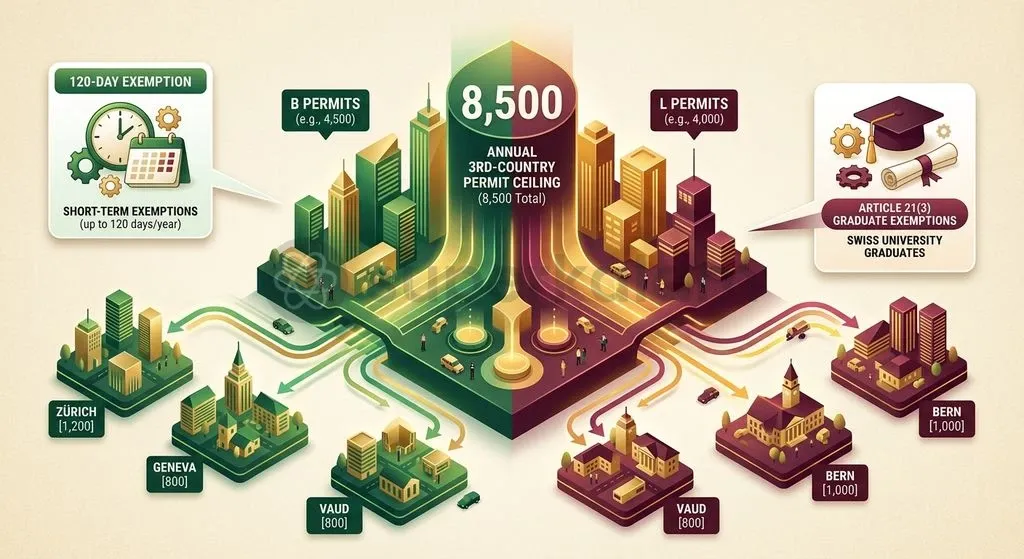
Swiss immigration policy maintains strict statutory barriers that restrict the broad inflow of non-European workers. Under the Ordinance on Admission, Period of Stay and Employment, the Swiss Federal Council enforces an annual national ceiling of 8,500 work permits for non-EU/EFTA third-country nationals.
Allocation of the 8,500 Non-EU/EFTA Annual Quota
- Long-Term B Permits (4,500 permits): For multi-year assignments, distributed between cantons and the federal reserve.
- Short-Term L Permits (4,000 permits): For stays up to one year, allocated based on cantonal economic weight.
- Distribution Mechanism: Divided across the 26 cantons with a central reserve held by the State Secretariat for Migration.
Employers face the domestic labour priority principle (Inländervorrang) under Article 21 of the Swiss Foreign Nationals and Integration Act. This requires proof that no qualified Swiss or EU/EFTA worker is available before hiring a third-country national.
This statutory structure creates a fundamental tension with bilateral mobility goals. While the Young Professionals Scheme establishes an annual corridor of 300 to 500 candidates, Swiss firms seeking to hire Indian professionals outside this specific quota must compete for slots within the national 8,500 permit pool and satisfy cantonal labour priority tests.
Similarly, translating the India-EFTA TEPA target of $100 billion in investment into one million direct jobs will require extensive deployment of technical experts. However, statutory labour caps restrict long-term secondments.
Certain regulatory exemptions mitigate this friction:
- Short-Term Assignments: Work assignments by third-country service providers not exceeding 120 days (or 4 consecutive months) per calendar year remain fully exempt from the federal quota ceiling.
- University Graduate Exemption: Article 21(3) of the Swiss Foreign Nationals and Integration Act permits non-EU/EFTA graduates of recognised Swiss universities to obtain work permits outside standard economic quotas if their employment holds high scientific or economic interest.
Discuss with Superkalam
Compare the quota and eligibility structures of India's mobility agreements with Switzerland, the United Kingdom, and Germany.
Ask NowWay Forward: Maximising Bilateral People-to-People Ties and Economic Value
Maximising the economic benefits of the India-Switzerland mobility pact requires focused institutional coordination across priority areas:
- Streamlining Cantonal Approvals: India's consular representatives should coordinate directly with the Swiss State Secretariat for Migration to ensure uniform processing across all 26 cantons, preventing administrative divergence from delaying visa issuances.
- Leveraging Regulatory Exemptions: Indian technology and engineering enterprises must utilise statutory exemptions, such as the 120-day quota-free short-term assignment rule and post-graduation pathways under Article 21(3) of the FNIA, to facilitate technical exchanges.
- Accelerating Qualification Verification: Consular authorities from both nations must adhere strictly to the 30 to 90-day verification timeline to ensure smooth administration under the Young Professionals Scheme.
- Expanding Research Partnerships: Academic consortia supported by the Department of Science and Technology and the Swiss National Science Foundation should focus on applied areas such as circular economy mobility, tunnelling, and life sciences.
Key Takeaways
- India and Switzerland signed a comprehensive Migration and Mobility Partnership Agreement and an Agreement on the Exchange of Young Professionals on 5 October 2026.
- The mobility pact introduces five-year multiple-entry visas with stays up to six months, renewable one-year student permits, and an annual quota of 300 young professionals (expandable to 500).
- The framework institutes legally binding readmission mechanisms and sets a strict 30 to 90-day timeline for nationality verification to counter irregular migration.
- Implementation must navigate Swiss immigration constraints, including the national ceiling of 8,500 third-country permits and the statutory domestic labour priority principle (Inländervorrang).
- The pact builds upon the India-EFTA Trade and Economic Partnership Agreement signed in March 2024, which targets $100 billion in direct investment over 15 years.
Mains Question
"Bilateral mobility pacts serve as crucial instruments for translating high-level trade commitments into functional economic exchanges." In the light of the India-Switzerland Migration and Mobility Partnership Agreement 2026, elucidate how mobility frameworks complement trade agreements like the India-EFTA TEPA. (10 Marks)
Evaluate NowMains Question
While India's talent diplomacy has secured structured legal corridors across Europe, domestic regulatory restrictions and quota ceilings in host nations pose significant operational hurdles. Critically examine this statement in the context of the India-Switzerland mobility framework. (15 Marks)
Evaluate NowPractice MCQs
QUESTION 1
With reference to the India-Switzerland Migration and Mobility Partnership Agreement signed in 2026, consider the following statements:
- It introduces a dedicated Young Professionals Scheme with an initial annual quota of 300 candidates.
- Under the agreement, eligible Indian travellers can obtain multiple-entry visas valid for up to ten years.
- The pact establishes a strict 30 to 90-day verification timeline for official nationality and residency status. Which of the statements given above are correct?
QUESTION 2
Consider the following statements regarding the economic and mobility architecture between India and Switzerland:
- The Trade and Economic Partnership Agreement (TEPA) signed with EFTA in March 2024 committed to a $100 billion investment target over 15 years.
- A bilateral Social Security Agreement between India and Switzerland has been in force since May 2011 to allow the totalisation of social security contributions.
- Switzerland allocates an uncapped number of work permits for non-EU/EFTA third-country nationals under its federal regulations. Which of the statements given above is/are correct?
QUESTION 3
Regarding the institutional arrangements concluded alongside the India-Switzerland Mobility Framework, consider the following pairs:
- Indo-Swiss Academia-Industry Training programme: Early-stage technology startups
- Transportation Technologies MoU: Electric vehicles, tunnelling, ropeways, and circular mobility
- Department of Science and Technology & Swiss National Science Foundation: Joint scientific consortia How many of the pairs given above are correctly matched?
QUESTION 4
Which among the following European countries served as the initial blueprint for India's comprehensive Migration and Mobility Partnership Agreements within continental Europe in December 2022?
QUESTION 5
With reference to the Swiss regulatory framework for non-EU/EFTA third-country nationals, consider the following statements:
- Long-Term B Permits are capped at 4,500 annually and distributed between cantons and the federal reserve.
- Short-Term L Permits are valid for stays up to three years. Which of the statements given above is/are correct?