India's Nuclear Doctrine: Evolution, Command Structure, and Triad
Balancing No First Use with credible minimum deterrence, India's strategic nuclear posture ensures second-strike survivability under strict civilian control.
Sep, 2026
•10 min read
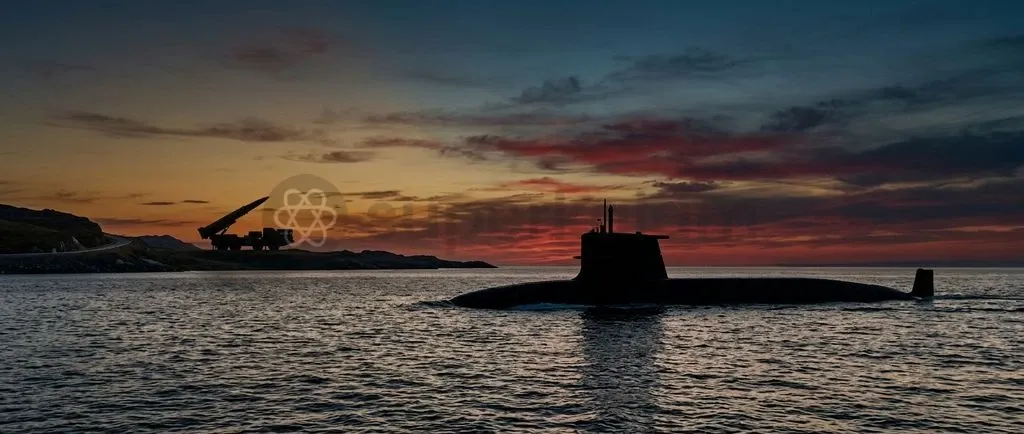
Overview
India’s nuclear doctrine balances a strict No First Use commitment with an assured retaliatory posture designed to deter adversaries. Codified officially by the Cabinet Committee on Security in January 2003, this strategic framework anchors national defence on Credible Minimum Deterrence, negative security assurances to non-nuclear weapon states, and complete civilian-political oversight through the Prime Minister-led Nuclear Command Authority.
As regional dynamics introduce tactical battlefield weapons and rapid triad modernisation, India’s operational posture is evolving toward calculated technological readiness and strategic ambiguity. This posture reinforces second-strike survivability without discarding political restraint.
Why India's Nuclear Posture Remains Central to Strategic Security
India's national security strategy relies on nuclear deterrence to protect territorial sovereignty against nuclear-armed neighbours along contested borders. The doctrine provides a predictable framework. It prevents military coercion while avoiding destabilising regional arms competition.
Southern Asian security is uniquely shaped by a contiguous tri-nuclear dynamic involving India, Pakistan, and China. This geopolitical reality requires New Delhi to maintain an assured second-strike capability that survives surprise decapitation strikes, as codified in official doctrine.
Indian nuclear weapons serve deterrence rather than war-fighting. By establishing a high atomic threshold, the framework preserves critical space for conventional diplomatic and military options during cross-border crises.
Discuss with Superkalam
What was the operational codename and date of India's first underground nuclear explosion conducted at Pokhran?
Ask NowHow India Became a Declared Nuclear State: From 1974 to 1998
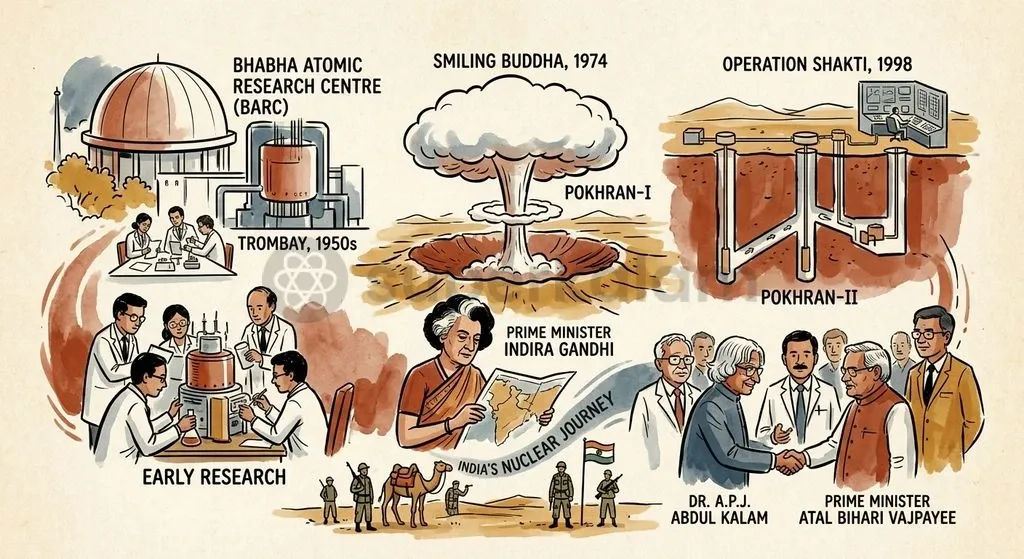
India transitioned toward overt nuclear weaponisation through underground testing at the Pokhran test range in the Thar Desert. Over two decisive decades, strategic calculations shifted from technological demonstration to declared capability.
Key historical milestones in this transition include:
- Operation Smiling Buddha (18 May 1974): India conducted its first underground nuclear explosion, designated as a Peaceful Nuclear Explosion. While validating plutonium implosion physics, India refrained from immediate weaponisation and advocated universal disarmament.
- Treaty Pressure (1995–1996): The indefinite extension of the Non-Proliferation Treaty in 1995 and the 1996 Comprehensive Nuclear-Test-Ban Treaty threatened to close the strategic window for non-signatories.
- Operation Shakti (11 and 13 May 1998): India conducted five underground nuclear tests at Pokhran. This step established India as a declared nuclear-armed state and led directly to formal doctrine drafting.
The Core Pillars: No First Use and Credible Minimum Deterrence Explained
The Cabinet Committee on Security codified India's official nuclear doctrine on 4 January 2003 to govern its strategic arsenal. The policy rests upon four interlinked operational pillars designed to signal restraint and resolve simultaneously.
According to the Cabinet Committee on Security press release, the primary tenets include:
- No First Use (NFU): Nuclear weapons will only be used in retaliation against a nuclear attack on Indian territory or on Indian forces anywhere.
- Massive Retaliation: Retaliation to a first strike will be massive and designed to inflict unacceptable damage on the aggressor.
- Credible Minimum Deterrence (CMD): The state maintains sufficient, survivable strategic assets to ensure retaliatory punishment without engaging in an open-ended numbers race.
- Non-Use Against Non-Nuclear States: India extends a negative security assurance by pledging never to use nuclear weapons against countries lacking atomic arsenals.
A critical operational caveat qualifies this defensive stance. The Cabinet Committee on Security explicitly retained the right to respond with nuclear weapons if Indian forces or territory suffer a major attack using biological or chemical weapons. This provision ensures comprehensive deterrence against all categories of weapons of mass destruction.
| Doctrinal Pillar | Strategic Mechanism | Primary Operational Objective |
|---|---|---|
| No First Use (NFU) | Retaliatory-only deployment | Prevents pre-emptive regional crises and inadvertent nuclear escalation |
| Credible Minimum Deterrence | Dynamic, survivable second strike | Avoids expensive arms racing while guaranteeing devastating retaliation |
| Massive Retaliation | High-volume punitive counter-value strikes | Maximises deterrence credibility to deter any initial atomic use |
| Negative Security Assurance | Non-use against non-nuclear states | Strengthens diplomatic legitimacy and non-proliferation credentials |
| CBRN Caveat | Retaliation against chemical/biological strikes | Closes strategic loopholes against unconventional mass attacks |
Discuss with Superkalam
Explain how the functional division between the Political Council and the Executive Council enforces civilian supremacy over the armed forces.
Ask NowDiscuss with Superkalam
Suppose an adversary initiates a major battlefield strike using chemical munitions against deployed Indian forces. Apply India's codified doctrine to determine the permissible strategic response options.
Ask NowNuclear Triad: Sea, Air, and Land-Based Second-Strike Capability
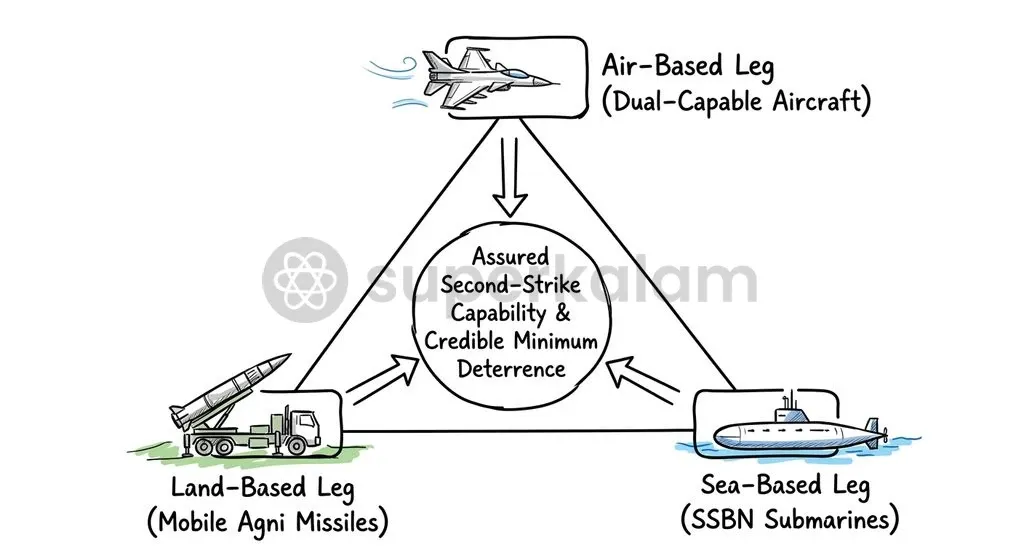
The Indian Armed Forces maintain an operational nuclear triad across land, air, and sea domains to guarantee second-strike survival. Triad survivability ensures that an adversary cannot eliminate India's retaliatory capabilities in a surprise first strike.
The triad comprises three distinct delivery legs:
- Land-Based Leg: Mobile ballistic missile systems provide high-readiness retaliatory firepower. According to annual reports from the Ministry of Defence and DRDO, this leg deploys solid-fuel systems from the Agni missile series (Agni-I through Agni-V) alongside canisterised Agni-Prime missiles mounted on road and rail launchers. The maiden test of the Agni-5 with Multiple Independently Targetable Re-entry Vehicle technology under Mission Divyastra on 11 March 2024 significantly enhanced delivery efficiency against complex missile defence shields.
- Air-Based Leg: Combat aircraft provide flexible, recallable delivery options. Modified multirole platforms, including the Mirage 2000, Su-30MKI, and Rafale, are configured for gravity bombs and standoff munitions.
- Sea-Based Leg: Ballistic missile submarines provide the most survivable leg of the triad. The commissioning of India's second indigenous nuclear-powered ballistic missile submarine, INS Arighaat, on 29 August 2024 at Visakhapatnam strengthened continuous undersea deterrence.
Comparison: India, Pakistan, and China's Nuclear Doctrines
Regional nuclear doctrines in Southern Asia reflect contrasting security environments, risk appetites, and strategic cultures. Understanding these distinctions is essential for analysing deterrence stability across the subcontinent.
| Dimension | India | Pakistan | China |
|---|---|---|---|
| Stated Posture | No First Use (NFU) with Credible Minimum Deterrence | Full Spectrum Deterrence (First-Use Posture) | No First Use (NFU) with Mutual Assured Retaliation |
| Command Structure | Civilian-led Nuclear Command Authority (headed by Prime Minister) | Military-dominated National Command Authority | Central Military Commission (headed by CCP General Secretary) |
| Tactical Weapons | Rejects tactical weapons; views any nuclear use as strategic | Deploys low-yield Hatf-IX (Nasr) tactical missiles | Concentrates primarily on strategic and theatre-range systems |
| Retaliatory Threshold | Massive retaliation inflicting unacceptable damage | Low threshold linked to conventional, territorial, or economic peril | High threshold; focused on secure second-strike counter-value punishment |
| Delivery Triad | Fully operational triad (Agni series, SSBNs, multirole aircraft) | Primarily land-based missiles and dual-capable aircraft | Advanced triad including ICBM silo fields and Type 094/096 SSBNs |
Pakistan adopts a posture of Full Spectrum Deterrence, integrating tactical nuclear weapons like the short-range Hatf-IX (Nasr) system to deter Indian conventional superiority.
Conversely, China's expanding nuclear triad—including expanding ICBM silo fields and modern Type 094/096 SSBNs—presents long-range deterrence challenges along India's northern frontier.
Discuss with Superkalam
Analyse the structural differences between India's 'Credible Minimum Deterrence' and Pakistan's 'Full Spectrum Deterrence' in terms of escalation control.
Ask NowModern Strategic Pressures: Tactical Nukes, Hypersonics, and the NFU Debate
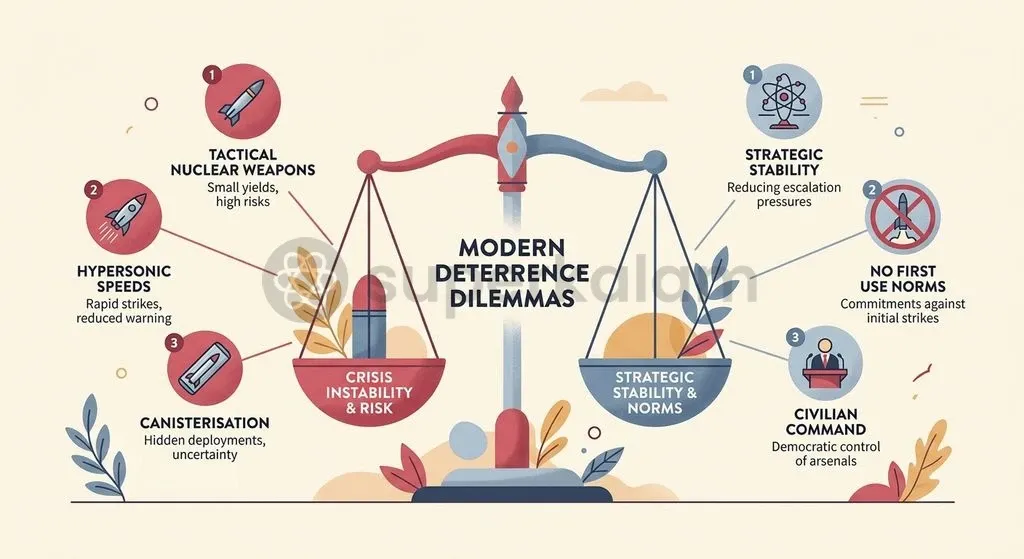
The Strategic Forces Command faces evolving deterrence challenges created by regional missile modernisation and low-yield battlefield weapons. These developments have prompted debate regarding whether India's strict No First Use posture requires greater ambiguity.
Pakistan's operationalisation of battlefield nuclear systems aims to exploit perceived space between conventional conflict and strategic retaliation. In response, former National Security Advisory Board Chairman Shyam Saran clarified in a keynote address on 24 April 2013 that India makes no distinction between tactical and strategic atomic weapons, reiterating that any nuclear strike on Indian forces triggers massive retaliation.
Doctrinal debate intensified following official remarks regarding strategic flexibility. Defence Minister Rajnath Singh stated at Pokhran on 16 August 2019 that while India has strictly adhered to No First Use, "what happens in future depends on the circumstances".
| Doctrinal Position | Core Strategic Arguments |
|---|---|
| Retain Strict NFU | Preserves international diplomatic legitimacy, reduces launch-on-warning pressures, maintains de-mated warhead posture, and upholds responsible nuclear power norms. |
| Adopt Strategic Ambiguity | Deters pre-emptive strikes by adversaries, neutralises tactical nuclear blackmail, leverages canisterised missile readiness, and complicates hostile operational planning. |
Technological shifts, particularly the deployment of canisterised missiles and hypersonic glide vehicles, challenge traditional de-mated postures by compressing decision-making timelines. Retaining a degree of doctrinal flexibility strengthens deterrence by complicating adversary war plans. This posture ensures New Delhi is never tactically constrained during high-intensity confrontations.
Ethical Dimension: Deterrence Ethics and Global Non-Proliferation
Nuclear deterrence introduces complex ethical dilemmas by relying on the threat of catastrophic civilian harm to preserve peace. This dynamic, known as Mutually Assured Destruction, forces states to reconcile immediate national defence with humanitarian principles.
To balance deterrence requirements with global disarmament norms, India pursues several institutional commitments:
- Universal Disarmament Advocacy: In June 1988, New Delhi presented the Rajiv Gandhi Action Plan at the UN General Assembly Special Session on Disarmament, proposing a phased, non-discriminatory elimination of all atomic weapons.
- Verifiable Global Treaties: According to the Cabinet Committee on Security press release from January 2003, India continues to advocate for a nuclear-weapon-free world achieved through global, verifiable disarmament agreements.
- Export Controls and Testing Moratorium: India maintains a voluntary unilateral moratorium on testing and enforces strict export control standards aligned with the Missile Technology Control Regime, the Wassenaar Arrangement, and the Australia Group.
Discuss with Superkalam
Evaluate whether India's No First Use policy weakens or enhances deterrence credibility in a contiguous tri-nuclear security environment.
Ask NowThe Way Forward: Balancing Deterrence Credibility with Strategic Restraint
India's strategic planners must continuously calibrate the nuclear posture to preserve deterrence stability without triggering an uncontrollable regional arms race. Sustainable strategic stability requires technological upgrades alongside institutional strengthening.
To maintain credible deterrence across coming decades, policy focus should centre on the following priorities:
- Hardening the Undersea Deterrent: Accelerate the construction and deployment of next-generation SSBNs to ensure continuous at-sea deterrence patrols in the Indian Ocean.
- Upgrading Early-Warning Architectures: Expand space-based sensor constellations and radar networks to guard against emerging hypersonic threats and compressed launch timelines.
- Institutionalising Command Redundancy: Regularly test and upgrade alternative communication links to guarantee seamless connectivity between the Political Council and the Strategic Forces Command during electronic or cyber warfare.
- Advancing Global Disarmament Diplomacy: Continue championing non-discriminatory, legally binding international arrangements that reduce the operational salience of nuclear weapons worldwide.
Key Takeaways
- India's official nuclear doctrine, codified on 4 January 2003, is grounded in No First Use, Credible Minimum Deterrence, and Massive Retaliation to inflict unacceptable damage.
- The doctrine retains an explicit caveat permitting nuclear retaliation if Indian territory or armed forces face a major attack by chemical or biological weapons.
- Absolute civilian-political control is maintained through the Nuclear Command Authority, where the Prime Minister-led Political Council holds sole launch authorisation.
- The nuclear triad is operationalised across land (Agni series), air (multirole aircraft), and sea (indigenous SSBNs including INS Arighaat).
- New Delhi upholds a voluntary test moratorium and supports universal, non-discriminatory nuclear disarmament as envisioned in the 1988 Rajiv Gandhi Action Plan.
Mains Question
"The institutional design of India's Nuclear Command Authority guarantees absolute civilian-political oversight while securing credible retaliatory survivability." In this context, elucidate the structure and operational mechanisms of the Nuclear Command Authority. (10 Marks)
Evaluate NowMains Question
"India's nuclear doctrine anchors regional stability on Credible Minimum Deterrence and No First Use, contrasting sharply with the deterrence postures of its nuclear-armed neighbours." Examine this statement in light of the tri-nuclear dynamics in Southern Asia. (15 Marks)
Evaluate NowPractice MCQs
QUESTION 1
With reference to the core tenets of India's Nuclear Doctrine codified in 2003, consider the following statements:
- Nuclear weapons will only be used in retaliation against a nuclear attack on Indian territory or on Indian forces anywhere.
- India explicitly reserves the right to respond with nuclear weapons in the event of a major attack against India or Indian forces using biological or chemical weapons.
- The doctrine commits India to a posture of proportional response rather than massive retaliation to avoid escalation.
Which of the statements given above is/are correct?
QUESTION 2
Regarding the institutional setup of the Nuclear Command Authority (NCA), consider the following statements:
- The Political Council is chaired ex-officio by the Prime Minister and is the sole body empowered to authorise operational nuclear release.
- The Executive Council is chaired ex-officio by the National Security Advisor to provide advisory inputs and execute operational directives.
- The Strategic Forces Command is headed directly by the Defence Minister for operational weapon custody.
Which of the statements given above is/are correct?
QUESTION 3
Consider the following statements regarding India's operational nuclear triad and strategic delivery systems:
- INS Arighaat is India's second indigenous nuclear-powered ballistic missile submarine commissioned to strengthen continuous undersea deterrence.
- Mission Divyastra marked the maiden test of the Agni-5 missile equipped with Multiple Independently Targetable Re-entry Vehicle (MIRV) technology.
- India's land-based leg incorporates short-range tactical nuclear weapons for battlefield-level counter-force strikes.
Which of the statements given above is/are correct?
QUESTION 4
Consider the following historical milestones in the evolution of India's nuclear capability:
- Operation Smiling Buddha in 1974 was designated as a Peaceful Nuclear Explosion and validated plutonium implosion physics.
- Operation Shakti in May 1998 involved five underground nuclear tests at the Pokhran test range.
Which of the statements given above is/are correct?
QUESTION 5
Under India's officially codified nuclear doctrine, what does the principle of 'Negative Security Assurance' signify?