India's Dengue Vaccine Dilemma: Qdenga vs Indigenous R&D
Navigating the trade-offs between imported private vaccines and cost-effective indigenous R&D for India's public health immunization framework.
Jul, 2026
•10 min read
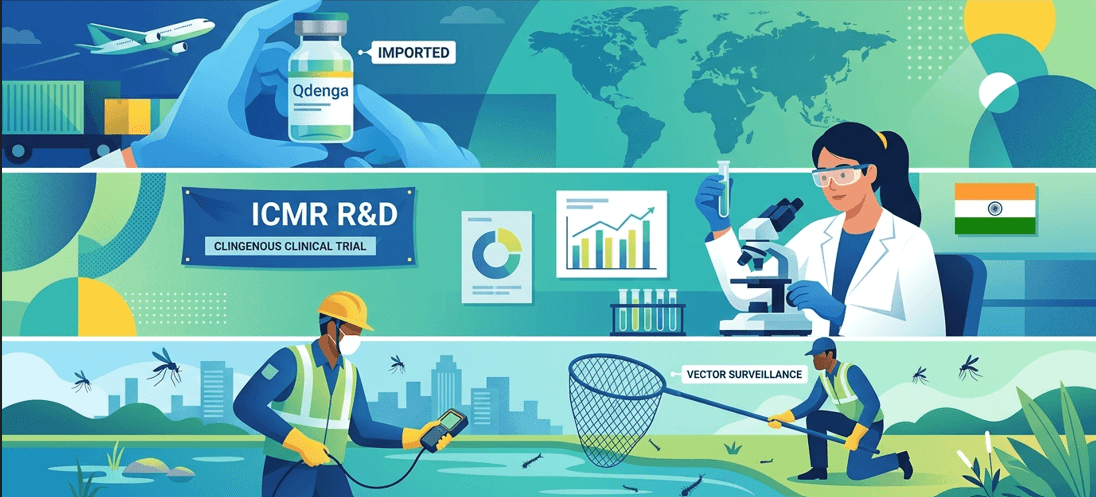
Fig: Navigating India's dengue challenge requires balancing imported vaccine technology with indigenous clinical pipelines and municipal sanitation.
India's dengue vaccine strategy navigates a trade-off between immediate private-market availability of Takeda's imported vaccine Qdenga and the long-term public health deployment of cost-effective indigenous candidates such as Panacea Biotec's DengiAll. While Qdenga offers approved protection for individuals aged 4 to 60, its potential fiscal burden on the Universal Immunization Programme necessitates reliance on domestic research pipelines alongside vector control. As of July 2026, the Central Drugs Standard Control Organisation has granted market authorisation to Qdenga, requiring post-marketing surveillance within six months. Meanwhile, the Indian Council of Medical Research is actively evaluating DengiAll in a national Phase 3 trial involving 10,335 adult participants across 18 states and Union Territories. Because vaccines provide partial long-term protection of approximately 61% against symptomatic infection, public health governance must combine immunization with traditional vector management to address India's multi-billion-dollar annual dengue burden effectively.
Why Dengue Vaccine Strategy is Making Headlines Now
As of July 2026, the Central Drugs Standard Control Organisation (CDSCO) granted market authorisation to Takeda's Qdenga, marking India's first approved dengue vaccine. This regulatory milestone addresses a severe public health crisis, as India accounts for nearly one-third of the global dengue burden. According to data from the National Centre for Vector Borne Diseases Control (NCVBDC), India reported over 233,000 cases and 236 deaths in 2024.
All four dengue virus serotypes—DENV-1, DENV-2, DENV-3, and DENV-4—co-circulate across Indian states. A serotype is a distinct variation within a virus species. Co-circulation of multiple serotypes dramatically heightens the risk of secondary infections, leading to severe complications such as Dengue Hemorrhagic Fever.
From a constitutional perspective, managing vector-borne epidemics falls under the state's mandate to improve public health under Article 47 of the Constitution. Article 47 forms part of the Directive Principles of State Policy (DPSP) in Part IV, serving as a non-justiciable directive to guide governance. This duty intersects with the justiciable Fundamental Right to life and health guaranteed under Article 21 in Part III, making the equitable availability of dengue interventions a critical policy focus.
TL;DR
- First Vaccine Approval: The CDSCO approved Takeda's Qdenga (TAK-003) in July 2026 for individuals aged 4 to 60 years, featuring a two-dose schedule administered three months apart without requiring baseline blood screening.
- Indigenous Pipeline Progress: The Indian Council of Medical Research (ICMR) and Panacea Biotec initiated Phase 3 trials for 'DengiAll'—a single-dose tetravalent candidate—on 14 August 2024 across 10,335 participants in 19 clinical sites.
- Fiscal Constraints: Health economists estimate Qdenga's private market cost at ₹6,000–₹12,000 for a full two-dose course (as reported by The Indian Express in July 2026), presenting severe budgetary challenges for public sector procurement under the Universal Immunization Programme.
- Integrated Control Necessary: Immunization cannot substitute municipal sanitation, as vaccines offer partial efficacy (~61% long-term against symptomatic infection) and do not suppress Aedes aegypti mosquito breeding.
- Research Gap & Uncertainty: Private market pricing and distribution timelines for Qdenga remain tentative ahead of its reported H1 2027 commercial rollout, while DengiAll's final public rollout depends on trial completion.
Understanding the Contenders: Imported Qdenga versus Indigenous Pipelines
The Central Drugs Standard Control Organisation (CDSCO) regulates both imported candidates like Takeda's Qdenga and indigenous vaccines like Panacea Biotec's DengiAll. Evaluating dengue vaccines requires understanding specific biological mechanisms that influence candidate selection.
Takeda's Qdenga (TAK-003) is a two-dose subcutaneous vaccine administered three months apart. In global pivotal Phase 3 trials (the TIDES study), Qdenga demonstrated 80.2% overall efficacy against virologically confirmed dengue at 12 months and achieved an 84% reduction in hospitalisations over 4.5 years. A key advantage of Qdenga is that it does not require pre-vaccination serological screening. However, clinical data revealed lower and variable efficacy against DENV-3 and DENV-4 serotypes in seronegative individuals. To support domestic supply, Takeda established a manufacturing partnership with Hyderabad-based Biological E to produce up to 50 million doses annually.
Panacea Biotec, in collaboration with the Indian Council of Medical Research (ICMR), is leading domestic efforts with 'DengiAll'. DengiAll is a single-dose, live-attenuated tetravalent vaccine formulation derived from the TV003/TV005 strain developed by the US National Institutes of Health (NIH), with process patents held by Panacea Biotec in India. ICMR initiated India's first Phase 3 clinical trial for DengiAll on 14 August 2024, enrolling over 10,335 healthy adult participants aged 18 to 60 across 19 clinical trial sites in 18 Indian states and Union Territories.
Serum Institute of India (SII) is independently advancing another tetravalent live-attenuated dengue candidate through Phase II clinical trials under CDSCO oversight.
| Parameter | Qdenga (TAK-003) | DengiAll (ICMR / Panacea Biotec) |
Developer / Sponsor | Takeda Pharmaceutical (Japan) | ICMR and Panacea Biotec (India) |
Vaccine Type | Live-attenuated tetravalent vaccine | Live-attenuated tetravalent (NIH TV003/TV005 strain) |
Dosing Schedule | Two-dose subcutaneous regimen (0 and 3 months) | Single-dose formulation |
Clinical Trial Status | Approved by CDSCO (July 2026) for ages 4–60 | Phase 3 trial initiated (14 August 2024; 10,335 participants) |
Pre-Vaccination Screening | Not required | Not required |
Operational Advantage | High overall early efficacy (80.2%) & 84% hospitalisation drop | Single-dose schedule eliminates patient loss to follow-up |
Key Limitations | Lower efficacy against DENV-3/DENV-4 in seronegative individuals | Phase 3 completion and regulatory reviews ongoing |
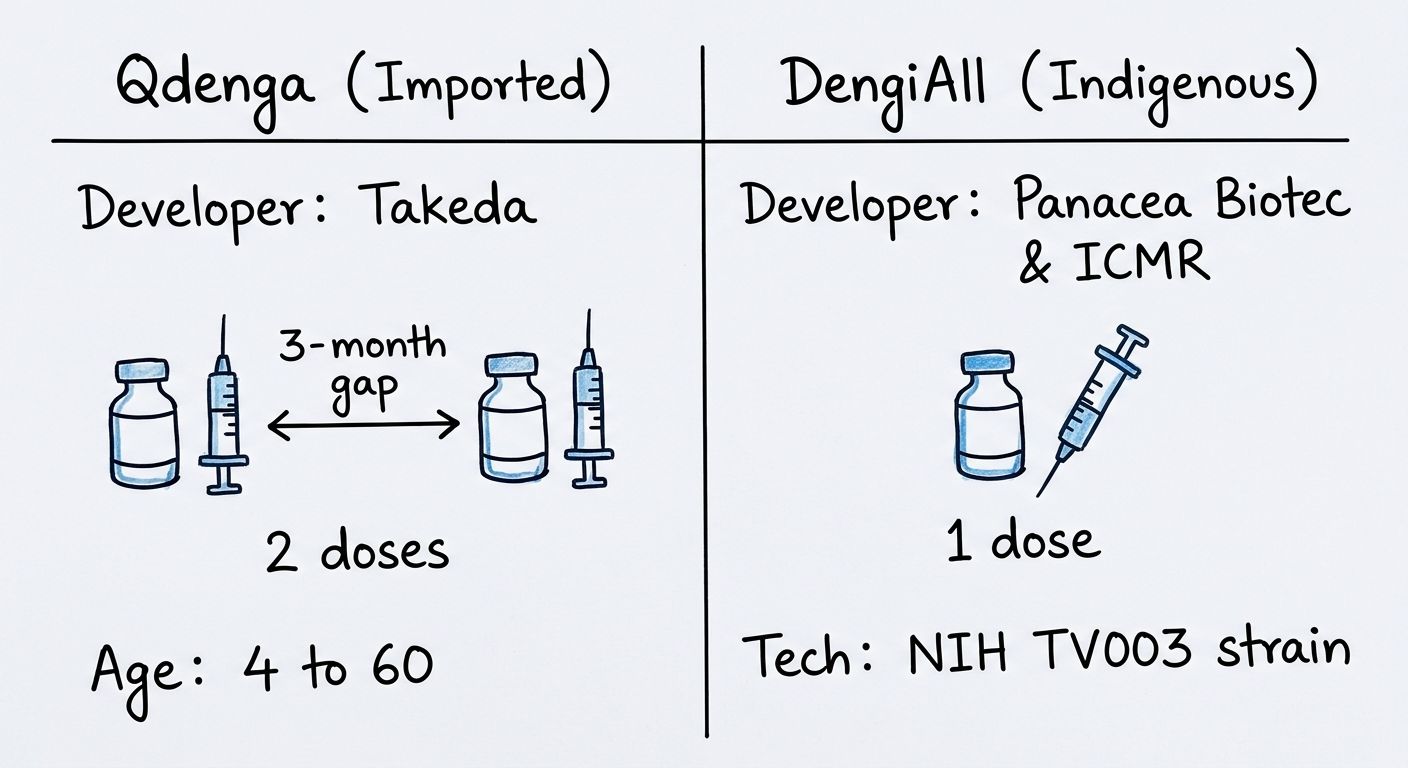
Fig: Key structural differences between Qdenga's two-dose regimen and DengiAll's single-dose tetravalent formulation.
Discuss with Superkalam
Recall the four co-circulating dengue serotypes in India and the participant count in DengiAll's Phase 3 clinical trial.
Ask NowComparing Approaches: Global Vaccine Rollout Models versus India's Vector Control Reality
The World Health Organization (WHO) Strategic Advisory Group of Experts (SAGE) recommends introducing Qdenga into routine national immunization programmes specifically in high-transmission areas where dengue seroprevalence exceeds 60% among children aged 6 to 16 years. Dengue seroprevalence indicates the percentage of a population carrying antibodies against the virus, confirming past exposure.
Public health experts at the ICMR stress that dengue vaccination cannot replace integrated vector management. Vaccines offer partial long-term protection—approximately 61% against symptomatic infection over extended follow-ups—and do not eliminate mosquito vectors.
The National Centre for Vector Borne Diseases Control (NCVBDC) oversees vector management strategies across Indian states. These strategies target Aedes aegypti mosquitoes through specific interventions:
- Source Reduction: Physical removal of stagnant urban water collections in domestic containers, discarded tires, and construction sites.
- Chemical Control: Application of anti-larval chemical treatments to breeding sites and indoor space-spraying (fogging) during outbreaks.
- Biological Control: Introduction of larvicidal fish species, such as Gambusia affinis, into water bodies to devour mosquito larvae.
Without sustained municipal sanitation, mass vaccination alone cannot stop local dengue transmission.
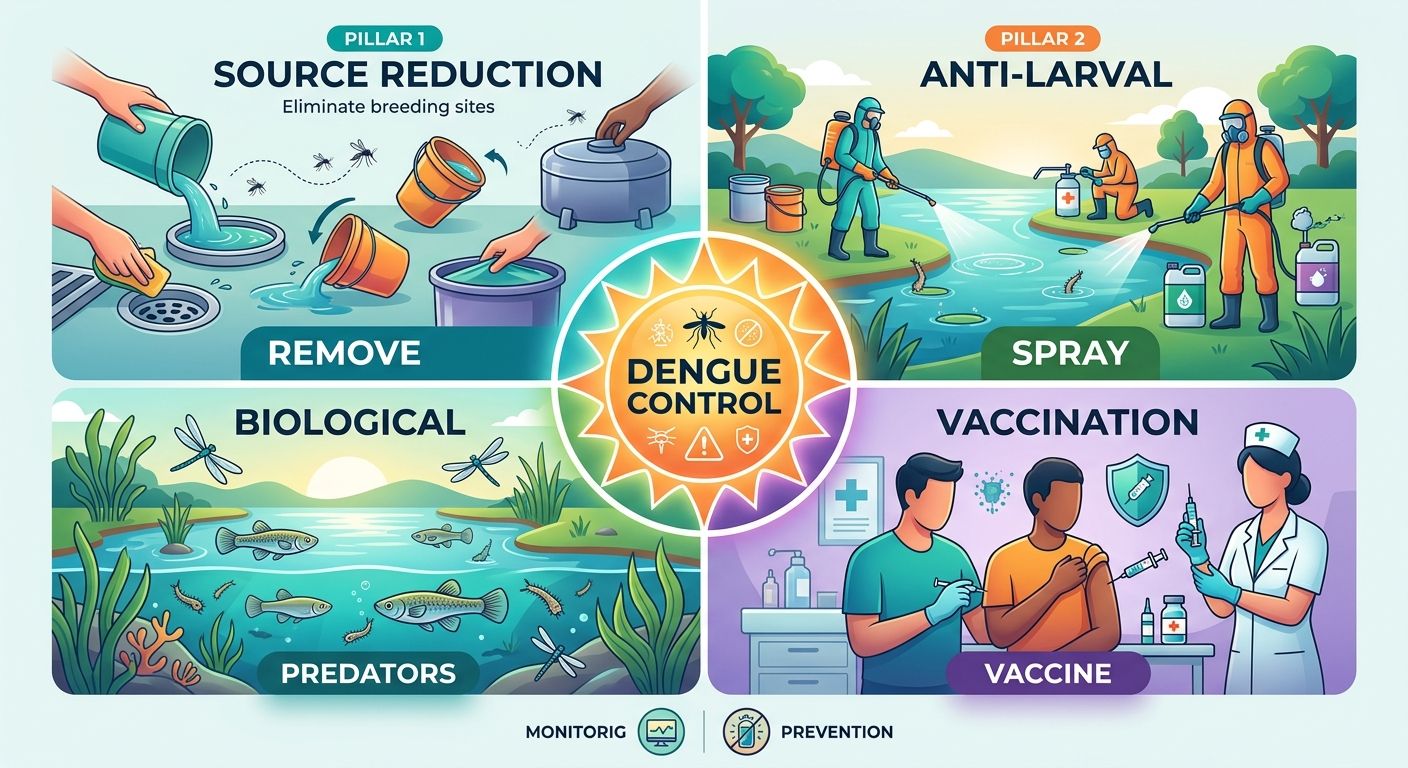
Fig: Integrated Vector Management combines biological, chemical, and physical source control to support vaccine efficacy.
Balancing Fiscal Realities: Public Procurement Economics and Out-of-Pocket Burdens
Public health economists evaluating the Universal Immunization Programme (UIP) highlight the extreme fiscal contrast between imported vaccines and indigenous options. Dengue places a substantial financial drain on India's healthcare system.
An economic study published in the Journal of Infection and Public Health calculated the total economic burden of dengue in India at $5.71 billion in 2016. Non-fatal cases accounted for 85.7% of these total direct medical costs and indirect productivity losses. Most families pay for outpatient diagnostic tests and inpatient care through direct out-of-pocket expenditure, increasing financial vulnerability among lower-income households.
Health economists estimate that Qdenga will cost between ₹3,000 and ₹6,000 per dose in India's private market, bringing the complete two-dose course to ₹6,000–₹12,000 (as reported by The Indian Express in July 2026). This price structure poses severe fiscal challenges for national rollout under the Universal Immunization Programme (UIP).
Single-dose indigenous candidates like DengiAll provide clear public sector procurement advantages. Eliminating the second dose lowers administration expenses and prevents loss to follow-up during mass vaccination campaigns.
Discuss with Superkalam
How would WHO SAGE guidelines guide dengue vaccine deployment in a high-seroprevalence district?
Ask NowNavigating Regulatory Hurdles and Clinical Trial Realities in India
The Central Drugs Standard Control Organisation (CDSCO) Subject Expert Committee attached explicit post-approval stipulations when authorizing Takeda's Qdenga. Post-marketing surveillance is mandatory because dengue clinical trial outcomes vary significantly based on regional seroprevalence and background immunity profiles.
The CDSCO required Takeda to initiate a post-marketing safety and effectiveness study within six months of launching Qdenga in the Indian market. Takeda anticipates that Qdenga will become commercially available in Indian private healthcare settings during the first half of 2027 (as reported by Reuters in July 2026).
Indigenous candidates operate under strict clinical monitoring schedules. The Phase 3 trial protocol for DengiAll includes a mandatory two-year post-vaccination monitoring period for all 10,335 enrolled participants before final efficacy data is submitted to the CDSCO (as reported by Hindustan Times in July 2025). This multi-year follow-up ensures trial safety and measures long-term efficacy against all four circulating serotypes.
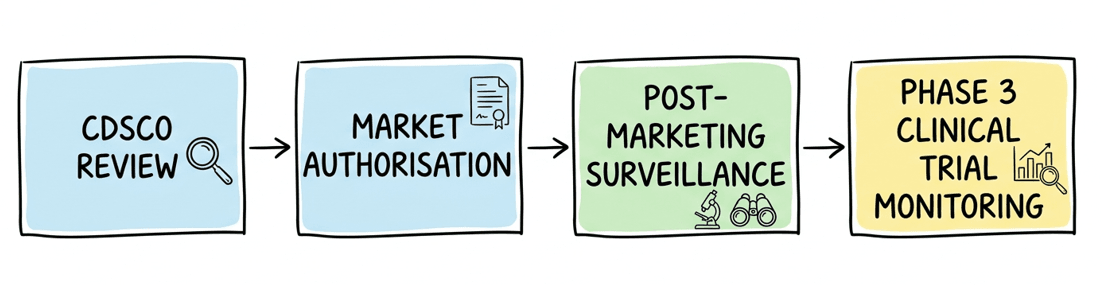
Fig: CDSCO regulatory oversight requires post-marketing surveillance for imported vaccines and multi-year trial monitoring for domestic candidates.
Risk Analysis & Contingency Planning: What If Indigenous R&D Falters?
The Ministry of Health and Family Welfare faces significant regulatory and fiscal risks if indigenous candidates like DengiAll experience Phase 3 delays or fail to meet primary endpoints. Public health strategy currently assumes that a cost-effective domestic vaccine will power national immunisation drives. If DengiAll experiences setbacks, relying exclusively on private-market imported vaccines could exacerbate health inequities across Indian states.
To manage potential R&D delays, public health authorities can deploy three specific policy levers:
- Tiered Procurement Negotiations: The Ministry of Health can leverage Takeda's manufacturing agreement with Biological E to negotiate bulk public procurement rates for Qdenga. Local manufacturing of up to 50 million doses annually provides leverage to lower per-dose costs for public health drives.
- Targeted Endemic Hotspot Rollouts: Rather than executing immediate national coverage, public health authorities can deploy Qdenga exclusively in high-transmission districts matching WHO SAGE criteria—where pediatric dengue seroprevalence exceeds 60%. This targeted approach maximises public health returns while containing fiscal outlays.
- Diversified Domestic Pipelines: CDSCO can accelerate clinical trial review pathways for secondary domestic candidates, such as the tetravalent vaccine currently in Phase II trials at the Serum Institute of India. Maintaining multiple domestic pipelines prevents reliance on any single manufacturer.
Discuss with Superkalam
Should imported dengue vaccines be excluded from the Universal Immunization Programme due to high costs?
Ask NowThe Way Forward: Harmonizing Vaccination with Comprehensive Vector Control
The National Centre for Vector Borne Diseases Control (NCVBDC) must integrate emerging vaccine rollouts into broader municipal vector management frameworks. A single intervention cannot eliminate vector-borne diseases.
- Strengthen Municipal Sanitation: Urban local bodies must enforce anti-larval measures, waste management, and drainage maintenance alongside vaccine deployment.
- Establish Serosurveillance Networks: ICMR and NCVBDC should establish state-level serosurveillance to map dengue seroprevalence accurately, ensuring vaccines are deployed where transmission rates cross WHO SAGE thresholds.
- Expand Domestic Manufacturing Capacity: Public institutions should continue supporting partnerships with domestic manufacturers like Panacea Biotec and Biological E to maintain long-term supply chain independence.
Integrating vector control with targeted vaccination will help protect vulnerable populations and reduce the overall economic burden of dengue in India.
Mains Question
"Vaccines offer partial long-term protection against symptomatic dengue infection and cannot serve as a direct substitute for municipal vector management." Critically examine this statement in the context of India's co-circulating dengue serotypes and WHO SAGE rollout guidelines.
Evaluate NowMultiple Choice Questions
QUESTION 1
Q1. Regarding dengue vaccines and regulatory approvals in India, consider the following statements:
- Takeda's Qdenga (TAK-003) requires mandatory pre-vaccination serological screening prior to administration.
- Panacea Biotec's DengiAll is a single-dose tetravalent live-attenuated vaccine candidate derived from the NIH TV003/TV005 strain.
- The Central Drugs Standard Control Organisation (CDSCO) granted market authorisation to Qdenga as India's first approved dengue vaccine.
Which of the statements given above are correct?
QUESTION 2
Q2. What is the primary operational advantage of the indigenous vaccine candidate 'DengiAll' over the imported vaccine 'Qdenga'?
QUESTION 3
Q3. With reference to public health administration in India, the state's mandate to improve public health is explicitly articulated under which constitutional provision?