India-Poland Trade Target: Doubling to $12 Billion by 2030, Explained
Doubling commerce to $12 billion demands navigating EU carbon tariffs and regulatory caps by pivoting into high-tech defence and green co-production.
Oct, 2026
•10 min read
Overview
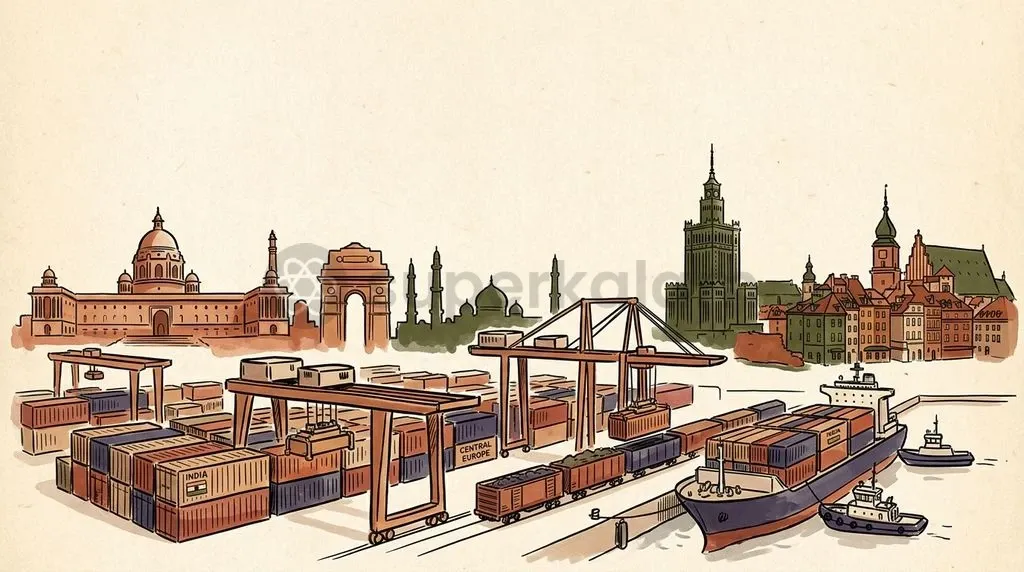
India and Poland's ambitious pact to double bilateral trade to approximately $12 billion by 2030 marks a pivotal geopolitical reorientation toward Central Europe, yet reaching this benchmark hinges on transforming bilateral commerce from traditional goods into high-value technological co-production while navigating stringent European Union regulatory barriers. Formalised during Polish Prime Minister Donald Tusk's official visit to New Delhi, the roadmap builds upon the 2024 Strategic Partnership and a five-year Action Plan spanning defence, energy, and digital services. However, because common commercial policy remains an exclusive EU competence under Article 207 of the Treaty on the Functioning of the European Union, New Delhi cannot negotiate an isolated trade treaty with Warsaw. Fulfilling the $12 billion target therefore requires overcoming overarching European Union carbon tariffs, sanitary barriers, and regional economic headwinds.
Why in the News: The Push for a $12 Billion Bilateral Target
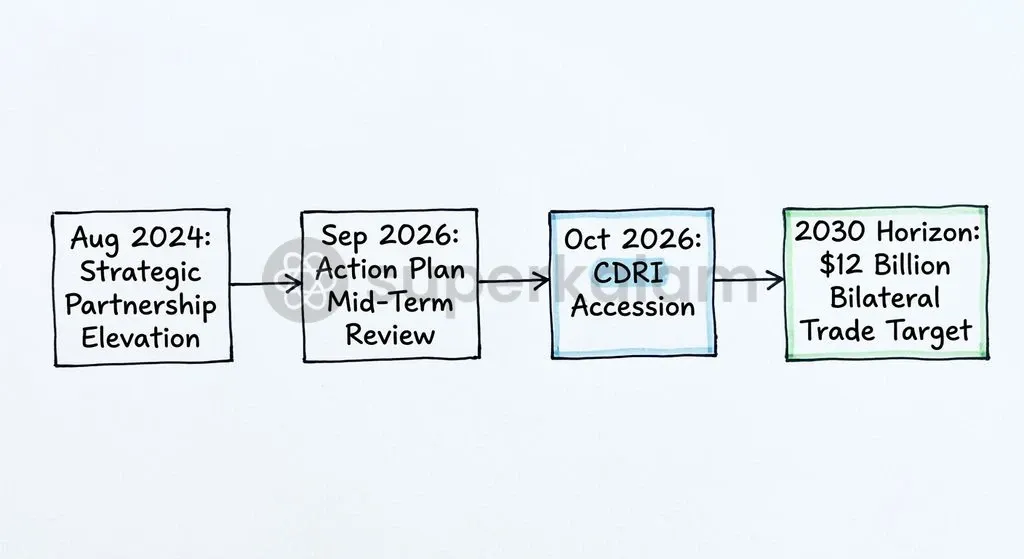
Prime Minister Narendra Modi and Polish Prime Minister Donald Tusk formally agreed in New Delhi to double bilateral trade to approximately $12 billion by 2030. As of October 2026, the diplomatic momentum between the two nations reflects an unprecedented political re-engagement across Central Europe. This high-level dialogue builds directly upon the formal elevation of bilateral ties to a Strategic Partnership during Prime Minister Modi's visit to Warsaw in August 2024, which marked the first visit by an Indian Prime Minister to Poland in 45 years.
Diplomatic engagement gained operational structure through the adoption of a five-year bilateral Action Plan covering 2024 to 2028 across political, economic, defence, and scientific domains. The foreign ministers of both nations completed the mid-term review of this framework in September 2026, setting specific commercial milestones across clean technology, mining, and advanced engineering.
Multilateral alignment accompanied these bilateral economic targets. Poland formally joined the Coalition for Disaster Resilient Infrastructure, an international partnership launched and hosted by India to enhance infrastructure climate resilience. The visit highlighted enduring historical goodwill, rooted in the sanctuary granted during World War II to over 1,000 Polish children by Jam Saheb Digvijaysinhji of Nawanagar and over 5,000 refugees at Valivade in Kolhapur.
Discuss with Superkalam
Which specific provision of the Treaty on the Functioning of the European Union bars Poland from negotiating an independent bilateral trade treaty with India?
Ask NowThe Baseline Math: What Annual Growth Rate Is Needed to Hit $12 Billion?
India and Poland registered approximately $6.36 billion in two-way merchandise trade in calendar year 2025, recording a 192% expansion from $1.95 billion in 2013. According to trade figures from the Central Statistical Office of Poland and the Embassy of India in Warsaw, bilateral commerce sustained steady momentum over the past decade, turning Poland into New Delhi's primary trading outpost within Central and Eastern Europe.
Expanding bilateral merchandise and services trade from the current $6.36 billion baseline to $12 billion by 2030 requires a sustained compound annual growth rate (CAGR) of approximately 13.5% to 15%. Achieving this pace demands that export volumes expand significantly faster than the historical trend recorded over the preceding five years.
| Trade Parameter | Historical Benchmark (2013) | Current Baseline (2025) | Target Level (2030) | Required Trajectory |
|---|---|---|---|---|
| Bilateral Trade Volume | $1.95 billion | $6.36 billion | $12.00 billion | Sustained expansion |
| Trade Balance Position | India surplus | India export surplus | Structural equilibrium | Value-added growth |
| Implied Growth Rate | Baseline setup | ~9.8% nominal CAGR | 13.5% to 15.0% CAGR | Requires industrial pivot |
| Governing Framework | Basic bilateral pacts | 2024–2028 Action Plan | Comprehensive EU-India FTA | Multilateral alignment |
Poland remains India's largest trading and investment partner in Central and Eastern Europe, with New Delhi enjoying a consistent bilateral export surplus. Sustaining a 13.5% to 15% annual growth rate is unachievable through traditional consumer exports alone. Trade expansion must diversify into capital-intensive, high-technology industrial supply chains to overcome volume caps on basic goods.
Discuss with Superkalam
Explain the operational mechanism of the European Union's Carbon Border Adjustment Mechanism and why it poses a cost barrier to Indian steel and aluminium exporters.
Ask NowPoland as Central Europe's Hub: The Strategic Drivers Powering Trade
Prime Minister Donald Tusk positioned Poland as an industrial and logistical gateway for Indian enterprises entering the wider 450-million-consumer European Single Market. Poland's geographic location links maritime Baltic supply routes with trans-continental European transport corridors, offering Indian exporters an integrated distribution springboard into Central and Eastern Europe.
Institutional outreach expanded beyond bilateral channels into regional mechanisms. India and the Visegrád Group (V4)—comprising Poland, Hungary, the Czech Republic, and Slovakia—convened their inaugural Foreign Ministers' meeting to institutionalise cooperation on supply-chain resilience, transport connectivity, and defence industrial partnerships.
Several high-growth industrial sectors provide practical mechanisms to bridge the bilateral trade gap:
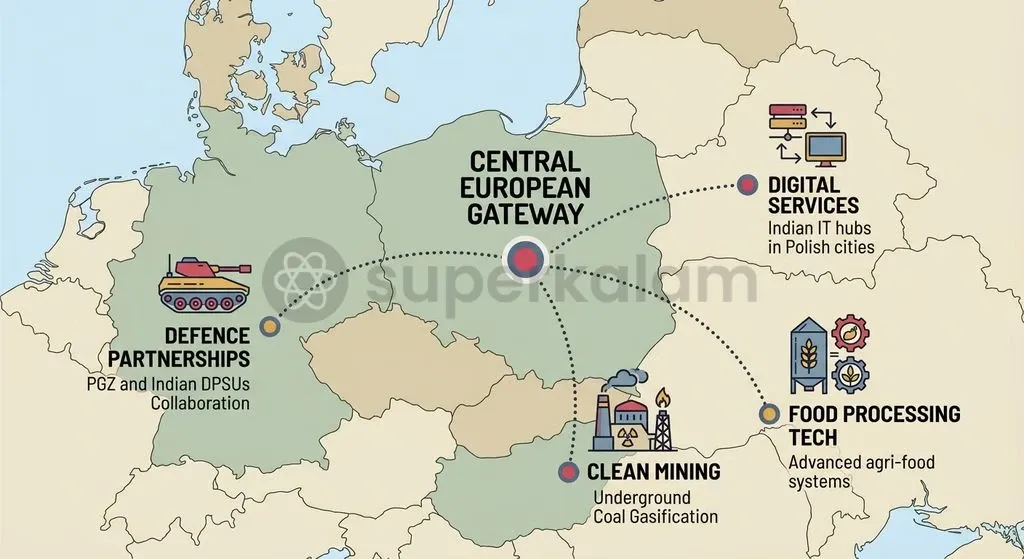
- Defence Co-production and Joint R&D: Both governments formalised an institutional Defence Industry Dialogue to facilitate military technology sharing and joint production. Direct engagements commenced between Indian Defence Public Sector Undertakings and the Polish state-owned defence conglomerate Polska Grupa Zbrojeniowa following the 8th Joint Working Group on Defence Cooperation in September 2026. This modern engagement builds upon historical industrial partnerships, such as the licensed assembly of WZT-3 Armoured Recovery Vehicles by Bharat Earth Movers Limited in collaboration with Poland's Bumar-Łabędy.
- Information Technology and Professional Services: Indian software leaders, including Tata Consultancy Services, Infosys, Wipro, and HCLTech, maintain major delivery centres across Warsaw, Łódź, and Wrocław, employing thousands of local professionals. Per the Ministry of External Affairs (as reported, October 2026), both nations are negotiating a bilateral Social Security Agreement to avoid dual social security contributions and support professional mobility.
- Agro-processing and Cold-chain Infrastructure: Bilateral authorities resumed the Joint Working Group on Agriculture to enable technology transfers in cold-chain logistics, post-harvest processing, and food preservation.
- Clean Energy and Mining Technology: Bilateral agreements established industrial cooperation in underground coal gasification and advanced mine reclamation techniques, supporting India's national mandate to gasify 100 million tonnes of coal by 2030.
Discuss with Superkalam
Analyse why conventional merchandise trade alone cannot sustain the 13.5% to 15% CAGR needed to reach the $12 billion target by 2030.
Ask NowThe Friction Points: How EU Regulations and Logistics Hold Trade Back
Article 207 of the Treaty on the Functioning of the European Union establishes common commercial policy as an exclusive EU competence, preventing Poland from concluding a separate bilateral free trade agreement with New Delhi. External tariffs, market access rules, and product quotas applied at Polish ports are determined entirely by the European Commission in Brussels.
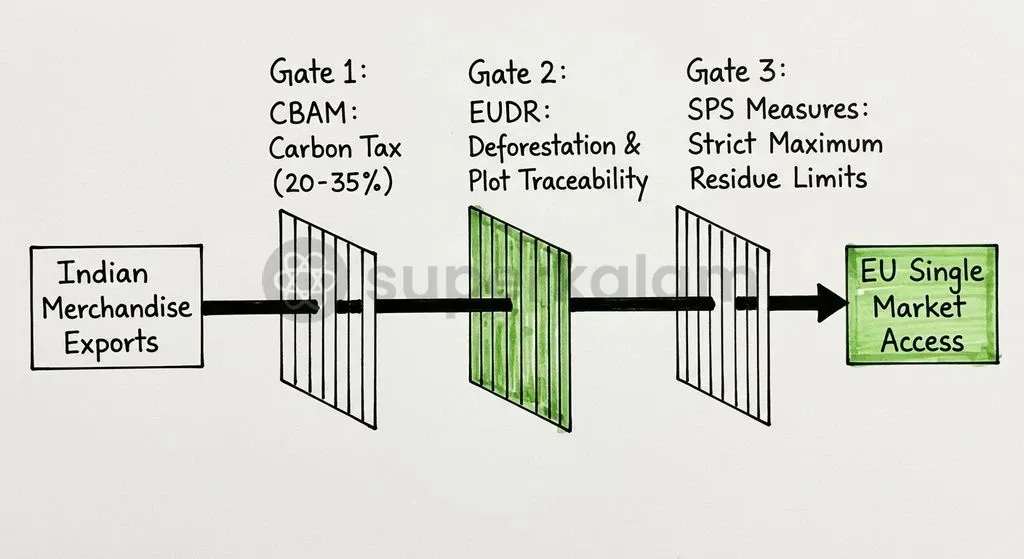
European environmental and supply-chain regulations impose significant compliance burdens on Indian exporters. The European Union's Carbon Border Adjustment Mechanism enforces carbon tariffs ranging from 20% to 35% on carbon-intensive goods, directly raising import costs on Indian aluminium and steel shipments entering European supply networks.
Simultaneously, the EU Deforestation Regulation mandates rigorous geolocation mapping and certified deforestation-free supply chains, introducing elevated administrative compliance costs for Indian exporters of rubber, coffee, leather, and timber. According to the Ministry of Finance's Economic Survey 2024-25, these non-tariff regulatory interventions could disrupt up to $9.5 billion worth of Indian merchandise exports directed toward European Union markets.
Non-tariff sanitary standards present persistent bottlenecks for agro-food and pharmaceutical merchandise. Indian exporters encounter stringent Maximum Residue Limits and rigorous Sanitary and Phytosanitary measures that frequently delay agricultural shipments at European ports.
Geopolitical divergence introduces additional strategic frictions. Divergent stances regarding European sanctions on Russian energy and trade require careful diplomatic management during bilateral deliberations. Compounding these regulatory hurdles, sluggish macroeconomic growth across the eurozone limits overall European import demand for manufactured goods.
Discuss with Superkalam
Evaluate whether Poland's geographic and logistical position can successfully offset the regulatory frictions imposed by Brussels on Indian enterprises entering the European Single Market.
Ask NowThe Feasibility Verdict: Why the Target Demands More Than Business-as-Usual
Achieving the $12 billion bilateral trade target demands a structural departure from traditional trade, as European macroeconomic deceleration caps organic growth across conventional merchandise export sectors. Standard commercial exchanges dominated by intermediate textiles, basic chemical compounds, and unworked metals cannot generate the 13.5% to 15% CAGR required to bridge the $5.64 billion gap between current trade levels and the 2030 objective.
Regulatory trade barriers further penalise unprocessed exports. European border adjustments and deforestation rules disproportionately target basic commodities, eroding profit margins for small-scale exporters. Growth must instead stem from technology co-development, defence production, and corporate service integration.
| Structural Dimension | Business-as-Usual Approach | High-Technology Strategic Pathway |
|---|---|---|
| Export Composition | Base metals, bulk agro-commodities, apparel | Advanced electronics, aerospace parts, green tech |
| EU Regulatory Exposure | Severe tariff exposure under CBAM and EUDR | High compliance resilience via certified manufacturing |
| Services Integration | Standalone offshore IT support contracts | Integrated R&D centres and engineering consultancies |
| Institutional Driver | Ad-hoc business chamber buyer-seller meets | Defence Industry Dialogue and B2B joint ventures |
| Trade Policy Anchor | Reliance on general market mechanisms | Comprehensive India-EU Free Trade Agreement |
Prime Minister Narendra Modi and Polish Prime Minister Donald Tusk explicitly called for the early conclusion, ratification, and implementation of the India-EU Free Trade Agreement to unlock systemic market access. Without this umbrella trade treaty to ease non-tariff barriers, bilateral commerce will struggle to reach its target.
Way Forward: A Policy Roadmap to Unlock Diversified Trade Corridors
New Delhi must deploy targeted institutional mechanisms to shield bilateral commercial expansion with Poland from external regulatory shocks and logistic bottlenecks. Expanding bilateral trade toward the $12 billion target requires coordinated reforms spanning trade diplomacy, industrial standardisation, and services integration.
- Conclude the Bilateral Social Security Agreement: Ministry of External Affairs negotiators must prioritise the early finalisation of the bilateral Social Security Agreement. Eliminating dual social security deductions will protect the mobility of Indian software engineers, lowering operational costs for Indian IT delivery centres operating across Warsaw, Wrocław, and Katowice.
- Institutionalise Defence Co-production Frameworks: The Ministry of Defence should translate engagements from the 8th Joint Working Group on Defence Cooperation into concrete manufacturing joint ventures. Partnering domestic defence firms with Poland's Polska Grupa Zbrojeniowa for vehicle modernisation, sub-system fabrication, and unmanned aerial platforms can establish stable, high-value export streams.
- Harmonise Domestic Standards with EU Regulations: The Department of Commerce should establish national compliance testing facilities to align domestic production with European standards. Assisting agricultural, chemical, and metal exporters in tracking carbon intensity and meeting Maximum Residue Limits will preserve market access against incoming CBAM and EUDR penalties.
- Operationalise the Visegrád Group Commercial Platform: External affairs planners must use regular India-V4 foreign ministerial meetings to position Poland as a multi-modal distribution gateway. Integrating Indian transport corridors with Central European rail freight networks will reduce maritime shipping transit times to the European Single Market.
Key Takeaways
- Bilateral merchandise trade between India and Poland stood at approximately $6.36 billion in 2025, requiring a sustained compound annual growth rate of 13.5% to 15% to achieve the $12 billion target by 2030.
- Poland is India's premier commercial and investment partner across Central and Eastern Europe, with New Delhi sustaining an active bilateral trade surplus.
- Under Article 207 of the Treaty on the Functioning of the European Union, common commercial policy is an exclusive EU competence, preventing Warsaw from executing an independent bilateral trade agreement with India.
- European regulatory barriers, notably the Carbon Border Adjustment Mechanism (20% to 35% duties) and the EU Deforestation Regulation, pose compliance risks to approximately $9.5 billion of Indian exports entering the EU.
- Future commercial expansion relies on high-value industrial sectors, including defence co-production via Polska Grupa Zbrojeniowa, IT delivery networks, clean coal gasification, and agricultural processing technology.
- Details regarding the finalised operational clauses and signature timeline of the proposed India-Poland Social Security Agreement remain subject to ongoing diplomatic negotiations .
Mains Question
Article 207 of the Treaty on the Functioning of the European Union establishes common commercial policy as an exclusive EU competence. In this context, examine the institutional and regulatory impediments confronting India's target to double bilateral trade with Poland to $12 billion by 2030. (10 Marks)
Evaluate NowMains Question
'Transforming bilateral commerce from traditional goods into high-value technological co-production is essential for India's strategic footprint in Central Europe.' Critically analyse the potential and challenges of diversifying India-Poland economic engagement beyond conventional merchandise trade. (15 Marks)
Evaluate NowPractice MCQs
QUESTION 1
Consider the following statements regarding the bilateral framework between India and Poland:
- Poland is prohibited from signing an independent bilateral Free Trade Agreement with India under Article 207 of the Treaty on the Functioning of the European Union.
- Bilateral commercial and strategic engagement is guided by a five-year Action Plan spanning 2024 to 2028.
- Poland has formally joined the India-hosted Coalition for Disaster Resilient Infrastructure. Which of the statements given above is/are correct?
QUESTION 2
With reference to non-tariff and regulatory measures implemented by the European Union, consider the following statements:
- The Carbon Border Adjustment Mechanism (CBAM) imposes carbon tariffs ranging between 20% and 35% on carbon-intensive imports such as steel and aluminium.
- The EU Deforestation Regulation mandates geolocation mapping and certified deforestation-free chains for goods like rubber, coffee, leather, and timber.
- The Economic Survey 2024-25 estimates that these non-tariff regulatory interventions could disrupt up to $9.5 billion worth of Indian merchandise exports to the EU. Which of the statements given above are correct?
QUESTION 3
Consider the following statements regarding India-Poland trade and regional engagement:
- The Visegrád Group (V4), which held its inaugural Foreign Ministers' meeting with India, comprises Poland, Hungary, Austria, and Slovakia.
- India historically maintains a consistent merchandise trade deficit in its bilateral trade with Poland.
- Expanding bilateral trade from the 2025 baseline of $6.36 billion to $12 billion by 2030 requires a compound annual growth rate (CAGR) of 13.5% to 15%. Which of the statements given above is/are correct?
QUESTION 4
Consider the following statements regarding sectoral cooperation between India and Poland:
- Both nations are negotiating a bilateral Social Security Agreement to prevent dual social security contributions for Indian IT and professional service workers.
- In the energy sector, Poland and India are collaborating on underground coal gasification to support India's mandate to gasify 100 million tonnes of coal by 2030. Which of the statements given above is/are correct?
QUESTION 5
Under European Union law, which of the following provisions designates common commercial policy as an exclusive EU competence, preventing individual member states from negotiating separate trade treaties with India?
Discuss with Superkalam
Propose policy mechanisms that India and Poland could incorporate under their 2024–2028 Action Plan to insulate bilateral defence and clean energy joint ventures from EU non-tariff barriers.
Ask Now