India-Philippines Strategic Partnership: Expanding Beyond the BrahMos Deal
Beyond the landmark BrahMos missile export, New Delhi and Manila are anchoring a rules-based Indo-Pacific order across contested maritime sea lanes.
Sep, 2026
•9 min read

Overview
India and the Philippines have formally elevated their diplomatic relationship into a comprehensive Strategic Partnership. This shift moves bilateral engagement beyond transactional arms sales like the BrahMos missile system. It establishes institutionalised maritime security cooperation, defence industrial collaboration, and strategic alignment across the Indo-Pacific.
The transition reflects India's evolution from a regional observer into a proactive security provider under its Act East Policy. Both nations share commitments to international maritime governance under the 1982 UNCLOS. Beyond security, bilateral cooperation now extends to digital infrastructure, space technology, and preferential trade.
Through coordinated naval exercises, coastal defence capacity building, and intelligence exchanges, both countries are constructing a shared security architecture. The goal is to safeguard sovereign rights and maintain navigational freedom along critical sea lanes.
Why in the News: Delivery of the BrahMos Missile System and Expanding Security Ties
The delivery of the BrahMos supersonic cruise missile system to the Philippine Marine Corps on 19 April 2024 marks India's first major indigenous military hardware export to an ASEAN member. This shipment executed the USD 375 million export contract signed between the Philippine Department of National Defense and BrahMos Aerospace Private Limited in January 2022.
The acquisition package provides the Philippine Marine Corps' Coastal Defense Regiment with three missile batteries, mobile launcher units, advanced radar command networks, and integrated operator training. These shore-based systems significantly enhance the defensive posture of the Philippines across its exclusive economic zone (EEZ).
Building on this milestone, Philippine President Ferdinand R. Marcos Jr. undertook a state visit to New Delhi. During the summit, both nations formally elevated ties to a Strategic Partnership and adopted the Joint Plan of Action (2025–2029).
Evolution of India–Philippines Relations Under the Act East Policy
Diplomatic ties between New Delhi and Manila have moved from traditional non-aligned goodwill to an operational security partnership. For decades, bilateral engagement remained limited to diplomatic exchanges and modest trade. Today's alignment reflects shared concerns over maritime disruptions and a mutual desire for strategic autonomy.
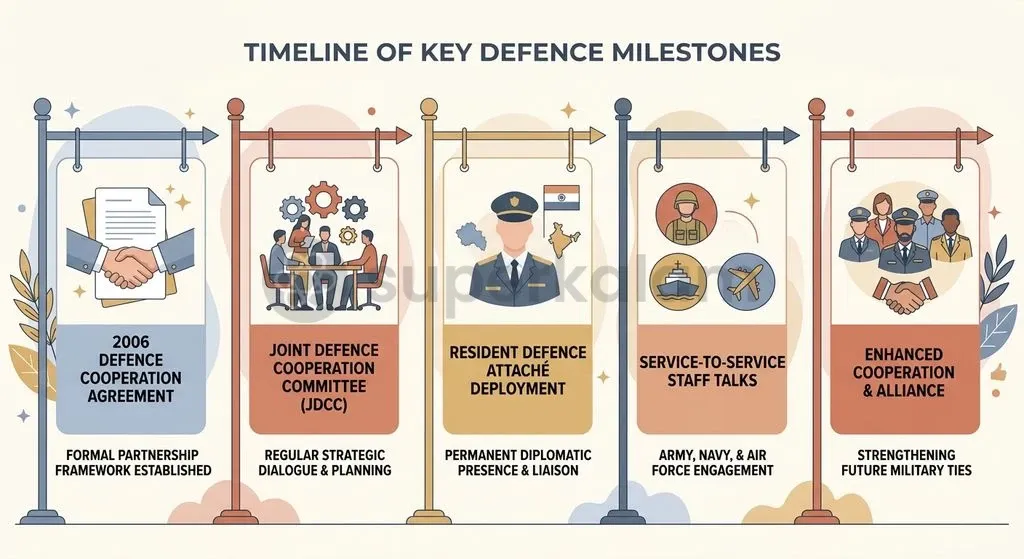
Bilateral defence governance operates under the institutional framework of the Joint Defence Cooperation Committee (JDCC), established under the 2006 Defence Cooperation Agreement. The JDCC held its 5th meeting in Manila on 11 September 2024 to evaluate defence trade, joint training initiatives, and service-level cooperation.
| Year | Institutional Milestone | Strategic Significance |
|---|---|---|
| 2006 | Defence Cooperation Agreement | Established the Joint Defence Cooperation Committee (JDCC) |
| 2014 | Act East Policy Launch | Upgraded India's diplomatic and security focus across Southeast Asia |
| 2022 | BrahMos Export Contract | USD 375 million deal signed for three shore-based missile batteries |
| 2024 | Defence Hardware Delivery | BrahMos delivered; resident Defence Attaché office opened in Manila |
| 2025 | Strategic Partnership Elevation | Joint Plan of Action (2025–2029) adopted during presidential state visit |
To deepen institutional links, India established a dedicated resident Defence Attaché office at the Embassy of India in Manila in March 2024. Bilateral architecture was further reinforced when both nations signed Terms of Reference (ToR) establishing Service-to-Service Staff Talks across the Army, Navy, and Air Force.
Discuss with Superkalam
Recall the exact date when India delivered the first BrahMos supersonic cruise missile system to the Philippine Marine Corps.
Ask NowDiscuss with Superkalam
Explain how the White Shipping Information Exchange mechanism helps maritime law enforcement agencies counter non-traditional security threats.
Ask NowStrategic Significance: Upholding a Rules-Based Order in the South China Sea
India and the Philippines actively support a rules-based maritime order anchored in international law. The South China Sea represents a critical maritime highway carrying over one-third of global shipping, including the vast majority of India's trade with East and Southeast Asia.
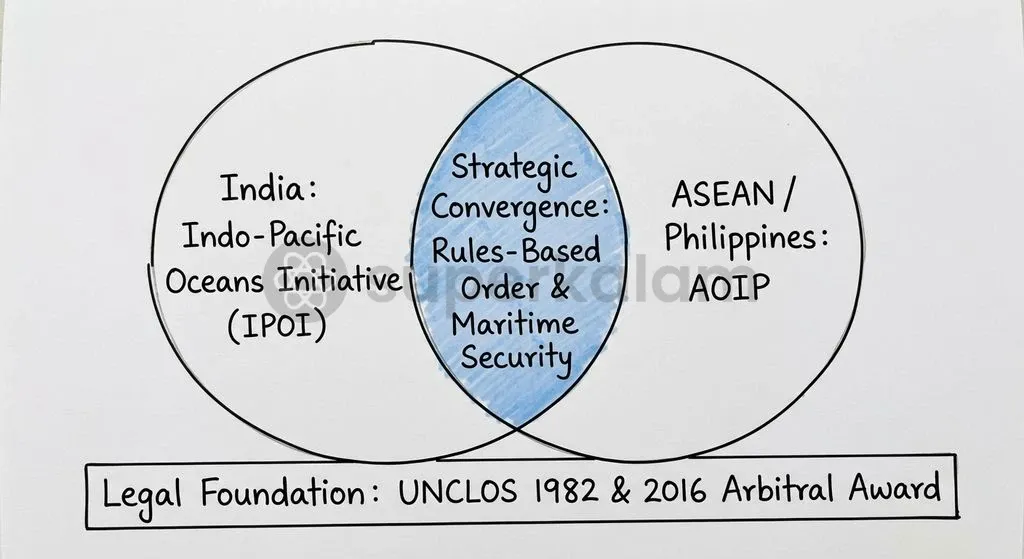
During the 5th Joint Commission on Bilateral Cooperation (JCBC), both governments issued an explicit reaffirmation of international maritime legal mechanisms. According to the Ministry of External Affairs, both sides emphasised adherence to the 1982 UNCLOS and the 2016 South China Sea Arbitral Award delivered by the Permanent Court of Arbitration.
| Strategic Framework | Core Pillars | Bilateral Convergence Focus |
|---|---|---|
| India's Act East / IPOI | Maritime security, marine ecology, resource governance | Capacity building, naval presence, and maritime rule of law |
| ASEAN Outlook (AOIP) | Sea line stability, economic connectivity, peaceful dispute resolution | Inclusive regional security architecture and unimpeded trade |
| Legal Anchor | 1982 UNCLOS and 2016 PCA Arbitral Award | Respect for sovereign EEZ rights and maritime boundary delimitations |
This joint diplomatic stance reflects India's willingness to endorse legal arbitrations in Southeast Asian maritime disputes. Both nations formally affirmed the convergence between the ASEAN Outlook on the Indo-Pacific (AOIP) and India's Indo-Pacific Oceans Initiative (IPOI). This alignment prioritises maritime ecology, connectivity, and maritime security pillars.
Discuss with Superkalam
Analyze why India's explicit endorsement of the 2016 South China Sea Arbitral Award represents a significant evolution in its Act East Policy.
Ask NowEconomic and Multilateral Convergence: ASEAN, Trade, and Supply Chain Resilience
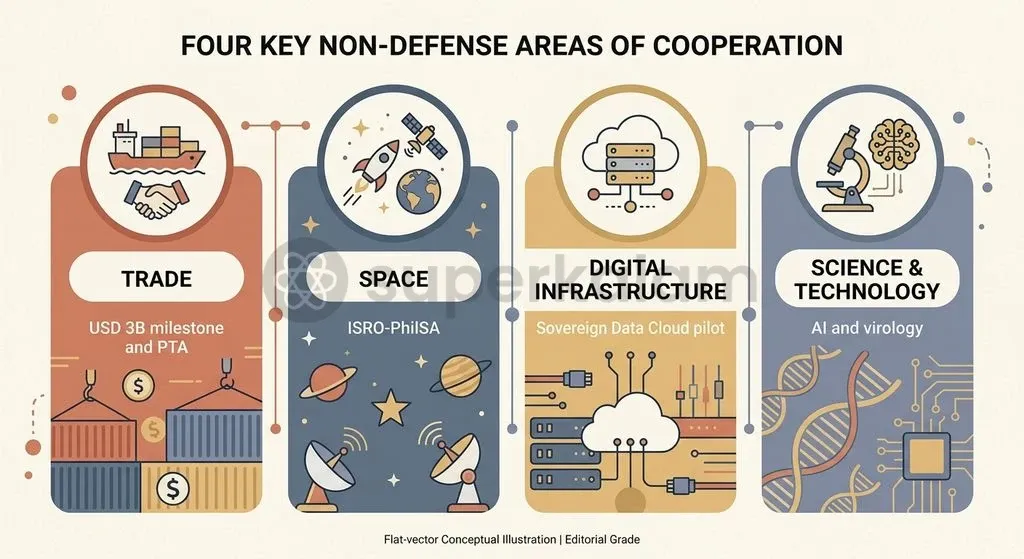
Bilateral merchandise trade crossed USD 3 billion during fiscal year 2023–24. Despite steady expansion, both administrations recognise substantial untapped potential across agriculture, pharmaceuticals, infrastructure, and electronic manufacturing.
To accelerate economic integration, both nations adopted formal Terms of Reference to commence negotiations for an India-Philippines Preferential Trade Agreement (PTA). A bilateral PTA will lower tariff barriers, boost value chain integration, and expand access for Indian generic pharmaceuticals and agricultural exports.
Bilateral engagement is expanding across high-technology and scientific sectors through the following initiatives:
- Civil Space Cooperation: The Indian Space Research Organisation (ISRO) and the Philippine Space Agency (PhilSA) executed a Statement of Intent to collaborate on satellite applications, earth observation, and peaceful space uses.
- Digital Infrastructure Development: The Ministry of External Affairs signed an MoU with the Philippine Department of Information and Communications Technology, launching a pilot project for a Sovereign Data Cloud utilising Indian digital stack architectures.
- Joint Scientific Research: A bilateral Programme of Cooperation in Science and Technology (2025–2028) established joint research initiatives in artificial intelligence, virology, and additive manufacturing.
- Legal and Consular Frameworks: Both governments ratified a bilateral Treaty on Mutual Legal Assistance in Criminal Matters (MLAT) and a Treaty on the Transfer of Sentenced Persons.
Key Challenges in Deepening Bilateral Security Cooperation
Strategic cooperation between India and the Philippines faces operational, financial, and external geopolitical hurdles that require sustained diplomatic management. Translating political goodwill into sustained operational synergy requires addressing key structural bottlenecks:
- Geopolitical Sensitivities in Contested Waters: Deepened military cooperation between India and the Philippines attracts scrutiny from regional powers asserting extensive maritime claims in the South China Sea. Both nations must balance assertive deterrence with diplomatic stability.
- Fiscal and Absorption Limits: Philippine defence modernisation programmes operate under stringent budgetary limitations. Integrating complex weapon systems demands sustained capital allocation for maintenance, spares, and ammunition.
- Logistical and Supply Chain Sustainability: Operating sophisticated platforms like the BrahMos system requires dedicated lifecycle support, technical maintenance infrastructure, and dependable supply lines across the Bay of Bengal and South China Sea.
- Bilateral Trade Asymmetry: Merchandise trade of USD 3 billion remains modest relative to the economic size of both nations. Trade diversification beyond pharmaceuticals, IT services, and auto components is essential to sustain strategic goodwill.
Discuss with Superkalam
Evaluate the strategic and economic utility of offering concessional Lines of Credit (LoC) for defence exports to Southeast Asian partners.
Ask NowKey Takeaways
- India and the Philippines formally elevated their ties to a Strategic Partnership during President Ferdinand R. Marcos Jr.'s state visit, adopting a Joint Plan of Action (2025–2029).
- Delivery of the USD 375 million shore-based BrahMos cruise missile system on 19 April 2024 represents India's first strategic indigenous military export to an ASEAN member state.
- Both nations explicitly uphold the 1982 UNCLOS and the 2016 South China Sea Arbitral Award, aligning India's Indo-Pacific Oceans Initiative (IPOI) with the ASEAN Outlook on the Indo-Pacific (AOIP).
- Bilateral maritime domain awareness has been institutionalised through Coast Guard White Shipping SOPs, naval exercises with vessels like INS Delhi and INS Kiltan, and an invitation to deploy a Philippine officer to IFC-IOR Gurugram.
- Economic and scientific partnerships are expanding through formal Preferential Trade Agreement (PTA) negotiations, ISRO-PhilSA space agreements, and digital sovereign cloud infrastructure pilots.
Mains Question
"The elevation of India–Philippines ties to a Strategic Partnership reflects India's transition from a regional observer to an active maritime security provider under the Act East Policy." Elucidate. (10 Marks)
Evaluate NowMains Question
Examining the strategic and economic dimensions of the India–Philippines partnership, discuss how bilateral cooperation serves to uphold a rules-based order and foster supply chain resilience in the Indo-Pacific. (15 Marks)
Evaluate NowPractice MCQs
QUESTION 1
With reference to the India–Philippines defence and maritime cooperation, consider the following statements:
- The delivery of the BrahMos supersonic cruise missile system in April 2024 marked India's first major indigenous military hardware export to an ASEAN member state.
- The Joint Defence Cooperation Committee (JDCC) between India and the Philippines was established under the Act East Policy in 2014.
- The Indian Coast Guard and Philippine Coast Guard have operationalised a White Shipping Information Exchange mechanism to facilitate real-time tracking of non-military commercial vessels.
Which of the statements given above are correct?
QUESTION 2
Consider the following statements regarding the strategic convergence between India and the Philippines in the Indo-Pacific:
- Both nations have formally affirmed the convergence between the ASEAN Outlook on the Indo-Pacific (AOIP) and India's Indo-Pacific Oceans Initiative (IPOI).
- Both governments explicitly reaffirmed adherence to the 1982 UNCLOS and the 2016 South China Sea Arbitral Award during the 5th Joint Commission on Bilateral Cooperation.
- The Armed Forces of the Philippines have signed a treaty to permanently co-command the Information Fusion Centre – Indian Ocean Region (IFC-IOR) in Gurugram.
Which of the statements given above is/are correct?
QUESTION 3
Consider the following naval vessels:
- INS Delhi
- INS Kiltan
- INS Shakti
Which of the naval assets mentioned above participated in bilateral Maritime Cooperative Activity (MCA) exercises alongside the Philippine Navy in the South China Sea?
QUESTION 4
Regarding institutional mechanisms in India–Philippines bilateral relations, consider the following pairs:
- Resident Defence Attaché Office: Established in Manila in March 2024
- Joint Plan of Action: Covers the period 2025–2029
- BrahMos Export Package: Procured for the Philippine Air Force Coastal Command
How many of the pairs given above are correctly matched?
QUESTION 5
In the context of bilateral technological and economic cooperation between India and the Philippines, the two nations have initiated negotiations or signed pacts for which of the following?
- Preferential Trade Agreement (PTA)
- Civil Space Cooperation via ISRO and PhilSA
- Sovereign Data Cloud pilot project using Indian digital architectures