India Net Zero Portal: Can Digital Governance Fix Carbon Accounting?
Digital dashboards streamline national climate reporting, but solving structural data gaps and federal silos remains vital for real carbon accountability.
Sep, 2026
•8 min read
Overview
India has launched the India Net Zero Portal and the National Action Plan on Climate Change (NAPCC) Dashboard. This establishes a centralised digital infrastructure to monitor sectoral decarbonisation pathways, track corporate carbon footprints, and assess progress toward national climate goals. As of September 2026, this digital monitoring ecosystem enables systematic tracking across energy, industrial, and state-level domains.
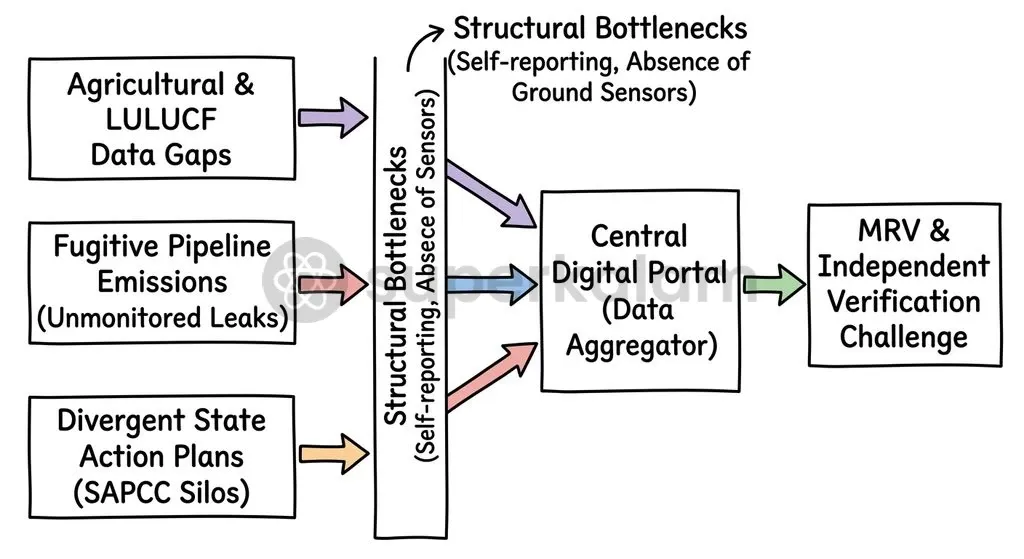
Digital portals operate strictly as aggregation tools rather than primary data generators. The ultimate integrity of national carbon accounting depends on resolving structural field-level data gaps in agriculture and forestry. It also requires aligning fragmented state baselines and instituting legally enforceable auditing mechanisms across voluntary corporate disclosures.
Why in the News? India's Move Toward Digital Climate Governance
Union Minister of State for Environment, Forest and Climate Change Kirti Vardhan Singh launched India's Net Zero Portal and the NAPCC Dashboard in Mumbai on World Ozone Day, September 16, 2026. The launch marks a decisive transition toward data-driven environmental governance under the Ministry of Environment, Forest and Climate Change (MoEFCC).
As of September 2026, India requires consolidated tracking systems to steer its commitments under the United Nations Framework Convention on Climate Change (UNFCCC). India committed under its updated Nationally Determined Contributions to reduce the emissions intensity of its Gross Domestic Product by 45% by 2030 from 2005 levels, as recorded in India's Updated NDC submission.
India also pledged to achieve 50% cumulative electric power installed capacity from non-fossil fuel-based resources by 2030, while building a pathway toward net-zero emissions by 2070. Digital platforms bridge fragmented administrative data streams across Union ministries. The launch establishes a baseline for domestic monitoring while aligning national reporting with international transparency obligations under the 2015 Paris Agreement.
Discuss with Superkalam
What are India's specific updated NDC targets for emissions intensity reduction and non-fossil fuel electric capacity by 2030?
Ask NowWhat the Net Zero Dashboards Track: Unpacking the Metrics and Architecture
The India Net Zero Portal (netzeroindia.moef.gov.in) provides a unified registry for public and private enterprises to record greenhouse gas baselines and transition targets. The platform operates as a voluntary transparency framework to capture corporate climate commitments across industrial sectors.
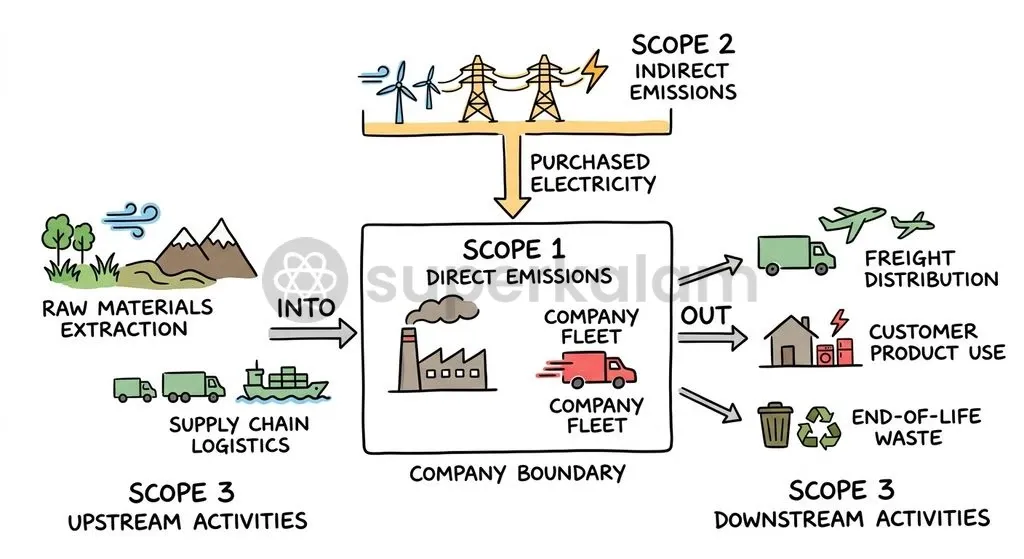
Under the reporting framework, the portal categorises emissions across standard international boundaries:
- Scope 1 Emissions: Direct greenhouse gas emissions from sources owned or controlled by the reporting entity, such as boilers, furnaces, and company-owned vehicles. Reporting is actively encouraged.
- Scope 2 Emissions: Indirect greenhouse gas emissions resulting from the generation of purchased electricity, heating, or steam consumed by the organisation. Reporting is actively encouraged.
- Scope 3 Emissions: Broader supply chain and value chain emissions, covering raw material extraction, logistics, and end-of-life product disposal. Reporting remains purely voluntary.
Alongside the enterprise registry, the newly launched NAPCC Dashboard monitors implementation metrics across India's National Missions on Climate Change. The dashboard creates a multi-ministerial interface tracking key performance indicators in renewable capacity additions, energy efficiency indices, sustainable habitat metrics, and water conservation targets.
| Portal Layer | Primary Focus | Key Performance Indicators | Operational Authority |
|---|---|---|---|
| India Net Zero Portal | Enterprise-level emission disclosures | Scope 1 and Scope 2 emissions baselines, Net Zero target years | MoEFCC |
| NAPCC Dashboard | Cross-ministerial mission monitoring | Solar installations, energy savings, afforestation coverage | MoEFCC & Line Ministries |
| CCTS Registry | Market-based compliance trading | Carbon credit issuance, sectoral energy intensity targets | Bureau of Energy Efficiency (BEE) |
The Digital Promise: Strengthening Measurement, Reporting, and Verification (MRV)
Standardised Measurement, Reporting, and Verification (MRV) protocols convert physical industrial activity data into verifiable carbon-dioxide equivalent metrics. According to technical guidance from the Bureau of Energy Efficiency (BEE) and the GHG Protocol, digital portals streamline this conversion through automated emission factors.
Digital MRV architectures replace cumbersome manual reporting, mitigating risks of double-counting and computational errors. The Bureau of Energy Efficiency demonstrated the viability of institutionalised monitoring through the Perform, Achieve and Trade scheme, which mandated digital energy verification and regular auditing across large industrial energy consumers.
The Energy Conservation (Amendment) Act, 2022 empowered the Central Government to establish a statutory Carbon Credit Trading Scheme, embedding digital MRV protocols into market trading mechanisms. Digital verification systems provide the operational foundation required to issue, register, and trade domestic carbon credits without regulatory friction.
Discuss with Superkalam
Explain how dynamic interstate power transmission complicates the calculation of Scope 2 emissions for individual states.
Ask NowThe Structural Bottlenecks: Why Software Cannot Fix Data Gaps and Federal Silos
The Ministry of Environment, Forest and Climate Change faces persistent data-fidelity challenges that digital dashboards cannot resolve on their own. High estimation uncertainties persist in measuring fugitive methane leaks from coal mines and petroleum pipelines due to inadequate continuous telemetry infrastructure, as detailed in India's Third National Communication to the UNFCCC.
Data reliability is similarly constrained across the Agriculture and LULUCF sectors (Land Use, Land-Use Change, and Forestry). The Forest Survey of India notes that extreme spatial variation in soil organic carbon, livestock enteric fermentation, and forest biomass regeneration limits the accuracy of desktop-based carbon accounting models.
| Pipeline Layer | Core Bottleneck | Impact on Carbon Accounting |
|---|---|---|
| State Action Plans (SAPCCs) | Disparate baselines and asymmetric technical capacity | Non-comparable sub-national mitigation reporting |
| Interstate Power Grids | Dynamic cross-border wheeling | Ambiguous Scope 2 emissions attribution |
| Primary Sector Land Use | High spatial heterogeneity and limited sensors | Inaccurate desktop estimation of carbon sinks |
Federal administrative asymmetries present another major hurdle. State Action Plans on Climate Change (SAPCCs) feature stark disparities across Indian states, reflecting unequal technical capacities and conflicting historical baseline years.
Interstate electricity transmission introduces severe Scope 2 carbon allocation challenges. The Central Electricity Authority highlights that dynamic interstate wheeling of renewable and thermal power makes attributing regional grid emission factors to individual consuming states technically complex.
Comparing Carbon Accounting: How India’s Self-Reporting Compares with Global MRV Frameworks
Article 13 of the Paris Agreement established the Enhanced Transparency Framework to govern how member nations measure, report, and review national mitigation progress and international climate assistance. India's domestic monitoring portals aggregate core datasets feeding directly into its mandatory Biennial Transparency Reports under this international architecture.
Global carbon accounting systems vary significantly between voluntary registries, market-driven compliance platforms, and statutory reporting directives.
| Dimension | India Net Zero Portal Framework | EU Corporate Sustainability Due Diligence / MRV | UNFCCC Enhanced Transparency Framework |
|---|---|---|---|
| Legal Nature | Voluntary enterprise disclosure | Mandatory statutory reporting | Legally binding national reporting |
| Emissions Coverage | Scope 1 & 2 encouraged; Scope 3 voluntary | Comprehensive Scope 1, 2, and 3 accounting | Economy-wide national greenhouse gas inventories |
| Verification Level | Self-declaration with optional audit | Mandatory accredited third-party assurance | International technical expert team review |
| Target Integration | Voluntary entity-level targets | Enforceable statutory corporate decarbonisation | Nationally Determined Contributions (NDCs) |
Discuss with Superkalam
Compare the legal enforceability and verification mechanisms of the India Net Zero Portal framework with the UNFCCC Enhanced Transparency Framework.
Ask NowGovernance and Ethics: The Risk of Digital Greenwashing vs Climate Justice
Unregulated corporate disclosures on digital platforms risk facilitating greenwashing when self-reported statistics lack independent validation and statutory penalties. The Securities and Exchange Board of India addressed this compliance vulnerability by introducing the mandatory BRSR Core disclosure framework for top listed corporate entities, establishing verifiable key performance indicators for greenhouse gas emissions and water footprints.
Digital accounting architectures must balance mitigation efficiency with ethical considerations surrounding climate justice. NITI Aayog emphasises that national decarbonisation metrics must integrate Just Transition indicators to prevent aggregate emissions data from obscuring severe economic disruptions in coal-dependent regional labour markets.
Way Forward: Building Independent Auditing, State Carbon Budgets, and High-Integrity Data Systems
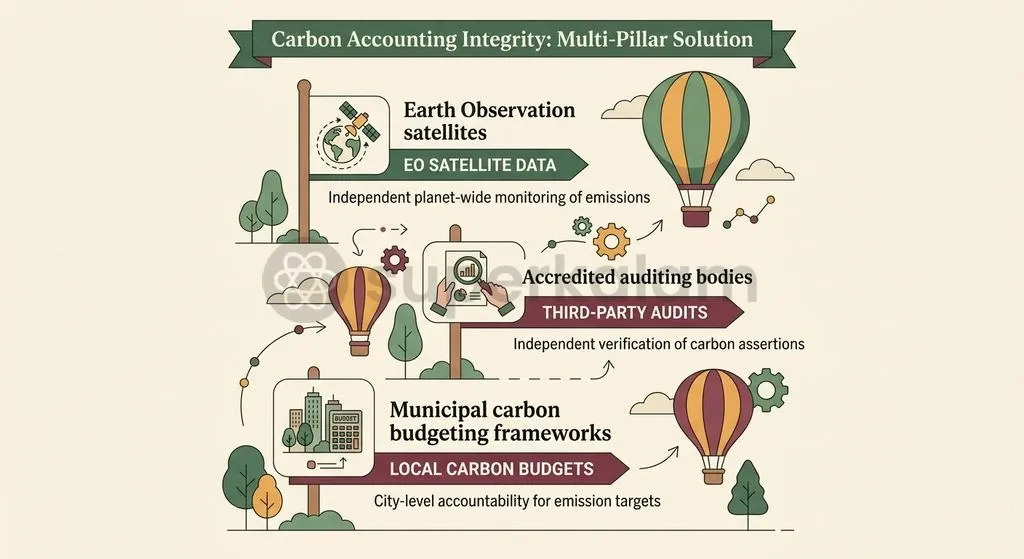
The Parliamentary Standing Committee on Science and Technology, Environment, Forests and Climate Change recommended establishing statutory sub-national carbon budgets to standardise greenhouse gas accounting frameworks across district and municipal administrations. A robust digital governance framework requires several key institutional reforms:
- Deploying Advanced Earth Observation Systems: Integrate high-resolution hyperspectral remote sensing from ISRO's Space Applications Centre to independently verify ground-level afforestation carbon sinks and quantify industrial methane flaring.
- Mandating Accredited Third-Party Assurance: Transition the Net Zero Portal from unverified voluntary disclosures to an audited regime backed by the Bureau of Energy Efficiency's accredited energy auditors.
- Harmonising State Climate Action Plans: Update all State Action Plans on Climate Change using a unified baseline year and common greenhouse gas accounting methodologies developed by the MoEFCC.
- Institutionalising Grid Emission Allocations: Adopt the Central Electricity Authority's dynamic regional emission factors to standardise interstate Scope 2 renewable wheeling accounting.
Discuss with Superkalam
How can India design an integrated carbon accounting framework that balances corporate decarbonisation targets with Just Transition principles for coal-dependent regions?
Ask NowKey Takeaways
- Union Minister of State for Environment, Forest and Climate Change Kirti Vardhan Singh launched India's Net Zero Portal and the NAPCC Dashboard in Mumbai on World Ozone Day, September 16, 2026.
- The Net Zero Portal tracks voluntary corporate decarbonisation targets, actively encouraging Scope 1 and Scope 2 reporting while keeping Scope 3 value-chain emissions voluntary.
- India's domestic digital portals aggregate critical sectoral emissions data feeding into mandatory Biennial Transparency Reports required under Article 13 of the Paris Agreement.
- Structural data uncertainties in fugitive methane, agricultural enteric fermentation, and forest carbon stocks require integration with ISRO Earth Observation remote sensing.
- The Energy Conservation (Amendment) Act, 2022 empowers the statutory Carbon Credit Trading Scheme, providing legal foundations to link digital MRV systems with carbon market compliance.
Mains Question
"Digital portals operate strictly as aggregation tools rather than primary data generators; software cannot fix field-level data gaps or federal administrative asymmetries." In light of this statement, critically analyse the challenges in building a robust Measurement, Reporting, and Verification (MRV) framework for carbon accounting in India. (15 Marks)
Evaluate NowMains Question
Highlighting the provisions of the Energy Conservation (Amendment) Act, 2022 and SEBI's BRSR Core framework, evaluate the role of market-based and regulatory mechanisms in curbing corporate greenwashing in India. (10 Marks)
Evaluate NowPractice MCQs
QUESTION 1
With reference to India's climate commitments and tracking architecture, consider the following statements:
- India's updated Nationally Determined Contributions (NDCs) target a 45% reduction in the emissions intensity of its GDP by 2030 from 2005 levels.
- The Carbon Credit Trading Scheme (CCTS) was statutorily established under the provisions of the Environment (Protection) Act, 1986.
- The India Net Zero Portal acts as a voluntary transparency framework where reporting of Scope 3 supply chain emissions is encouraged on mandatory terms. Which of the statements given above is/are correct?
QUESTION 2
Consider the following statements regarding the reporting architecture of the India Net Zero Portal:
- Scope 1 emissions include direct greenhouse gas emissions from sources owned or controlled by the reporting entity.
- Scope 2 emissions cover indirect emissions resulting from the generation of purchased electricity, heating, or steam consumed by the entity.
- Scope 3 emissions encompass broader value chain emissions such as raw material extraction, logistics, and end-of-life product disposal. Which of the statements given above are correct?
QUESTION 3
Consider the following statements regarding carbon accounting bottlenecks in India:
- The Forest Survey of India highlights that spatial variation in soil organic carbon and livestock enteric fermentation constrains desktop carbon accounting models.
- Inadequate continuous telemetry infrastructure leads to high estimation uncertainties in measuring fugitive methane leaks from coal mines and petroleum pipelines.
- State Action Plans on Climate Change (SAPCCs) currently share uniform historical baseline years and identical technical methodologies across all Indian states. Which of the statements given above is/are correct?
QUESTION 4
With reference to corporate ESG reporting and market mechanisms in India, the 'BRSR Core' disclosure framework was introduced by which of the following authorities to address voluntary disclosure vulnerabilities?
QUESTION 5
Consider the following pairs of climate governance platforms and their respective primary operational authorities:
- India Net Zero Portal — Ministry of Environment, Forest and Climate Change (MoEFCC)
- Carbon Credit Trading Scheme (CCTS) Registry — Bureau of Energy Efficiency (BEE)
- NAPCC Dashboard — MoEFCC and Line Ministries How many of the pairs given above are correctly matched?