India-Nepal Relations: Power Trade, Border Realism, and Strategic Ties
As hydro-diplomacy reshapes Himalayan ties, New Delhi and Kathmandu must balance transformative energy pacts against territorial and military impasses.
Nov, 2026
•11 min read
Overview
India and Nepal are recalibrating their bilateral ties. Pragmatic economic cooperation is replacing historical sentimentality. The shift is anchored in cross-border electricity trade, modern logistics corridors, and border realism.
According to official briefings from the Ministry of External Affairs, this structural transition reflects mutual strategic priorities designed to deliver concrete infrastructure outcomes.
As of November 2024, bilateral engagement has prioritised sub-regional connectivity. Milestones include a 25-year power export agreement and South Asia's first trilateral energy flow to Bangladesh.
Disputes over border cartography and the freeze on Gorkha military recruitment under the Agnipath scheme test diplomatic goodwill. Even so, both capitals recognise that tangible economic dependencies provide the most resilient foundation for 21st-century Himalayan geopolitics.
Why the Nepal Prime Minister's Visit Matters Right Now
High-level summits between New Delhi and Kathmandu offer a clear opening to consolidate connectivity frameworks. According to diplomatic reporting by The Kathmandu Post and IANS, Nepali Prime Minister Balendra Shah is reported to undertake an official state visit to New Delhi in late November 2026. This marks his first bilateral summit with Prime Minister Narendra Modi since assuming office in March 2026.
The reported engagement comes as both administrations seek to formalise structural economic integration. Concurrently, both leaderships must manage domestic political pressures over territorial identity.
Bilateral negotiators have reportedly drafted a comprehensive 10-point vision document titled 'Samriddha Nepal, Samunnat Bharat', as reported in November 2026 by The Kathmandu Post citing foreign ministry briefings. The draft framework focuses on several core sectors:
- Energy Trade: Expanding cross-border transmission corridors and power purchase commitments.
- Commerce & Transit: Streamlining bilateral trade routes and port access.
- Digital Links: Integrating cross-border digital payment interfaces.
- Border Systems: Upgrading logistics and regulatory coordination at crossing points.
Kathmandu faces acute economic pressures that demand direct foreign investment and electricity export receipts. For India, maintaining proactive leadership in Himalayan connectivity counters competing regional infrastructure initiatives.
Rather than relying on fraternal declarations, both nations are establishing institutional channels. These mechanisms ensure cross-border infrastructure initiatives meet strict commissioning schedules.
Moving Beyond Old Rhetoric: The Rise of Transactional Diplomacy
Bilateral relations are shifting from traditional sociocultural affinity toward hard-nosed economic bargaining. For decades, official discourse relied on 'Roti-Beti' ties to describe open borders, kinship networks, and linguistic affinities.
According to official briefings from the Ministry of External Affairs, policy focus has decisively turned toward hard connectivity, logistics infrastructure, and regional energy markets.
This shift reflects changing generational expectations across Nepal. Modern foreign policy debates in Kathmandu increasingly reject patron-client framings. Instead, Nepali interlocutors demand sovereign equality and equitable commercial terms on transit and water rights.
Indian diplomacy has responded with a business-like posture. This stance prizes rapid execution over emotional appeals.
| Dimension | Traditional 'Roti-Beti' Approach | Emerging Transactional Model |
|---|---|---|
| Core Diplomatic Narrative | Shared cultural heritage, civilisational bonds, and familial linkages | Sub-regional connectivity, trade balances, and physical infrastructure |
| Economic Linchpin | Unilateral grant assistance and commodity transit rights | Commercial power purchase agreements and equity joint ventures |
| Border Management | Informally managed open frontiers with minimal physical control | Digital customs checkpoints, automated cargo scanning, and integrated posts |
| Security Architecture | Exclusive special relations based on mutual treaty obligations | Pragmatic strategic bargaining balancing national security parameters |
Economic metrics underline the scale of this structural integration. According to survey reports from the Nepal Rastra Bank, India accounts for over 30 percent of total Foreign Direct Investment inflows into Nepal.
Under the bilateral Treaty of Transit, India provides Nepal's primary gateway to maritime routes. These flows move through the ports of Kolkata, Haldia, and Visakhapatnam.
Discuss with Superkalam
Which river was designated as Nepal's western boundary under Article 5 of the 1816 Treaty of Sugauli?
Ask NowHydro-Diplomacy: Power Grids as the New Economic Anchor
Cross-border electricity trade has emerged as the principal engine of bilateral integration under the 25-year Long-Term Power Trade Agreement. Signed on January 4, 2024, during the Seventh Meeting of the Nepal-India Joint Commission, the pact commits India to import 10,000 megawatts of electricity from Nepal over a 10-year period.
This agreement establishes predictable revenue for Nepal's hydropower sector. Simultaneously, it helps India meet its industrial base-load demands.
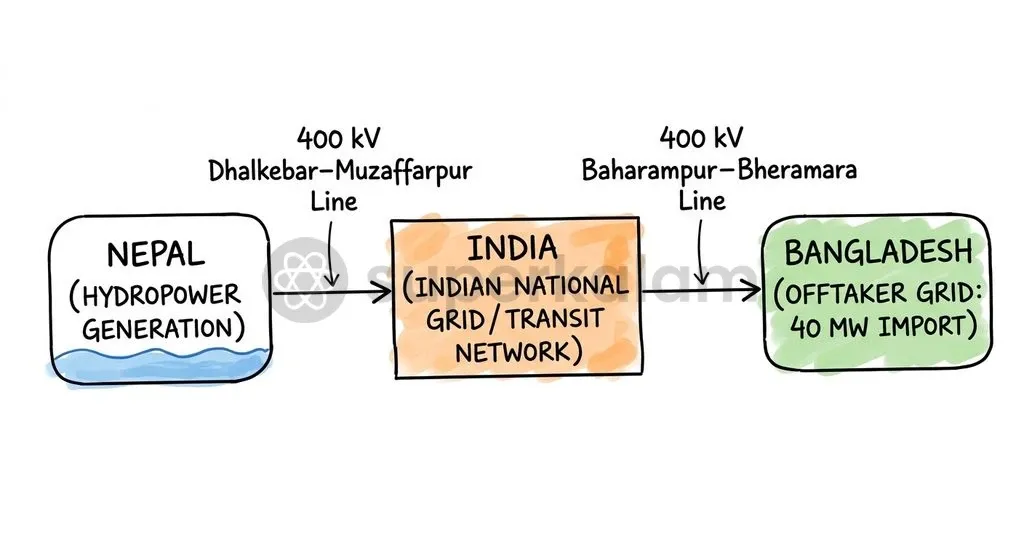
Sub-regional energy integration reached a major milestone on November 15, 2024, when India, Nepal, and Bangladesh operationalised South Asia's first trilateral power transaction. According to Press Information Bureau Release ID 2073606, the tripartite arrangement facilitates the transmission of 40 megawatts of Nepalese electricity to Bangladesh across the Indian national grid.
Operating records from the Central Electricity Regulatory Commission indicate that this power routes through the cross-border 400 kV Dhalkebar-Muzaffarpur line. It then moves onward via the 400 kV Baharampur-Bheramara interconnection.
Indian public sector undertakings are spearheading this transformation through substantial capital deployments in Nepalese river basins. Regulatory filings from the Investment Board Nepal show that SJVN is developing the 900 MW Arun-3 project alongside the 669 MW Lower Arun installation.
Simultaneously, NHPC is advancing the 480 MW Phukot Karnali hydroelectric venture. These initiatives embed Indian technical standards across the Himalayan watershed.
| Hydropower Project / Asset | Developer / Agency | Installed Capacity / Route | Strategic Significance |
|---|---|---|---|
| Arun-3 Hydroelectric Project | SJVN Limited | 900 MW | Commercial export-oriented project supplying the North Indian power grid |
| Lower Arun Project | SJVN Limited | 669 MW | Cascade development optimising water discharge from the upper Arun basin |
| Phukot Karnali Project | NHPC Limited | 480 MW | Major run-of-the-river project strengthening Western Nepal grid infrastructure |
| Dhalkebar-Muzaffarpur Link | Cross-Border Transmission JV | 400 kV High-Voltage Line | South Asia's primary bilateral power conduit, enabling trilateral transmission |
Power sales generate foreign exchange that helps Kathmandu trim its bilateral trade deficit. As cross-border transmission networks expand, clean hydro-diplomacy replaces historical water disputes as the foundation of bilateral cooperation.
Discuss with Superkalam
How does cross-border electricity export serve as an economic instrument to narrow Nepal's bilateral trade deficit with India?
Ask NowThe Agnipath Stalemate: Why Gorkha Recruitment Remains Suspended
Gorkha enlistment from Nepal into the Indian Army has faced a total freeze since the rollout of the Agnipath scheme in 2022. According to proceedings recorded by the Parliamentary Standing Committee on External Affairs, recruitment drives across Nepalese hills remain halted because Kathmandu has withheld official clearance for short-term contractual hiring. This suspension halts an operational relationship spanning more than two centuries.
Kathmandu's diplomatic objection centres on the Britain-India-Nepal Tripartite Agreement signed in November 1947. Nepal contends that the four-year tour of duty under Agnipath alters the agreed terms of military engagement through two primary mechanisms:
- Absence of Pension Entitlements: Retaining only 25 percent of recruits for regular service while discharging the remainder without lifelong pensions is viewed as contrary to the spirit of the 1947 treaty.
- Socio-Economic Vulnerability: Nepalese leaders argue that discharging young soldiers without permanent safety nets undermines the standing of Gorkha service and leaves returnees vulnerable.
Socio-economic repercussions across Nepal's hill districts are severe. The suspension has cut off steady remittances for thousands of families within Magar, Gurung, Rai, and Limbu communities.
For New Delhi, the prolonged impasse deprives the Indian Army of dedicated infantry personnel. It also weakens a long-standing source of strategic goodwill in Nepal.
Discuss with Superkalam
If sub-regional power trade expands further, how can the India-Nepal-Bangladesh transmission model be adapted for broader BBIN grid integration?
Ask NowBoundary Disputes and the Frozen Eminent Persons Group Report
Territorial disagreements along the Himalayan frontier remain sharp following the 2020 cartographic dispute. Tensions escalated when the Parliament of Nepal enacted the Constitution of Nepal (Second Amendment) Act, 2077 on June 18, 2020. This amendment altered Schedule 3 of the constitution to incorporate Kalapani, Lipulekh, and Limpiyadhura into Nepal's official coat of arms.
India's Ministry of External Affairs rejected the alteration as an artificial enlargement of territorial claims unsupported by historical documentation. The cartographic friction stems from conflicting interpretations of Article 5 of the Treaty of Sugauli (1816), which designated the Kali River as Nepal's western border.
Because the treaty omitted specific geographical coordinates for the river's source, New Delhi identifies the ridgeline stream near Kalapani as the boundary. Kathmandu, however, claims the stream originating at Limpiyadhura.
Friction extended to currency notes when Nepal Rastra Bank issued a new Rs 100 denomination displaying the revised map. According to administrative reports from bordering districts, this dispute provoked payment rejections across border trade markets in Uttarakhand.
Further south, the Susta territory presents another unresolved dispute covering over 14,000 hectares along the Bihar border. Historical shifts in the Gandak (Narayani) River have left boundary markers contested.
Institutional review of bilateral treaties remains similarly stalled. The joint Eminent Persons Group on Nepal-India Relations completed a consensus report in July 2018 recommending revisions to the 1950 Treaty of Peace and Friendship. However, the report remains formally unsubmitted and unaccepted by Indian leadership. Key clauses under contention include:
- Article 2: Mandatory bilateral security consultations during regional crises or interstate friction.
- Article 5: Regulatory mechanisms governing Nepal's arms imports through Indian transit corridors.
- Article 6: Equal treatment for citizens of both nations regarding industry and commercial rights.
- Article 7: Reciprocal privileges concerning property acquisition, residence, and trade movement.
Discuss with Superkalam
Compare how the traditional 'Roti-Beti' narrative and the emerging transactional diplomacy treat border management and security architecture.
Ask NowConnectivity Race: Countering Chinese Infrastructure in the Himalayas
India is building integrated multimodal transit corridors to offset China's expanding Belt and Road footprint across Nepal. Strategic analyses from the Manohar Parrikar Institute for Defence Studies and Analyses indicate that rapid border logistics upgrades counterbalance Beijing's Trans-Himalayan Multi-Dimensional Connectivity Network.
By providing reliable and cost-effective transport, New Delhi ensures Kathmandu's southern economic orientation remains dominant.
Hydrocarbon logistics demonstrated this operational efficiency through the 69-km Motihari-Amlekhganj petroleum pipeline, operational since September 2019 as South Asia's first cross-border pipeline. According to project disclosures from the Indian Oil Corporation, civil works are underway to extend this pipeline to Chitwan. Concurrently, advanced engineering plans are progressing for a greenfield pipeline between Siliguri and Jhapa.
This infrastructure eliminates road transport bottlenecks, curbs fuel adulteration, and saves Nepal billions of rupees in transit losses.
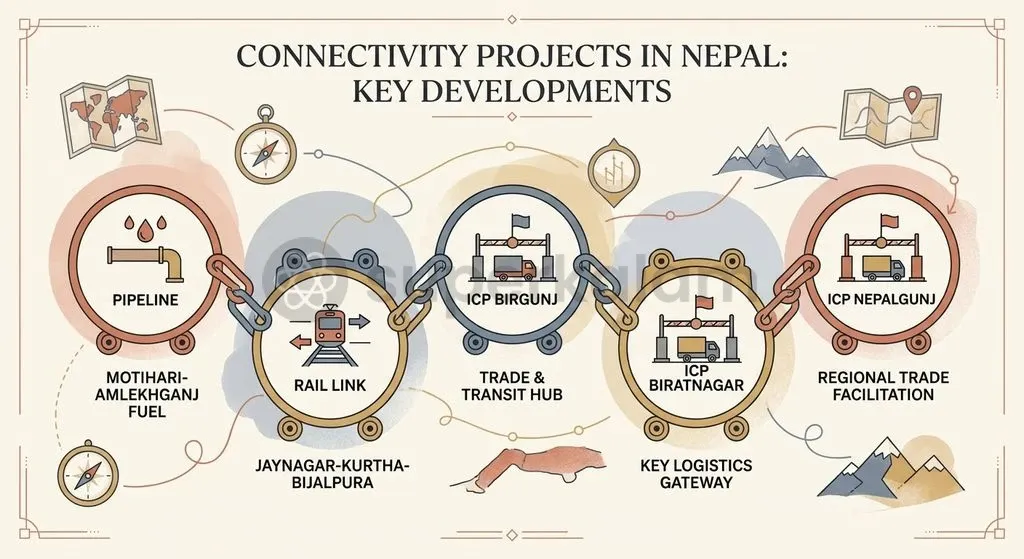
Cross-border railway engineering has revived critical commercial links:
- Jaynagar-Kurtha Rail Segment: Operationalised over 34.9 km in April 2022 under Indian grant financing to reconnect passenger movements across Bihar and Madhesh Province.
- Bijalpura Rail Extension: Extended the operational track by 17.3 km in July 2023, expanding market connectivity within Nepal's eastern plains.
- Direct Freight Corridors: Commercial rail freight commenced in July 2026 between Kolkata Port and Biratnagar Customs Yard, allowing container movements without border cargo transshipment.
Border trade facilities have been reinforced through the Land Ports Authority of India. Integrated Check Posts are fully operational at Birgunj, Biratnagar, and Nepalgunj, while Bhairahawa undergoes testing and Dodhara Chandani remains under active construction. These multi-acre logistics facilities combine automated immigration, phytosanitary checks, and customs clearance under one roof.
Way Forward: Resetting Ties on Mutual Delivery Rather Than Nostalgia
Sustaining resilient ties requires New Delhi and Kathmandu to decouple economic infrastructure delivery from historical and cartographic debates. Sentimental appeals no longer insulate bilateral ties from domestic electoral pressures or third-country geopolitical inroads. Both nations must establish pragmatic dispute-management mechanisms while accelerating mutual capital projects.
Diplomatic engagement should operationalise concrete confidence-building measures:
- Regularise Boundary Mechanism Dialogues: Technical joint boundary committees must meet consistently to demarcate fluctuating riverine sectors like Susta using satellite imagery, leaving complex high-altitude points to formal diplomatic channels.
- Review Military Recruitment Terms: Both defence establishments should consider modified administrative protocols under the Agnipath framework, possibly negotiating retention quotas or dedicated post-service corporate pathways for Nepalese Gorkha personnel.
- Formalise the EPG Review: Acknowledging the Eminent Persons Group recommendations would dispel political misgivings in Kathmandu, enabling both sides to modernise outdated clauses of the 1950 Treaty.
- Expand Trilateral Power Commerce: Building on the November 2024 trilateral breakthrough with Bangladesh, New Delhi should establish open-access regional electricity trading platforms to integrate Bhutan, Bangladesh, India, and Nepal into a unified sub-regional power grid.
Mutual economic delivery creates structural interdependencies that withstand routine political friction. By treating each other as sovereign economic partners, India and Nepal can build a secure, prosperous Himalayan economic corridor.
Discuss with Superkalam
Weigh the merits of revising the 1950 Treaty of Peace and Friendship versus maintaining the bilateral status quo amidst evolving Himalayan geopolitical realities.
Ask NowKey Takeaways
- Bilateral diplomacy has shifted from traditional sentimental rhetoric toward transactional cross-border connectivity, energy integration, and infrastructure delivery.
- Under the 25-year Long-Term Power Trade Agreement signed in January 2024, India has committed to importing 10,000 MW of Nepalese electricity over a 10-year horizon.
- South Asia's first trilateral energy flow was operationalised in November 2024, transmitting 40 MW of Nepalese hydro-power to Bangladesh through Indian high-voltage grids.
- Gorkha recruitment into the Indian Army remains completely frozen since 2022 due to Kathmandu's objections regarding the contractual terms of India's Agnipath scheme under the 1947 Tripartite Agreement.
- Boundary friction persists over Kalapani, Lipulekh, and Limpiyadhura following Nepal's 2020 constitutional amendment, alongside unresolved riverine demarcation at Susta.
- The 2018 joint Eminent Persons Group report proposing reforms to the 1950 Treaty of Peace and Friendship remains unsubmitted and unreviewed by Indian leadership.
Mains Question
"Bilateral relations between India and Nepal are witnessing a structural transition from the traditional 'Roti-Beti' narrative to a transactional model anchored in hard connectivity and hydro-diplomacy." Elucidate. (10 Marks)
Evaluate NowMains Question
Evaluate the strategic and institutional challenges bedevilling India-Nepal ties, with particular reference to the Agnipath stalemate, cartographic disputes, and the 1950 Treaty of Peace and Friendship. (15 Marks)
Evaluate NowPractice MCQs
QUESTION 1
With reference to cross-border energy cooperation between India and Nepal, consider the following statements:
- The Long-Term Power Trade Agreement signed in January 2024 commits India to import 10,000 MW of power from Nepal over a 10-year period.
- South Asia's first trilateral power transaction involves the export of electricity from Nepal to Bangladesh routed across the Indian transmission grid.
- The Arun-3 and Lower Arun hydroelectric projects in Nepal are being executed by NHPC Limited. Which of the statements given above are correct?
QUESTION 2
Consider the following statements regarding the suspension of Gorkha recruitment under the Agnipath scheme:
- Recruitment drives have been halted since 2022 because Nepal has withheld clearance for short-term contractual hiring.
- Nepal's diplomatic reservations are anchored in the Britain-India-Nepal Tripartite Agreement of November 1947.
- Under the Agnipath framework, 50 percent of recruits are retained for regular service with lifelong pension benefits. Which of the statements given above is/are correct?
QUESTION 3
Regarding the boundary disputes between India and Nepal, consider the following statements:
- The cartographic dispute over Kalapani, Lipulekh, and Limpiyadhura stems from differing interpretations of the Treaty of Sugauli (1816).
- The Susta territorial dispute along the Bihar border arose primarily due to historical shifts in the course of the Gandak River.
- The Eminent Persons Group (EPG) report of July 2018 was formally ratified and implemented by both governments to amend the 1950 Treaty of Peace and Friendship. Which of the statements given above is/are correct?
QUESTION 4
Under the bilateral Treaty of Transit, which of the following Indian seaports serve as primary maritime gateways for Nepal's international trade?
QUESTION 5
Consider the following statements regarding bilateral institutional and economic ties between India and Nepal:
- India accounts for over 30 percent of total Foreign Direct Investment inflows into Nepal.
- The Constitution of Nepal (Second Amendment) Act, 2077 amended Schedule 3 to update Nepal's official coat of arms with disputed territories. Which of the statements given above is/are correct?