India–MERCOSUR Protocol: Electronic Rules of Origin and Trade Expansion
As India and MERCOSUR digitise trade origin rules, paperless customs clear the path for expanding their 450-line preferential pact into a full economic accord.
Sep, 2026
•8 min read
Overview
On September 14, 2026, India and the MERCOSUR trading bloc signed the First Additional Protocol to their Preferential Trade Agreement. The pact legally equates electronic Certificates of Origin with paper documents to slash customs clearance delays and deepen bilateral South-South trade.
This regulatory amendment updates Article 16 of Annex III of the pact. Exporters can now authenticate product origins electronically through national digital portals. By modernising origin certification, the protocol curtails port dwell times, removes courier friction, and supports ongoing talks to expand trade across Latin America.
Why is the India–MERCOSUR Electronic Origin Protocol in the News?
India and the MERCOSUR trade bloc signed the First Additional Protocol to their Preferential Trade Agreement on September 14, 2026, granting legal validity to electronic Certificates of Origin. As of September 2026, according to a press release by the Press Information Bureau, this agreement amends Article 16 of Annex III (Rules of Origin) of the bilateral pact, establishing that electronically issued Certificates of Origin hold the same legal standing as conventional paper versions.
The reform follows technical consensus across bilateral administrative rounds:
- Administrative Clearance: Per the Ministry of Commerce and Industry, the digital certification initiative gained formal backing at the 4th Joint Administrative Committee meeting on November 27, 2025, before officials finalised the treaty text on April 9, 2026.
- Ratification Step: The protocol will formally enter into force once India and member states conclude domestic legal ratification and complete reciprocal diplomatic notifications.
- Trade Expansion Talks: Alongside this signing, both sides launched formal negotiations on September 14, 2026, to expand the existing Preferential Trade Agreement into a broader economic partnership. The expansion aims to widen tariff coverage and establish disciplines on non-tariff measures, solidifying South-South trade cooperation between India and Latin America.
What is MERCOSUR and How Does the India–MERCOSUR PTA Work?
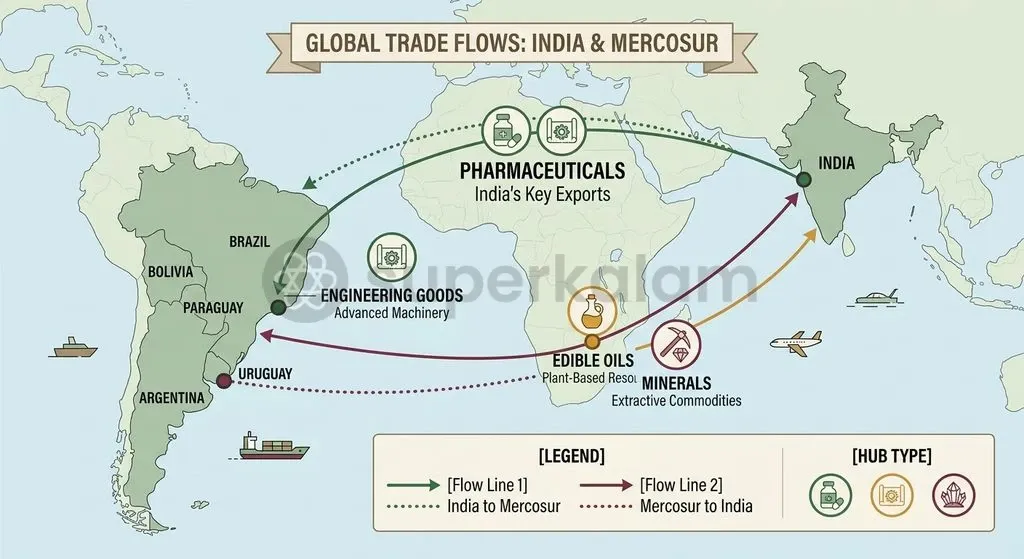
MERCOSUR operates as a major South American customs union. The 2004 India–MERCOSUR Preferential Trade Agreement grants tariff concessions across more than 900 bilateral tariff lines.
Founded by Argentina, Brazil, Paraguay, and Uruguay, the bloc has seen Bolivia initiate accession as a full member, whereas Venezuela has remained suspended from the grouping since 2016. The original pact was signed on January 25, 2004, and became fully operational on June 1, 2009. Unlike a comprehensive Free Trade Agreement that eliminates tariffs on nearly all goods, a Preferential Trade Agreement lowers duties on a targeted positive list.
| Agreement Dimension | Operational Scope under India–MERCOSUR PTA |
|---|---|
| Founding Treaty Date | Signed on January 25, 2004; operationalised on June 1, 2009 |
| Member States Involved | Argentina, Brazil, Paraguay, Uruguay, and India |
| Tariff Concessions (India) | Concessions extended across 450 tariff lines |
| Tariff Concessions (MERCOSUR) | Concessions offered across 452 tariff lines |
| Tariff Duty Margins | Preferential margins ranging from 10% to 100% |
| Primary Indian Exports | Pharmaceuticals, refined fuels, organic chemicals, engineering goods |
| Primary Indian Imports | Edible oils, raw minerals, agricultural goods, bulk chemicals |
Commercial exchanges under the pact have expanded significantly over the past two decades. According to trade estimates reported by the Ministry of Commerce and Industry, bilateral merchandise trade reached approximately $21 billion to $21.8 billion during 2025–26. Indian manufacturing exports rely heavily on predictable preferential tariff treatment when entering South American seaports.
Discuss with Superkalam
Recall the specific article and annex of the India–MERCOSUR Preferential Trade Agreement that was amended to legalise electronic Certificates of Origin.
Ask NowUnderstanding Rules of Origin and Preferential Trade Agreements
Rules of Origin verify that imported goods originate within member states rather than routed third-party exporters. As outlined by the Central Board of Indirect Taxes and Customs, these legal provisions ensure that preferential tariff concessions benefit only products that are wholly obtained or have undergone substantial transformation within the exporting signatory country.
Without strict origin parameters, non-member countries could route their merchandise through a low-tariff partner state—a distortion known as trade deflection.
Key pillars governing origin enforcement include:
- Substantial Transformation Thresholds: Products containing imported inputs must meet specific criteria, such as a change in tariff classification or mandatory local value addition.
- Statutory Due Diligence: Under the CAROTAR, 2020 rules, Indian importers claiming preferential duty rates must exercise due diligence, maintain origin documentation, and submit a valid Certificate of Origin issued by an authorised designated agency.
Discuss with Superkalam
Explain how the operational workflow of an e-CoO on the DGFT Common Digital Platform prevents container demurrage at foreign ports.
Ask NowHow Electronic Certificates of Origin (e-CoO) Enable Paperless Customs
The Directorate General of Foreign Trade issues digital origin documents through its Trade Connect platform, integrating secure digital signatures to replace paper-based trade documentation. Historically, preferential trade required exporters to obtain physical, ink-signed certificates from designated domestic agencies and courier paper records overseas before consignments could secure preferential customs clearance.
Under amended Article 16 of Annex III, the India–MERCOSUR protocol establishes direct equivalence between digital origin records and traditional paper certificates. India processes these authorisations via the DGFT Common Digital Platform, providing a secure, single-window workflow for issuing digitally signed electronic Certificates of Origin.
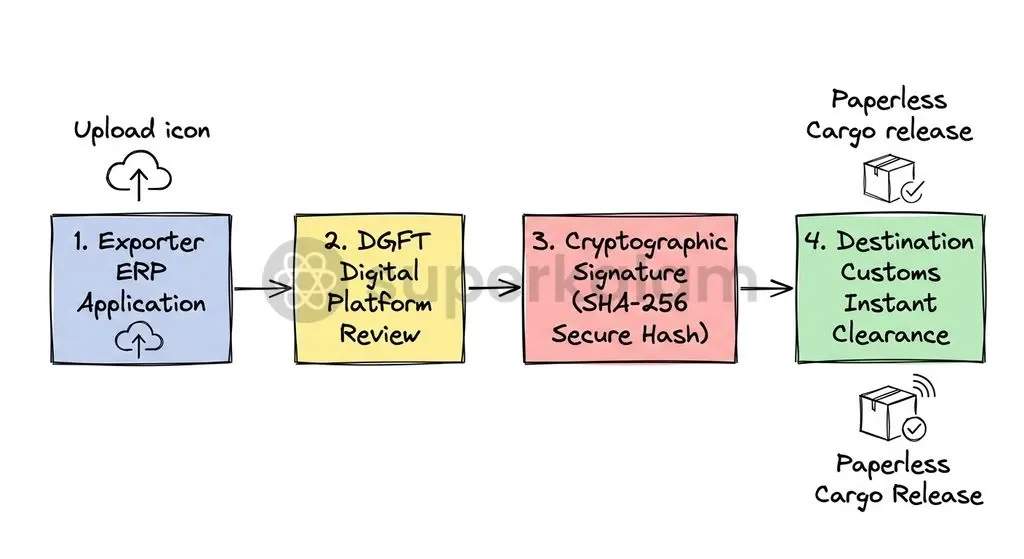
The operational architecture of cross-border electronic origin certification functions through sequential digital steps:
- Digital Application and Upload: The exporter submits product data, manufacturing cost sheets, and value-addition details through the national trade portal.
- Authorised Issuance: Designated issuing authorities review origin compliance and approve the application using secure asymmetric cryptographic signatures.
- Automated Data Integration: Through DGFT Trade Notice No. 25/2026-27, issued on September 7, 2026, an Open API facility enables exporters to integrate Enterprise Resource Planning (ERP) software directly with the portal using SHA-256 RSA digital signatures.
- Customs Verification at Destination: Border officials in partner countries verify document authenticity in real time using secure online verification links or digital certificates, eliminating physical inspection delays.
Similar digital origin architectures have already been integrated into several of India's major economic partnerships, including the ASEAN–India FTA, SAFTA, India–UAE CEPA, India–Australia ECTA, and the India–Japan CEPA.
Key Benefits: From Transaction Costs to Faster Port Clearance
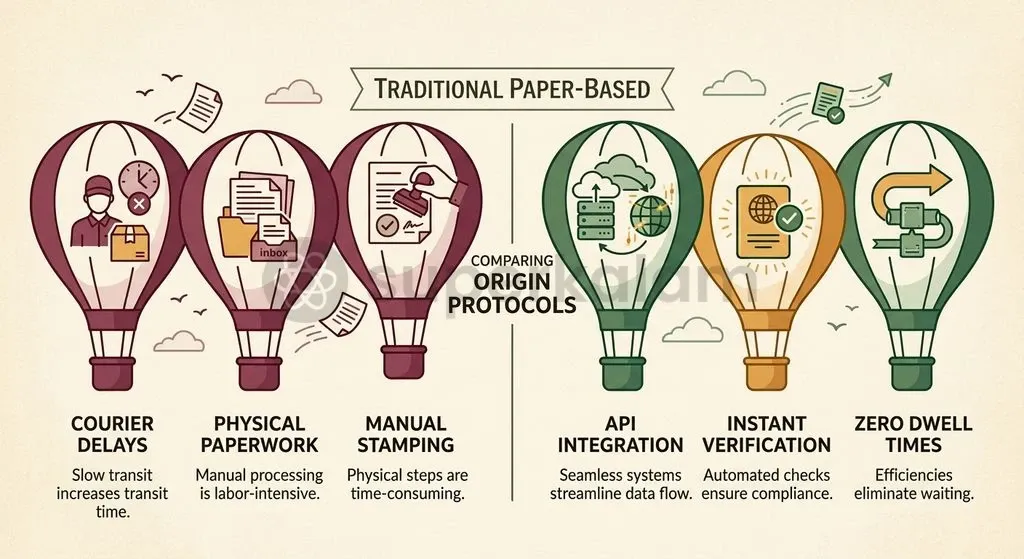
Implementing electronic Certificates of Origin reduces port dwell times, cuts administrative expenses for Indian exporters, and curbs document tampering across bilateral customs checkpoints. By replacing physical courier chains with digital issuance, the mechanism tackles persistent non-tariff logistics bottlenecks.
| Process Step | Traditional Paper-Based Workflow | Modernised e-CoO Digital Workflow |
|---|---|---|
| Filing & Signing | Physical application with manual ink signatures | Online portal or ERP with SHA-256 RSA signatures |
| Transmission | International postal courier overseas | Instant direct electronic exchange |
| Port Clearance | Manual document scrutiny causing transit delays | Real-time automated customs verification |
| Risk Profile | Vulnerable to transit loss, fraud, and demurrage | Tamper-proof validation with reduced overheads |
The protocol delivers concrete trade facilitation gains across four primary operational dimensions:
- Curtailing Dwell Times: Cargo frequently reaches distant South American seaports before physical paper documents arrive by courier. Electronic certification enables pre-arrival customs processing and prevents container demurrage charges.
- Lowering Administrative Overheads: Eliminating document printing, physical attestation visits, and international postal dispatch lowers compliance expenses for micro, small, and medium-sized exporters.
- Preventing Document Fraud: Centralised electronic verification with SHA-256 encryption prevents the submission of forged or altered certificates, safeguarding tariff revenues.
- Multilateral Policy Alignment: The digital transition directly advances commitments under Article 10 of the WTO Trade Facilitation Agreement, which mandates the reduction of import formalities and the wider acceptance of paperless documentation.
Discuss with Superkalam
Compare the economic implications of a limited Preferential Trade Agreement (positive list) with a Comprehensive Economic Partnership Agreement for India's export basket.
Ask NowChallenges in Digital Verification and Cross-Border Standards
Cross-border electronic origin verification faces technical hurdles across three main operational areas:
- Divergent Ratification Timelines: Because the trade protocol requires independent legislative approval in Argentina, Brazil, Paraguay, and Uruguay, administrative rollouts may occur at varying speeds across different border checkpoints.
- Cybersecurity and System Uptime: Customs authorities must maintain dependable digital infrastructure to ensure high platform uptime and prevent digital spoofing across interconnected trade portals.
- Small Business Integration Gaps: Smaller Indian exporters require technical assistance to adapt internal accounting software to automated API-driven filing systems.
While the protocol establishes legal equivalence, smooth execution depends on sustained digital infrastructure interoperability among all customs administrations.
Way Forward: Deepening India-Latin America Trade Integration
Expanding the India–MERCOSUR Preferential Trade Agreement into a Comprehensive Economic Partnership requires widening tariff coverage, addressing non-tariff sanitary barriers, and harmonising bilateral digital infrastructure. The September 14, 2026 decision to open comprehensive trade negotiations offers an institutional pathway to broaden the existing agreement beyond its modest 450-line coverage.
Policymakers should focus on three strategic priorities:
- Transitioning from PTA to CEPA: Expanding product lines and including trade in services, investment protection, and digital commerce will unlock deeper value chains between India and South America.
- Single-Window Customs Interoperability: Integrating India's DGFT portal directly with the National Single Window systems of MERCOSUR countries will automate cross-border origin validation.
- Diversifying Strategic Supply Chains: Broadening trade ties facilitates secure supplies of critical minerals, agricultural commodities, and energy imports while creating export markets for Indian engineering goods and generic pharmaceuticals.
Discuss with Superkalam
Propose technical and administrative measures that India and MERCOSUR member states should adopt to resolve divergent domestic ratification timelines.
Ask NowKey Takeaways
- India and MERCOSUR signed the First Additional Protocol to their Preferential Trade Agreement on September 14, 2026, granting full legal equivalence to electronic Certificates of Origin.
- The protocol amends Article 16 of Annex III (Rules of Origin) to allow paperless customs administration, reducing port dwell times and international courier costs for exporters.
- Rules of Origin prevent trade deflection, ensuring that preferential tariffs apply strictly to goods wholly obtained or substantially transformed within signatory states under frameworks like CAROTAR, 2020.
- Digital origin certification aligns with Article 10 of the WTO Trade Facilitation Agreement, building upon domestic systems like DGFT's Trade Connect portal and SHA-256 RSA encrypted Open APIs.
- Alongside the origin protocol, India and MERCOSUR initiated formal negotiations on September 14, 2026, to expand the existing 450-tariff-line agreement into a comprehensive trade pact.
Mains Question
"Modernising trade facilitation through paperless regulatory mechanisms is essential for expanding South-South economic integration." In light of the First Additional Protocol to the India–MERCOSUR Preferential Trade Agreement, elucidate the significance of electronic Rules of Origin in mitigating non-tariff logistics bottlenecks. (10 Marks)
Evaluate NowMains Question
While the transition from physical to electronic origin certification represents a critical step in trade facilitation, cross-border digital verification faces distinct structural and operational hurdles. Critically examine the challenges involved and discuss the measures needed to deepen India's trade engagement with MERCOSUR. (15 Marks)
Evaluate NowPractice MCQs
QUESTION 1
Consider the following statements regarding the India–MERCOSUR Preferential Trade Agreement (PTA):
- It was signed in 2004 and became operational in 2009.
- India extends tariff concessions to MERCOSUR across all lines of its tariff schedule.
- Bolivia has initiated accession to MERCOSUR, whereas Venezuela was suspended in 2016. Which of the statements given above are correct?
QUESTION 2
With reference to the Rules of Origin and trade administration in India, consider the following statements:
- Rules of Origin prevent non-member nations from engaging in trade deflection by routing goods through a preferential partner.
- Under CAROTAR, 2020, Indian importers claiming preferential duty rates are required to maintain origin documentation and exercise statutory due diligence.
- The First Additional Protocol to the India–MERCOSUR PTA amends Article 16 of Annex III to grant legal equivalence to electronic Certificates of Origin. Which of the statements given above is/are correct?
QUESTION 3
Consider the following statements regarding the implementation of Electronic Certificates of Origin (e-CoO) in India's trade architecture:
- DGFT enables exporters to integrate ERP systems directly with the digital platform using SHA-256 RSA signatures.
- The transition to electronic certification eliminates pre-arrival processing at destination seaports.
- Acceptance of paperless documentation aligns with commitments under Article 10 of the WTO Trade Facilitation Agreement. Which of the statements given above is/are correct?
QUESTION 4
Apart from MERCOSUR, which of the following trade agreements of India have integrated digital electronic Certificate of Origin (e-CoO) architectures according to the DGFT Common Digital Platform guidelines?
- India–UAE Comprehensive Economic Partnership Agreement (CEPA)
- India–Australia Economic Cooperation and Trade Agreement (ECTA)
- ASEAN–India Free Trade Area (FTA) Select the correct answer using the code given below:
QUESTION 5
In the context of international trade logistics, which of the following best describes the primary advantage of replacing physical Certificates of Origin with digitally signed e-CoOs?