India's Foreign Technology Dependence: NavIC, Cloud and Tejas
Foreign networks and components expose India to disruption. Read about NavIC, MeghRaj cloud, UPI apps and Tejas engines for UPSC.
Oct, 2026
•9 min read
Context
India's pursuit of technology sovereignty means moving past 20th-century autarky toward strategic autonomy. This posture builds on asymmetric leverage, domestic innovation, and resilient minilateral partnerships.
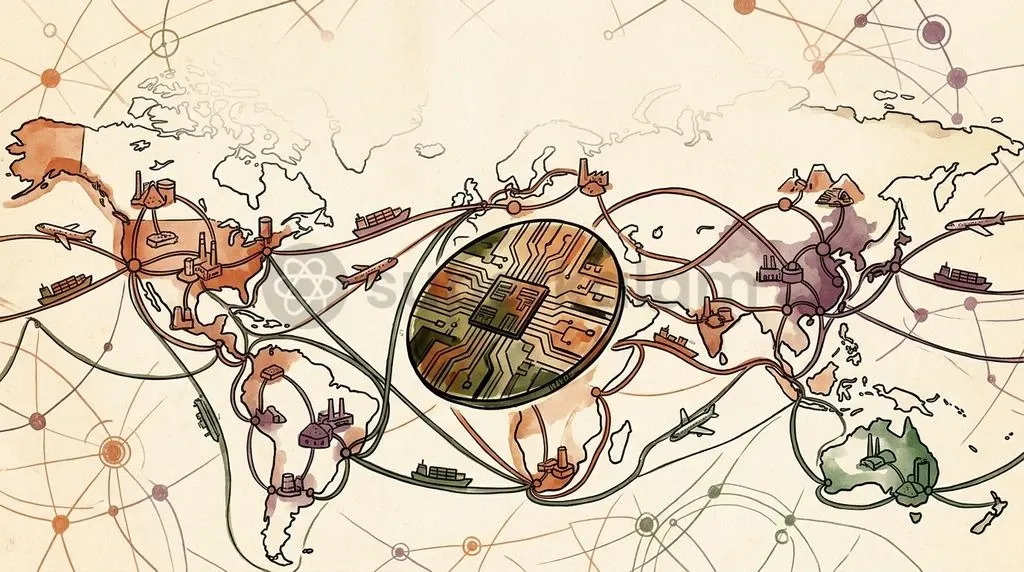
Hardware fabrication remains concentrated in a few fragile choke points. No single nation can achieve total vertical integration across raw materials, precision tools, and foundry capacity.
True digital sovereignty balances targeted domestic manufacturing under the India Semiconductor Mission with world-class chip design and software. Strategic initiatives like the Initiative on Critical and Emerging Technologies embed India within trusted production corridors. This protects the digital economy from weaponised supply chains.
Why Tech Sovereignty Dominates the Global Policy Agenda
The Hindu's 22 October 2026 analysis examines how foreign-controlled services, platforms and components can expose Indian infrastructure to disruption. The issue is operational control, not simply where data is stored or whether an Indian company holds equity. The article maps five areas of exposure:
Satellite connectivity: Foreign operators retain technical control of their satellite networks, including in ventures with Indian investment. This creates a potential service restriction risk, but it does not mean that all Indian communications depend on foreign satellites; ordinary telephone and internet traffic largely uses terrestrial networks, alongside India's own satellite capabilities.
Satellite navigation: Gaps in NavIC's operational constellation limit standalone positioning capability and illustrate why an indigenous system needs sustained launch and maintenance capacity. The article cites a parliamentary statement on NavIC's shortcomings rather than treating the existence of the constellation as proof of complete independence.
Cloud computing: MeghRaj is the government's NIC-operated cloud, while departments also use empanelled private providers. The AWS-Yotta plan for MeghRaj 2.0 uses AWS Outposts within NIC data centres, keeping data physically in India. Yet monitoring and software updates still require an AWS regional control connection. Data localisation alone therefore does not establish operational independence.
Digital payments: NPCI operates UPI's domestic infrastructure, which gives India substantial payment autonomy. Google Pay and PhonePe are foreign-controlled consumer-facing apps, not the underlying UPI rails. A single app's shutdown would not shut down UPI; users could switch apps. Banks' exposure to international payment and correspondent banking networks, including sanctions risk, remains a separate vulnerability.
Military equipment: Even the indigenous Tejas fighter depends on U.S.-made GE Aerospace engines. The article reports that engine-delivery delays have constrained production and pushed delivery deadlines, showing how a foreign component can limit a domestic programme.
The policy question is how to reduce these specific points of dependence while retaining useful international partnerships, rather than equating technological sovereignty with complete self-sufficiency.
Discuss with Superkalam
Which 15 essential minerals does India remain 100% import-dependent on, according to the 2023 Ministry of Mines report?
Ask NowBeyond Complete Autarky: What Realistic Tech Sovereignty Entails
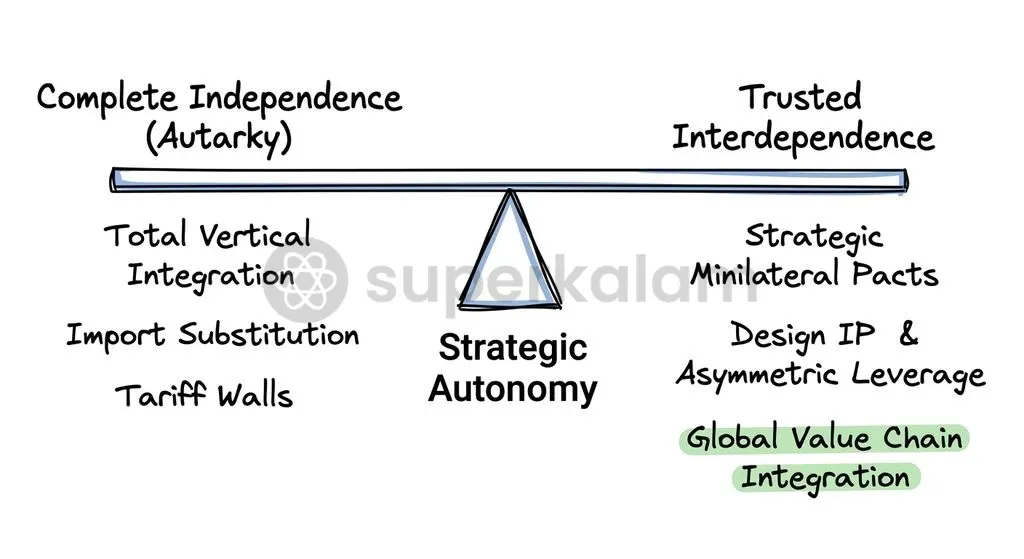
Strategic autonomy rejects pure autarky. Instead, it builds asymmetric domestic strengths that make an economy indispensable to global value chains. Total self-reliance is an impossible goal in globally distributed high-technology industries.
Traditional import substitution tried to replicate entire supply chains within domestic borders. That model collapses under the hyper-specialisation of modern tech. Strategic sovereignty relies instead on mutual dependencies.
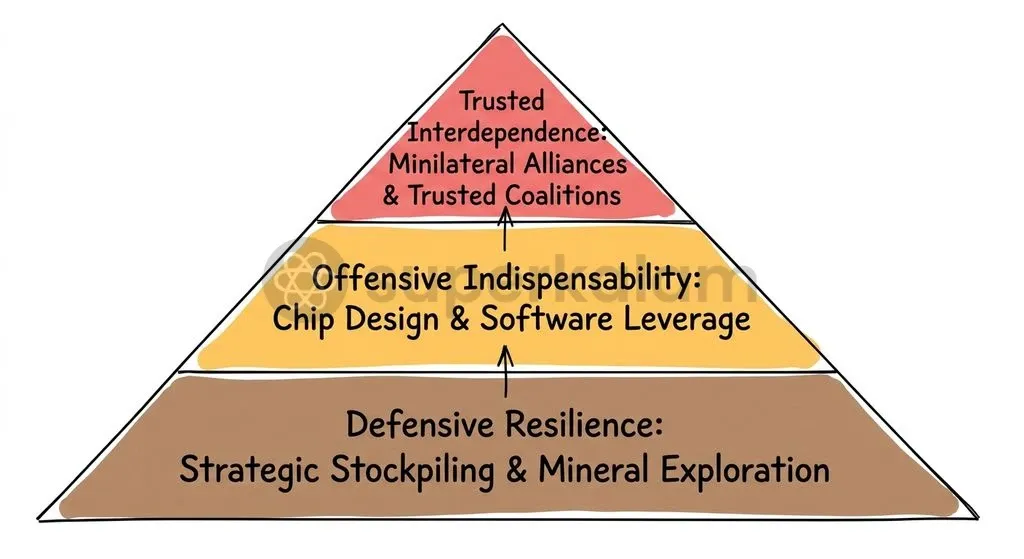
A state gains real security when foreign partners depend on its specialized outputs. That reciprocal vulnerability deters geopolitical coercion. Analysts distinguish ideological autarky from pragmatic strategic autonomy across three distinct layers:
- Defensive Resilience: Buffering domestic supply lines through mineral stockpiling, alternate sourcing routes, and backward integration for critical components.
- Offensive Indispensability: Dominating specialised niches—such as fabless circuit design or software stacks—so that denying access to one nation triggers retaliatory costs globally.
- Trusted Interdependence: Securing reciprocal technology sharing and joint development pacts with allied nations to guarantee emergency access.
Where India Faces Severe Chokepoints: Compute, Silicon, and Minerals
India faces critical vulnerabilities across raw mineral inputs, photolithography tooling, and the intellectual property frameworks behind leading-edge computing. A 2023 Ministry of Mines report confirmed that India remains 100% import dependent on foreign suppliers for 15 essential minerals, including lithium, cobalt, nickel, niobium, and tantalum.
These resource gaps leave domestic clean energy transitions and electronics assembly vulnerable to geopolitical disruption. China's Ministry of Commerce showed these risks by imposing export licensing curbs on gallium and germanium in August 2023. Beijing followed with antimony controls in August 2024 and direct country prohibitions in December 2024.
China suspended certain country-specific bans through November 27, 2026. However, its retention of discretionary licensing maintains substantial leverage over global supply networks.
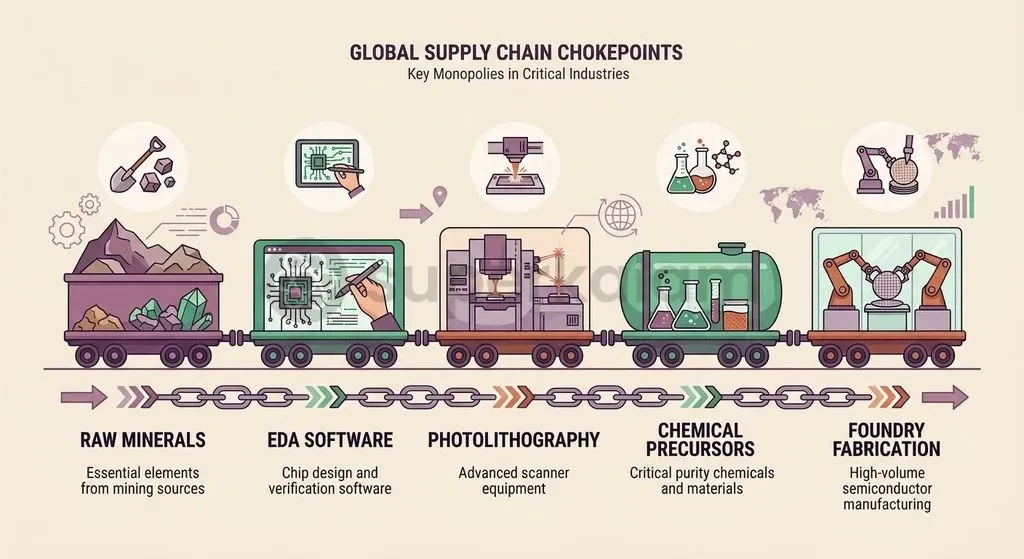
Upstream processing and downstream tooling dependencies expose the Indian hardware ecosystem to multiple single-point failures:
- Lithography Machinery: The Dutch manufacturer ASML holds an absolute 100% commercial global monopoly on Extreme Ultraviolet (EUV) scanners, which are essential for producing logic chips at sub-7nm process nodes.
- Chemical Inputs: Specialised chemical producers in Japan command an aggregate market share exceeding 80% for advanced photoresists and fluorinated polyimides needed in semiconductor lithography.
- Design Automation Tools: Three US-based software vendors—Synopsys, Cadence, and Mentor Graphics (Siemens EDA)—control over 75% of global market revenue for Electronic Design Automation (EDA) software, creating software chokepoints in modern chip blueprint production.
Discuss with Superkalam
Explain the operational differences between the 'chokepoint effect' and the 'panopticon effect' in globalised technology networks.
Ask NowThe Limits of Self-Sufficiency: Why No Country Can Build It All Alone
Massive capital costs and extreme technical specialisation prevent any single country from building a fully domestic semiconductor ecosystem. Building a single commercial sub-5nm fabrication facility demands capital expenditures exceeding $15 billion to $20 billion. These facilities carry immense fiscal outlays and face rapid obsolescence cycles.
Commercial fabrication requires operational scale, hyper-pure chemicals, and guaranteed baseload power. These prerequisites take decades to develop. Wafer yields depend on accumulated engineering experience, precision metrology, and hundreds of specialised sub-suppliers operating within tightly integrated geographic clusters.
Several structural barriers stop any single domestic entity from achieving complete vertical integration:
- R&D Capital Intensity: Advanced foundries spend billions of dollars every year purely on process engineering research, outstripping the capital budgets of most industrial conglomerates.
- Yield Curve Economics: New semiconductor foundries operate at steep initial financial losses until wafer defects fall below fractional percentage thresholds.
- Specialised Sub-Tiers: Fabricating an integrated circuit involves over a thousand separate processing steps, each managed by proprietary industrial equipment and patented chemical precursors.
Minilateral Coalitions: How iCET and Quad Reshape Supply Chains
Minilateral technology pacts help India de-risk critical supply vulnerabilities through shared financing, joint research, and integrated cross-border industrial corridors. Several diplomatic frameworks drive this realignment:
- US-India iCET Framework: Through the US-India Initiative on Critical and Emerging Technology (iCET), both governments operationalised the Strategic Trade Dialogue to harmonise advanced export controls and expand licensed co-production across semiconductors and defence hardware.
- Minerals Security Partnership (MSP): Plurilateral coalitions provide alternative avenues for securing critical raw materials. In June 2023, India joined the US-led 14-nation Minerals Security Partnership (MSP) as its only developing country member, accelerating co-investment into international mineral processing projects.
- Quad Critical Minerals Initiative: Regional frameworks deliver complementary financial mechanisms. On May 26, 2026, the Quad partner nations adopted the Quad Critical Minerals Initiative Framework in New Delhi, committing to mobilise up to $20 billion in public and private financing to diversify regional processing networks.
Discuss with Superkalam
If a foreign supplier abruptly embargoes EDA software tools or advanced photoresists, how should India deploy its diplomatic and industrial tools to cushion the impact?
Ask NowDomestic Chokepoint Strategy: Capitalising on Chip Design and Software
India counters physical hardware dependencies by building intellectual property in chip design and sovereign software architectures. Approximately 20% of the world's semiconductor design engineers operate from India. That represents roughly 125,000 trained professionals who generate more than 3,000 integrated circuit blueprints annually.
The Ministry of Electronics and Information Technology (MeitY) updated its industrial policy through the Semicon 2.0 framework. It expanded the Semicon India Programme with a total financial outlay of ₹1,27,500 crore across six core pillars: design, equipment, materials, fabs, advanced packaging, and R&D.
Under Semicon 2.0 Pillar 1, the government removed the former ₹15 crore financial cap on the Design-Linked Incentive (DLI) scheme. It now provides project-linked funding up to ₹1,000 crore to incubate 100 domestic fabless chip design startups.
| Programme Component | Strategic Scope | Financial Allocation / Target |
|---|---|---|
| Semicon 2.0 (Pillar 1) | Fabless chip design startup incubation | Up to ₹1,000 crore project funding |
| DIR-V Programme | Open microprocessor architectures | Shakti and Vega processor cores |
| ISM 1.0 (Commercial Fabs) | Five commercial fab & packaging units | ₹1.52 lakh crore cumulative investment |
Targeted state initiatives build indigenous capabilities across the hardware-software boundary:
- Open Hardware Architectures: MeitY's Digital India RISC-V (DIR-V) programme funds indigenous microprocessors, backing the development of the Shakti and Vega processor cores to reduce reliance on foreign proprietary instruction sets.
- Foundry Construction: Under India Semiconductor Mission 1.0, the central government approved five commercial semiconductor fabrication and packaging facilities with a cumulative planned investment of ₹1.52 lakh crore.
- Software-Layer Counterweights: Open digital public infrastructure provides strategic autonomy at the application layer. India's India Stack processed over 130 billion annual UPI payment transactions by FY 2023-24, preventing global digital platforms from establishing monopolistic payment choke points.
Discuss with Superkalam
Break down why vertical integration in sub-5nm fabrication is economically and technically unfeasible for a single nation acting alone.
Ask NowComplete Independence vs Trusted Interdependence: A Comparative View
Policymakers evaluate technology security across two contrasting frameworks: classical domestic autarky and contemporary strategic interdependence. The following comparison illustrates how each model approaches industrial planning, capital deployment, and international alliances:
| Strategic Dimension | Complete Independence (Autarky) | Trusted Interdependence (Strategic Autonomy) |
|---|---|---|
| Primary Strategic Objective | Domestic replacement of foreign components across all tiers | Establishing reciprocal reliance and mutual supply-chain choke points |
| Capital Allocation | Subsidising full-stack domestic fabrication facilities | Targeted co-investments in design, packaging, and raw materials |
| Supply Chain Posture | Protectionist tariff walls and import bans | Friend-shoring, plurilateral coalitions, and trade integration |
| Vulnerability to Shocks | High systemic fragility due to domestic production delays | Resilient diversification through multilateral alliances and stockpiles |
| Core Geopolitical Levers | Domestic regulatory mandates | Indispensable design intellectual property and processing nodes |
Way Forward: Building Strategic Autonomy in Critical Technologies
Strategic industrial policy requires securing upstream mineral processing while establishing sovereign downstream capabilities. Domestic resource governance saw major statutory reform when the Parliament passed the Mines and Minerals (Development and Regulation) Amendment Act, 2023, introducing Part D to the First Schedule to designate 24 critical and strategic minerals and empowering the Central Government to auction commercial leases.
Upstream security received further fiscal backing on January 29, 2025, when the Union Cabinet approved the National Critical Mineral Mission with a central expenditure of ₹16,300 crore and an expected public sector contribution of ₹18,000 crore through FY 2030-31.
Under its operational roadmap, the Geological Survey of India conducted 195 exploration projects in FY 2024-25 and planned 227 projects for FY 2025-26.
A comprehensive technology sovereignty strategy balances domestic mining, foreign asset acquisitions, and fiscal rationalisation:
- Overseas Asset Acquisition: Khanij Bidesh India Limited (KABIL) operationalised global sourcing in January 2024 through a ₹200 crore agreement to explore and develop five lithium brine blocks covering 15,703 hectares in Catamarca, Argentina.
- Exploration and Production Targets: The National Critical Mineral Mission mandates executing 1,200 domestic exploration projects by 2031, achieving domestic production for at least 15 critical minerals, and securing 50 overseas mining assets.
- Strategic National Buffers: The Ministry of Mines earmarked an initial allocation of ₹500 crore under the National Critical Mineral Mission to build a National Strategic Critical Minerals Stockpile covering at least five vulnerable commodities.
- Tariff Modernisation: The Union Budget 2024-25 provided domestic refiners input-cost relief by fully exempting customs duties on 25 critical minerals and rare earth elements, including lithium, cobalt, and nickel.
Discuss with Superkalam
Formulate a policy roadmap balancing India's fiscal support between commercial wafer foundries and domestic fabless chip design startups.
Ask NowKey Takeaways
- Technology sovereignty in modern geopolitical strategy means building indispensable asymmetric capabilities within global supply networks rather than pursuing unviable domestic autarky.
- Extreme capital barriers and technical specialisation prevent unilateral semiconductor autarky; single advanced fabrication facilities require over $15 billion to $20 billion in capital expenditure.
- Upstream hardware vulnerabilities are structural, as demonstrated by ASML's 100% commercial global monopoly on EUV scanners and India's 100% import dependence on 15 critical minerals.
- India's strategic leverage lies in fabless engineering, where its estimated 125,000 design engineers represent approximately 20% of the world's semiconductor design workforce.
- Statutory and financial architectures, including the ₹16,300 crore National Critical Mineral Mission and the ₹1,27,500 crore Semicon 2.0 framework, anchor India's long-term technology security.
Mains Question
'Total self-reliance is an impossible goal in globally distributed high-technology industries.' In light of global semiconductor chokepoints, elucidate how India can transition from traditional autarky to a posture of trusted interdependence. (15 Marks)
Evaluate NowMains Question
Assess how the 'chokepoint' and 'panopticon' effects of weaponised interdependence threaten India's digital economy. Discuss. (10 Marks)
Evaluate NowPractice MCQs
QUESTION 1
Regarding global semiconductor chokepoints and India's critical vulnerabilities, consider the following statements:
- A 2023 Ministry of Mines report revealed that India is entirely import-dependent for 15 essential minerals, including lithium, cobalt, and nickel.
- ASML commands a complete commercial global monopoly on Extreme Ultraviolet (EUV) lithography scanners required for sub-7nm process nodes.
- The Electronic Design Automation (EDA) software market is evenly diversified across European and Asian software vendors. Which of the statements given above are correct?
QUESTION 2
With reference to the concept of 'weaponised interdependence' outlined by political scientists Henry Farrell and Abraham Newman, consider the following statements:
- The chokepoint effect involves throttling technological access via dominant hubs in global supply and transit networks.
- The panopticon effect refers to monitoring proprietary information and intellectual capital across centralised communication architectures. Which of the statements given above is/are correct?
QUESTION 3
Consider the following statements regarding minilateral initiatives and India's technology supply chain diplomacy:
- India joined the Minerals Security Partnership (MSP) as its only developing country member.
- The Quad Critical Minerals Initiative Framework adopted in New Delhi committed to mobilising up to $20 billion in public and private financing.
- The US-India Initiative on Critical and Emerging Technology (iCET) operationalised the Strategic Trade Dialogue to harmonize advanced export controls. Which of the statements given above are correct?
QUESTION 4
Under the Semicon 2.0 framework, which specific shift was introduced in Pillar 1 to strengthen domestic fabless chip design startups?
QUESTION 5
Consider the following pairs regarding global semiconductor supply chain inputs and their market characteristics:
- EUV Lithography Scanners: 100% commercial monopoly held by ASML (Netherlands)
- Advanced Photoresists & Fluorinated Polyimides: Over 80% aggregate market share held by Japanese chemical producers
- Indian Semiconductor Design Talent: Hosts approximately 20% of global design engineers generating over 3,000 IC blueprints annually How many of the pairs given above are correctly matched?