India-EU FTA Copyright Rules: Section 65A and Digital Rights
As EU trade demands push for strict digital lock prohibitions, India must defend Section 65A to protect fair dealing, reverse engineering, and consumer repair.
Sep, 2026
•10 min read
Context
India's calibrated intent-based anti-circumvention framework under Section 65A of the Copyright Act, 1957 safeguards public interest exceptions. In contrast, European Union trade demands seek absolute legal prohibitions against breaking digital locks regardless of whether copyright infringement occurs.
Intellectual property provisions have emerged as a friction point in bilateral trade talks. The European Union advocates for strict anti-circumvention rules that ban both the act of bypassing digital locks and the distribution of circumvention tools. Conversely, Indian copyright law expressly protects legitimate fair dealing, cybersecurity research, and consumer repair rights by penalising circumvention only when paired with an intention to infringe.
Why Is the India–EU FTA Intellectual Property Chapter in the News?
The European Commission is seeking TRIPS-Plus intellectual property standards in the ongoing free trade agreement negotiations with India. These negotiations cover sweeping chapters on digital trade and copyright enforcement. As of January 2024, negotiating documents indicate that European negotiators are pressing for strict bans on the circumvention of digital locks protecting software and media.
| Anti-Circumvention Model | Legal Standard | Impact on Users and Repair |
|---|---|---|
| EU Model / US DMCA | Absolute ban regardless of intent | Criminalises tools, diagnostics, and independent repair |
| India (Section 65A) | Intent-linked liability | Preserves fair dealing, security audits, and repair rights |
Indian policymakers and civil society groups have raised concerns regarding these demands. The core debate centres on whether trade commitments should override domestic public interest flexibilities. Adopting strict anti-circumvention rules would alter the statutory balance established under the Copyright Act, 1957, affecting local industries, academic institutions, and independent repair economies across the country.
What Are Technological Protection Measures (TPMs) and Digital Locks?
Technological Protection Measures refer to digital access-control and copy-control tools designed to regulate access to copyrighted digital content, computer software, and firmware. According to the WIPO Standing Committee on Copyright and Related Rights (SCCR/10/4), these mechanisms include encryption, digital handshakes, and digital rights management (DRM) systems. Manufacturers embed TPMs across various digital works, ranging from digital books and streaming media to embedded firmware inside physical devices.
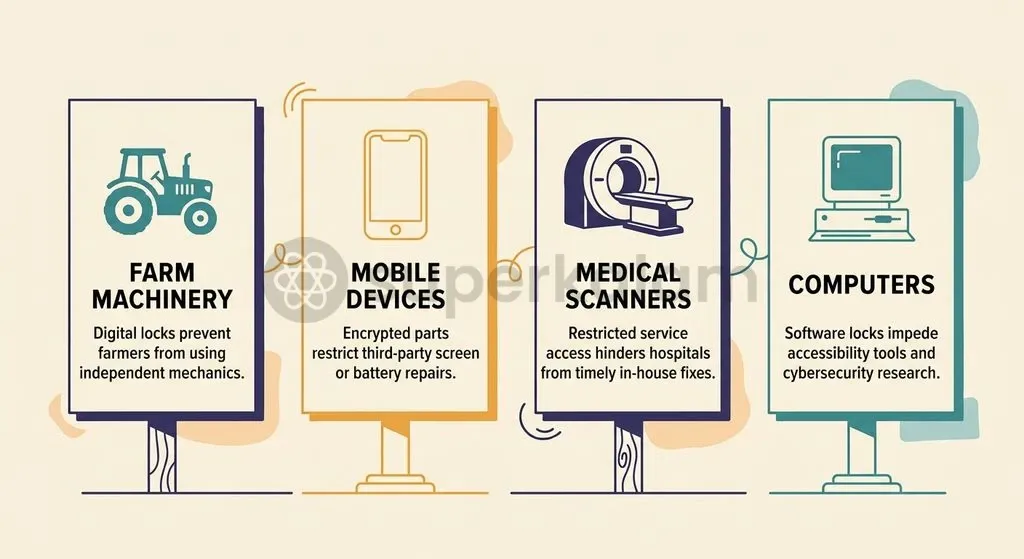
Manufacturers increasingly deploy digital locks on physical consumer hardware. Modern tractors, smartphones, medical diagnostic machinery, and electric vehicles operate on proprietary software safeguarded by access barriers.
- Access Controls: Implement password protection, paywalls, hardware-software handshakes, and region-locking mechanisms to restrict initial device access.
- Copy Controls: Deploy encryption of data streams, anti-copying watermarks, and device-binding restrictions to prevent unauthorised reproduction.
While technological locks protect creative works from commercial piracy, they also grant rightsholders unilateral control over post-sale product usage. When the law prohibits bypassing a digital lock, it creates a separate legal barrier above standard copyright protection.
Discuss with Superkalam
Can you recall the specific statutory element under Section 65A(1) of the Copyright Act, 1957 required to trigger criminal penalties for bypassing a digital lock?
Ask Now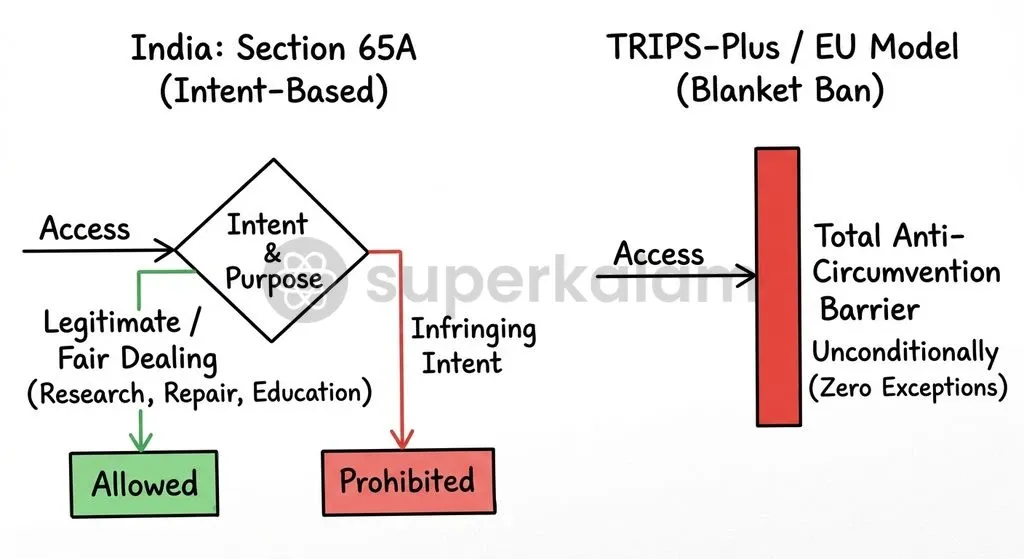
How Indian Law Balances Copyright: Section 65A and Legitimate Circumvention
The Copyright (Amendment) Act, 2012 introduced Section 65A into the Copyright Act, 1957 to address digital locks while safeguarding user rights. Under Section 65A(1) of the Act, circumvention of an effective technological measure is punishable with imprisonment up to two years and a fine only when undertaken with the intention of infringing rights conferred by the statute. The presence of an explicit infringing intent is the foundational requirement for criminal liability in India.
Section 65A(2) of the Act establishes comprehensive statutory exceptions to ensure that lawful, non-infringing activities remain fully protected:
- Preservation of Fair Dealing: Section 65A(2)(a) permits any person to circumvent a technological measure for any purpose not prohibited by the Act, explicitly protecting the fair dealing exceptions listed under Section 52.
- Encryption and Security Research: Section 65A(2)(b) and Section 65A(2)(d) exempt circumvention conducted for encryption research and authorised cybersecurity testing of computer systems.
- Law Enforcement and Governance: Section 65A(2)(c) and Section 65A(2)(g) protect activities undertaken for lawful investigations and national security.
- Privacy Protection: Section 65A(2)(f) allows circumvention to identify and disable covert surveillance or data-collection features.
Section 65B of the Copyright Act, 1957 complements this structure by penalising the unauthorised removal or alteration of Rights Management Information (RMI). Together, these provisions align Indian law with multilateral treaties while preserving statutory flexibilities for research and education.
What the EU Demands: The TRIPS-Plus Push on Anti-Circumvention Rules
European Union trade negotiators consistently demand TRIPS-Plus commitments that exceed the baseline requirements of multilateral intellectual property agreements. Bilateral trade proposals from the European Union seek dual-track prohibitions that ban both the act of circumvention and the dealing in circumvention tools.
- Act Prohibitions: Bans bypassing digital locks outright, making circumvention illegal per se regardless of whether copyright infringement occurs.
- Device Prohibitions: Prohibits importing, manufacturing, or distributing tools that facilitate circumvention, including software used for repairs or diagnostics.
International treaties provide significant national policy space on this issue. Article 11 of the WIPO Copyright Treaty (WCT), 1996 and Article 18 of the WIPO Performances and Phonograms Treaty (WPPT), 1996 require contracting parties to provide adequate legal protection and effective legal remedies against circumvention.
The WIPO treaties restrict this obligation to acts that are not authorised by authors or permitted by law. The agreed statements concerning Article 10 of the WCT affirm that member states may carry forward and devise new exceptions suitable to digital environments. The European Union's FTA proposals restrict this sovereign flexibility by enforcing strict liability standards.
Discuss with Superkalam
How does the EU's dual-track prohibition decouple the protection of Technological Protection Measures from actual copyright infringement?
Ask NowComparing Approaches: India's Section 65A vs TRIPS-Plus Standards
The Indian legal framework under the Copyright Act, 1957 contrasts sharply with the Western anti-circumvention regimes found in the European Union and the United States.
| Dimension | Indian Framework (Section 65A) | European Union (Directive 2001/29/EC) | United States (17 U.S.C. § 1201 DMCA) |
|---|---|---|---|
| Primary Standard | Intent-linked liability | Strict liability prohibition | Strict liability prohibition |
| Requirement of Infringement | Required; circumvention is lawful if purpose is non-infringing | Not required; bypassing locks is illegal per se | Not required for access controls |
| Regulation of Tools | Does not ban manufacturing or distribution of general tools | Prohibits commercial manufacture, sale, or distribution of tools | Prohibits manufacturing, importing, or trafficking circumvention tools |
| Interoperability Exceptions | Permitted under Section 52(1)(ab) and 52(1)(ac) | Limited exceptions subject to strict administrative conditions | Narrow statutory exceptions requiring periodic administrative renewal |
| Protection for Fair Use | Expressly preserved under Section 65A(2)(a) | Secondary to technical measures unless Member States intervene | Subject to complex three-year exemption review rulemaking |
Indian law treats Technological Protection Measures as an auxiliary safeguard to copyright rather than an independent legal monopoly. Western models enforce digital locks even when the underlying act serves an educational or diagnostic purpose.
Everyday Risks: How Tougher TPM Rules Threaten Repair, Research, and Education
Stricter anti-circumvention provisions create substantial collateral damage across multiple sectors of the Indian economy. The Department of Consumer Affairs highlighted this challenge when establishing the national Right to Repair framework.
- Right to Repair and Rural Livelihoods: The Department of Consumer Affairs set up an inter-ministerial committee in July 2022 and launched the national Right to Repair portal in December 2022 across sectors including farming equipment, mobile phones, consumer durables, and automobiles. Modern agricultural tractors and consumer electronics use software locks to prevent component matching. A consultation paper by the Department of Consumer Affairs notes that blanket anti-circumvention rules prevent independent repairers and farmers from unlocking firmware-paired components.
- Reverse Engineering and Software Interoperability: Sections 52(1)(ab) and 52(1)(ac) of the Copyright Act, 1957 permit the reverse engineering of lawfully obtained computer software to achieve interoperability. Strict anti-device rules would criminalise the software utilities required to conduct such reverse engineering.
- Persons with Disabilities: Section 52(1)(zb) of the Copyright Act, 1957 allows the reproduction of works into accessible formats for persons with disabilities, harmonising domestic law with the Marrakesh Treaty (2013). Encrypted e-books often block screen readers, requiring circumvention to ensure accessibility.
- Digital Preservation and Education: Sections 52(1)(p) and 52(1)(za) of the Copyright Act, 1957 allow non-commercial archives and libraries to make digital copies of works for preservation. TPM anti-device rules restrict educational institutions from archiving digital media when proprietary formats become obsolete.
Discuss with Superkalam
If a local technician unlocks firmware-paired components on a tractor for repair purposes, how would their legal liability differ under Indian law compared to the US DMCA?
Ask NowInternational Lessons: How the US DMCA and EU Directives Impacted Fair Use
Foreign legal jurisdictions demonstrate the practical pitfalls of adopting absolute anti-circumvention rules. Section 1201 of Title 17 of the United States Code, enacted under the Digital Millennium Copyright Act (DMCA) of 1998, created an independent legal prohibition against bypassing access controls.
Over two decades of DMCA enforcement showed that companies used Section 1201 to suppress independent cybersecurity audits, restrict third-party printer cartridges, and prevent independent automotive maintenance.
Article 6 of the EU Information Society Directive (Directive 2001/29/EC) adopted a similarly rigid standard by prohibiting both the act of circumvention and the commercial trafficking of circumvention tools. European courts have frequently prioritised the technical integrity of digital locks over traditional public interest exceptions.
| Jurisdiction | Statutory Vehicle | Practical Impact on Fair Dealing and Markets |
|---|---|---|
| United States | DMCA § 1201 | Chilled vulnerability research, restricted repair markets, and created triennial exemption hurdles |
| European Union | Directive 2001/29/EC | Restricted tool development for interoperability and subordinated fair dealing to technical locks |
These international experiences illustrate that divorcing anti-circumvention rules from copyright infringement enables manufacturers to build secondary monopolies on repair, replacement parts, and aftermarket services.
Discuss with Superkalam
Weigh the trade-off between granting absolute legal protection to digital locks for IP holders versus protecting domestic reverse engineering and accessibility rights.
Ask Now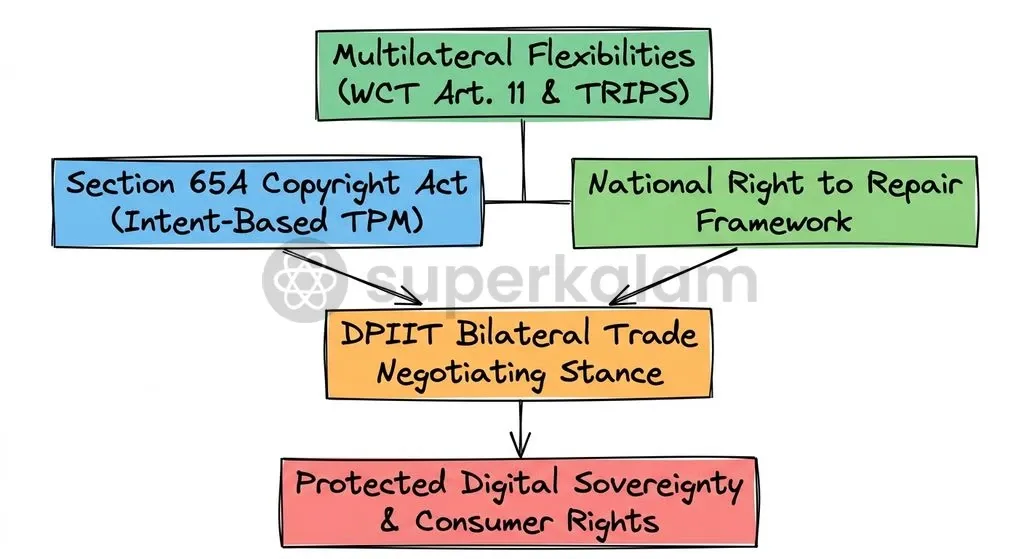
Way Forward: Protecting Digital Sovereignty and Consumer Rights in Trade Talks
India's negotiating strategy must defend domestic statutory flexibilities to maintain balance in the digital knowledge ecosystem. The Department for Promotion of Industry and Internal Trade (DPIIT) should anchor India's intellectual property position in existing multilateral commitments.
To safeguard public interest goals during trade discussions, policymakers should pursue the following measures:
- Defending Section 65A as Fully Compliant: Indian negotiators must assert that Section 65A of the Copyright Act, 1957 fulfils all legal requirements under Article 11 of the WCT and Article 18 of the WPPT without needing TRIPS-Plus expansions.
- Harmonising Trade with Consumer Policy: Trade negotiating stances must align with the Right to Repair framework instituted by the Department of Consumer Affairs, ensuring that proprietary software locks do not compromise domestic repair rights.
- Rejecting Bans on Circumvention Tools: India should reject proposals that criminalise general-purpose technical tools, preserving the technological capacity of domestic security researchers and software engineers.
- Protecting Domestic Innovation: Safeguarding the reverse-engineering flexibilities in Section 52 of the Copyright Act, 1957 is essential to ensure that Indian technology startups can build interoperable software products.
Preserving the intent requirement in Section 65A ensures that copyright enforcement penalises actual piracy while protecting the digital rights of researchers, consumers, and educational institutions.
Key Takeaways
- The Intent Requirement: Section 65A(1) of the Indian Copyright Act, 1957 penalises the circumvention of digital locks only when done with the intention of infringing copyright, distinguishing Indian law from Western strict-liability models.
- Preservation of Fair Dealing: Section 65A(2)(a) explicitly protects legitimate exceptions under Section 52, ensuring that research, reverse engineering, accessible formatting, and non-commercial archiving remain lawful.
- TRIPS-Plus Trade Demands: The European Union seeks TRIPS-Plus standards in free trade negotiations, demanding blanket bans on circumvention acts and tools regardless of copyright infringement.
- Threat to Right to Repair: Strict technological protection measures prevent farmers, consumers, and independent technicians from accessing firmware necessary to repair tractors, automobiles, and electronic devices.
- WIPO Treaty Leeway: Article 11 of the WIPO Copyright Treaty, 1996 grants member nations the sovereign flexibility to design anti-circumvention remedies that accommodate domestic public interest exceptions.
Mains Question
"The intent-linked liability under Section 65A of the Copyright Act, 1957 establishes a calibrated balance between digital copyright enforcement and domestic public interest flexibilities." In this context, critically examine how European Union TRIPS-Plus demands on anti-circumvention rules could impact India's research, digital preservation, and independent repair ecosystems. (15 Marks)
Evaluate NowMains Question
"Strict anti-device and anti-circumvention prohibitions in trade agreements run counter to the objectives of the national Right to Repair framework." Elucidate. (10 Marks)
Evaluate NowPractice MCQs
QUESTION 1
With reference to the anti-circumvention legal framework under the Copyright Act, 1957 in India, consider the following statements:
- Section 65A was introduced through the Copyright (Amendment) Act, 2012.
- Criminal liability for circumventing a Technological Protection Measure (TPM) requires an explicit intention of infringing copyright.
- Indian copyright law places a blanket prohibition on the commercial manufacture and distribution of general circumvention tools regardless of intent.
Which of the statements given above is/are correct?
QUESTION 2
Consider the following statements regarding the statutory exceptions under the Copyright Act, 1957:
- Section 65A(2)(f) permits the circumvention of technological measures to identify and disable covert surveillance or data-collection features.
- Reverse engineering of lawfully obtained computer software to achieve interoperability is permitted under Section 52.
- Section 52(1)(zb) facilitates the reproduction of works into accessible formats for persons with disabilities, aligning domestic law with the Marrakesh Treaty (2013).
Which of the statements given above is/are correct?
QUESTION 3
With reference to multilateral copyright treaties and Technological Protection Measures (TPMs), consider the following statements:
- Article 11 of the WIPO Copyright Treaty (WCT), 1996 restricts the obligation to provide legal protection against circumvention only to acts not authorised by authors or permitted by law.
- The agreed statements concerning Article 10 of the WCT permit contracting parties to carry forward and devise new exceptions in digital environments.
- The European Union's TRIPS-Plus proposals require member countries to implement intent-linked liability rather than strict liability prohibitions.
Which of the statements given above is/are correct?
QUESTION 4
Consider the following statements regarding the 'Right to Repair' framework and digital locks in India:
- The Department of Consumer Affairs established an inter-ministerial committee and launched the national Right to Repair portal in 2022 covering sectors such as farming equipment and automobiles.
- Blanket anti-circumvention rules restrict independent repairers from unlocking firmware-paired components in modern hardware.
Which of the statements given above is/are correct?
QUESTION 5
Under Section 65A(1) of the Indian Copyright Act, 1957, any person who circumvents an effective technological protection measure with the intention of infringing copyright is punishable with: