India Electric Mobility Index 2025: State Rankings and Grid Challenges
While PM E-DRIVE fuels central EV incentives, NITI Aayog’s index shows sub-national decarbonisation hinges on discom health and grid readiness.
Sep, 2026
•9 min read
Overview
According to the India Electric Mobility Index 2025 released by NITI Aayog, sub-national electric vehicle adoption across India remains highly uneven. Only two large states achieved top-performer status due to significant disparities in power distribution infrastructure, regulatory tariff rationalisation, and state-level fiscal capacities. The index highlights that national decarbonisation cannot rely solely on central demand incentives like the PM E-DRIVE scheme. Achieving sustainable transport electrification requires resolving structural grid bottlenecks and the financial distress of state-level electricity distribution companies.
Why in the News: Findings of the India Electric Mobility Index 2025
NITI Aayog, in collaboration with WRI India, released the second edition of the India Electric Mobility Index 2025 on 16 September 2026 to evaluate the clean mobility transition across all 36 States and Union Territories. Composite performance scores revealed wide regional divergence, ranging from 10 to 84 out of 100. The national median score improved modestly from 36 in 2024 to 40 in 2025.
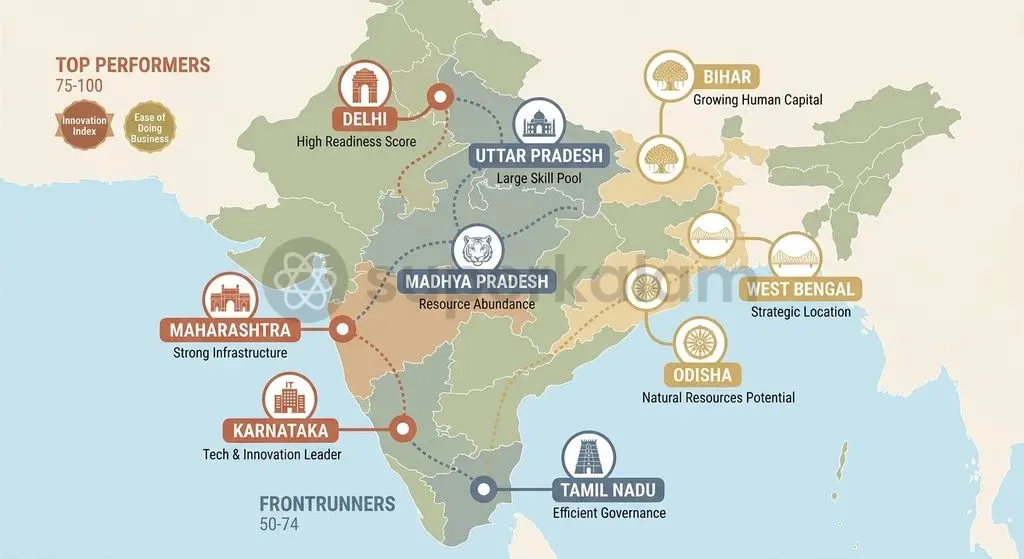
Delhi achieved the highest overall score in the country at 84, followed by Maharashtra at 78, Karnataka at 73, Chandigarh at 71, and Goa at 65. Transport electrification is a major macro-economic priority under Viksit Bharat 2047.
India relies on imports for nearly 89% of crude oil requirements. At the same time, the domestic automotive industry contributes approximately 7.1% to GDP while supporting nearly 19 million direct and indirect jobs.
Understanding the Index: Parameters, Methodology, and State Categorisation
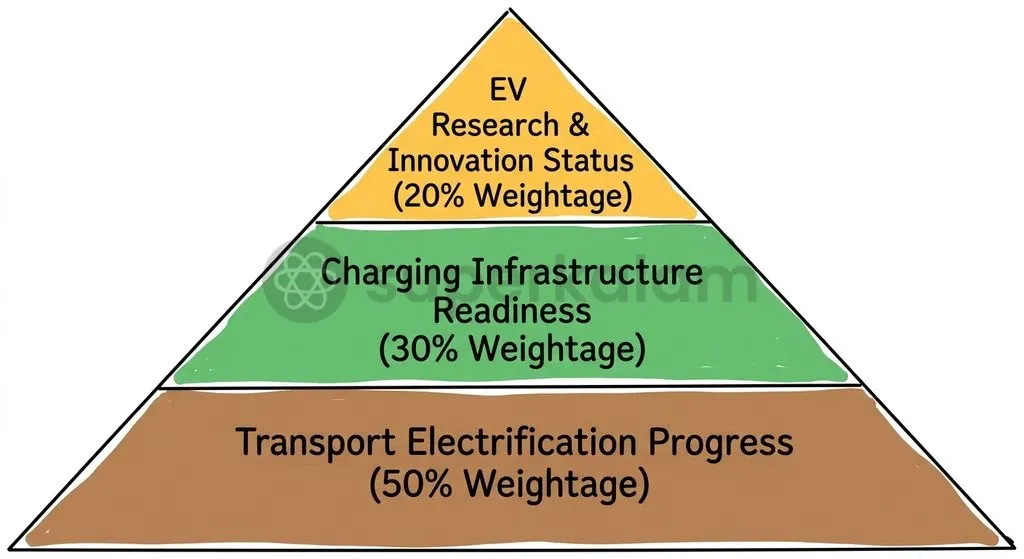
The India Electric Mobility Index evaluates state-level electric mobility readiness across 16 performance indicators grouped into three core pillars. These pillars capture different operational dimensions of the clean energy transition:
- Transport Electrification Progress (50% weight): Assesses the actual registration, adoption, and fleet conversion rates across two-wheelers, three-wheelers, commercial cars, and public buses.
- Charging Infrastructure Readiness (30% weight): Tracks the spatial density of public charging stations, upstream grid connectivity, single-window clearances, and tariff structures.
- EV Research & Innovation Status (20% weight): Measures industrial policy incentives, local component manufacturing, technological patents, and enterprise incubation.
As documented by NITI Aayog, 29 out of 36 States and Union Territories have notified dedicated Electric Vehicle policies. However, state categorisation reveals persistent structural divergence.
Among the 17 large states assessed, only Maharashtra (78) and Karnataka (73) qualified as top performers. Eight large states emerged as frontrunners with scores between 50 and 64: Tamil Nadu (61), Madhya Pradesh (59), Odisha (55), Andhra Pradesh (52), Telangana (51), Haryana (51), Rajasthan (51), and Uttar Pradesh (51). Meanwhile, seven large states remained emerging performers scoring between 35 and 49: Chhattisgarh, West Bengal, Bihar, Kerala, Jharkhand, Punjab, and Gujarat.
Discuss with Superkalam
Recall the three core pillars of the India Electric Mobility Index 2025 and their respective weightages.
Ask NowAmong Hilly and Northeastern States, Manipur recorded the highest score at 46, followed by Tripura at 36 and Assam at 35. Half of the northeastern states identified research and innovation deficits as their primary operational constraint.
| Category Tier | Score Range | Large States Included | Regional / Hilly Leaders |
|---|---|---|---|
| Top Performers | 65–100 | Maharashtra (78), Karnataka (73) | Delhi (84), Chandigarh (71), Goa (65) |
| Frontrunners | 50–64 | TN (61), MP (59), Odisha (55), AP (52), Telangana (51), Haryana (51), Rajasthan (51), UP (51) | None |
| Emerging Performers | 35–49 | Gujarat, Punjab, Kerala, West Bengal, Bihar, Jharkhand, Chhattisgarh | Manipur (46), Tripura (36), Assam (35) |
| Aspirants | Below 35 | None | Remaining Northeastern & UT jurisdictions |
What the Front-Runners Got Right: Key Drivers in the Top Two States
Maharashtra and Karnataka outperformed other large states by combining supply-side industrial support with rapid charging grid deployment. In the Charging Infrastructure Readiness pillar, Karnataka led the country with a score of 97, while Maharashtra recorded 91.
The success of these two states rests on specific institutional mechanisms:
- Early Policy Predictability: Both states notified dedicated electric vehicle regulations early. This created stable capital subsidy frameworks and road tax exemptions that spurred consumer demand.
- Upstream Grid Integration: Power utilities in Maharashtra and Karnataka streamlined the process for high-tension line connections. This allowed private charge point operators to deploy fast-charging plazas along urban corridors.
- Industrial Ecosystem Creation: In the Research and Innovation pillar, Maharashtra scored 85 and Karnataka achieved 82. Both states leveraged existing manufacturing clusters to attract battery assembly investments and automotive software development.
Discuss with Superkalam
Explain how high fixed demand charges and delays in Time-of-Day (ToD) tariff notifications hinder the commercial viability of EV charging stations.
Ask NowComparing State Performance: Leading Models vs Lagging Ecosystems
The India Electric Mobility Index exposes a sharp operational divide between states with integrated execution frameworks and those relying on uncoordinated announcements. While front-ranking states treat electric mobility as a joint transport-energy problem, lagging states suffer from severe administrative fragmentation.
Under the Transport Electrification Progress pillar (50% weightage), only Delhi (77), Chandigarh (75), and Maharashtra (68) qualified as Top Performers. In contrast, 14 of 36 jurisdictions remained classified as Aspirants. In lagging states, EV policies frequently exist on paper without notified electricity tariffs or capital subsidy disbursals.
| Evaluation Dimension | Top Performers (e.g., Maharashtra, Karnataka) | Lagging / Emerging States (e.g., Bihar, Jharkhand) |
|---|---|---|
| Charging Station Density | High urban concentration; proactive land bank allocation along state highways | Sparse public infrastructure; limited highway charging corridors |
| Electricity Tariff Design | Dedicated EV category with promotional, single-part Time-of-Day (ToD) tariffs | Undifferentiated commercial tariffs with high fixed demand charges |
| Administrative Clearances | Unified single-window clearance for power connections and municipal permits | Fragmented approvals across municipal corporations and local power subdivisions |
| R&D and Industrial Base | High scores (82–85) driven by component manufacturing and technology parks | Low scores due to absence of local manufacturing clusters |
Structural Bottlenecks: Why Sub-National EV Transition Stalls
Sub-national electric mobility expansion in India faces acute implementation bottlenecks across regulatory and financial domains. The primary constraint is the uneven pace of institutional coordination between state transport departments and power utilities.
Key structural constraints identified by NITI Aayog include:
- Tariff Notification Lags: Delays by State Electricity Regulatory Commissions in notifying single-part Time-of-Day tariffs undermine the commercial viability of public charging stations.
- High Fixed Demand Charges: Charge point operators facing steep fixed demand charges struggle to achieve operational break-even when initial vehicle utilisation is low.
- Municipal Land Hurdles: Municipal bodies in several emerging states lack standardised land-allocation guidelines, creating multi-month delays in civil works.
Discuss with Superkalam
How can revenue-constrained emerging states apply the Uttar Pradesh model of upstream infrastructure subsidies within limited fiscal space?
Ask NowFiscal Federalism and the EV Sector: The Subsidy and Revenue Dilemma
The Union Government restructured central demand incentives on 29 September 2024 by notifying the PM Electric Drive Revolution in Innovative Vehicle Enhancement (PM E-DRIVE) scheme with an outlay of ₹10,900 crore, succeeding the FAME-II programme.
Funding allocations under PM E-DRIVE follow clear sectoral targets:
- Vehicle Demand Incentives: ₹3,679 crore supports demand incentives for 24.79 lakh e-2Ws, 3.16 lakh e-3Ws, e-ambulances, and e-trucks.
- Public Transit Electrification: ₹4,391 crore funds 14,028 e-buses across major urban centres.
- Charging Infrastructure: ₹2,000 crore supports the deployment of public charging stations.
The Ministry of Heavy Industries later extended the scheme's tenure to 31 March 2028 for e-trucks, e-buses, and testing agencies, while capping subsidies for e-2Ws and e-3Ws at 31 March 2026.
A fundamental tension in electric vehicle federalism arises because central schemes apply uniform timelines and subsidy taper schedules across the country, irrespective of state-level fiscal readiness. Fiscally strong states can supplement tapering central incentives with state-funded road tax waivers and direct buyer subsidies. In contrast, revenue-constrained states cannot match these outlays. This dynamic widens regional adoption disparities, turning national decarbonisation targets into an uneven sub-national burden.
Discuss with Superkalam
Compare the institutional coordination mechanisms of top-performing states (like Karnataka and Maharashtra) with those of lagging states.
Ask NowInfrastructure Deficit: Discom Health, Charging Grids, and Land Allocation
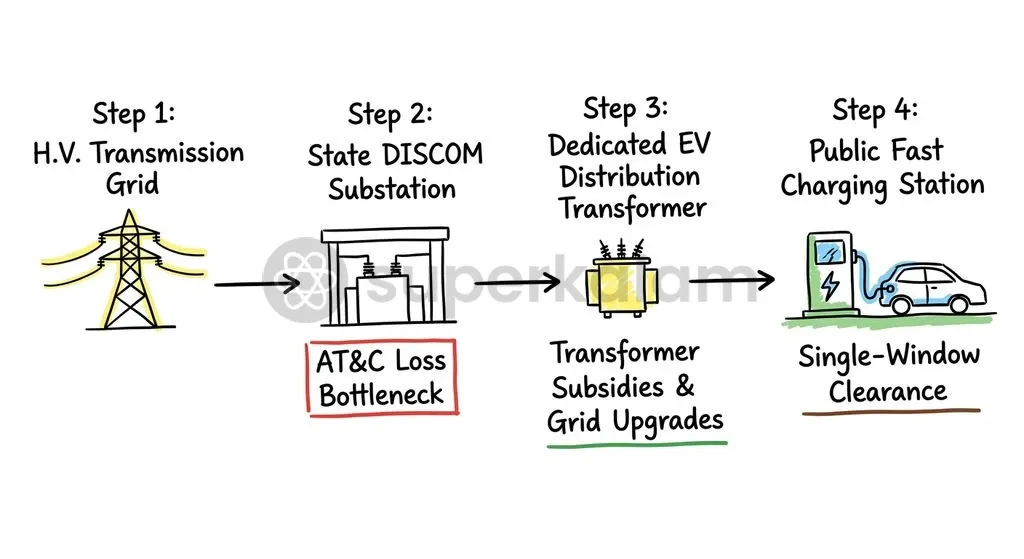
Electricity distribution companies represent the critical supply-side link in the electric mobility value chain. However, their poor financial health severely limits grid modernisation.
Elevated Aggregate Technical and Commercial losses prevent distribution utilities from funding upstream distribution transformers and dedicated feeders needed for high-voltage fast chargers.
To overcome this hurdle, Uttar Pradesh became the first state to directly subsidise upstream electrical infrastructure costs. The state provides up to ₹10 lakh per unit for transformers, cables, and grid enhancements across 2,000 public charging stations. Without similar dedicated capital support, power utilities in lagging states treat public charging connections as commercial liabilities rather than grid assets.
Way Forward: Building a Cooperative EV Federalism Framework
NITI Aayog recommends establishing unified single-window clearance portals to eliminate multi-departmental administrative friction across municipal and power distribution agencies.
To accelerate commercial fleet electrification, policy frameworks must adopt vehicle and battery leasing models, concessional green financing, and targeted Priority Sector Lending inclusion to convert heavy upfront capital expenditures into predictable operating costs.
Addressing the inter-governmental coordination gap requires concrete institutional reforms:
- National EV Council: India needs a dedicated inter-governmental platform modelled on the GST Council to align central schemes like PM E-DRIVE with state industrial and transport policies.
- Targeted Finance Commission Grants: Future fiscal transfers should provide tied grants-in-aid to financially stressed power utilities for developing dedicated EV charging feeders and substation upgrades.
- Standardised Tariff Guidelines: The Forum of Regulators must establish uniform single-part Time-of-Day tariff principles to guide State Electricity Regulatory Commissions across all jurisdictions.
Discuss with Superkalam
Evaluate the risk of uniform central subsidy taper schedules under PM E-DRIVE widening regional disparities between fiscally strong and weak states.
Ask NowKey Takeaways
- The India Electric Mobility Index 2025, published by NITI Aayog on 16 September 2026, reveals that Delhi (84) scored highest nationally, while Maharashtra (78) and Karnataka (73) were the only top performers among 17 large states.
- The index evaluates 16 indicators across three pillars: Transport Electrification Progress (50% weight), Charging Infrastructure Readiness (30%), and EV Research & Innovation Status (20%).
- The Union Government notified the PM E-DRIVE scheme with a ₹10,900 crore outlay on 29 September 2024, allocating ₹3,679 crore for vehicle demand incentives, ₹4,391 crore for 14,028 e-buses, and ₹2,000 crore for public charging stations.
- Elevated Aggregate Technical and Commercial losses in state electricity distribution companies remain the primary bottleneck restricting capital expenditure on upstream charging infrastructure.
- Uttar Pradesh established a key precedent by providing up to ₹10 lakh per unit to subsidise upstream electrical grid assets for 2,000 charging stations.
- NITI Aayog recommends single-window clearance portals, battery leasing models, concessional green finance, and Priority Sector Lending inclusion for commercial e-trucks and e-buses.
Mains Question
"National decarbonisation cannot rely solely on central demand incentives like the PM E-DRIVE scheme; it necessitates addressing structural grid bottlenecks and sub-national fiscal disparities." Elucidate. (10 Marks)
Evaluate NowMains Question
Evaluating the performance of front-running states in the India Electric Mobility Index 2025, critically analyse the key institutional, regulatory, and infrastructural drivers that separate leading EV ecosystems from lagging ones. (15 Marks)
Evaluate NowPractice MCQs
QUESTION 1
Regarding the India Electric Mobility Index (IEMI) 2025, consider the following statements:
- It was developed by NITI Aayog in collaboration with the World Resources Institute (WRI) India.
- The Transport Electrification Progress pillar carries the highest weightage of 50% in the index.
- All 36 States and Union Territories scored above the national median score of 40. Which of the statements given above are correct?
QUESTION 2
With reference to the PM Electric Drive Revolution in Innovative Vehicle Enhancement (PM E-DRIVE) scheme, consider the following statements:
- It has an overall financial outlay of ₹10,900 crore to succeed the FAME-II scheme.
- Subsidies for e-2Ws and e-3Ws have been extended up to 31 March 2028.
- The highest sectoral funding allocation under the scheme is dedicated to public transit electrification through e-buses. Which of the statements given above is/are correct?
QUESTION 3
Consider the following statements regarding the performance of states in the India Electric Mobility Index 2025:
- Delhi secured the highest overall composite score among all States and Union Territories.
- Among the 17 large states assessed, only Maharashtra and Karnataka qualified as 'Top Performers'.
- In the Charging Infrastructure Readiness pillar, Maharashtra achieved the highest score in the country. Which of the statements given above is/are correct?
QUESTION 4
Which among the following states became the first in India to directly subsidise upstream electrical infrastructure costs (up to ₹10 lakh per unit) for distribution transformers and grid enhancements for public charging stations?
QUESTION 5
Consider the following statements regarding sub-national structural bottlenecks in India's EV transition:
- The financial distress of state electricity distribution companies (Discoms) is exacerbated by high Aggregate Technical and Commercial (AT&C) losses.
- Undifferentiated commercial electricity tariffs with high fixed demand charges hinder the operational break-even of charge point operators.
- The majority of northeastern states cited upstream grid connectivity as their primary operational constraint. Which of the statements given above is/are correct?