India-Canada CEPA: Why Economic Ties Outlast Diplomatic Freezes
Despite severe diplomatic ruptures, soaring pension fund investments and critical trade dependencies are compelling New Delhi and Ottawa back to the table.
Oct, 2026
•11 min read
Overview
Bilateral economic ties between New Delhi and Ottawa show a profound structural divergence. Institutional capital flows and essential commodity trade continue to expand, even as political disputes froze negotiations for the Comprehensive Economic Partnership Agreement.
As of October 2026, Canadian institutional pension funds hold over USD 55 billion across Indian infrastructure. Two-way trade in goods and services reached CAD 30.4 billion in 2025 according to Statistics Canada.
Talks paused in September 2023 over national security disputes and diplomat expulsions. Even so, ministerial re-engagement in 2026 revived trade negotiations towards a targeted CAD 70 billion bilateral horizon. Structural demand for Indian market yields and Canadian commodities clearly outlasts cyclical diplomatic chill.
Why in the News?
The India-Canada commercial track gained fresh momentum in October 2026. Both nations concluded the fifth round of revived Comprehensive Economic Partnership Agreement negotiations in Ottawa. According to the Ministry of Commerce and Industry, the sixth negotiation round is scheduled for early November 2026 in New Delhi.
Canadian International Trade Minister Maninder Sidhu led the 'Team Canada Trade Mission' of nearly 300 business delegates to Mumbai and Bengaluru between 12 and 17 October 2026.
As of October 2026, these high-level engagements operationalise the 'New Roadmap for India-Canada Relations' adopted in October 2025 to restore economic partnerships after a two-year diplomatic freeze. Commercial imperatives and institutional capital maintained their own momentum despite sovereign political friction.
Why India-Canada Trade Negotiations Hit the Brakes
India-Canada trade negotiations halted abruptly in September 2023. Severe diplomatic friction prompted both governments to pause talks on an interim pact after more than a decade of sporadic progress.
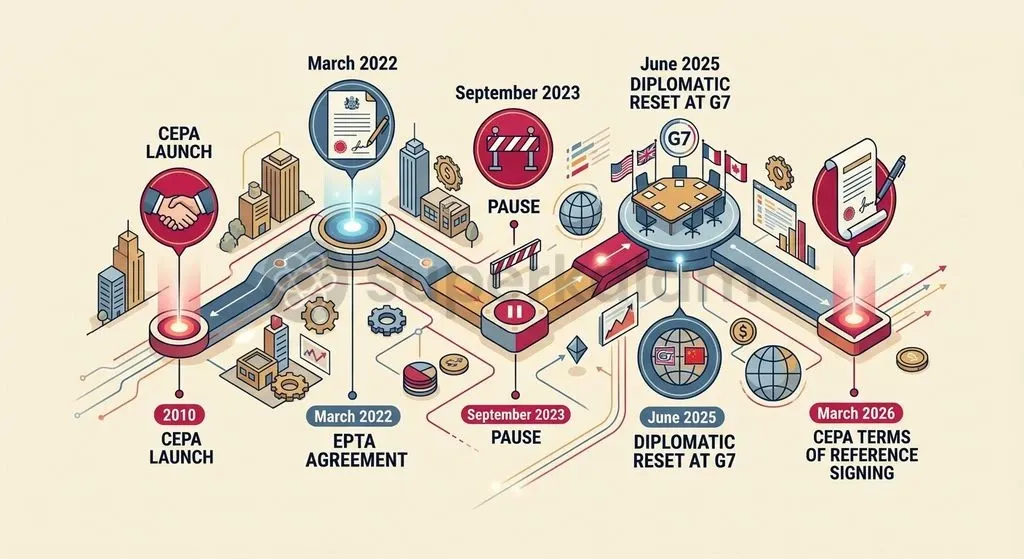
The stop-and-start negotiating track moved through three distinct phases:
- November 2010 launch: Formal talks for the India-Canada Comprehensive Economic Partnership Agreement (CEPA) originally opened in November 2010. Negotiators sought broad market access across goods, services, and cross-border investment. Progress soon slowed over differing regulatory approaches, agricultural market access demands, and intellectual property disputes.
- March 2022 re-launch: Ministerial dialogues injected fresh momentum. Both governments agreed to re-launch CEPA negotiations while simultaneously pursuing an interim Early Progress Trade Agreement (EPTA) as a stepping stone. Negotiators then held multiple formal rounds to fast-track early harvest concessions in selected sectors.
- September 2023 freeze: This framework fractured when Canada unilaterally paused trade talks and postponed a planned ministerial trade mission to India just before the G20 New Delhi Summit. Domestic political friction and unresolved security disputes derailed years of technical groundwork.
Discuss with Superkalam
Recall the two primary agricultural and farm-input commodities that India predominantly imports from Canada to meet its domestic requirements.
Ask NowTrade and Capital Realities: The Economic Baseline Before the Freeze
Bilateral trade between India and Canada rests on strong economic complementarities. The exchange of agricultural commodities, chemical fertilisers, pharmaceuticals, and technology services meets domestic needs in both countries that cannot be readily substituted.
According to the Department of Commerce, bilateral merchandise trade between India and Canada stood at USD 7.95 billion in FY 2025-26, an 8.23% decline from USD 8.7 billion in FY 2024-25. Yet comprehensive two-way trade in goods and services remained substantial, totalling CAD 30.4 billion in 2025. Both governments maintain a shared long-term goal of CAD 70 billion (roughly USD 50 billion) by 2030.
Trade data from Statistics Canada indicates that Canadian merchandise exports to India rebounded sharply between January and August 2026, growing 36.7% year-over-year to CAD 3.03 billion. Indian demand for Canadian metallic minerals, industrial inputs, and agri-food shipments drove this surge.
India's primary import dependencies from Canada remain concentrated in two critical areas:
- Pulses and edible grain: Imports of dry yellow peas and lentils form an essential component of India's domestic food buffer, cushioning national pulse price stability. To deepen technical integration, both governments established the Canada-India Pulse Protein Centre of Excellence at the National Institute of Food Technology Entrepreneurship and Management (NIFTEM) in Kundli, Haryana, in March 2026.
- Potassic fertilisers: Canadian potash is an indispensable input for Indian agricultural output, directly supporting national nutrient-based subsidy programmes and crop yields.
India's merchandise export basket provides significant value-addition. Shipments are led by pharmaceutical formulations and biologicals, gems and jewellery, ready-made garments, and precision engineering goods.
In services, Indian IT firms supply enterprise software solutions across Canada's financial sector. Educational links run deeper still: Indian citizens hold 392,810 study permits as of 2024, making them Canada's largest international student cohort according to Immigration, Refugees and Citizenship Canada (IRCC). The wider Indian diaspora exceeds 1.8 million people, making up roughly 5.1% of Canada's population.
Discuss with Superkalam
Explain why Canadian pension entities like CPP Investments and CDPQ continue to invest in Indian infrastructure despite political standoffs between the two national governments.
Ask NowThe Pension Fund Paradox: Why Canadian Billions Keep Flowing into India
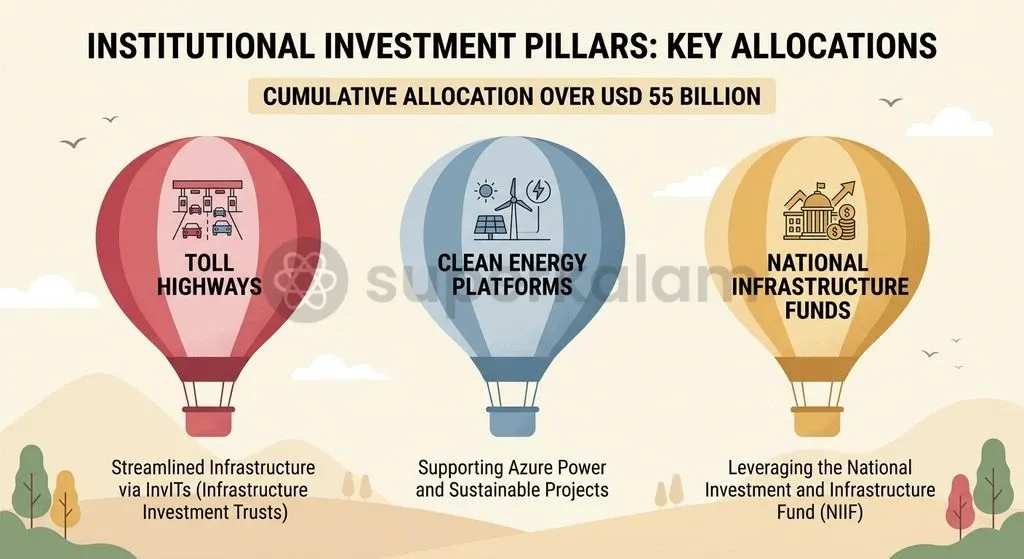
Canadian institutional investors have channelled more than USD 55 billion into Indian infrastructure, renewable energy, and digital platforms. This massive exposure demonstrates how institutional capital allocation stays detached from sovereign political disputes.
Canada's largest public pension entities operate under strict fiduciary mandates requiring portfolio diversification and stable long-term yields. The Canada Pension Plan Investment Board (CPP Investments), Caisse de dépôt et placement du Québec (CDPQ), and Ontario Municipal Employees Retirement System (OMERS) view Indian demographics and capital investment as structural growth drivers.
CPP Investments illustrates this commitment clearly. The fund held over USD 22 billion in net assets in India by late 2025, tripling its domestic capital exposure in just five years. Ignoring the diplomatic standoff, CPP Investments committed up to INR 20.7 billion (approximately USD 215 million) to the National Investment and Infrastructure Fund (NIIF) Infrastructure Fund II in August 2026.
Similar commitments extend across other major Canadian funds:
- CDPQ and OMERS: Both institutions maintain substantial equity holdings in Indian infrastructure investment trusts (InvITs) and green energy developers, including significant stakes in IndInfravit and Azure Power.
- Highways and Logistics: Long-term Canadian capital funds operating toll roads and logistics corridors through structured InvITs, providing the Indian economy with patient capital while generating predictable inflation-indexed cash flows for Canadian retirees.
Institutional investors look past short-term diplomatic posturing. India's large domestic market, dependable legal framework for private capital, and transparent infrastructure investment trusts offer an attractive yield premium over mature Western markets.
What Was on the Table: Unpacking the CEPA and Early Progress Trade Deal
The Comprehensive Economic Partnership Agreement and the interim Early Progress Trade Agreement were designed as stepped mechanisms to lower tariffs and secure cross-border investment. Negotiators structured the interim agreement to bank early gains while complex issues were sorted out.
The proposed Early Progress Trade Agreement (EPTA) emerged during ministerial dialogues in 2022. Instead of waiting for a single overarching pact, EPTA sought to unlock immediate market access in specific priority industries.
| Dimension | Early Progress Trade Agreement (EPTA) | Comprehensive Economic Partnership Agreement (CEPA) |
|---|---|---|
| Negotiation Scope | Limited interim deal focusing on selected tariff lines and immediate mutual commercial gains | Broad comprehensive economic pact covering all bilateral commercial exchanges |
| Goods Coverage | Targeted tariff concessions on agricultural products, industrial chemicals, and select manufactured exports | Substantial reduction or elimination of customs duties across more than 90% of tariff lines |
| Services & Mobility | Preliminary framework for temporary entry of business professionals and service providers | Full Mode 1 to Mode 4 services commitments, mutual recognition of professional qualifications |
| Regulatory Measures | Basic chapters covering sanitary and phytosanitary (SPS) rules and technical barriers to trade | Harmonised regulatory standards, cross-border data governance, and joint conformity assessment |
| Investment Protection | Focused dispute settlement and fundamental safeguards for commercial entities | Comprehensive investment chapters or linked standalone Bilateral Investment Treaty (BIT) |
| Implementation Horizon | Short-term harvest pact designed to build mutual confidence between trade negotiators | Long-term institutional pact intended to anchor bilateral trade towards the 2030 target |
India's EPTA strategy focused on securing duty cuts for labour-intensive merchandise and expanding Mode 4 mobility for Indian professionals. Canada sought tariff-free access for agricultural goods like lentils, malting barley, and processed foods, alongside duty relief for wines, spirits, and industrial machinery.
Investment protection runs alongside these trade discussions. During the inaugural India-Canada Finance Ministers' Economic and Financial Dialogue in August 2026, New Delhi formally registered its readiness to negotiate a standalone Bilateral Investment Treaty (BIT). A standalone BIT provides legal certainty for institutional investors without getting bogged down in wider free trade disputes.
Discuss with Superkalam
If diplomatic tensions disrupt direct political summits, how can trade instruments like an Early Progress Trade Agreement (EPTA) or a Bilateral Investment Treaty (BIT) be applied to keep commercial corridors open?
Ask NowWhere Talks Collapsed: Political Friction, Security, and Trade Chokepoints
Diplomatic ties ruptured in September 2023 over severe national security allegations and sovereignty concerns, prompting an immediate halt to bilateral trade missions. The dispute escalated swiftly, demonstrating how sovereign political disputes can disrupt commercial diplomacy.
The fatal shooting of Canadian citizen Hardeep Singh Nijjar in British Columbia in June 2023, coupled with claims by Ottawa alleging Indian state involvement, brought bilateral relations to an impasse. New Delhi firmly rejected these allegations as unfounded and politically motivated, triggering tit-for-tat diplomatic retorts . The dispute led to reciprocal expulsions of senior diplomats and the downsizing of diplomatic missions under the Vienna Convention on Diplomatic Relations.
This rupture generated immediate fallout across the commercial track:
- Suspension of EPTA: Formal negotiations on the interim trade deal were paused, preventing businesses from accessing negotiated tariff concessions.
- Postponement of Trade Delegations: Planned ministerial trade visits were deferred, stalling commercial partnerships in renewable energy and clean technology.
- Regulatory Uncertainty: Heightened political scrutiny raised compliance concerns for bilateral trade desks, even as daily commercial shipments continued.
Bilateral re-engagement began in mid-2025. Prime Minister Narendra Modi and Canadian Prime Minister Mark Carney met during the G7 Summit in Kananaskis in June 2025, agreeing to restore ministerial dialogues and reinstate High Commissioners.
Foreign Minister Anita Anand visited New Delhi on 13 October 2025 to adopt the 'New Roadmap for India-Canada Relations'. Both sides solidified this rapprochement on 2 March 2026 by signing formal Terms of Reference to resume CEPA negotiations.

Insulating Commerce from Politics: A Realistic Way Forward
Protecting commercial ties requires the Indian Ministry of Commerce and Global Affairs Canada to wall off economic dialogues from diplomatic disputes. Analysts note that bilateral business ties need stability from political cycles to give investors long-term certainty.
A sustainable economic strategy should focus on four pragmatic policy levers:
Ring-Fencing Institutional Investment: Institutional capital allocations and scientific partnerships must be protected from high-level political tensions. The establishment of the Canada-India Pulse Protein Centre of Excellence in early 2026 demonstrates that sectoral, technical cooperation can progress productively when insulated from diplomatic debate.
Prioritising a Standalone BIT: Rather than delaying investment protections until a full CEPA is completed, both governments should expedite a standalone investment treaty based on the August 2026 finance ministerial dialogue. A ratified BIT provides institutional pension funds such as CPP Investments and CDPQ with binding legal protections, safeguarding long-term capital flows into Indian infrastructure.
Revitalising Inter-Governmental Mechanisms: Both nations should consistently utilise institutional dialogue platforms established under previous agreements. These include:
- The Ministerial Dialogue on Trade and Investment (MDTI)
- The Joint Science and Technology Cooperation Committee
- The bilateral Energy Dialogue
- Six Canadian provincial trade offices operating across Indian commercial hubs
- Leveraging B2B Platforms: Direct engagements between private industry federations and institutional investors provide commercial stability during diplomatic downturns. Expanding initiatives like the Team Canada Trade Mission across emerging sectors, including green hydrogen, critical minerals, and artificial intelligence, builds economic ties that remain resilient against sovereign political friction.
Discuss with Superkalam
Analyse how the sectoral priorities of India (such as Mode 4 services mobility and pharmaceutical market access) contrast with Canada's commercial demands in agricultural tariff lines.
Ask NowKey Takeaways
The India-Canada commercial partnership highlights how institutional capital allocation and mutual commodity dependencies survive cyclical sovereign geopolitical disputes.
- Negotiation Trajectory: Originally launched in November 2010 and re-launched with an interim EPTA framework in March 2022, CEPA negotiations were suspended in September 2023 due to diplomatic friction before formally resuming with signed Terms of Reference in March 2026.
- Trade Volume and Targets: Two-way trade in goods and services reached CAD 30.4 billion in 2025, with both governments working towards a shared bilateral target of CAD 70 billion (USD 50 billion) by 2030.
- Critical Import Dependencies: India relies on Canadian dry yellow peas, lentils, and potassic fertilisers for national food security and agricultural productivity, while exporting pharmaceuticals, garments, and IT services.
- The Pension Fund Paradox: Major Canadian pension funds (CPP Investments, CDPQ, OMERS) hold over USD 55 billion across Indian infrastructure, logistics, and renewable energy, continuing direct capital commitments regardless of diplomatic disputes.
- Diaspora and Education Bridge: Over 1.8 million people of Indian origin reside in Canada, while Indian students held 392,810 Canadian study permits as of 2024, forming a vital economic and demographic bridge.
- Unresolved Evidence Base:
Mains Question
"Institutional capital flows and essential commodity exchanges often exhibit resilience against cyclical diplomatic chills." In the context of India-Canada economic ties, elucidate how commercial complementarities and institutional investments operate independently of diplomatic friction. (10 Marks)
Evaluate NowMains Question
The stop-and-start trajectory of the India-Canada Comprehensive Economic Partnership Agreement (CEPA) underscores the delicate balance between commercial ambitions and geopolitical frictions. Critically examine the key drivers and underlying impediments in achieving the CAD 70 billion bilateral trade horizon. (15 Marks)
Evaluate NowPractice MCQs
QUESTION 1
With reference to the trade and institutional investment ties between India and Canada, consider the following statements:
- Canadian institutional pension funds hold over USD 55 billion across Indian infrastructure, renewable energy, and digital assets.
- The Canada Pension Plan Investment Board (CPP Investments) committed capital to the National Investment and Infrastructure Fund (NIIF) Infrastructure Fund II in 2026.
- Bilateral trade between the two countries has already surpassed the shared target horizon of CAD 70 billion in goods and services in 2025. Which of the statements given above are correct?
QUESTION 2
Consider the following statements regarding the commodity composition of India-Canada bilateral trade:
- Dry yellow peas and lentils imported from Canada support domestic pulse price stability and food buffers in India.
- Potassic fertiliser imports from Canada serve as a critical input for Indian agriculture and its nutrient-based subsidy programmes.
- Pharmaceutical formulations and biologicals constitute one of India's leading merchandise exports to Canada. Which of the statements given above is/are correct?
QUESTION 3
Regarding the evolution of trade frameworks between India and Canada, consider the following statements:
- Formal negotiations for the Comprehensive Economic Partnership Agreement (CEPA) were initially launched in November 2010.
- The Early Progress Trade Agreement (EPTA) was conceptualised in 2022 as an interim step to fast-track concessions on selected tariff lines.
- Under the EPTA framework, negotiators agreed to eliminate customs duties across more than 90% of tariff lines. Which of the statements given above is/are correct?
QUESTION 4
Consider the following initiatives and institutional arrangements mentioned in the context of India-Canada bilateral relations:
- The 'New Roadmap for India-Canada Relations' was adopted in October 2025 to restore economic partnerships.
- The Canada-India Pulse Protein Centre of Excellence was established at the National Institute of Food Technology Entrepreneurship and Management (NIFTEM) in Kundli, Haryana. Which of the statements given above is/are correct?
QUESTION 5
In the context of India-Canada bilateral negotiations, what was the primary rationale behind pursuing an Early Progress Trade Agreement (EPTA) alongside the Comprehensive Economic Partnership Agreement (CEPA)?
Discuss with Superkalam
Assess whether pursuing an interim trade pact (EPTA) is a more effective negotiating strategy for India than committing directly to a comprehensive agreement (CEPA).
Ask Now