IMO Flat Carbon Tax: Why India Resists Universal Shipping Levies
As the IMO pushes a universal maritime bunker levy, New Delhi champions climate equity to protect developing trade corridors from punitive freight inflation.
Nov, 2026
•9 min read
Overview
India strongly opposes a universal flat carbon levy on international shipping proposed under the International Maritime Organization framework. A uniform bunker tax ignores historical emission responsibilities, whilst disproportionately driving up freight rates for developing economies. It also contradicts core climate equity principles established under international environmental law.
The diplomatic deadlock pits advanced maritime nations advocating an immediate carbon levy of approximately 100 US dollars per tonne of carbon dioxide equivalent against emerging economies championing differentiated standards. New Delhi contends that a flat penalty penalises bulk-shipping nations without offering accessible green technologies or equitable transition finance. As of April 2025, India champions a fuel intensity compliance mechanism to protect developing trade corridors while transitioning fleets sustainably.
Why in the News: The IMO Net-Zero Roadmap and the Push for Green Levies
The International Maritime Organization adopted Resolution MEPC.377(80) in July 2023, committing global shipping to reach net-zero emissions by or around 2050. This revised strategy established aggressive benchmarks to transform commercial maritime operations over coming decades.
To guide this transition, the assembly instituted four interim checkpoints:
- Cut total annual shipping emissions by at least 20%, striving for 30%, by 2030 compared to 2008 levels.
- Reduce aggregate shipping emissions by at least 70%, striving for 80%, by 2040.
- Deliver a minimum 40% reduction in carbon intensity across operations by 2030.
- Ensure zero or near-zero emission fuels and technologies constitute at least 5%, striving for 10%, of energy used by 2030.
Reaching these targets requires bridging the price differential between cheap fossil bunker fuel and expensive zero-emission alternatives. To implement these goals, the IMO's Marine Environment Protection Committee has negotiated a package of mid-term economic measures. These proposals have split member states into opposing negotiating blocs over maritime taxation.
How the Proposed Maritime Emission Rules and Bunker Fuel Taxes Work
The Marine Environment Protection Committee has evaluated measures under MARPOL Annex VI to operationalise the 2023 greenhouse gas strategy. The policy package combines technical fuel standards with global carbon pricing mechanisms to penalise conventional marine fuels.
A coalition of European Union member states and Pacific Island nations submitted proposals at MEPC 80 and MEPC 81 advocating a flat universal GHG levy of approximately 100 US dollars per tonne of carbon dioxide equivalent on marine fuels. Under this approach, every commercial vessel operating internationally would pay an identical tax per tonne of fuel consumed, irrespective of flag state, trade route, or cargo type.
To provide an alternative to universal taxation, India and Singapore co-sponsored a Greenhouse Gas Fuel Intensity mechanism. This regulatory tool penalises only the deficit by which a vessel's fuel blend exceeds a prescribed carbon intensity threshold, rather than imposing a blanket tax on every unit of fuel burned.
| Regulatory Dimension | Flat Universal Carbon Levy | GHG Fuel Intensity (GFI) Mechanism |
|---|---|---|
| **Primary Proponents** | European Union member states and Pacific Island nations | India, Singapore, and developing maritime states |
| **Tax Base** | Every tonne of marine fuel consumed across voyages | Emissions exceeding established annual fuel carbon intensity limits |
| **Economic Mechanism** | Universal carbon price of ~$100 per tonne CO2 equivalent | Targeted financial penalties on non-compliant fuel deficits |
| **Compliance Focus** | Uniform revenue generation across all commercial tonnage | Progressive adoption of low-carbon marine fuel blends |
| **Impact on Bulk Trade** | Immediate, broad-based freight inflation across all routes | Contained compliance costs focused on carbon deficits |
Discuss with Superkalam
What specific percentage share of renewable electricity do India's Major Ports need to achieve by 2030 under the Harit Sagar Guidelines?
Ask Now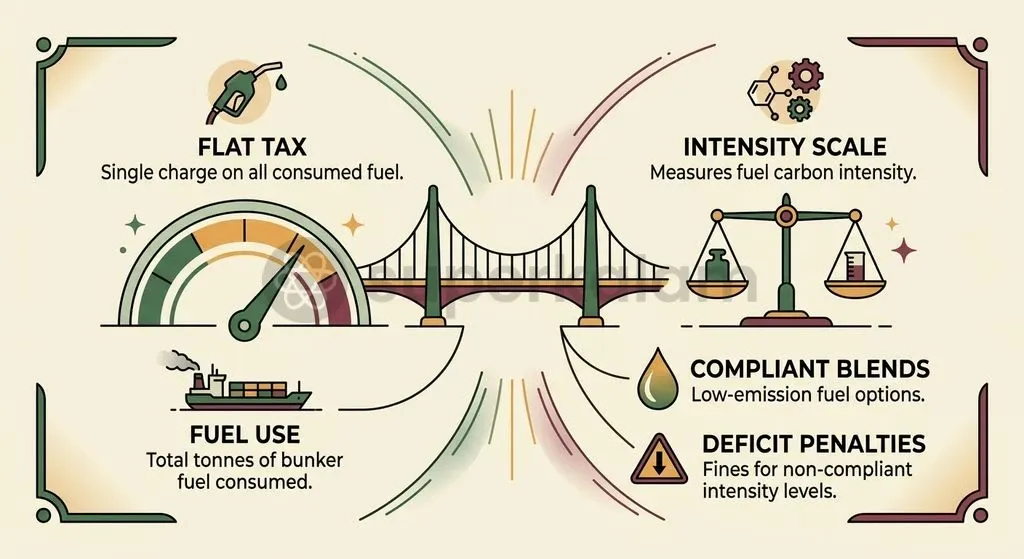
Why India and the Global South Oppose a Uniform Shipping Levy
India and Singapore co-sponsored the fuel intensity mechanism to prevent punitive bunker levies across emerging economies. New Delhi argues that an indiscriminate tax creates profound structural inequities between advanced maritime powers and emerging markets.
The opposition centres on three primary structural grievances:
- Heavy financial exposure: The Directorate General of Shipping calculated that an unmitigated flat carbon levy would impose an annual impact of 1.5 billion to 2.4 billion US dollars on Indian maritime trade, whereas a fuel intensity mechanism keeps direct national compliance costs below 100 million US dollars annually.
- Disregard for historical equity: Official submissions by the Ministry of Ports, Shipping and Waterways emphasise that flat levies ignore historical cumulative emissions, punishing nations that lack domestic low-carbon fuel supply chains, early-stage capital subsidies, and modern engine technologies.
- Asymmetric registry liabilities: More than 70% of global merchant shipping tonnage by deadweight is registered under flag states of developing nations, placing disproportionate legal, reporting, and financial liabilities on their registries while advanced economies hold intellectual property rights over alternative propulsion systems.
Discuss with Superkalam
How does the Greenhouse Gas Fuel Intensity mechanism differ from a flat carbon levy in the way it calculates financial compliance penalties?
Ask NowTrade and Economic Fallout: The Disproportionate Burden on Developing Nations
Approximately 99% of the commercial maritime fleet remains dependent on fossil fuels, making blanket carbon taxes an immediate driver of freight inflation. Because alternative fuels like green methanol and ammonia remain commercially scarce, shipowners cannot switch energy sources quickly to avoid penalties.
Global supply chain modelling reveals severe cost impacts across developing corridors:
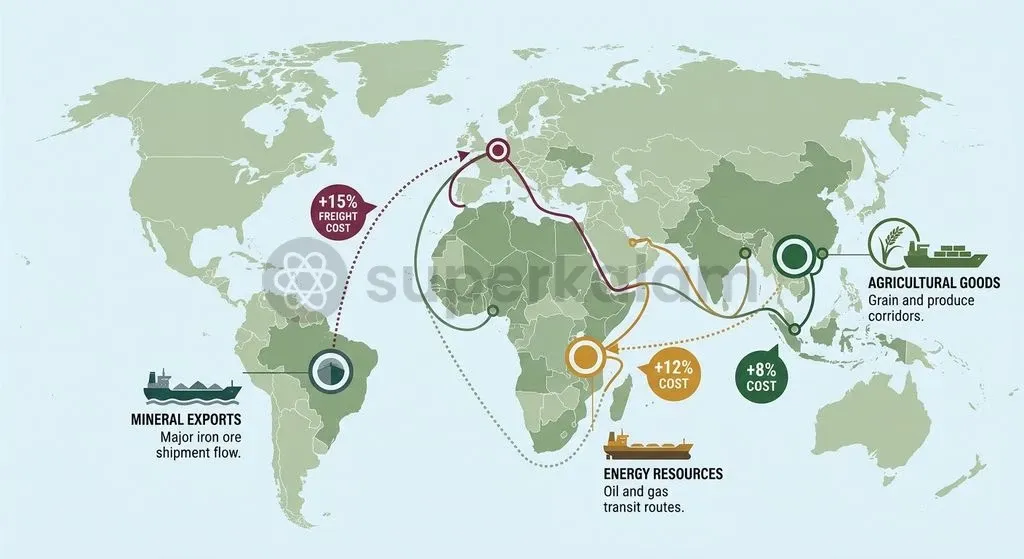
- Sharp freight inflation: UNCTAD assessments indicate that a uniform carbon levy on bunker fuels would trigger a 5% to 8% pass-through increase in maritime transport freight costs for developing countries by 2030, rising significantly by 2050.
- Erosion of export competitiveness: Developing economies depend heavily on maritime transport to export price-sensitive raw materials, agricultural goods, and manufactured commodities. Higher freight costs reduce the competitiveness of low-margin bulk goods on long-haul routes, skewing terms of trade toward advanced economies dealing in high-value, light-weight goods.
- Regressive revenue distribution: Developing nations strongly oppose proposals where maritime carbon revenues merely subsidise operational premiums for zero-emission ships operated by advanced shipping lines. Instead, emerging states insist funds must directly remedy disproportionate economic impacts.
Climate Equity at Sea: Resolving the Conflict Between IMO Mandates and CBDR
The United Nations Framework Convention on Climate Change establishes CBDR-RC, creating an institutional clash with maritime law. This legal conflict lies at the core of the diplomatic impasse over shipping decarbonisation.
The regulatory collision hinges on competing legal traditions and voting rules:
- Conflicting legal mandates: The fundamental discord stems from the friction between the IMO's No More Favourable Treatment rule under MARPOL Article 5(4) and the climate equity mandate of CBDR-RC under Article 3(1) of the UNFCCC. Under MARPOL, port states enforce standards equally against all arriving ships to deter substandard vessels, but applying this operational equality to economic measures erases differentiated obligations.
- Council voting leverage: India holds a permanent Category 'B' seat on the 40-member IMO Council, having been re-elected with the second-highest vote tally for the 2024-2025 biennium.
- Strict amendment procedures: Amendments under MARPOL Annex VI incorporating the mid-term net-zero framework require formal approval and entry into force under a deemed acceptance procedure, unless rejected by one-third of parties representing 50% of world merchant gross tonnage.
To bridge this divide, India and fellow developing nations demand that maritime greenhouse gas revenues flow into an independent climate fund. This fund must channel resources directly into Global South port adaptation, bunkering infrastructure, and green technology transfer.
Discuss with Superkalam
Why does the concentration of over 70% of merchant fleet tonnage in developing country registries create an asymmetrical compliance burden?
Ask NowIndia's Green Maritime Strategy: Clean Ports and Fleet Modernisation
The Ministry of Ports, Shipping and Waterways launched the Harit Sagar Guidelines in May 2023 to operationalise quantified clean energy roadmaps across Major Ports. Rather than delaying action, India is modernising its domestic maritime infrastructure.
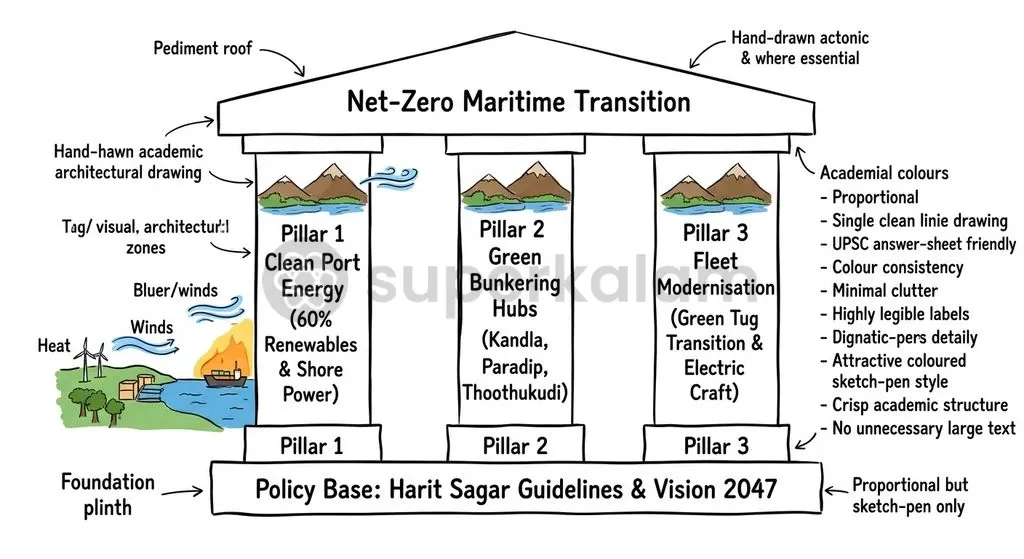
The Harit Sagar framework mandates that India's Major Ports increase the share of renewable energy in total electricity consumption to 60% by 2030, scaling up from an initial baseline of less than 10%. This shift involves installing shore-to-ship green power connections, distributed solar arrays, and energy-efficient cargo handling systems.
Long-term expansion follows the Maritime Amrit Kaal Vision 2047, launched by Prime Minister Narendra Modi in October 2023 at the Global Maritime India Summit. The vision outlines 80 lakh crore rupees in planned sector investments, including dedicated green shipping corridors.
The roadmap designates three Major Ports—Deendayal (Kandla), Paradip, and V.O. Chidambaranar (Thoothukudi)—to be developed into dedicated Green Hydrogen and Green Ammonia bunkering hubs. Technical research for this rollout is supported by the National Centre of Excellence in Green Ports and Shipping, established in Gurugram in partnership with TERI.
Fleet modernisation extends across auxiliary vessels and inland waterways:
- Green harbour tugs: The Green Tug Transition Programme sets a target to convert at least 50% of all harbour tugboats in major ports into green hybrid tugs by 2030.
- Electric vessel construction: Under this programme, steel-cutting commenced in December 2025 for India's first all-electric zero-emission harbour tug, built by Atreya Shipyard for the Deendayal Port Authority.
- Inland fleet transition: The Harit Nauka Guidelines direct the decarbonisation of inland passenger and cargo vessels using electric, hybrid, and hydrogen propulsion.
The Way Forward: Designing a Fair and Differentiated Maritime Transition
The International Maritime Organization must reconcile decarbonisation mandates with economic equity by adopting a balanced architecture for global shipping emissions. Imposing uniform financial burdens without equitable transition mechanisms risks derailing multilateral consensus.
- Adopt a tiered fuel intensity standard: Member states should implement progressive emission reduction benchmarks alongside flexible compliance credits, shielding critical trade corridors from sudden freight shocks.
- Direct maritime revenues into a dedicated transition fund: Capital raised through compliance penalties should be earmarked for a dedicated Global South Maritime Transition Fund, financing zero-emission bunkering facilities and coastal adaptation projects.
- Broaden technology transfer frameworks: Multilateral agreements must expand beyond vessel purchases to encompass domestic shipbuilding and green fuel production, sharing intellectual property to help developing economies build clean maritime supply chains.
Discuss with Superkalam
Weigh the arguments: Does the IMO's 'No More Favourable Treatment' rule legitimately safeguard open seas, or does it undermine climate equity under CBDR-RC?
Ask NowKey Takeaways
- The International Maritime Organization's Resolution MEPC.377(80) sets an international target of net-zero greenhouse gas emissions by or around 2050, with indicative checkpoints for 2030 and 2040.
- European Union states propose a flat levy of roughly 100 US dollars per tonne of CO2 equivalent on marine fuels, while India advocates a targeted Fuel Intensity mechanism to prevent broad freight inflation.
- Directorate General of Shipping estimates reveal that a flat bunker tax would cost Indian maritime trade between 1.5 billion and 2.4 billion US dollars annually, compared to under 100 million US dollars under a fuel intensity regime.
- UNCTAD analysis highlights that 99% of commercial shipping relies on fossil fuels, meaning universal levies could cause a 5% to 8% rise in developing country transport freight costs by 2030.
- The fundamental legal discord stems from the clash between the IMO's "No More Favourable Treatment" rule under MARPOL Article 5(4) and the UNFCCC's Common but Differentiated Responsibilities principle under Article 3(1).
- India's domestic decarbonisation initiatives include the Harit Sagar Guidelines targeting 60% renewable electricity at Major Ports by 2030, the Maritime Amrit Kaal Vision 2047, and the Green Tug Transition Programme.
Mains Question
"The structural clash between MARPOL's 'No More Favourable Treatment' clause and the UNFCCC principle of Common But Differentiated Responsibilities and Respective Capabilities (CBDR-RC) lies at the heart of the maritime decarbonisation deadlock." Elucidate. (10 Marks)
Evaluate NowMains Question
"A flat universal carbon levy on maritime shipping risks eroding the export competitiveness of emerging economies without providing accessible transition finance." In light of this statement, critically analyse India's opposition to uniform bunker taxes and evaluate its domestic alternatives under the Harit Sagar Guidelines and Maritime Amrit Kaal Vision 2047. (15 Marks)
Evaluate NowPractice MCQs
QUESTION 1
With reference to the International Maritime Organization's Resolution MEPC.377(80), consider the following statements: 1. It commits international shipping to achieve net-zero greenhouse gas emissions by or around 2050. 2. It sets an interim checkpoint of reducing carbon intensity across international shipping operations by at least 40% by 2030. 3. It mandates that zero or near-zero emission technologies constitute 100% of maritime fuel consumption by 2040. Which of the statements given above is/are correct?
QUESTION 2
Consider the following statements regarding the Greenhouse Gas Fuel Intensity (GFI) mechanism and the flat universal carbon levy proposed at the IMO: 1. The flat universal carbon levy taxes every tonne of marine bunker fuel consumed irrespective of trade route or flag state. 2. The Greenhouse Gas Fuel Intensity mechanism penalises only the deficit by which a vessel's fuel blend exceeds a prescribed carbon intensity threshold. 3. The Directorate General of Shipping estimated that the GFI mechanism would impose an annual direct compliance impact of 1.5 billion to 2.4 billion US dollars on Indian maritime trade. Which of the statements given above is/are correct?
QUESTION 3
Regarding the legal and governance architecture of the International Maritime Organization (IMO), consider the following statements: 1. MARPOL Article 5(4) enshrines the 'No More Favourable Treatment' principle to prevent substandard vessels regardless of flag state. 2. Amendments to MARPOL Annex VI enter into force under a deemed acceptance procedure unless rejected by one-third of parties representing 50% of world merchant gross tonnage. 3. India serves on the IMO Council as a permanent Category 'A' member state representing the largest international seaborne trade interests. Which of the statements given above is/are correct?
QUESTION 4
With reference to India's national maritime decarbonisation roadmaps, consider the following statements: 1. The Harit Sagar Guidelines mandate India's Major Ports to achieve a 60% share of renewable energy in total electricity consumption by 2030. 2. Under the Maritime Amrit Kaal Vision 2047, Deendayal, Paradip, and V.O. Chidambaranar ports are designated to be developed into green hydrogen and green ammonia bunkering hubs. Which of the statements given above is/are correct?
QUESTION 5
According to the UNCTAD Review of Maritime Transport 2023 cited in discussions on maritime decarbonisation equity, what proportion of global merchant shipping tonnage by deadweight is registered under flag states of developing nations?
Discuss with Superkalam
How can maritime carbon revenues be structured into a dedicated climate fund to resolve the diplomatic deadlock between the EU and the Global South?
Ask Now