Hollongapar Gibbon Sanctuary: Can Canopy Bridges Save India's Only Apes?
While synthetic rope bridges restore vital mobility for Hollongapar's gibbons, railway electrification reveals the limits of stopgap conservation.
Oct, 2026
•11 min read
Context
Artificial canopy bridges in Assam's Hollongapar Gibbon Sanctuary provide immediate tactical mobility across fragmented forest patches. These narrow lines cannot substitute for continuous ecological corridors, nor can they counter expanding railway infrastructure.
The sanctuary harbours India's only ape species, the endangered Western Hoolock Gibbon. It also shelters six other non-human primate species within a modest 20.98-square-kilometre reserve.
A 1.65-kilometre railway line has bisected the forest since 1887, isolating several gibbon family groups. Synthetic twin-rope bridges engineered by the Wildlife Institute of India have enabled historic crossings. Yet escalating track electrification and right-of-way widening now threaten these arboreal primates with fatal electrocution and deepened genetic decay.
As of May 2026, conservation evidence demonstrates that while artificial rope crossings prevent immediate demographic isolation, lasting population viability demands natural canopy restoration and the eventual realignment of linear transport corridors outside protected boundaries.
Why in the News? Hollongapar's Bisected Forest and the Gibbon Crisis
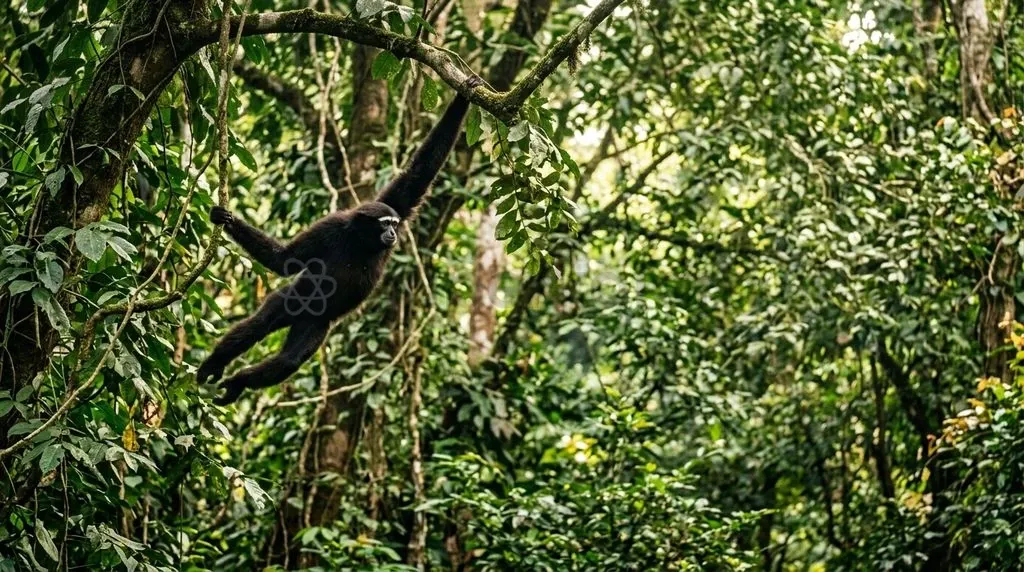
The Western Hoolock Gibbon (Hoolock hoolock) faces an acute survival crisis in the Jorhat district of Assam. As of May 2026, researchers and camera traps recorded a male Western Hoolock Gibbon traversing a newly installed synthetic twin-rope bridge across the railway track in Hollongapar Gibbon Sanctuary, as documented by the Wildlife Institute of India.
This observation marks the first recorded use of an artificial canopy bridge over an active railway track anywhere in the world.
The breakthrough follows months of acute concern over linear infrastructure expansion. On 8 February 2026, an endangered male gibbon was electrocuted along the sanctuary's railway infrastructure, confirming long-standing warnings issued by primatologists. The accident highlighted the severe hazards posed by overhead traction lines inside protected forests.
Hollongapar Gibbon Sanctuary at a Glance:
- Location: Jorhat district, Assam (Area: 20.98 sq km)
- Dominant Flora: Hollong (Dipterocarpus macrocarpus) and Nahar (Mesua ferrea)
- Key Fauna: Western Hoolock Gibbon (India's only ape species)
- Protection: Schedule I of the Wildlife (Protection) Act, 1972; IUCN Endangered
- Severing Feature: 1.65 km stretch of the Mariani–Dibrugarh railway line (laid 1887)
The core problem is plain. Artificial canopy bridges offer short-term tactical mobility. They cannot replace contiguous tree cover or mitigate the compounding dangers of railway electrification and genetic bottlenecks.
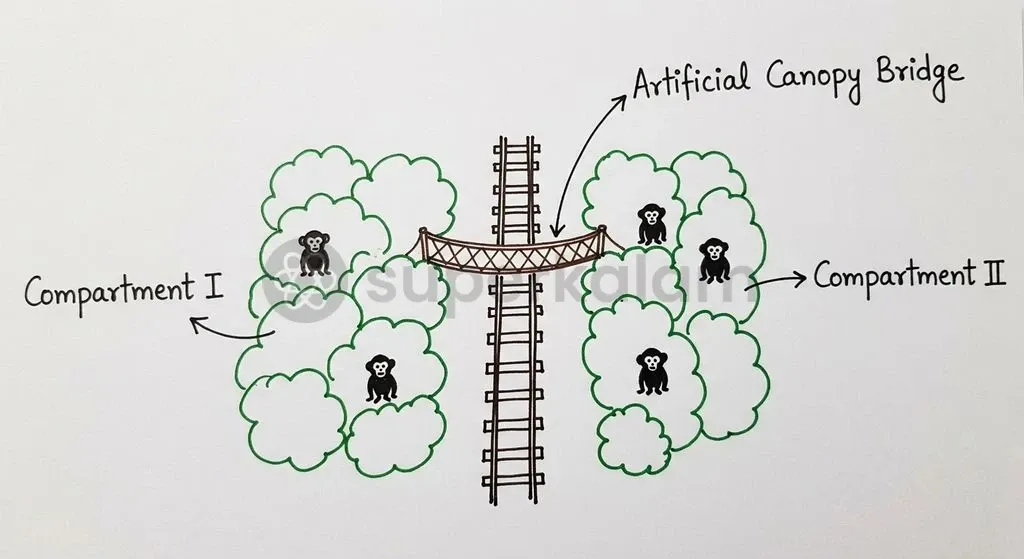
Hollongapar contains approximately 125 gibbons organised into 26 family groups, according to census figures from the Wildlife Institute of India Technical Report TR No/2023/07. A 1.65-kilometre stretch of the Mariani–Dibrugarh railway line severs the reserve into two unequal sections. This divide strands four to five family groups in the isolated Compartment I.
Discuss with Superkalam
Identify the year the Mariani–Dibrugarh railway line was laid through Hollongapar and the number of gibbon family groups it isolated in Compartment I.
Ask NowThe Arboreal Trap: Why Hoolock Gibbons Cannot Simply Walk Across
Hoolock gibbons are strictly canopy-dwelling primates that cannot adapt to ground-level movement. The Western Hoolock Gibbon is India's only ape species, listed as Endangered on the IUCN Red List and shielded under Schedule I of the Wildlife (Protection) Act, 1972.
Morphologically, gibbons evolved for brachiation. This specialised mode of locomotion relies on suspensory, hand-over-hand swinging beneath tree branches.
Their elongated arms, hook-like fingers, and reduced thumbs make bipedal walking or quadrupedal crawling on flat ground biomechanically awkward and energy-intensive. When forced to descend to the forest floor, gibbons experience severe behavioural hesitation.
Terrestrial movement leaves them exceptionally vulnerable to feral dogs, speeding locomotives, and ground predators, as highlighted in the Wildlife Institute of India Technical Report TR No/2023/07.
| Primate Attribute | Arboreal Reality (In Canopy) | Ground-Level Exposure (On Forest Floor) |
|---|---|---|
| Locomotion Mode | Brachiation and suspensory swinging | Awkward bipedal waddling or bounding |
| Predation Risk | Low; natural camouflage in high crowns | Severe vulnerability to feral predators |
| Foraging Strategy | High frugivory; leaves, shoots, and figs | Zero food availability on ballast tracks |
| Infrastructure Hazard | Vulnerable to overhead electrical lines | Fatal collisions with railway rolling stock |
In an unbroken forest, gibbons travel seamlessly across overlapping upper branches of Dipterocarpus and Mesua trees. When transport corridors shear these crowns apart, the primates treat the resulting sunlight gap as an absolute physical barrier.
For decades, the railway line in Hollongapar remained an open trench. This barrier prevented family groups in Compartment I from interacting with the larger population in Compartment II.
Building the Crossing: How the Artificial Canopy Bridges Were Set Up
Bridging high-canopy voids requires structural engineering that matches the precise biomechanics of arboreal locomotion. Prior engineering efforts stalled because rigid structures failed primate anatomical requirements.
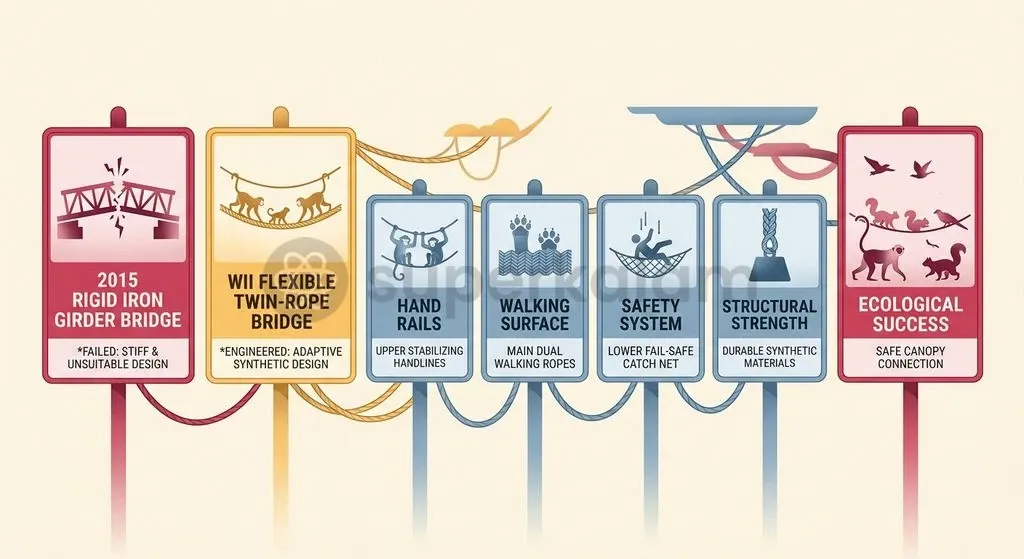
Field interventions at Hollongapar evolved across three distinct design stages:
- 2015 Iron Girder Crossing: Erected by Northeast Frontier Railway and the Assam Forest Department, the metal design proved a complete failure; gibbons avoided it due to surface heat and rigidity.
- 2006–2019 Natural Restoration: Aaranyak and the Assam Forest Department planted over 3,000 native saplings along a 1-kilometre stretch; by 2019, intertwined branches enabled natural gibbon crossings.
- WII Synthetic Rope Bridges: Technicians suspended five twin-rope lines using low-stretch synthetic ropes across the 1.65-kilometre railway line, deploying wide safety nets below each span as a catch system for falling primates.
The engineered rope bridges bridged the remaining canopy gaps where planted saplings had not yet matured into an overhead crossing.
Discuss with Superkalam
Explain how the specialized morphological adaptation of brachiation restricts Western Hoolock Gibbons from adapting to ground-level travel.
Ask NowDo They Work? What Camera Traps and Gibbon Behavior Reveal
Camera traps and field observations show that artificial rope bridges can restore passage across linear clearings. The recorded crossing by an adult male gibbon in May 2026 confirmed that primates accept synthetic materials when rope diameter and tension match their gripping anatomy. Other canopy dwellers, including the capped langur and macaque species, have also adopted the crossings.
The sanctuary supports seven non-human primate species within its compact borders, making it an essential ecological refuge. Forest Department records and research surveys document the presence of:
- Western Hoolock Gibbon (Hoolock hoolock)
- Bengal slow loris (Nycticebus bengalensis)
- Capped langur (Trachypithecus pileatus)
- Stump-tailed macaque (Macaca arctoides)
- Northern pig-tailed macaque (Macaca leonina)
- Rhesus macaque (Macaca mulatta)
- Assamese macaque (Macaca assamensis)
Species Targeting Arboreal Corridors in Hollongapar:
- Western Hoolock Gibbon: Canopy specialist; strict brachiator
- Capped Langur: Upper canopy folivore
- Bengal Slow Loris: Nocturnal canopy dweller
- Macaque Species: Arboreal to semi-terrestrial foragers
However, adoption remains slow and variable. Gibbons are neophobic creatures that display deep suspicion toward unfamiliar shapes and synthetic materials placed within their home ranges.
Camera trap monitoring reveals long inspection intervals before individuals test bridge tension. Mothers carrying infants often refuse to traverse exposed single-line bridges, limiting the immediate demographic utility of artificial links.
Discuss with Superkalam
Break down the structural and behavioral reasons why an artificial twin-rope bridge fails to prevent long-term inbreeding depression in territorial gibbons.
Ask NowStopgap vs Solution: The Limits of Artificial Corridors Under Railway Expansion
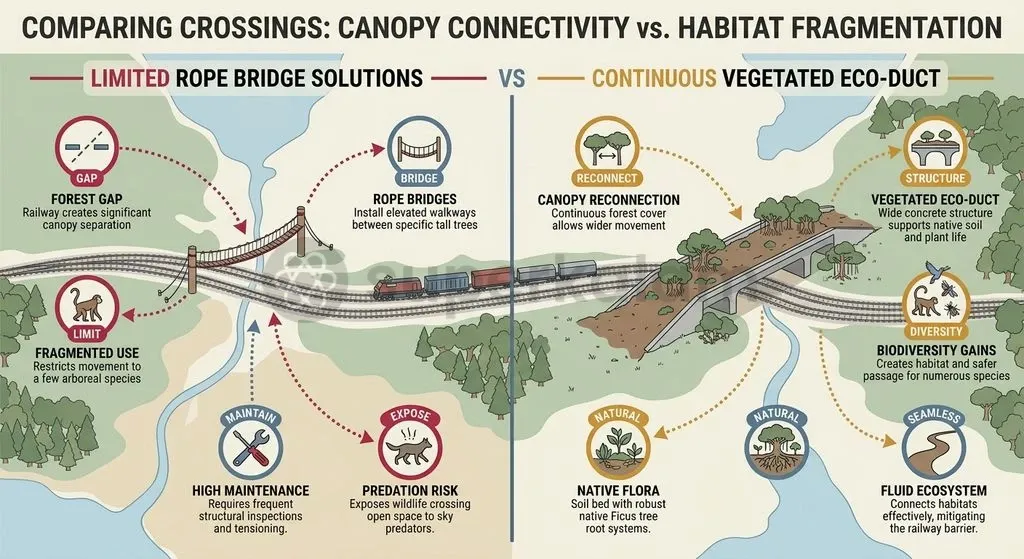
Artificial canopy lines remain a temporary stopgap rather than a comprehensive ecological solution. A single pair of ropes across a gap cannot restore the complex ecological dynamics of a continuous forest. The Wildlife Institute of India Technical Report TR No/2023/07 emphasises that physical crossings do not automatically reverse long-term genetic bottlenecks.
Gibbons are strictly monogamous and maintain rigid territorial boundaries. Dispersing juveniles forced across a narrow artificial crossing cannot simply join an established group on the other side.
Without expansive, unoccupied canopy to settle, displaced sub-adults face aggressive territorial defence from resident family units. Narrow rope bridges fail to provide the spatial cushion necessary for non-violent genetic exchange, leaving small sub-populations vulnerable to inbreeding depression.
| Conservation Dimension | Synthetic Rope Bridge | Natural Canopy Corridor |
|---|---|---|
| Structural Complexity | Two synthetic cables with safety net | Multi-tier branching, lianas, and dense crowns |
| Microclimate Buffer | None; exposed to wind and high solar radiation | Preserves forest humidity and ambient temperature |
| Foraging Value | Zero food or resting sites | Yields fruits, shoots, and roosting perches |
| Territorial Dispersal | Bottlenecked; creates territorial conflict | Facilitates multi-point movement and dispersal |
| Vulnerability to Weather | Subject to UV degradation and material fatigue | Self-repairing via vegetative growth |
At the same time, the physical footprint of linear infrastructure is expanding. Planned track doubling and electrification projects undertaken by Northeast Frontier Railway threaten to widen the right-of-way clearance gap up to 50 metres.
A 50-metre void surpasses the stability limits of simple rope crossings. It also eliminates all natural tree-fall and leap options.
The Policy Dilemma: Linear Infrastructure Clashes with Wildlife Clearances
The conflict in Hollongapar illustrates the systemic friction between national infrastructure development and statutory wildlife safeguards. Central to this clash is the National Board for Wild Life (NBWL), a statutory body established under Section 5A of the Wildlife (Protection) Act, 1972.
Under Section 5A of the Act, the Prime Minister is the ex-officio chairperson of the NBWL. Clearance proposals impacting national parks and wildlife sanctuaries fall under the purview of its Standing Committee.
At its 80th meeting on 9 October 2024, the Standing Committee of the NBWL approved the diversion of 9.0 hectares of land for railway electrification. This clearance comprised 1.6 hectares of forest inside the sanctuary alongside 7.4 hectares within its Eco-Sensitive Zone. The clearance sanctioned the installation of 25 kV high-tension overhead traction lines along the tracks.
Statutory Conditions Imposed by the NBWL (80th Meeting):
- Pre-Energisation Mandate: Traction wires cannot be charged until WII mitigations are installed.
- Corpus Fund Contribution: User agency must deposit 2% of project cost with Assam's CWLW.
- Mitigation Scope: Structural animal passages and canopy bridges across the track corridor.
The tragedy of 8 February 2026 exposed the operational limits of administrative conditions. While the NBWL mandated that lines remain un-energised until safety structures were certified, infrastructural execution often outpaces ecological mitigation.
Overhead wires carrying 25 kV currents present an immediate lethal hazard to arboreal animals navigating open spaces. Under the Forest (Conservation) Act, 1980, linear projects receive incremental diversions, but piecemeal clearances frequently miss the cumulative ecological fallout inside sensitive biodiversity hotspots.
Discuss with Superkalam
Evaluate whether the Standing Committee of the National Board for Wild Life was justified in approving railway electrification clearances inside Hollongapar Sanctuary.
Ask NowWay Forward: Moving from Artificial Bridges to Real Forest Reconnection
Long-term survival for Hollongapar's wildlife requires transitioning from piecemeal synthetic fixtures to durable ecological landscape management. Engineered rope bridges provide an indispensable immediate band-aid, but enduring genetic and demographic health requires unyielding habitat restoration.
Conservation biologists and forestry experts recommend four key structural interventions:
- Aggressive Native Silviculture: Expand targeted planting programmes using native canopy giants, specifically Hollong (Dipterocarpus macrocarpus) and wild fig varieties (Ficus species). Strangler figs create broad, interlocking crowns that provide essential fruit resources while naturally weaving arboreal pathways over clearance gaps.
- Engineered Vegetated Eco-Ducts: Where ground transportation corridors cannot be rerouted, replace open-air track cuttings with reinforced overpass tunnels topped with soil, shrubs, and mature trees. These broad green bridges allow canopy and terrestrial species to cross without encountering high-voltage electrical wires or railway ballast.
- Strict Compliance with Mitigation Preconditions: Regulatory authorities must enforce the NBWL's binding mandates. Rail agencies must ensure that animal passage measures certified by the Wildlife Institute of India are completely operational before introducing higher train frequencies or energising new sections.
- Realignment Outside Protected Boundaries: The most durable solution remains total infrastructure relocation. Writing in the journal Science, researchers from the Wildlife Institute of India urged the Ministry of Railways to reroute the 1.65-kilometre railway line around the sanctuary perimeter entirely.
Diverting traffic through non-critical agricultural belts outside Hollongapar would eliminate train collisions and electrocution hazards permanently. It would allow the central forest canopy to close naturally, ending more than a century of ecological fragmentation.
Key Takeaways
- Hollongapar Gibbon Sanctuary is a 20.98-square-kilometre protected area in Jorhat district, Assam, fragmented since 1887 by a 1.65-kilometre stretch of the Mariani–Dibrugarh railway line.
- The Western Hoolock Gibbon (Hoolock hoolock) is India's only ape species, classified as Endangered on the IUCN Red List and protected under Schedule I of the Wildlife (Protection) Act, 1972.
- Gibbons are strictly arboreal brachiators whose specialised morphology makes crossing open ground biologically unnatural and perilous against terrestrial predators.
- Synthetic twin-rope bridges designed by the Wildlife Institute of India achieved the world's first documented gibbon crossing over an active railway track in May 2026.
- Artificial crossings cannot resolve long-term genetic bottlenecks or territorial isolation, and planned 25 kV railway track electrification introduces lethal electrocution hazards.
- Permanent recovery demands vegetated eco-ducts, intensive native canopy replanting (Ficus and Dipterocarpus species), and the eventual rerouting of the railway line outside the sanctuary.
Mains Question
"Artificial canopy bridges provide tactical mobility across fragmented habitats, but cannot substitute for continuous ecological corridors under expanding linear infrastructure." In light of the ongoing interventions in Assam's Hollongapar Gibbon Sanctuary, critically analyse this statement. (15 Marks)
Evaluate NowMains Question
Examine the role and statutory mandate of the National Board for Wild Life (NBWL) under the Wildlife (Protection) Act, 1972, in balancing linear infrastructure development against the conservation of endangered species. (10 Marks)
Evaluate NowPractice MCQs
QUESTION 1
With reference to the Western Hoolock Gibbon (Hoolock hoolock), consider the following statements:
- It is the only ape species found in India.
- It is listed as Endangered on the IUCN Red List and protected under Schedule I of the Wildlife (Protection) Act, 1972.
- Its specialised mode of locomotion, brachiation, involves suspensory swinging beneath tree branches rather than efficient bipedal or quadrupedal walking. Which of the statements given above are correct?
QUESTION 2
Consider the following statements regarding the Hollongapar Gibbon Sanctuary:
- It is located in the Jorhat district of Assam.
- Hollong (Dipterocarpus macrocarpus) and Nahar (Mesua ferrea) form dominant floral components of the sanctuary.
- The sanctuary harbours seven non-human primate species, including the Bengal slow loris and capped langur. Which of the statements given above are correct?
QUESTION 3
Regarding the institutional and legal mechanisms governing wildlife clearances in India, consider the following statements:
- The National Board for Wild Life (NBWL) is a statutory body established under Section 5A of the Wildlife (Protection) Act, 1972.
- The Prime Minister serves as the ex-officio chairperson of the National Board for Wild Life.
- Projects involving diversion of land inside national parks and wildlife sanctuaries require clearance from the Standing Committee of the NBWL. Which of the statements given above is/are correct?
QUESTION 4
In the context of wildlife corridor management at Hollongapar Gibbon Sanctuary, why did the 2015 iron girder crossing fail as an arboreal bridge?
QUESTION 5
With reference to the ecological limitations of artificial twin-rope canopy bridges highlighted in the Wildlife Institute of India Technical Report TR No/2023/07, consider the following statements:
- Synthetic canopy lines do not reverse long-term genetic bottlenecks because gibbons are strictly monogamous and maintain rigid territorial boundaries.
- Dispersing sub-adult gibbons traversing narrow rope crossings face aggressive territorial defence from resident family units in adjacent forest patches.
- Synthetic rope crossings provide microclimate buffering and yield resting and foraging resources similar to natural multi-tier canopies. Which of the statements given above is/are correct?