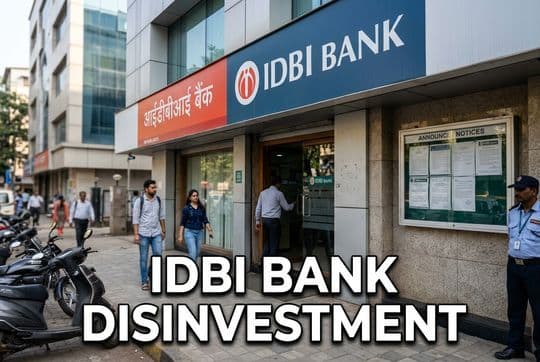
High-Level Committee on Demographic Changes: Mandate and Questionnaire
The MHA committee seeks 15 years of religion-wise data through a 35-point questionnaire. See its mandate, requested records and privacy concerns.
Sep, 2026
•9 min read
Overview
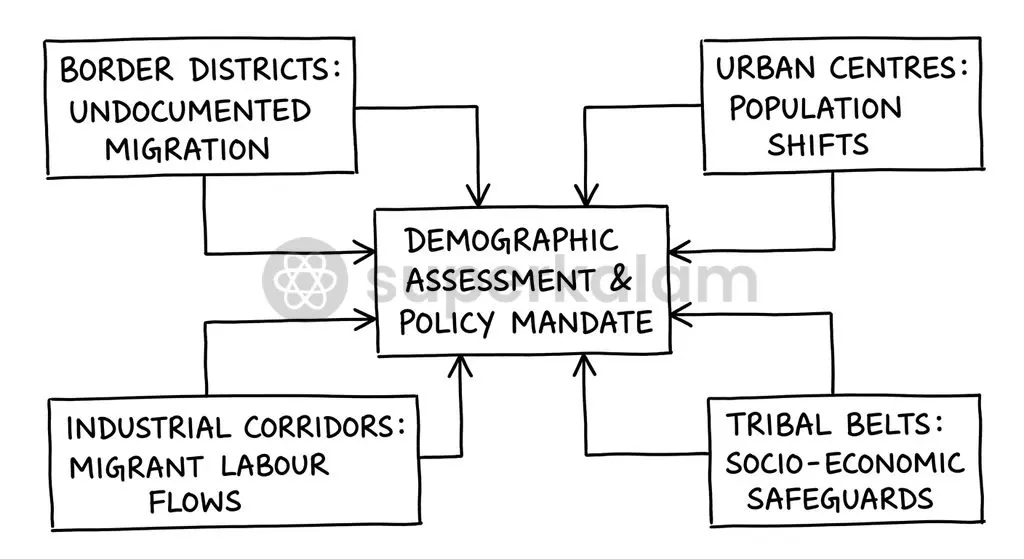
The Ministry of Home Affairs constituted the High-Level Committee on Demographic Changes in May 2026 under retired Supreme Court Justice Prakash Prabhakar Naolekar. Its mandate covers population shifts and undocumented migration across border districts, urban centres, industrial corridors, and tribal areas.
This initiative stems from a policy commitment announced during the Prime Minister's Independence Day address in August 2025 to analyse demographic vulnerabilities systematically. National security considerations under Article 355 justify monitoring cross-border shifts. However, executing statistical surveys via administrative questionnaires rather than the Census Act, 1948 creates friction with constitutional federalism and data privacy safeguards. The resulting debate centres on the boundary between Union security powers and State jurisdiction over local administration.
Why is the High-Level Committee on Demographic Changes in the News?
The committee stepped into the spotlight after issuing an extensive questionnaire to States and Union Territories.
Key triggers behind the ongoing debate include:
- Extensive historical data demand: As of September 2026, several states raised administrative and jurisdictional objections to the survey instrument, which seeks 15 years of records.
- High-level executive origin: Prime Minister Narendra Modi originally announced the plan during his Independence Day address on 15 August 2025. The Ministry of Home Affairs Foreigners-I Division subsequently issued an official resolution on 26 May 2026 to formally establish the committee.
- Jurisdictional overreach claims: Friction escalated when states highlighted legal limits regarding the collection of religion-disaggregated administrative data outside decennial census operations.
What is the High-Level Committee on Demographic Changes?
The High-Level Committee on Demographic Changes is an executive body established by the Ministry of Home Affairs to study demographic shifts and recommend institutional countermeasures. Retired Supreme Court judge Justice Prakash Prabhakar Naolekar is the chairman of the panel.
The committee comprises technical experts, civil servants, and security analysts:
- Chairman: Justice Prakash Prabhakar Naolekar (Retired Judge, Supreme Court of India).
- Member: Registrar General and Census Commissioner of India.
- Member: Durga Shanker Mishra (Former Union Housing Secretary).
- Member: Balaji Srivastava (Former Director General, Bureau of Police Research and Development).
- Member: Dr. Shamika Ravi (Member, Economic Advisory Council to the Prime Minister).
- Member: Joint Secretary (Foreigners-I), Ministry of Home Affairs.
The committee is an advisory body tasked with submitting actionable policy measures to the Union government. Unlike the Office of the Registrar General of India during decennial operations, the panel does not conduct direct pan-India statutory enumeration.
Discuss with Superkalam
Which retired Supreme Court Justice heads the High-Level Committee on Demographic Changes constituted by the Ministry of Home Affairs?
Ask NowMandate of the Committee: Border Security and Population Trends
The Terms of Reference mandate the panel to conduct a scientific investigation into demographic changes caused by illegal immigration and unnatural factors. The inquiry spans border districts, rapidly expanding urban centres, industrial corridors, and tribal areas.
Geographic focus areas reflect internal security priorities:
- Frontier stability: Border districts facing undocumented migration can experience sudden shifts in electoral rolls, land ownership patterns, and socio-economic infrastructure.
- Constitutional duty: In Sarbananda Sonowal v. Union of India (2005), the Supreme Court observed that large-scale undocumented migration creates an acute burden on the State. This invokes the Union's duty under Article 355 of the Constitution to protect states against internal disturbance.
- Targeted countermeasures: The committee must formulate legislative, administrative, and technological solutions. Recommendations are expected to address surveillance mechanisms, land record management, and border policing coordination.
Inside the 35-Point Questionnaire: Key Areas of Inquiry
The panel distributed a comprehensive 35-point questionnaire to States and Union Territories in September 2026, as reported by reputable news organisations. The instrument reportedly requests 15 years of administrative data disaggregated across six recognised religious communities: Hindus, Muslims, Christians, Sikhs, Buddhists, and Parsis.
Administrative domains covered under the reported questionnaire include:
- Civil Registration Systems: Religion-wise breakdowns of birth and death registrations over the past 15 years.
- Social Welfare and Public Distribution: Disaggregated beneficiary records across school enrolments and ration card allocations.
- Asset and Transport Registries: Religion-tagged data for motor vehicle registrations and immovable property sales deeds.
- Electoral and Civic Records: Trends in local voter registrations and municipal boundary alterations.
- Security and Legal Assessments: Intelligence inputs regarding religious conversions among Scheduled Tribes, operational status of detention centres, and assessments on whether new legislation is required to counter demographic changes.
Discuss with Superkalam
How does the legal protection given to data under Section 15 of the Census Act, 1948 differ from data collected via executive questionnaires?
Ask NowWhy Are States Objecting to the Exercise?
State administrations have expressed procedural, legal, and operational reservations regarding the 35-point questionnaire. Under existing statutory frameworks, civil registries—including Regional Transport Offices (RTOs) and Sub-Registrar offices handling property deeds—do not record citizen religion.
Three primary structural concerns drive state objections:
- Statutory Absence of Religious Tagging: State officials note that extracting religion-wise data from property deeds or vehicle registrations is legally impermissible and technically impossible without manual profiling, as standard forms do not contain religious identifiers.
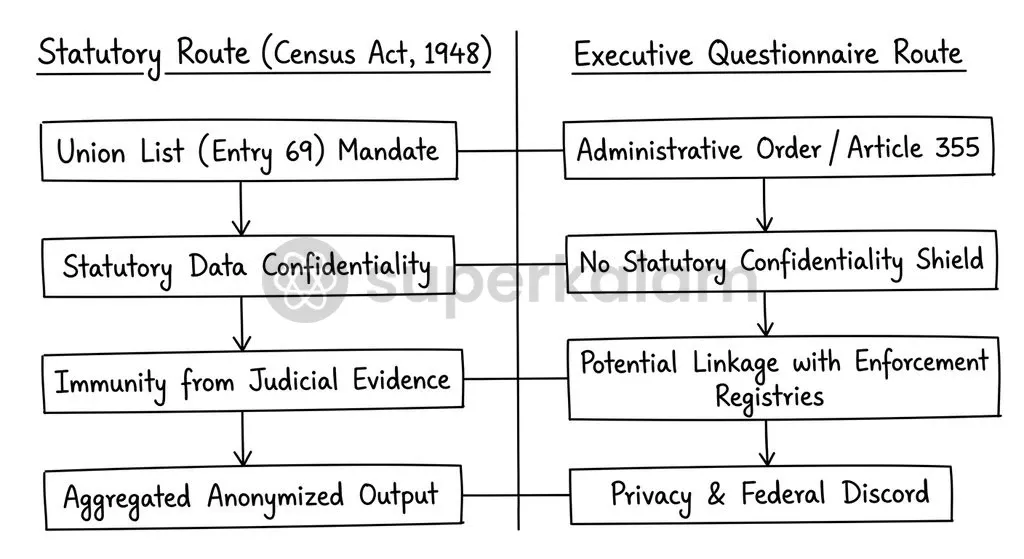
- Parallel Census Concerns: States argue that seeking extensive, community-wise demographic data through executive questionnaires circumvents the formal safeguards of the Census Act, 1948.
- Administrative Strain: Compiling 15 years of micro-level administrative data across multiple departments imposes a severe workload on district collectorates and local law enforcement.
Constitutional and Legal Matrix: Seventh Schedule and Census Powers
The Indian Constitution establishes a precise division of powers between the Union and the States regarding demographic data collection, policing, and statistical inquiries.
| Constitutional Entry / Statute | Sphere of Authority | Subject Matter and Scope |
|---|---|---|
| Union List (List I), Entry 69 | Union Parliament | Exclusive legislative authority over the Census. |
| Union List (List I), Entry 94 | Union Parliament | Inquiries, surveys, and statistics for any Union List subject. |
| Concurrent List (List III), Entry 45 | Union and States | Inquiries and statistics for any subject in List II or List III. |
| State List (List II), Entries 1 & 2 | State Legislatures | Exclusive authority over Public order and Police. |
| Section 15, Census Act, 1948 | Statutory Protection | Mandates statutory confidentiality of individual census records, barring their use as evidence in judicial proceedings. |
| Sections 9 & 10, Collection of Statistics Act, 2008 | Regulatory Safeguards | Imposes disclosure restrictions, purpose limitations, and informant consent rules for government data collection. |
The Union derives its authority to establish advisory panels from its executive power under Article 73, read with Entry 94 of List I. However, executive inquiries lack statutory confidentiality guarantees embedded in Section 15 of the Census Act, 1948, creating potential vulnerabilities regarding data misuse.
Discuss with Superkalam
If a border district faces rapid undocumented migration, how should administrative data collection be balanced between national security needs and civil registry limitations?
Ask NowArguments For and Against the Demographic Study
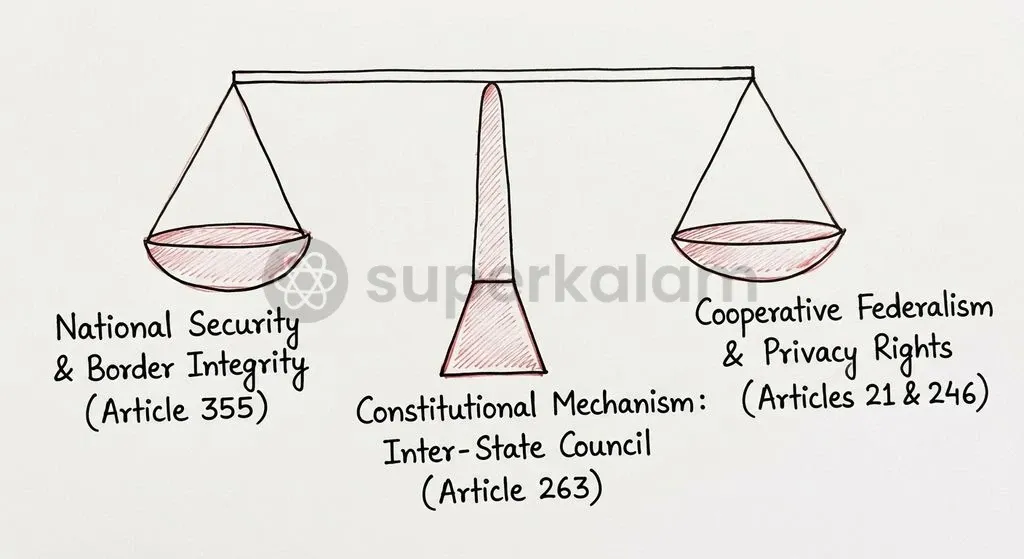
Policy analysts and legal scholars remain divided over the utility and methodology of the High-Level Committee's investigation. The debate balances national security and border integrity against administrative propriety and constitutional federalism.
| Dimension | Arguments For the Study | Arguments Against the Study |
|---|---|---|
| Constitutional & Legal | Invokes Article 355 duty to safeguard states against external disruption. | Lacks statutory confidentiality safeguards provided under the Census Act, 1948. |
| Governance & Federalism | Enables evidence-based policy making for critical infrastructure planning. | Risks federal friction by bypassing formal consultation with State executives. |
| Operational Feasibility | Identifies cross-border infiltration patterns across vulnerable frontiers. | Faces absence of religious metrics in existing baseline administrative registries. |
Proponents argue that rapid, undocumented demographic shifts in sensitive border districts alter local security environments. Systematic data collection enables law enforcement to detect cross-border infiltration networks and adjust welfare delivery mechanisms. Proponents cite the Union's duty under Article 355 to protect states from external disruptions as a foundational justification.
Critics contend that seeking religion-specific administrative data outside statutory census protocols risks societal profiling. Because the panel is an executive body rather than an authority under the Census Act, 1948 or the Collection of Statistics Act, 2008, data collected lacks formal statutory immunity. State governments also argue that unilateral inquiries without prior consultation undermine cooperative federalism.
Discuss with Superkalam
Analyse the friction between Union executive inquiries under List I Entry 94 and State jurisdiction over local public administration under List II.
Ask NowWay Forward: Balancing Security and Cooperative Federalism
The Union government and State administrations must align national security requirements with constitutional processes to avoid federal paralysis. Conducting demographic inquiries through transparent, statutory mechanisms preserves intergovernmental cooperation while securing vital border intelligence.
Key institutional measures should include:
- Activating the Inter-State Council: The Union should leverage Article 263 of the Constitution to discuss demographic concerns within the Inter-State Council, ensuring State Chief Ministers participate in framing study parameters.
- Aligning with Statutory Frameworks: Rather than relying on open-ended executive questionnaires, data collection should adhere to purpose limitations and confidentiality norms under the Collection of Statistics Act, 2008.
- Prioritising the Decennial Census: Conducting the official national Census under the Census Act, 1948 remains the most robust, scientifically validated, and legally protected method for capturing nationwide demographic trends.
- Depoliticising Border Management: Strengthening technological border surveillance, digitising land records objectively, and upgrading border infrastructure must proceed without intrusive, ad-hoc administrative profiling.
Key Takeaways
- The Ministry of Home Affairs constituted the High-Level Committee on Demographic Changes on 26 May 2026, chaired by retired Supreme Court Justice Prakash Prabhakar Naolekar.
- The committee's mandate focuses on studying demographic shifts caused by illegal immigration and unnatural factors in border districts, urban clusters, and tribal belts.
- In September 2026, the panel issued a 35-point questionnaire seeking 15-year religion-disaggregated administrative data from States across welfare, vehicle, and land registries.
- State governments have objected on grounds that civic registries do not record religion, and executive data gathering bypasses the statutory confidentiality of Section 15 of the Census Act, 1948.
- Constitutional authority over the Census is an exclusive Union subject under Seventh Schedule List I Entry 69, while Public Order and Police remain exclusive State subjects under List II Entries 1 and 2.
- Upholding the three-fold test from K.S. Puttaswamy (2017) and utilising the Inter-State Council under Article 263 are essential to reconcile national security with cooperative federalism.
Mains Question
"The Union's duty under Article 355 to monitor cross-border demographic vulnerabilities often intersects with State jurisdiction over local administration and statutory census protocols." Critically examine this statement in light of the mandate and functioning of the High-Level Committee on Demographic Changes. (15 Marks)
Evaluate NowMains Question
Highlight the constitutional and statutory limitations of gathering religion-disaggregated demographic data through executive questionnaires rather than statutory census operations. Elucidate. (10 Marks)
Evaluate NowPractice MCQs
QUESTION 1
With reference to the constitutional and statutory framework governing demographic surveys and census in India, consider the following statements:
- Legislative authority over the Census is placed exclusively under the Union List in the Seventh Schedule.
- Inquiries and statistics for any subject in the State List fall exclusively under the legislative domain of State Legislatures.
- Section 15 of the Census Act, 1948 provides statutory confidentiality to individual census records, barring their use as evidence in judicial proceedings. Which of the statements given above is/are correct?
QUESTION 2
Consider the following statements regarding the High-Level Committee on Demographic Changes:
- It was constituted by the Ministry of Home Affairs under the chairmanship of retired Supreme Court Justice Prakash Prabhakar Naolekar.
- It carries statutory powers under the Census Act, 1948 to conduct direct pan-India statutory enumeration.
- Its inquiry covers border districts, expanding urban centres, industrial corridors, and tribal areas. Which of the statements given above are correct?
QUESTION 3
Which of the following provisions of the Constitution of India was invoked in Sarbananda Sonowal v. Union of India (2005) regarding the Union's duty to protect States against internal disturbance arising from large-scale undocumented migration?
QUESTION 4
Consider the following statements regarding the regulatory safeguards for government data collection in India:
- The Collection of Statistics Act, 2008 contains provisions imposing disclosure restrictions and purpose limitations.
- Administrative registries such as Regional Transport Offices and Sub-Registrar offices statutorily capture religion-disaggregated metrics in their standard property and vehicle registration forms. Which of the statements given above is/are correct?
QUESTION 5
With reference to the Seventh Schedule of the Constitution of India, consider the following pairs:
- Entry 69, List I : Census
- Entry 94, List I : Inquiries, surveys, and statistics for Union List subjects
- Entries 1 & 2, List II : Public order and Police How many of the pairs given above are correctly matched?