Heat Storms and Heat Cascades: India's Compounding Climate Crisis
As compounding heat events strain India's power grid and informal workforce, policy must shift from ad-hoc relief to statutory climate adaptation.
Oct, 2026
•11 min read
Overview
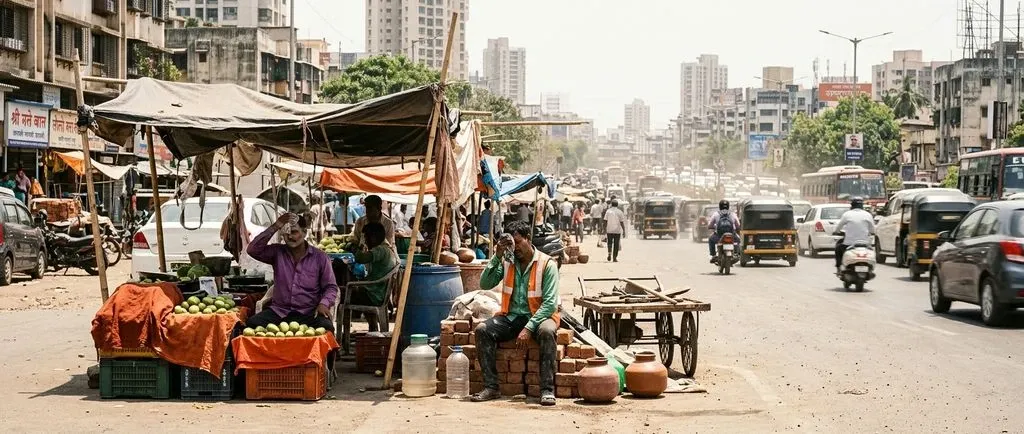
India faces a severe shift in extreme summer temperatures. Localised scorch events have expanded into vast synoptic heat systems. These triggers spark compound infrastructure failures that test human physiology and state resources alike.
Rising temperatures no longer appear as brief seasonal spikes. Instead, they act as structural hazards to regional food security, electrical grid stability, and urban livelihoods. Decisive policy adaptation must bridge the gap between emergency health responses and statutory urban climate resilience.
Why in the News: The Emergence of Compound Heat Phenomena
The India Meteorological Department recorded unprecedented regional temperature departures across Northern and Central India during the pre-monsoon seasons. These departures forced repeated emergency mobilisations across state governments.
Several concurrent crises converged across northern river basins:
- Record electricity demand peaking alongside depleted water reservoirs.
- Severe occupational distress concentrated among unorganised and outdoor workers.
- Statutory fiscal constraints, as heatwaves are still not classified as a notified national disaster under the Disaster Management Act, 2005.
This statutory omission restricts direct fiscal transfers from the central government. As a result, municipal bodies must rely on ad-hoc budgetary diversions. Meanwhile, the Supreme Court of India has linked climate vulnerability to the fundamental Right to Life under Article 21, establishing that environmental health and human survivability are non-negotiable constitutional guarantees.
India has moved past discrete, isolated heatwaves. The country now faces interconnected heat cascades that render traditional emergency relief obsolete.
Discuss with Superkalam
What are the specific temperature thresholds set by the IMD to declare a heatwave in the plains, coastal regions, and hilly areas?
Ask NowBeyond Traditional Heatwaves: Defining Heat Storms and Heat Cascades
The India Meteorological Department classifies an official heatwave when the maximum surface temperature reaches at least 40°C in the plains, 37°C in coastal regions, and 30°C in hilly tracts. These absolute thresholds require a positive departure from normal climatological temperatures of 4.5°C to 6.4°C, or an absolute maximum surface recording touching 45°C or higher.
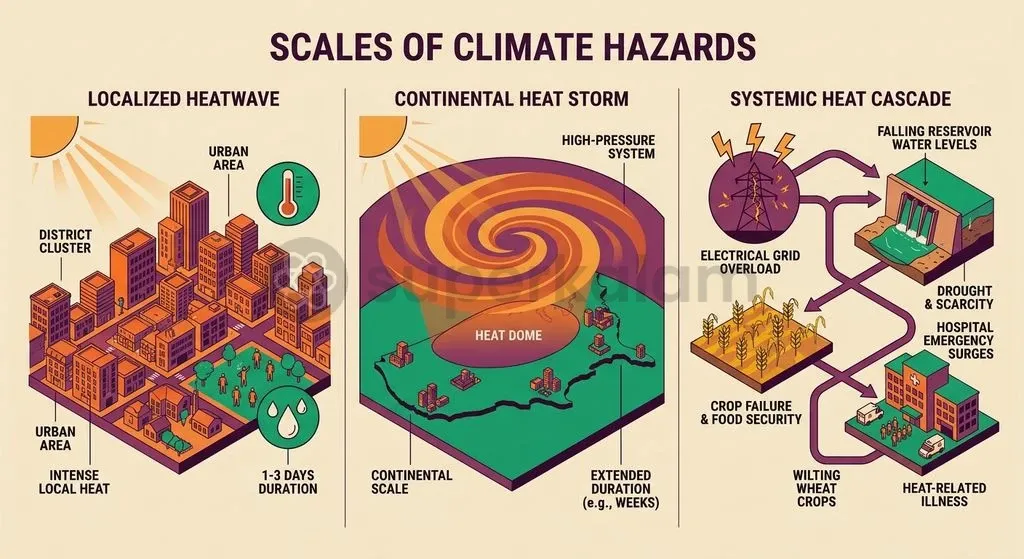
Climatologists now track wider spatial phenomena. According to recent meteorological analyses reported by Reuters Global Heat Storm Analysis and The Hindu Science Review, an atmospheric heat storm describes a vast, contiguous synoptic weather system covering at least 1% of the Earth's surface at peak intensity. Unlike isolated local heatwaves that dissipate over a 48-hour cycle, heat storms sustain intense thermal anomalies across thousands of contiguous square kilometres for multiple weeks.
A heat cascade occurs when successive or overlapping heat storms trigger sequential, multi-system failures across critical infrastructure sectors. The disaster ceases to be purely meteorological. It becomes a compounding socio-economic breakdown spanning power transmission, municipal water networks, food supply chains, and hospital emergency facilities.
| Parameter | Traditional Heatwave | Atmospheric Heat Storm | Systemic Heat Cascade |
|---|---|---|---|
| Spatial Extent | Localised district or sub-division clusters | Sub-continental scale covering ≥1% of the globe | Regional to nationwide footprint across human systems |
| Primary Driver | Localised surface heating and dry winds | Synoptic atmospheric blocking and heat domes | Interconnected infrastructure failures triggered by prolonged heat |
| Duration | Typically 2 to 5 consecutive days | Several weeks of sustained high pressure | Months of compounding sectoral stresses |
| Governance Focus | Short-term emergency medical hydration | Regional energy management and grid alerts | Multi-sectoral disaster response and structural adaptation |
How Heat Storms Form: Atmospheric Blocking, Jet Streams, and Heat Domes
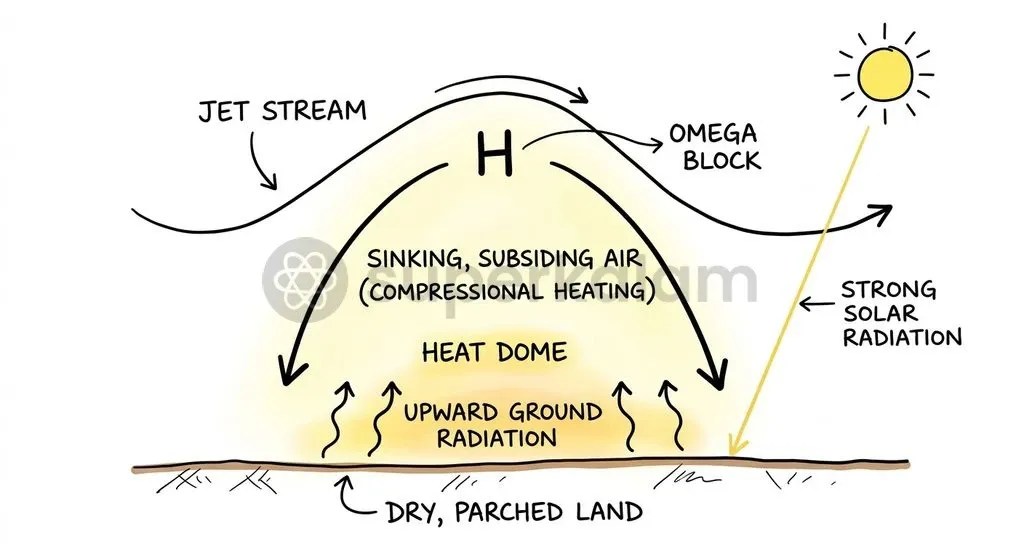
Atmospheric blocking patterns in the upper troposphere drive persistent continental heat anomalies across the Northern Hemisphere. High-amplitude meanders within the subtropical jet stream—specifically stationary circumglobal Rossby waves with wavenumbers 5 and 7—frequently lock into place over the Eurasian landmass and Northern India. These wave configurations form Omega-shaped blocking systems. They stop cooler maritime air masses from reaching continental interiors and trap blistering air over vast territories.
The thermodynamic build-up follows three distinct physical phases:
- High-pressure ridge stagnation: A heat dome develops when an expansive high-pressure atmospheric ridge settles over a landmass, trapping ocean-warmed air beneath it like a lid on a pot.
- Vertical subsidence: Sinking air within this high-altitude ridge undergoes adiabatic heating, where gas temperature rises purely due to compression without external heat exchange.
- Cloud suppression and radiative baking: Adiabatic compression vaporises ascending moisture and halts cloud formation. This allows uninterrupted shortwave solar radiation to bake the surface, creating a self-reinforcing feedback loop that feeds thermal energy back into the compressed column.
Discuss with Superkalam
How do stationary Rossby waves and atmospheric blocking combine to sustain high-pressure heat domes over continental landmasses?
Ask NowThe Anatomy of a Heat Cascade: How One Extreme Event Triggers Systemic Collapse
A heat cascade transforms an atmospheric anomaly into a multi-sector disaster through tightly coupled socio-technical interdependencies. The breakdown progresses through distinct stages:
- Atmospheric Compression and Soil Desiccation: Persistent high pressure creates severe soil moisture deficits, eliminating natural evaporative cooling across rural agricultural belts and peri-urban buffers.
- Surging Cooling Demand and Grid Strain: Urban populations simultaneously engage space-cooling appliances, driving grid loads to absolute physical thresholds and risking transformer burnouts.
- Thermal Power Plant Derating: Power plants simultaneously suffer thermodynamic efficiency drops due to elevated cooling-water temperatures, curtailing baseload generation precisely when consumption peaks.
- Hydrological Exhaustion: Municipal water utilities face plunging reservoir levels and falling groundwater tables, forcing emergency water rationing and impairing hospital sanitation.
- Supply Chain Disruption: Perishable agricultural commodities rot in transit due to inadequate cold-chain logistics, triggering food inflation while farm labourers suffer debilitating heat stress.
India's Special Vulnerability: High Humidity, Wet-Bulb Limits, and Dense Cities
India presents unique physiological vulnerabilities to compounding heat due to tropical humidity, dense settlements, and geographical location. Dry desert heat permits human bodies to shed internal thermal energy through sweating. High relative humidity severely restricts this biological cooling pathway.
Climatologists assess this combined hazard using wet-bulb temperature—the lowest temperature to which an air parcel can be cooled purely through water evaporation at constant pressure.
| Metric / Condition | Temperature Threshold | Physiological and Physical Impact |
|---|---|---|
| Theoretical Survival Limit | 35°C Wet-Bulb | Maximum theoretical limit where metabolic heat cannot escape, inducing fatal hyperthermia within six hours even at rest in shade. |
| Empirical Safety Threshold | 30.5°C to 31.5°C Wet-Bulb | Point of uncompensable heat stress for young, healthy adults performing basic daily routines. |
| Urban Heat Island Amplification | Variable nocturnal elevation | High thermal inertia in asphalt and concrete retains radiation, depriving human bodies of nocturnal recovery. |
Dense Indo-Gangetic river plains and coastal metropolitan regions frequently cross the empirical safety range during pre-monsoon and monsoon transitional periods. In cities like Delhi, Mumbai, and Kolkata, low surface albedo and vehicular air conditioning trap excess heat, turning metropolitan centres into overnight heat traps.
Discuss with Superkalam
If a metropolitan area experiences consecutive days exceeding 31°C wet-bulb temperature, what emergency protocols should a municipal commissioner trigger for outdoor workers?
Ask NowSocioeconomic Fallout: Water Scarcity, Grid Strain, and Agricultural Disruption
Concurrent heat extremes drive severe systemic stress across energy, water, and food systems. The operational shocks manifest across several key sectors:
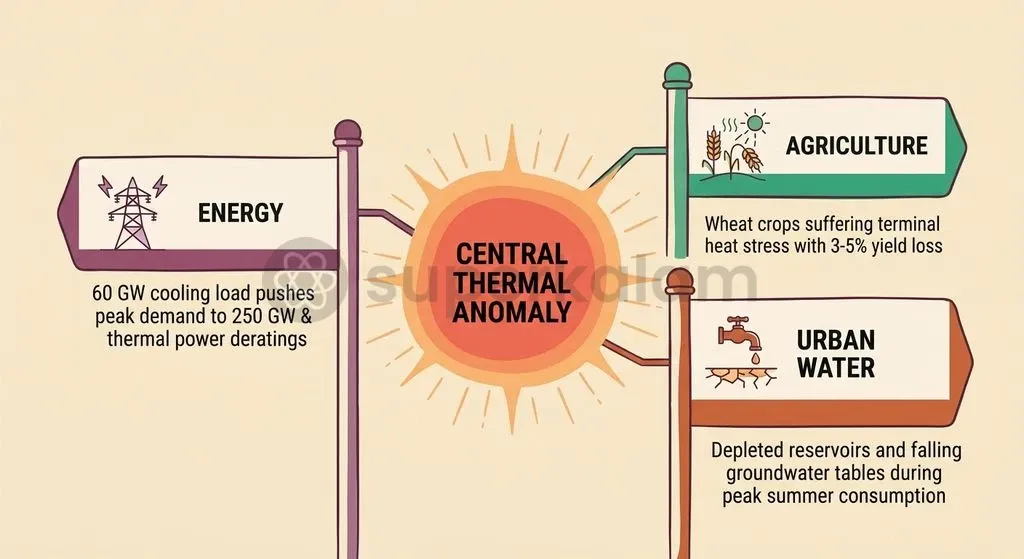
- Peak electricity demand surges: The Central Electricity Authority recorded an all-time high national peak electricity demand of approximately 250 GW in May 2024. Space cooling and domestic air conditioning accounted for roughly 60 GW of this surge, with projections from the International Energy Agency indicating that cooling will represent one-third of India's total peak power demand by 2030.
- Generation deratings at power plants: As river and canal intake waters warm, thermal facilities experience reduced thermodynamic cooling efficiency. Plants must derate generation to avoid violating thermal discharge regulations, often facing intake shortages as surface water gets diverted to municipal drinking networks.
- Harvest contraction from terminal heat: In March 2022, early terminal heat stress struck North-Western India during the critical reproductive and grain-filling stages of the rabi wheat crop, shrinking total yields by 3% to 5%. The resulting supply shortfall prompted the central government to impose a comprehensive wheat export ban in May 2022 to stabilise domestic buffer stocks.
The Human Cost: Outdoor Workers, Cooling Poverty, and Climate Justice
The economic and human costs of extreme heat fall disproportionately on vulnerable workers and informal settlements:
- Productivity shocks to outdoor labour: The International Labour Organization projected that India could lose 5.8% of its total working hours by 2030 due to heat-induced occupational stress. This reduction represents a loss equivalent to over 34 million full-time jobs.
- Vulnerability in the informal economy: According to the Periodic Labour Force Survey, more than 90% of India's total labour force works within the informal economy, concentrated in agriculture, brick kilns, gig delivery, and manual construction. These workers lack statutory protections, paid heat-leave provisions, public healthcare safety nets, and climate-controlled resting spaces during IMD Red Alerts.
- Severe cooling poverty in informal housing: Urban lower-income groups suffer from cooling poverty, lacking the mechanical and structural tools needed for basic thermal safety. Thermal mapping in India's First Biennial Transparency Report to the UNFCCC confirmed that indoor temperatures inside informal homes with tin or asbestos roofs exceed ambient outdoor readings by 3°C to 5°C.
These homes become indoor ovens at night. Those least responsible for greenhouse gas emissions absorb the heaviest physiological penalty.
Discuss with Superkalam
In what ways does simultaneous high electricity demand during a heatwave create a conflicting bottleneck for municipal water utilities and thermal power stations?
Ask NowAssessing Current Defenses: Where Local Heat Action Plans Fall Short
The National Disaster Management Authority issued structured national guidelines in 2019 to standardise early warning distribution, public health preparedness, and municipal cooling protocols. Following pioneering frameworks such as the 2013 Ahmedabad Heat Action Plan, more than one hundred cities and districts across India have formulated local Heat Action Plans.
A comprehensive assessment of 37 state, district, and city Heat Action Plans across 18 states conducted by the Centre for Policy Research revealed systemic implementation vulnerabilities. The study found that:
- Only 3 out of 37 reviewed plans identified dedicated, recurring funding mechanisms for proposed heat mitigation operations.
- Fully 8 plans instructed participating municipal line departments to self-allocate operational expenses from existing, already constrained municipal budgets.
- Most action frameworks lacked clear legal accountability, operating as advisory guidance documents rather than binding administrative mandates.
Municipal governance remains locked in short-term reactionary measures, such as distributing oral rehydration salts and broadcasting digital alerts, rather than implementing long-term cooling infrastructure.
The statutory architecture governing disaster financing poses a formidable fiscal barrier. Under the 15th Finance Commission's allocations for the 2021–26 period, the State Disaster Risk Management Fund received ₹1,60,153 crore, apportioned into ₹1,28,122 crore for response (SDRF) and ₹32,031 crore for mitigation (SDMF). In paragraph 8.143 of its final report, the 15th Finance Commission explicitly declined requests to include heatwaves within the centrally notified list of natural disasters under the NDRF and SDRF framework.
Because heatwaves remain unnotified, state governments are legally restricted to expending a maximum of up to 10% of their annual SDRF allocation for non-notified, state-specific local disasters. Furthermore, there is no dedicated central capital expenditure window under the Disaster Management Act, 2005 to finance municipal Heat Action Plans, leaving local administrations unable to fund structural cooling interventions.
Way Forward: Building Early Warning Systems and Resilient Urban Architecture
India must transition from fragmented emergency advisories to a statutory, multi-tiered climate disaster adaptation architecture. Addressing compound heat events requires systematic interventions across multiple policy domains:
- Statutory Recognition and Budgetary Windows: The central government should amend disaster management regulations to formally recognise heatwaves as notified disasters under the SDRF/NDRF frameworks, lifting the restrictive 10% cap on local disaster expenditure.
- Parametric Insurance and Income Shields: State labour departments must institute parametric insurance mechanisms that automatically disburse daily wage compensation to informal construction and agricultural labourers whenever wet-bulb temperatures exceed safety limits.
- Passive Urban Cooling Mandates: Municipal building bye-laws must incorporate the Energy Conservation Building Code for commercial structures and mandate cool-roof coatings, reflective white paint, and passive ventilation corridors across informal housing upgrades.
- Nature-Based Climate Buffers: Urban local bodies must expand urban forestry belts and restore historic wetland catchments to suppress the Urban Heat Island effect and restore local microclimatic stability.
- Decentralised Cold Storage Infrastructure: Agricultural ministries should invest in solar-powered village-level cold rooms to insulate horticultural and dairy supply chains from extreme terminal heat spikes.
Discuss with Superkalam
Considering that heatwaves are not notified disasters under the Disaster Management Act, 2005, how should India reform its statutory disaster framework to address compounding climate cascades?
Ask NowKey Takeaways
- The India Meteorological Department defines a heatwave using specific regional thresholds: 40°C in plains, 37°C in coastal belts, and 30°C in hills, accompanied by a 4.5°C to 6.4°C departure from normal baseline levels.
- Atmospheric heat storms represent synoptic high-pressure systems covering at least 1% of the globe, while heat cascades describe the compounding multi-sectoral collapse of power grids, water networks, and food chains.
- High-amplitude meanders in the subtropical jet stream create stationary circumglobal Rossby waves that trigger intense vertical subsidence and adiabatic heating within persistent atmospheric heat domes.
- Human survivability faces thermodynamic barriers at a wet-bulb temperature of 35°C, but controlled physiological experiments indicate that fatal thermal strain begins between 30.5°C and 31.5°C wet-bulb temperature for active individuals.
- The 15th Finance Commission declined to include heatwaves in the centrally notified disaster list, legally capping state SDRF spending on heat relief at 10% and leaving local Heat Action Plans without dedicated statutory capital expenditure.
Mains Question
"Heatwaves are still not classified as a notified national disaster under the Disaster Management Act, 2005, restricting direct fiscal transfers from the central government." In light of this statutory limitation, critically examine the institutional and fiscal challenges faced by urban local bodies in managing compound heat cascades. (10 Marks)
Evaluate NowMains Question
"A heat cascade occurs when successive or overlapping heat storms trigger sequential, multi-system failures across critical infrastructure sectors." Elucidate the thermodynamic drivers behind such phenomena and evaluate their compounding socioeconomic impacts on India's energy, agriculture, and water systems. (15 Marks)
Evaluate NowPractice MCQs
QUESTION 1
Consider the following statements regarding the criteria adopted by the India Meteorological Department (IMD) for declaring a heatwave:
- A heatwave is officially declared in the plains when the maximum surface temperature reaches at least 40°C.
- In coastal regions, the absolute threshold temperature for a heatwave is 30°C.
- A positive departure from normal climatological temperature of 4.5°C to 6.4°C qualifies as a heatwave. Which of the statements given above are correct?
QUESTION 2
With reference to the physical mechanisms driving atmospheric 'heat storms', consider the following statements:
- High-amplitude meanders within the subtropical jet stream, specifically stationary Rossby waves with wavenumbers 5 and 7, can form Omega-shaped blocking systems.
- In a heat dome, sinking air within the high-altitude ridge undergoes adiabatic expansion, causing rapid cooling.
- Cloud suppression by adiabatic compression creates a self-reinforcing feedback loop of uninterrupted shortwave solar radiation. Which of the statements given above is/are correct?
QUESTION 3
Consider the following statements regarding human physiological limits and wet-bulb temperatures:
- Wet-bulb temperature represents the lowest temperature to which an air parcel can be cooled purely through water evaporation at constant pressure.
- A wet-bulb temperature of 35°C is considered the empirical safety threshold for healthy young adults performing basic daily routines.
- High relative humidity impairs the human body's primary cooling mechanism by restricting sweat evaporation. Which of the statements given above is/are correct?
QUESTION 4
According to meteorological definitions cited in the context of synoptic weather systems, an atmospheric 'heat storm' is characterized by:
QUESTION 5
Regarding the socioeconomic impact of extreme heat events in India discussed in the article, consider the following statements:
- Space cooling and domestic air conditioning accounted for roughly 60 GW of the record 250 GW peak electricity demand recorded in May 2024.
- Elevated cooling-water temperatures improve the thermodynamic efficiency and baseload generation of thermal power plants.
- Terminal heat stress in March 2022 reduced total rabi wheat crop yields by 3% to 5%. Which of the statements given above are correct?