H-1B Crackdown: $100,000 Fee, PERM Suspensions, Impact on Indian IT
As protectionist American immigration rules stall onsite software deployment, India's tech sector is turning regulatory friction into domestic GCC expansion.
Oct, 2026
•15 min read

Overview
United States immigration curbs and procedural freezes under the permanent labour certification framework are ending the traditional onsite staffing model. That model sustained Indian information technology services for three decades. The shift moves work away from cross-border labour arbitrage toward India-based Global Capability Centres and high-value offshore engineering.
Multinational enterprises and domestic IT firms are replacing cross-border personnel mobility with domestic digital infrastructure. As of late 2026, this structural transition redefines India's balance of payments, bilateral trade diplomacy, and skilled expatriate welfare.
Why in the News: Escalating H-1B Denials and the PERM Labor Freeze
The United States Department of Labor (DOL) has tightened oversight on skilled guest workers, disrupting traditional mobility channels for Indian IT professionals. Higher petition fees, strict evidentiary bars, and prolonged processing times have choked historical deployment pipelines.
At the centre of this disruption sits the de facto suspension of the Program Electronic Review Management (PERM) system following corporate restructurings across American technology enterprises. Under Title 20 of the Code of Federal Regulations, specific statutory mandates protect domestic employment during workforce contractions:
- Mandatory recruitment safeguards: Under 20 CFR § 656.17(k)(1), a US employer that has laid off workers in the area of intended employment within six months of filing a PERM application must document that it actively notified and considered all potentially qualified laid-off US workers before sponsoring a foreign employee.
- Corporate compliance freezes: Widespread layoffs across major US tech corporations triggered mandatory six-month notification periods under 20 CFR § 656.17(k), prompting companies such as Google, Meta, and Amazon to impose freezes or pauses on new PERM filings to avoid Department of Labor audits and high-risk denials, as reported in corporate disclosures.
- Adjudication logjams: As of late 2026, the US Department of Labor's Office of Foreign Labor Certification reports an average PERM analyst review processing time of approximately 336 calendar days.
A prevailing wage determination queue adds three to six months to the front of that timeline. Consequently, total pre-filing processing times for employment-based permanent residence regularly exceed 18 months. These protracted timelines disrupt skilled talent retention and accelerate the structural move away from deployment-heavy operations.
Discuss with Superkalam
Recall the statutory time period specified under 20 CFR § 656.17(k)(1) during which laid-off US workers must be notified and considered before a PERM petition is submitted.
Ask NowBeyond the H-1B Lottery: Understanding PERM and Why Its Halt Hits Harder
The Program Electronic Review Management system is the statutory gateway through which a foreign professional transitions from a temporary non-immigrant visa to legal permanent residence. Administered by the US Department of Labor under the Immigration and Nationality Act, PERM requires employers to prove that foreign hires will not displace qualified domestic workers or undercut prevailing wages.
Prospective applicants enter the annual H-1B lottery as an interim step, but PERM certification remains mandatory to secure an approved Form I-140 Immigrant Petition. Under the American Competitiveness in the Twenty-First Century Act (AC21), an approved Form I-140 permits an Indian professional to extend their H-1B status beyond the statutory six-year limit while awaiting green card priority dates. Without a timely PERM clearance, high-skilled professionals exhaust their non-immigrant visas and face mandatory departure from the United States.
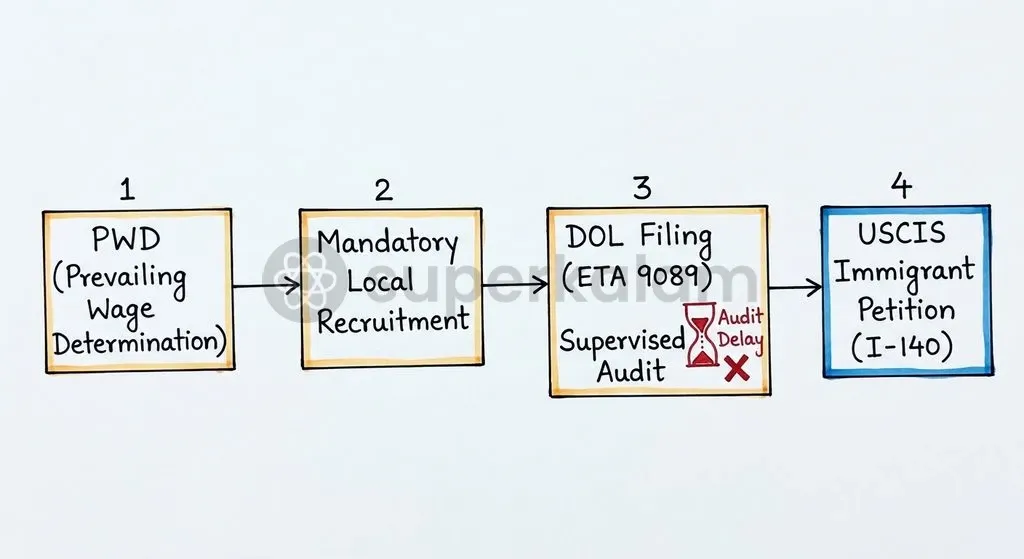
The regulatory pathway follows four strict statutory milestones:
- Prevailing wage determination: Employers obtain certified prevailing wage floors from the DOL (taking three to six months).
- Mandatory recruitment campaign: Sponsoring employers test the domestic job market through state workforce filings, internal notices, and media advertisements.
- PERM adjudication: The DOL analyst review evaluates the labour market test, averaging approximately 336 calendar days.
- Form I-140 filing: Sponsoring employers lodge the immigrant petition with USCIS to lock in the worker's permanent priority date.
Procedural delays multiply under heightened regulatory oversight. Under 20 CFR § 656.20 and § 656.24, the Department of Labor subjects selected PERM applications to comprehensive audit reviews and supervised recruitment procedures, extending adjudication timelines by an additional six to twelve months.
Statutory filing fees have escalated alongside these delays. Effective April 1, 2024, the USCIS Final Fee Rule increased the standard Form I-129 petition filing fee for H-1B visas from $460 to $780 and L-1 visas from $460 to $1,385 for large employers, while simultaneously introducing a mandatory $600 Asylum Program Fee on every Form I-129 and Form I-140 filing.
Public Law 114-113 adds a further 9-11 Biometric Entry-Exit Fee of $4,000 for H-1B petitions and $4,500 for L-1 petitions on employers with 50 or more workers where over 50 percent of the domestic workforce holds temporary visa status. These cumulative overheads make prolonged foreign worker retention economically unsustainable.
The GCC Counter-Revolution: How Tech Work Is Moving to India Instead
Global Capability Centres (GCCs) in Indian metropolitan hubs have become the primary beneficiaries of American immigration barriers. Rather than sponsoring foreign workers through costly and volatile visa pipelines, Fortune 500 corporations embed core software engineering, enterprise architecture, and research teams directly inside wholly-owned Indian entities.
India's technical talent base has advanced from executing basic back-office transactions to leading core digital roadmaps. According to NASSCOM, India hosts over 1,700 Global Capability Centres generating $64.6 billion in annual revenue and employing more than 1.9 million professionals as of FY2024. Global firms use these engineering hubs to steer cloud architecture, machine learning implementations, and corporate cybersecurity directly from domestic tech campuses.
Long-term projections indicate that this institutional migration will continue to expand. NASSCOM projects India's GCC ecosystem to expand to over 2,400 centres, reaching an annual market size of $100 billion and employing upwards of 2.5 million professionals by 2030.
Geographic concentration remains pronounced across India's premier technological corridors. Over 85 percent of India's GCC capacity remains heavily concentrated within six primary metropolitan tech clusters led by Bengaluru, Hyderabad, and Pune, with emerging expansion into Tier-2 urban hubs. Retaining seasoned technical leaders within these domestic hubs accelerates indigenous innovation and shields multinational operations from external visa shifts.
Discuss with Superkalam
Explain how the interaction between AC21 provisions and DOL PERM adjudication delays impacts the legal status of an H-1B visa holder completing six years of US residency.
Ask NowThe Death of the Traditional 'Body-Shopping' Delivery Model
India's early software export sector expanded on labour-cost differentials by placing engineers directly at American client sites. This operational model, known as onsite staffing or labour-arbitrage dispatch, billed corporate clients on an hourly, time-and-materials basis.
Indian service providers generated substantial operating margins by paying contracted engineers baseline guest-worker salaries while billing American enterprises prevailing domestic contractor rates. However, rising visa friction, steep statutory filing fees, high Request for Evidence (RFE) rates, and client onsite restrictions have structurally eroded the high-margin time-and-materials onsite staffing arbitrage model historically relied upon by Tier-1 Indian IT service firms, according to industry analyses.
Several structural pressures have made the legacy dispatch framework unviable:
- Direct margin compression: Escalating compliance levies, biometric surcharges, and mandatory asylum fees have inflated per-seat deployment costs, wiping out traditional onsite labour margins.
- Heightened statutory scrutiny: Rigorous interpretations of specialty occupation standards have elevated petition denial rates, making client project schedules unpredictable.
- Distributed development tools: Enterprise adoption of secure cloud platforms has eliminated the technical requirement for physical developer co-location.
- Client-side insourcing: Global enterprises bypass third-party IT contractors by building their own GCC operations or contracting directly with specialized offshore software labs.
In response, Tier-1 Indian IT firms are overhauling their service catalogues. Revenue streams are transitioning toward fixed-price digital transformation programmes, proprietary cloud platforms, and software intellectual property licensing.
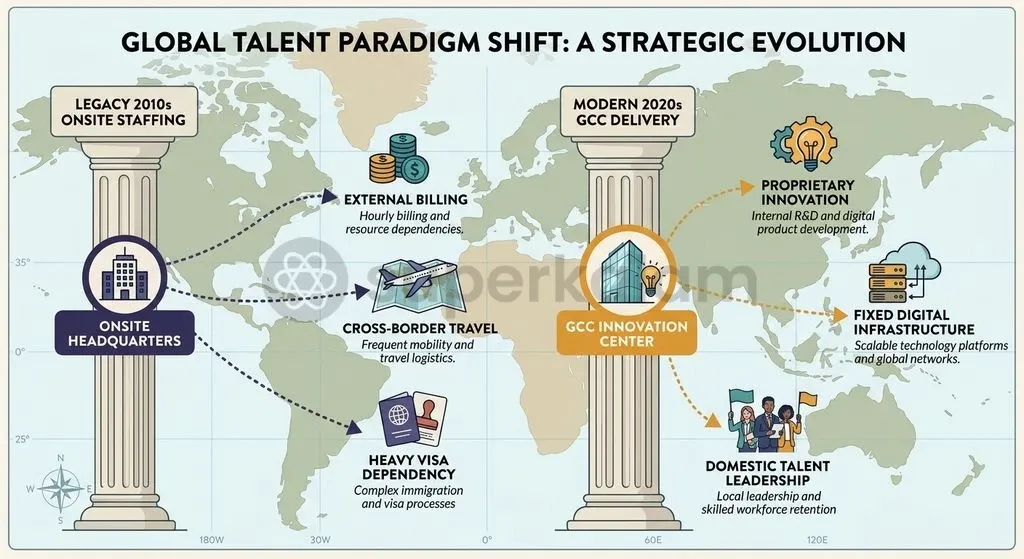
Comparison: The 2010s Onsite Staffing Model vs. The 2020s GCC and Offshore Hub Model
The operational mechanics of global software delivery have shifted from physical personnel deployment to distributed, remote digital workflows.
| Analytical Dimension | The 2010s Legacy Onsite Staffing Model | The 2020s GCC and Offshore Hub Delivery Model |
|---|---|---|
| Primary Value Proposition | Wage arbitrage achieved through temporary cross-border personnel deployment | High-value digital capability, proprietary product ownership, and continuous innovation |
| Contractual Structure | Time-and-materials billing based on deployed onsite engineer hours | Fixed-price transformational contracts, platform licensing, and internal shared-service cost centres |
| Regulatory Exposure | High vulnerability to US DOL audits, USCIS visa caps, and PERM processing halts | Protected from cross-border labour quotas; subject primarily to Indian domestic commercial regulations |
| Corporate Ownership | Third-party Indian system integrators providing external staffing services | Wholly-owned global subsidiaries (GCCs) or specialized offshore engineering centres |
| Talent Location Strategy | Rotation of skilled domestic engineers through US client sites on H-1B and L-1 visas | Retention of top-tier engineering leadership within domestic hubs like Bengaluru, Hyderabad, and Pune |
| Capital Allocation Focus | Visa processing overheads, compliance legal fees, and overseas per-diem allowances | Advanced domestic research and development infrastructure, internal upskilling, and patent portfolios |
Discuss with Superkalam
If a multinational firm faces rising US visa rejection rates and statutory fee hikes, how can it apply the GCC operational model to maintain project continuity without client-site deployment?
Ask NowStrategic Implications for India: From Dollar Remittances to High-Value Global Centers
The decline of onsite staffing and the simultaneous expansion of domestic delivery hubs directly reshape India's external economic position, altering services trade receipts and balance of payments stability.
India's services export engine demonstrates continued growth supported by remote engineering delivery. According to the Reserve Bank of India, India's software services exports reached US$ 159.61 billion in FY 2024-25, expanding from US$ 142.07 billion in FY 2023-24. Net services receipts stood at US$ 50.9 billion in Q2:2025-26, playing a critical structural role in moderating the current account deficit to 1.3 percent of GDP against a merchandise trade deficit of US$ 87.4 billion.
Meanwhile, household remittances have scaled fresh highs. Private transfer receipts, primarily reflecting inward remittances by Indian nationals employed overseas, totaled US$ 124.56 billion in FY 2024-25 compared to US$ 106.63 billion in FY 2023-24. Yet the composition of these external financial flows shows a distinct transition:
- Moderation of temporary expatriate savings: Visa renewal hurdles and decades-long green card backlogs leave temporary workers with tenure insecurity, prompting capital repatriation.
- Expansion of onshore value-add: High-value product design, IP structuring, and data architecture are invoiced directly from India, expanding enterprise service receipts over individual transfers.
- Mitigation of human capital flight: Competitive compensation packages at domestic GCCs allow skilled engineers to lead global initiatives without relocating abroad, curbing historical brain-drain pressures.
This structural pivot hedges India's external account against overseas labour curbs while solidifying the domestic ecosystem as a primary base for enterprise software.
Discuss with Superkalam
Analyse the structural differences between the 2010s onsite staffing arbitrage model and the 2020s GCC delivery model in terms of corporate risk and margin profiles.
Ask NowBilateral Friction: India-US Trade Policy, Labor Mobility, and Mode 4 Services
Cross-border skilled labour mobility remains an enduring friction point in India-US bilateral trade discussions. Both nations hold contrasting interpretations of international trade commitments.
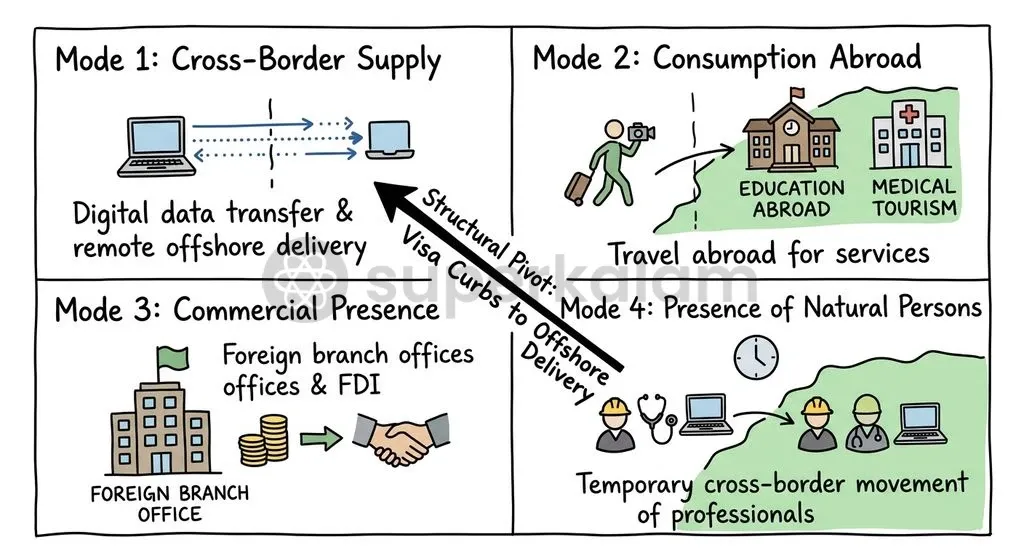
Under the World Trade Organization framework, the General Agreement on Trade in Services classifies service delivery into four distinct operational modes. Article I of the GATS framework establishes that Mode 4 covers the temporary cross-border movement of natural persons to supply commercial services. The tightening of US work visas has accelerated a structural shift in India's external trade from GATS Mode 4 to Mode 1, which governs cross-border remote digital delivery, expanding software trade receipts directly from Indian shores.
The four distinct service delivery frameworks under GATS operate as follows:
- Mode 1 (Cross-Border Supply): Services supplied digitally across borders, such as software delivered from India.
- Mode 2 (Consumption Abroad): Services consumed overseas, such as foreign personnel training in India.
- Mode 3 (Commercial Presence): Foreign entities establishing operational units, such as US corporations establishing GCCs.
- Mode 4 (Movement of Natural Persons): Expatriate professionals travelling temporarily to deliver onsite services, such as engineers deployed on H-1B visas.
India has consistently challenged protectionist immigration barriers within multilateral forums. India has consistently raised non-tariff barriers, economic needs tests, and quantitative visa caps on Mode 4 at the WTO, contending that developed countries protect domestic labour while pressing developing nations for Mode 3 commercial market access. New Delhi argues that treating temporary skilled service professionals as permanent economic immigrants misapplies immigration law to obstruct legitimate trade in commercial services.
Bilateral discussions under the India-US Trade Policy Forum (TPF) have consistently addressed payroll tax deductions. At the 14th Ministerial meeting of the India-US Trade Policy Forum in New Delhi, India reiterated its call for a bilateral Social Security Totalisation Agreement to protect Indian IT professionals working temporarily in the US from forfeited contributions.
Under domestic US Social Security regulations, an employee must accumulate a minimum of 40 quarters—equivalent to 10 years—of contributions to qualify for old-age retirement benefits. Because temporary Indian IT professionals operate under six-year statutory H-1B limits, they forfeit an estimated US$ 1 billion annually in mandatory, non-refundable Federal Insurance Contributions Act (FICA) payroll taxes. The lack of a totalisation agreement remains an unresolved commercial dispute.
Ethical Dimension: Career Limbo, Spousal Work Rights, and the Human Cost of Decades-Long Green Card Backlogs
Behind corporate delivery models and trade statistics lies a human crisis affecting hundreds of thousands of Indian professional households across the United States.
Statutory geographic allocation formulas in American immigration law impose severe waits on applicants from populous countries. Section 202 of the US Immigration and Nationality Act (8 U.S.C. § 1152) establishes a statutory 7 percent per-country limit on the total number of employment-based and family-sponsored preference immigrant visas issued in any fiscal year.
This rigid national ceiling applies identical quotas regardless of applicant volume. According to data from USCIS analyzed by the National Foundation for American Policy, over 1.2 million individuals are trapped in the US employment-based Green Card backlog across the EB-1, EB-2, and EB-3 tiers, with Indian nationals and their dependents accounting for approximately 79 percent of the total. Actuarial projections published by NFAP and the Cato Institute estimate that an Indian national filing an EB-2 immigrant petition today faces a projected wait time of up to 134 to 179 years due to annual statutory per-country visa caps.
This intergenerational bottleneck imposes severe socio-ethical costs:
- The Documented Dreamers crisis: Under US immigration law, children holding derivative H-4 visa status lose their legal dependent status upon turning 21, a phenomenon known as aging out that deprives them of green card eligibility under their parents' pending applications. An estimated 250,000 dependent children of employment-based visa holders in the United States, predominantly of Indian origin and termed Documented Dreamers, face the risk of aging out and self-deportation upon reaching age 21.
- Spousal employment restrictions: Under 8 CFR § 274a.12(c)(26), H-4 dependent spouses are eligible for an Employment Authorization Document (EAD) only if the principal H-1B holder has an approved Form I-140 or has received an AC21 extension beyond the six-year statutory limit.
- Systemic career disruption: Long-term green card retrogression and delays in H-4 EAD renewals subject hundreds of thousands of Indian expatriate families to recurring career disruptions, compounding ethical and socio-economic vulnerabilities for skilled dependent spouses.
These statutory bottlenecks restrict civil mobility, impede property purchases, and penalize qualified professionals based solely on country of birth.
Discuss with Superkalam
Evaluate whether shifting high-skilled tech delivery entirely to Indian domestic hubs offers a superior long-term economic outcome for India compared to cross-border guest-worker mobility.
Ask NowWay Forward: How Indian IT Must Pivot Toward IP Creation and Nearshore Talent
The erosion of cross-border staffing requires a strategic pivot across Indian corporate leadership and state policy formulation. Lobbying for foreign visa reforms cannot replace product and business model innovation.
To preserve global competitiveness, industry leaders and policymakers must focus on targeted initiatives:
- Accelerating proprietary intellectual property development: Indian IT conglomerates must shift from low-margin labour supply toward building proprietary, patent-protected enterprise software platforms. Developing algorithmic assets inside domestic centres strengthens operating margins and solidifies customer stickiness beyond physical staffing.
- Expanding nearshoring and multi-hub operational networks: Delivery networks must diversify outside India and the United States. Indian IT enterprises and tech multinationals have increasingly expanded nearshoring hubs in Canada—supported by Canada's Global Skills Strategy—and Mexico to service North American corporate clients. Establishing nearshore development clusters provides geographic proximity to North American commercial centres without exposure to US immigration friction.
- Institutionalizing bilateral social security arrangements: New Delhi must continue prioritizing a totalisation framework within bilateral Trade Policy Forum negotiations. Securing credit transfers or payroll tax exemptions for temporary Indian professionals would restore approximately US$ 1 billion annually in forfeited contributions, mitigating cross-border fiscal penalties.
- Decentralizing domestic infrastructure toward Tier-2 clusters: Sustaining the domestic GCC expansion requires mitigating infrastructure bottlenecks within primary metropolitan hubs. State governments must incentivize the creation of secondary technological ecosystems across emerging urban centres, broadening the national talent catchment area and managing commercial real estate overheads.
By executing these operational changes, India can turn foreign immigration restrictions into a launchpad for domestic technological maturity.
Key Takeaways
- PERM freezes compound H-1B restrictions: Mandatory recruitment rules under 20 CFR § 656.17(k)(1) following corporate layoffs, combined with average DOL review delays of 336 days, have paralyzed the employment-based green card pipeline for Indian engineers.
- GCC expansion cements offshore pivot: India hosts over 1,700 Global Capability Centres generating $64.6 billion annually, projected by NASSCOM to expand to $100 billion and 2.5 million professionals by 2030, shifting work from onsite delivery to domestic hubs.
- Macroeconomic resilience via digital export growth: Software services exports reached US$ 159.61 billion in FY 2024-25, helping maintain net services receipts of US$ 50.9 billion in Q2:2025-26 and cushioning the external account deficit.
- Persistent trade friction over Mode 4: Bilateral negotiations remain strained over US non-tariff labour restrictions under GATS Mode 4 and the absence of a Social Security Totalisation Agreement, which results in roughly US$ 1 billion in forfeited FICA taxes annually.
- Severe ethical toll of per-country caps: The 7 percent statutory per-country ceiling under Section 202 of the Immigration and Nationality Act leaves over 1.2 million professionals in green card backlogs—79 percent of Indian origin—putting an estimated 250,000 Documented Dreamers at risk of aging out.
Mains Question
"The structural paralysis of the PERM framework and rising visa compliance fees have sounded the death knell for the traditional 'body-shopping' onsite delivery model." Examine how these regulatory curbs are reshaping the operating architecture of Indian IT service providers. (10 Marks)
Evaluate NowMains Question
According to NASSCOM projections, India's Global Capability Centre (GCC) ecosystem is poised to become a $100 billion market employing 2.5 million professionals by 2030. Evaluate the implications of this shift from cross-border personnel mobility to domestic high-value engineering hubs for India's external sector and talent retention. (15 Marks)
Evaluate NowPractice MCQs
QUESTION 1
With reference to United States labour certification and immigration regulations, consider the following statements:
- Under 20 CFR § 656.17(k)(1), an employer that has laid off workers in the area of intended employment within six months of filing a PERM application must document that it actively notified and considered potentially qualified laid-off US workers.
- Under the American Competitiveness in the Twenty-First Century Act (AC21), an approved Form I-140 permits an Indian professional to extend H-1B status beyond the six-year limit while awaiting green card priority dates.
- The USCIS Final Fee Rule effective April 1, 2024, abolished the mandatory Asylum Program Fee to ease administrative burdens on foreign high-skilled visa petitions.
Which of the statements given above are correct?
QUESTION 2
Consider the following statements regarding the Global Capability Centres (GCCs) ecosystem in India:
- According to NASSCOM data cited in the context of FY2024, India hosted over 1,700 GCCs generating $64.6 billion in annual revenue.
- Over 85 percent of India's GCC capacity is concentrated in six primary metropolitan tech clusters led by Bengaluru, Hyderabad, and Pune.
- NASSCOM projections estimate that by 2030, the GCC annual market size will contract due to rising domestic regulatory restrictions.
Which of the statements given above is/are correct?
QUESTION 3
With reference to the statutory fee structures governing US employment-based visas, consider the following statements:
- The USCIS Final Fee Rule effective April 1, 2024, increased the standard Form I-129 petition fee for H-1B visas from $460 to $780 for large employers.
- Public Law 114-113 imposes a 9-11 Biometric Entry-Exit Fee of $4,000 for H-1B petitions on employers with 50 or more workers where over 50 percent of their workforce holds temporary visa status.
- The standard Form I-129 filing fee for L-1 visas was reduced to $460 under the 2024 revisions to encourage intra-company transferees.
Which of the statements given above is/are correct?
QUESTION 4
Which of the following bodies administers the Program Electronic Review Management (PERM) system under the statutory provisions of the US Immigration and Nationality Act?
QUESTION 5
Consider the following statements regarding the structural shift in Indian IT service delivery models:
- The legacy onsite delivery model relied heavily on time-and-materials billing derived from cross-border wage arbitrage.
- In response to regulatory frictions and deployment cost escalation, Indian IT service catalogues are pivoting toward fixed-price digital transformation programmes and software intellectual property licensing.
- Under 20 CFR § 656.20 and § 656.24, comprehensive audit reviews and supervised recruitment procedures reduce PERM adjudication timelines to under three months.
Which of the statements given above is/are correct?