GSDP by Expenditure Method: Draft Guidelines and 2022-23 Base Year
MoSPI's draft guidelines explain expenditure-based GSDP using the 2022-23 base year, complementing production estimates through a separate demand measure.
Oct, 2026
•9 min read
Overview
India’s adoption of the expenditure method for compiling Gross State Domestic Product shifts regional economic measurement from factory-floor output to territorial final demand, fundamentally recalibrating how policymakers evaluate state fiscal health, borrowing entitlements, and revenue capacity. By capturing consumption, investment, and interstate trade flows rather than relying solely on production figures, the new statistical framework exposes the real purchasing power within consumer-driven states. This reform addresses a long-standing structural blind spot in sub-national accounting, where open borders previously obscured interstate trade volumes that exceed half of national output. Ultimately, establishing expenditure-side accounts provides an essential analytical cross-check for fiscal federalism, influencing Net Borrowing Ceilings under Article 293(3) and reshaping formulaic assessments for intergovernmental tax devolution.
Why in the News: MoSPI's Push for State-Level Expenditure Data
The Ministry of Statistics and Programme Implementation published draft guidelines on 9 October 2026 to introduce the expenditure approach for Gross State Domestic Product calculations using the revised 2022–23 base year. As of October 2026, no Indian State or Union Territory regularly measures Private Final Consumption Expenditure for official income releases.
This methodology does not discard existing accounts. The draft guidelines clarify that the expenditure approach is designed to complement—not replace—the production approach, providing an independent statistical cross-check whose gap is published as Statistical Discrepancy. The reform builds directly upon the New Series of National Accounts Statistics rebased to 2022–23, which replaced the 2011–12 series as India's eighth base revision on 27 February 2026.
The Historical Blind Spot: Why Measuring State Output Misses Regional Demand
Sub-national economic accounting in India has historically relied almost exclusively on the production approach, tracking Gross State Value Added across geographic sectors. Because state borders lack physical customs checkpoints, compiling cross-border trade matrices remained an intractable accounting challenge for regional statisticians.
Maharashtra was historically the only Indian state to compile sub-national Private Final Consumption Expenditure, generating experimental series between 2004–05 and 2008–09 by apportioning national consumption using National Sample Survey Consumer Expenditure Survey ratios. This reliance on production metrics created significant diagnostic distortions:
- Territorial factory bias: Under the production approach, value addition is recorded at the physical location of manufacturing units, systematically elevating the recorded output of industrial hubs.
- Exclusion of remittance inflows: Domestic and foreign household transfers fuel local purchasing power, but production accounting omits this demand when goods originate elsewhere.
- Invisible interstate commerce: The Economic Survey demonstrated that India's inter-state trade in goods and services accounts for roughly 60% of GDP, proving that interstate trade is a dominant macroeconomic driver rather than a minor statistical residual.
Production-only indicators show where capital produces goods, but fail to demonstrate where households spend their income.
Discuss with Superkalam
Which base year was adopted for India's eighth revision of National Accounts Statistics on 27 February 2026?
Ask NowInside the Expenditure Formula: Tracking Consumption, Investment, and Trade at State Level
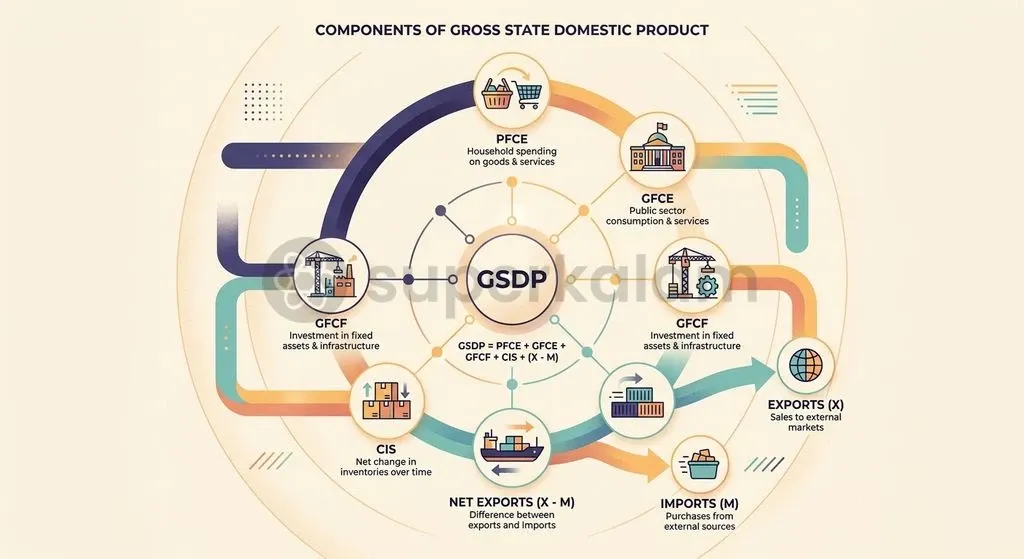
Gross State Domestic Product under the expenditure approach measures total spending on final goods and services produced within a state's borders. Under the framework defined by the Ministry of Statistics and Programme Implementation, expenditure GSDP aggregates distinct demand components:
- Private Final Consumption Expenditure (PFCE): Household final spending on durable, semi-durable, and non-durable goods alongside consumer services.
- Government Final Consumption Expenditure (GFCE): Current operational outlays by state government departments and local governance tiers on compensation and goods purchases.
- Gross Fixed Capital Formation (GFCF): Net domestic additions to fixed assets, encompassing infrastructure installations, commercial buildings, machinery, and intellectual property.
- Change in Inventories (CIS) and Valuables: Physical net adjustments in stock inventories and net acquisitions of precious stores of value.
- Net Exports (X - M): The combined external trade balance and inter-state trade balance, tracking merchandise and service outflows against external inflows.
| Macroeconomic Aggregate | Production Approach (GSVA) | Expenditure Approach (GSDP) |
|---|---|---|
| Primary Metric | Gross State Value Added by economic sector | Final expenditure components within state borders |
| Data Focus | Factory-gate output, farm harvests, registered services | Household spending, state procurement, capital investment |
| Trade Capturing | Ignores inter-state supply movements | Integrates net external and inter-state exports |
| Deflator Base | Sectoral producer price indices and input costs | Final product consumer prices and investment deflators |
| Regional Disparity Angle | Highlights manufacturing concentration and capital clustering | Reveals consumption demand, remittances, and living standards |
Statistical discrepancy captures the variance between the two computational methods, maintaining balance across state balance sheets.
Discuss with Superkalam
Why does the production approach fail to reflect purchasing power generated by domestic and foreign remittances in states like Kerala and Bihar?
Ask NowThe GST and E-Way Bill Solution: Cracking the Interstate Trade Puzzle
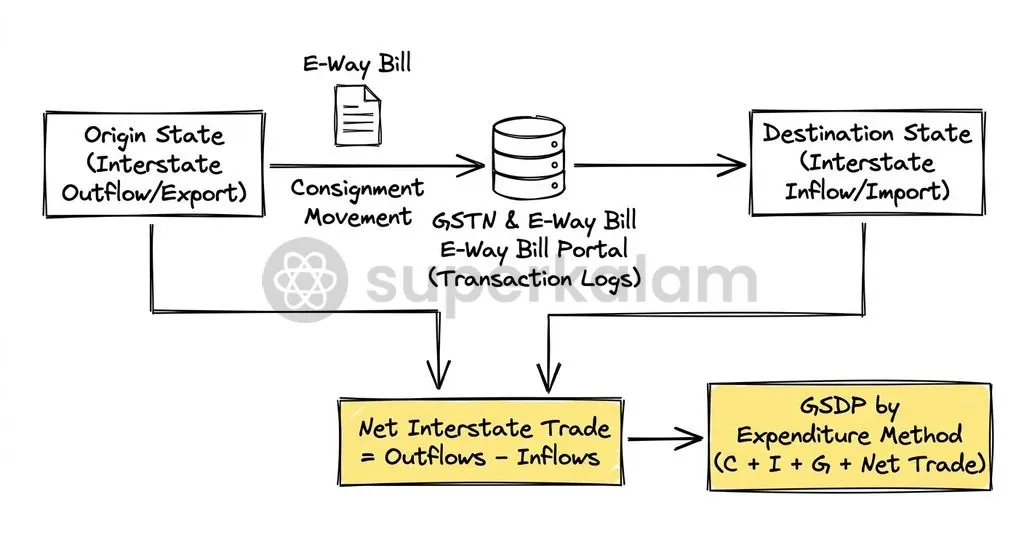
The Goods and Services Tax Network provides the statistical architecture required to quantify domestic commerce across state borders. Under MoSPI's sub-national framework, transactions recorded on the unified digital tax portal allow statisticians to reconstruct interstate commercial balances without physical border customs.
Tracking these flows relies on specific transaction records across three main channels:
- Harmonized System of Nomenclature analytics: Mandatory HSN codes on electronic way bills capture consignment origin, transit path, and destination, recording business-to-business product movements across state boundaries.
- Integrated Goods and Services Tax settlement trails: Tax reconciliation accounts show inter-state trade flows, documenting transactions between registered suppliers and end-state distribution hubs.
- External trade accounting gaps: The Directorate General of Commercial Intelligence and Statistics publishes state-wise merchandise export data, but it lacks matching state-wise merchandise import allocations, creating an official statistical gap in tracking net foreign trade by State.
Resolving this external import deficit requires combining digital trade registries with freight data, ensuring that net trade figures reflect real resource movements.
Manufacturing Hubs vs Consumer States: What Real Demand Diagnostics Reveal
Divergence between production figures and expenditure accounts illuminates the split between production-heavy and consumption-driven state economies. Production accounting attributes value added to factory sites, providing an incomplete picture of where consumer demand is concentrated across the nation.
Industrialized states such as Gujarat, Maharashtra, and Tamil Nadu concentrate significant shares of national output due to established industrial corridors and ports. When evaluated through value-added metrics, these states appear as dominant regional economies. However, their local consumer markets absorb only a portion of their total production, while the remainder is exported to other states.
Conversely, consumption-driven economies like Bihar and Kerala show substantial household purchasing power financed by external remittances and transfers that is excluded from territorial GSVA. In these states, consumer spending routinely outpaces local production output.
Evaluating these regions on production value added alone understates the depth of their consumer markets. Expenditure metrics register this demand directly, measuring how household consumption and inter-state trade distribute economic activity across states.
Discuss with Superkalam
How might an industrial state's borrowing ceiling under Article 293(3) change if its GSDP is calculated via the expenditure method rather than the production method?
Ask NowFiscal Federalism at Stake: State Borrowing Limits, FRBM Caps, and Finance Commission Grants
The shift toward expenditure accounts carries direct consequences for statutory borrowing caps and constitutional intergovernmental transfers. State annual borrowing limits under Article 293(3) of the Constitution and State Fiscal Responsibility and Budget Management Acts are capped as a percentage of projected nominal GSDP, set at a baseline of 3% of GSDP for 2026–31.
Methodological divergence between production GSDP and expenditure GSDP directly alters the nominal denominator used to enforce State Net Borrowing Ceilings and debt-to-GSDP prudential targets. A state whose nominal denominator expands under expenditure metrics gains borrowing headroom under fiscal responsibility ceilings, whereas states seeing lower nominal totals face tighter borrowing constraints.
The 16th Finance Commission established key structural criteria for intergovernmental fiscal allocations across the 2026–31 award period:
- Income Distance criterion: The 16th Finance Commission assigned a 42.5% weight to Income Distance—calculated as the gap between a state's per capita GSDP and the average of the top three large states—in its horizontal tax devolution formula.
- Contribution to GDP: The Commission introduced a 10% weight for Contribution to GDP in the horizontal tax devolution matrix while maintaining vertical tax devolution to states at 41%.
- Discontinuation of revenue deficit grants: The 16th Finance Commission discontinued post-devolution Revenue Deficit Grants provided under Article 275, eliminating the mechanism previously used to bridge normative budget deficits.
Because the 16th Finance Commission assigned 42.5% of its horizontal formula to Income Distance and 10% to GDP contribution, any statistical revision to per-capita state output alters federal tax distribution across the country.
Discuss with Superkalam
Compare the strengths and limitations of relying on GST e-way bills versus physical customs checkpoints for estimating inter-state trade balances.
Ask NowCapacity Hurdles: Closing the Statistical Divide Across State Economics Directorates
State Directorates of Economics and Statistics compile regional accounts independently under technical guidance from MoSPI's National Accounts Division. This decentralized structure causes noticeable variations in reporting speed, survey quality, and accounting standards.
To address these variations, MoSPI organized a three-day All-India Workshop on State Income and Related Aggregates with base year 2022–23 in Visakhapatnam from 8 to 10 April 2026 to train State DES officials on methodological synchronization.
Sub-national statistical agencies face operational constraints across three main areas:
- Municipal and panchayat accounts: State DES units face persistent capacity deficits in tracking local government spending, as Panchayati Raj Institutions and Urban Local Bodies frequently lack standardized, timely audited accounts needed to compile sub-national GFCE.
- Informal sector consumption: Household consumption surveys occur periodically, making it difficult to capture unorganised retail transactions between official survey rounds.
- Service trade accounting: Digital platforms facilitate cross-border service trade, such as software and consultancies, which lacks physical waybills and complicates state-level accounting.
Without uniform technical capabilities across state directorates, state-level expenditure figures will struggle to provide the reliability required for fiscal governance.

Way Forward: Building Reliable Sub-National Economic Accounts
Building reliable expenditure accounts requires integrating administrative data pipelines with sub-national statistical systems. Aligning GST Network records, commercial registry filings, and electronic financial records provides an empirical foundation for measuring state-level demand.
- Institutional data integration: Establish automated data-sharing protocols connecting the GST Network, the Central Board of Indirect Taxes and Customs, and state statistical directorates to track regional trade balances.
- Standardising local government balance sheets: Enforce uniform digital accounting platforms across Panchayati Raj Institutions and Urban Local Bodies to capture local public expenditure.
- Tracking external state imports: The Directorate General of Commercial Intelligence and Statistics must address its statistical gap by compiling state-level merchandise import data alongside existing export tracking.
- Protecting fiscal neutrality: Establish regulatory safeguards to prevent statistical revisions in GSDP denominators from causing abrupt shifts in state borrowing ceilings under Article 293(3).
A coordinated statistical architecture will provide policymakers with an accurate assessment of regional demand, balancing factory output measures with real sub-national consumption.
Discuss with Superkalam
What institutional mechanism should the Finance Commission establish to prevent statistical discrepancy between production and expenditure GSDP from triggering intergovernmental disputes?
Ask NowKey Takeaways
- MoSPI released draft guidelines on 9 October 2026 to compile Gross State Domestic Product using the expenditure approach based on the 2022–23 series.
- Expenditure accounts aggregate household consumption, public expenditure, gross capital formation, and net interstate trade balances, providing a necessary counterweight to production metrics.
- Transaction analytics from the GST Network and HSN-coded e-way bills resolve historical challenges in recording interstate merchandise commerce.
- Methodological shifts alter nominal GSDP figures, impacting state Net Borrowing Ceilings governed by Article 293(3) and the Fiscal Responsibility and Budget Management Act.
- The 16th Finance Commission linked horizontal devolution directly to state economic metrics, allotting a 42.5% weight to Income Distance and 10% to GDP contribution.
- DGCIS records state exports but lacks state-wise import data, representing a structural gap in sub-national external trade accounting.
Mains Question
'Evaluating regional economies purely on production value-added systematically distorts diagnostic assessments of consumption-driven and remittance-recipient states.' Examine the significance of MoSPI's shift toward the expenditure method of compiling GSDP. (10 Marks)
Evaluate NowMains Question
The transition from factory-floor Gross State Value Added (GSVA) to expenditure-based Gross State Domestic Product (GSDP) carries profound implications for fiscal federalism and statutory debt management. Critically analyse how this accounting reform impacts State Net Borrowing Ceilings under Article 293(3) and intergovernmental resource transfers. (15 Marks)
Evaluate NowPractice MCQs
QUESTION 1
With reference to the compilation of Gross State Domestic Product (GSDP) by the expenditure approach in India, consider the following statements: 1. Under MoSPI's guidelines, the expenditure approach is intended to completely substitute the existing production approach. 2. The difference between GSDP estimated through the production approach and the expenditure approach is recorded as Statistical Discrepancy. 3. As of October 2026, no Indian State or Union Territory regularly measures Private Final Consumption Expenditure (PFCE) for official releases. Which of the statements given above is/are correct?
QUESTION 2
Consider the following statements regarding sub-national economic accounting in India: 1. Maharashtra was historically the only state to compile an experimental sub-national PFCE series between 2004–05 and 2008–09. 2. Inflows of remittances into a state are fully captured under Gross State Value Added (GSVA) computed via the production approach. 3. According to the Economic Survey, inter-state trade in goods and services in India accounts for roughly 60% of Gross Domestic Product. Which of the statements given above is/are correct?
QUESTION 3
Regarding the data infrastructure used to estimate inter-state trade flows under the expenditure framework of GSDP, consider the following statements: 1. Electronic way bills utilize Harmonized System of Nomenclature (HSN) codes to capture consignment origin and destination. 2. Integrated Goods and Services Tax (IGST) settlement trails document transactions between registered suppliers and end-state distribution hubs. 3. The Directorate General of Commercial Intelligence and Statistics (DGCI&S) provides comprehensive state-wise merchandise import allocations matching its export data. Which of the statements given above are correct?
QUESTION 4
Which of the following bodies or statutory instruments sets the baseline Net Borrowing Ceiling for Indian States at 3% of projected nominal GSDP for the 2026–31 period?
QUESTION 5
In the context of the New Series of National Accounts Statistics released by MoSPI, consider the following statements: 1. The 2022–23 base year series replaced the 2011–12 series on 27 February 2026. 2. The 2022–23 base revision marks India's eighth base revision of National Accounts Statistics. Which of the statements given above is/are correct?