Critical Mineral Stockpiling Policy in India: Proposed Reserves Explained
India's proposed critical mineral stockpiling policy aims to buffer supply shocks. See how reserves work and why processing and recycling also matter.
Oct, 2026
•11 min read
Overview
India is establishing a dedicated National Critical Mineral Stockpiling Policy to shield clean energy and defence manufacturing from volatile supply bottlenecks. The country faces total import reliance on mineral markets heavily concentrated in foreign refining facilities.
Physical stockpiles provide a tactical buffer against export bans, trade weaponisation, and shipping blockades. Yet physical reserves alone cannot guarantee security without domestic processing facilities, overseas equity mining, and circular recycling networks. This analysis examines the mechanics, economic costs, and strategic alternatives underpinning India's mineral stockpiling roadmap.
Why in the News: India's Push for Strategic Mineral Reserves
The Ministry of Mines confirmed that India is finalising an elaborate National Critical Mineral Stockpiling Policy to govern strategic reserve release triggers, volume thresholds, and eligible industrial off-takers. As of October 2026, the central government is formulating this policy to insulate strategic manufacturing sectors from global supply weaponisation and commodity market volatility.
This initiative builds on the Union Budget 2024-25, which launched the National Critical Minerals Mission (NCMM) to oversee domestic exploration, overseas asset acquisition, recycling mandates, and mineral security. Upstream access alone cannot insulate industrial plants unless the state maintains accessible, refined mineral buffers on sovereign territory.
Discuss with Superkalam
Recall the five critical minerals for which India currently exhibits 100% import dependency as identified in the article.
Ask NowThe Vulnerability: Why India's Supply Chains Are Exposed to Geopolitical Chokepoints
India faces severe industrial risks because domestic clean-energy manufacturing relies entirely on overseas supply chains. The Ministry of Mines Report on Critical Minerals for India identified 30 critical minerals essential for economic growth and national security, yet the country exhibits 100% import dependency for foundational inputs including lithium, cobalt, nickel, niobium, and tantalum.
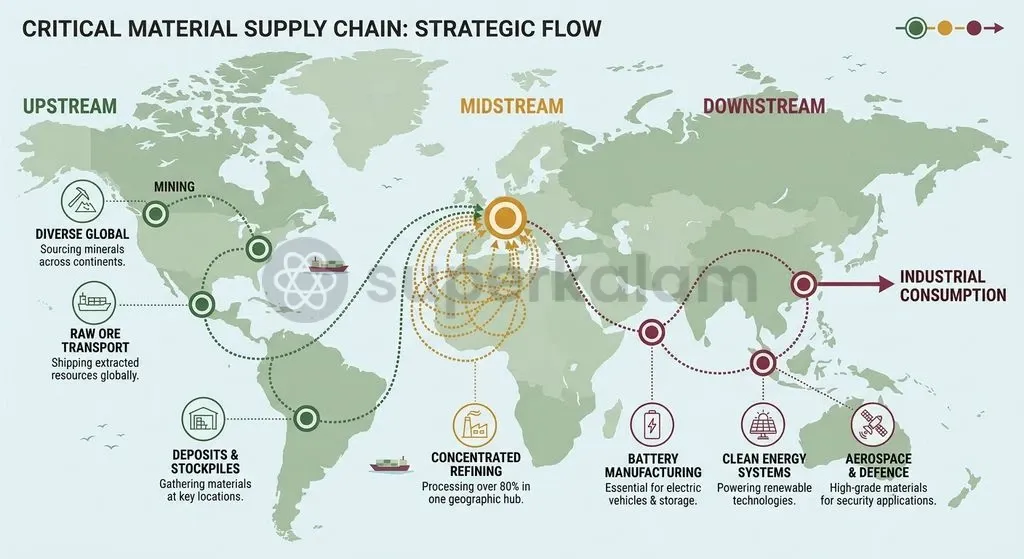
This vulnerability deepens along the processing tier. While raw mining occurs across multiple continents, the International Energy Agency reports that China controls 60% to 90% of global processing and refining capacity for critical clean-energy metals, including lithium, cobalt, and rare earth elements. Even when India procures raw ores from South America or Africa, intermediate chemical refining remains tied to Chinese facilities.
Recent trade curbs underline how quickly midstream monopolies can choke supply:
- Gallium and Germanium: Subjected to stringent export controls by the Ministry of Commerce of the People's Republic of China starting August 2023.
- Graphite: Added to export curbs in December 2023.
- Antimony: Restricted under targeted export bans in September 2024.
How a Strategic Mineral Reserve Works: Physical Stockpiles vs Financial Hedges
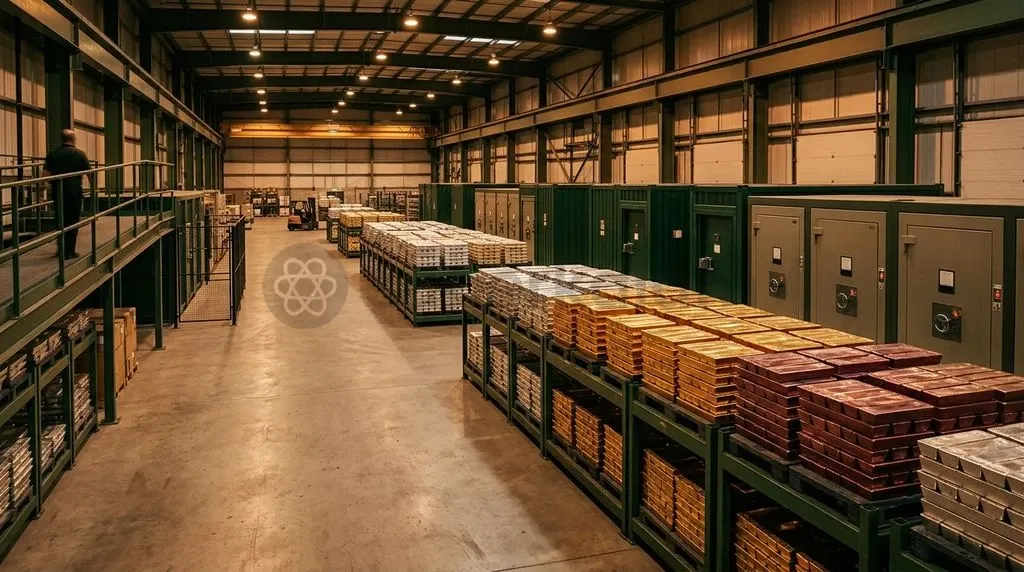
A strategic mineral reserve is a state-managed inventory buffer designed to maintain industrial continuity during extreme supply shocks, geopolitical blockades, or market failures. The government purchases, verifies, and stores critical raw materials or intermediate chemicals under sovereign custody, using predefined rules for emergency releases.
Policymakers distinguish between holding physical inventory and acquiring financial derivatives or supply contracts. The table below details these contrasting approaches:
| Dimension | Physical Strategic Stockpile | Financial Hedges & Paper Contracts |
|---|---|---|
| Operational Mechanism | Warehousing refined ingots, salts, or precursor materials within domestic borders | Purchasing futures, options contracts, or off-take equity agreements |
| Physical Embargo Protection | Immediate physical availability during blockades, trade embargoes, or shipping disruptions | Zero immediate physical supply if trade corridors or exporting ports are halted |
| Carrying Costs | High capital expenditure for climate-controlled warehousing, security, and material degradation management | Lower ongoing storage overheads, primarily limited to capital commitment fees and margin calls |
| Price Volatility Protection | Releases physical stock to domestic manufacturers at capped rates during price spikes | Mitigates price spikes financially, but leaves factories idle if materials cannot be delivered |
| Deployment Lag | Rapid domestic release through established industrial transport networks | Subject to overseas shipping lead times, customs clearance, and transit risks |
Physical stockpiles provide sovereign protection that financial hedges cannot deliver during export curbs. However, physical warehousing introduces complex chemical hurdles. Stockpiling unprocessed ores or raw concentrates without domestic midstream chemical refining leaves downstream factories exposed during disruptions. Battery and semiconductor manufacturers cannot process raw rock. Stockpiles must therefore contain refined chemicals, battery-grade salts, or processed alloys.
To bridge this gap, NITI Aayog recommended establishing a dedicated national stockpile of refined mineral precursors used in lithium-ion battery electrodes to shield Indian gigafactories from international commodity price swings.
Discuss with Superkalam
Explain why holding paper futures contracts fails to protect domestic manufacturing during an export embargo.
Ask NowGlobal Precedents: How the US, Japan, and South Korea Manage Strategic Reserves
Industrial democracies with severe import exposures have established statutory institutions to maintain mineral buffers. Their operational frameworks offer practical lessons for India.
| Country | Nodal Agency | Legal / Strategic Mandate | Core Storage Target | Primary Focus |
|---|---|---|---|---|
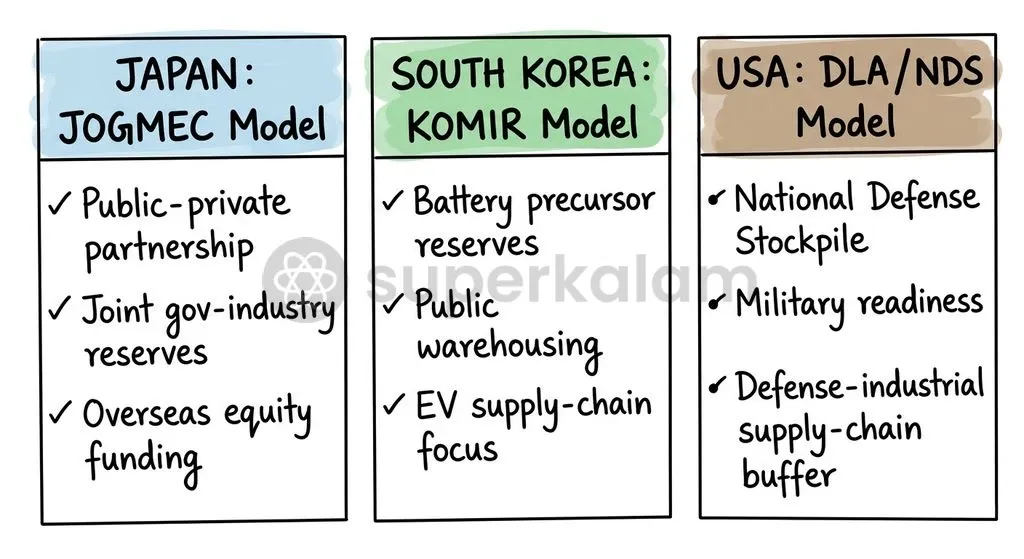
| Japan | JOGMEC | Act on Japan Oil, Gas and Metals National Corporation | 60 to 180 days of standard domestic consumption | Public-private joint stockpiling and working-capital subsidies |
| South Korea | KOMIR | Special Act on National Resources Security | Expanding from 54 to 100 days by 2031 | Automated climate-controlled warehouses for high-grade battery precursors |
| United States | Defense Logistics Agency (DoD) | Strategic and Critical Materials Stock Piling Act (50 U.S.C. § 98 et seq.) | Dynamic emergency requirements | Military readiness and domestic defence supply chains |
Japan: The JOGMEC Public-Private Model
Japan manages mineral reserves through the Japan Organization for Metals and Energy Security under the Ministry of Economy, Trade and Industry. Under the JOGMEC framework, the Japanese government establishes a statutory strategic reserve target of 60 days of standard domestic consumption, which can be expanded up to 180 days for minerals exposed to acute geopolitical friction.
JOGMEC pairs state-owned warehouses with private industrial reserves. The state finances core stockpiles while providing working-capital subsidies to private manufacturing conglomerates to maintain secondary emergency inventories, ensuring that stored materials circulate continuously through industrial plants.
South Korea: The KOMIR Expansion Strategy
South Korea manages strategic metals through the Korea Mine Rehabilitation and Mineral Resources Corporation. Facing semiconductor and battery supply chain risks, South Korea enacted the Special Act on National Resources Security.
Under the KOMIR Saemangeum Masterplan, South Korea plans to expand national critical mineral reserves from 54 days to 100 days of domestic consumption by 2031. The Korean strategy focuses on high-grade precursors, deploying automated warehouses that regulate temperature and humidity to prevent chemical degradation.
United States: The National Defense Stockpile
The United States maintains the National Defense Stockpile under the authority of the Strategic and Critical Materials Stock Piling Act (50 U.S.C. § 98 et seq.). The stockpile is managed directly by the Defense Logistics Agency within the Department of Defense.
The American framework focuses primarily on military readiness and essential civilian supply during national defence emergencies. The Defense Logistics Agency continuously evaluates supply chain vulnerabilities, funding domestic acquisition programmes for rare earth elements, antimony, and high-performance alloys to insulate defence systems from geopolitical adversaries.
The Strategic Dilemma: Physical Stockpiles vs Overseas Mining Assets vs Trade Pacts
India cannot rely on a single policy lever to insulate its industrial base. Policymakers must balance physical stockpiling, overseas equity purchases through Khanij Bidesh India Limited, and multilateral diplomatic partnerships.
Overseas Equity Acquisitions: Khanij Bidesh India Limited
To secure upstream critical mineral assets abroad, the Ministry of Mines incorporated Khanij Bidesh India Limited in August 2019 as a joint venture among National Aluminium Company Limited, Hindustan Copper Limited, and Mineral Exploration and Consultancy Limited, with an equity ratio of 40:30:30.
KABIL achieved a major breakthrough in January 2024 by signing an exploration and development agreement worth ₹200 crore with Argentina's state-owned CAMYEN SE. This pact granted exploration and commercial development rights for five lithium brine blocks covering 15,703 hectares in Catamarca province.
Upstream equity, however, cannot replace domestic stockpiles during an immediate crisis:
- Long Gestation Timelines: The Parliamentary Standing Committee on Coal, Mines and Steel highlighted in August 2026 that commercial lithium extraction from these Argentinian blocks will require an estimated 4 to 5 years before physical output reaches Indian plants.
- Sovereign and Transit Risks: Overseas mines secure equity ownership, yet they remain vulnerable to host-country policy shifts, asset nationalisation, and maritime trade choke points.
Diplomatic Alliances: MSP and iCET
India participates in strategic partnerships to de-risk critical material dependencies. In June 2023, India joined the US-led Minerals Security Partnership (MSP) as its 14th member to accelerate public and private investments across resilient global supply chains.
Complementing this, India and the United States established the initiative on Critical and Emerging Technology (iCET) in January 2023, expanding bilateral technical cooperation and critical mineral supply security.
These multilateral groupings offer co-financing platforms, but they do not guarantee priority supply allocation during acute shortages. Overseas equity and diplomatic alliances must therefore operate alongside sovereign physical stockpiles.
Discuss with Superkalam
Compare Japan's JOGMEC model of public-private stockpiling with South Korea's KOMIR model of automated warehousing.
Ask NowKey Challenges: High Holding Costs, Technology Obsolescence, and Degradation Risks
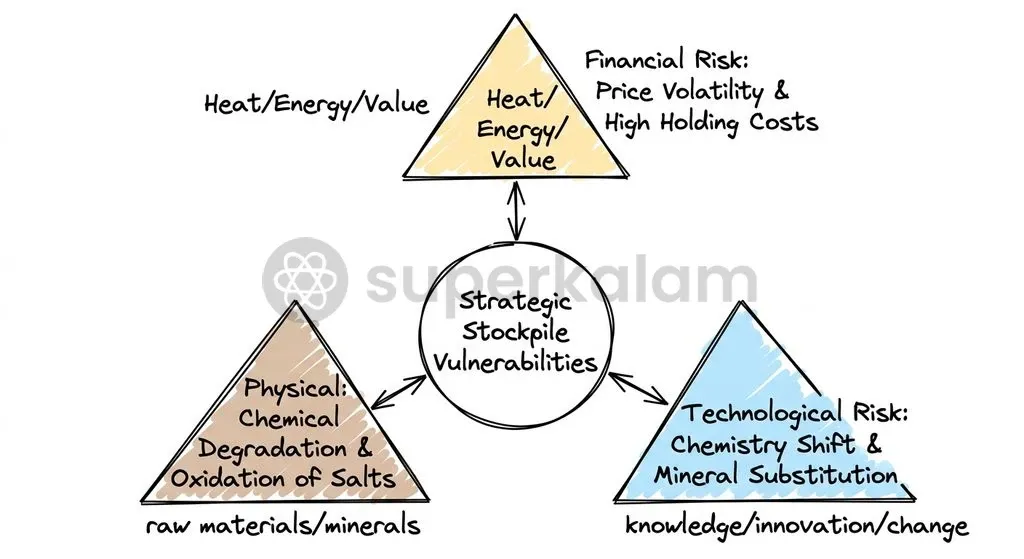
Building a national physical stockpile creates major fiscal and technical liabilities. Warehousing transition elements involves distinct financial, chemical, and substitution risks.
Financial Impairment and Price Volatility
Physical mineral stockpiles tie up substantial public capital in dormant inventory. Transition minerals undergo volatile price swings. Global lithium carbonate spot prices fell by over 80% between late 2022 and 2024. An agency purchasing inventory at cyclical peaks risks heavy balance-sheet depreciation and severe carrying losses when forced to revalue stocks at falling spot prices.
Chemical Degradation and Storage Overhead
Unlike crude oil or coal, processed transition metals degrade chemically over time. Refined battery compounds, including lithium hydroxides, fine metal powders, and rare earth alloys, absorb moisture and suffer surface oxidation unless preserved in specialised, climate-controlled environments.
Preserving these materials requires specialized handling:
- Continuous inert-gas environments or industrial dehumidification to prevent oxidation.
- Dedicated climate-controlled facilities that generate high, recurring operational power costs.
Technology Obsolescence and Chemical Substitution
Stockpiled transition elements face persistent technology substitution risks. Innovations in battery and electronics manufacturing can quickly render stored minerals obsolete.
Commercial adoption has shifted heavily toward cobalt- and nickel-free Lithium Iron Phosphate (LFP) chemistries, alongside early deployments of non-lithium Sodium-ion batteries. Storing massive inventories of a single element exposes public funds to technical displacement if domestic industries adopt different chemical architectures.
Way Forward: A Layered Economic Security Strategy for Critical Minerals
India needs an integrated strategy combining physical warehousing with midstream industrial processing, regulatory flexibility, and circular economy mandates.
Institutional Framework: The ISPRL Template
India can adapt the institutional model of Indian Strategic Petroleum Reserves Limited (ISPRL), a special purpose vehicle under the Ministry of Petroleum and Natural Gas, for mineral security.
A dedicated Special Purpose Vehicle under the National Critical Minerals Mission could run physical warehouses, execute commercial off-take agreements, and manage emergency drawdown protocols.
Adopting a Dynamic Rolling Stockpile
To avoid capital lock-in and chemical oxidation, India should adopt a dynamic rolling stockpile framework. Research by the Centre for Social and Economic Progress indicates that a rolling stockpile architecture mitigates physical degradation and financial carrying costs by cyclically releasing ageing inventory to domestic manufacturing off-takers while replenishing stocks with fresh batches at spot prices.
This continuous rotation prevents material decay, curtails balance-sheet write-downs, and supplies steady raw feedstocks to domestic industry.
Domestic Refining and Upstream Reforms
Downstream plants can benefit from mineral stockpiles only if India develops midstream processing infrastructure. The Union Budget 2026-27 addressed this bottleneck by announcing dedicated rare earth industrial corridors across Odisha, Kerala, Andhra Pradesh, and Tamil Nadu to accelerate domestic beach sand processing and value addition.
Alongside processing, the central government reformed upstream exploration through the Mines and Minerals (Development and Regulation) Amendment Act, 2023, which delisted six minerals—lithium, beryllium, niobium, titanium, tantalum, and zirconium—from the atomic minerals list, enabling commercial private exploration and mining. Expanding refining capacity alongside private exploration ensures that strategic stockpiles can be converted directly into commercial products.
Circular Economy and Recycling Mandates
Urban mining and secondary extraction provide a domestic mineral supply shielded from maritime transit risks. The Ministry of Environment, Forest and Climate Change notified the Battery Waste Management Rules, 2022, establishing mandatory Extended Producer Responsibility targets that prohibit battery disposal in landfills.
These rules establish binding statutory recovery metrics:
- Producers must achieve 90% recovery of battery materials by weight by 2026-27.
- New batteries must incorporate a minimum of 5% domestically recycled materials starting in 2027-28, rising to 20% by 2030-31.
Enforcing strict recycling mandates generates a resilient domestic secondary mineral stream, lowering the required footprint of expensive primary physical stockpiles over time.
Discuss with Superkalam
Formulate a policy roadmap for an Indian stockpiling agency to mitigate the risk of chemical degradation and technological obsolescence in stored battery minerals.
Ask NowKey Takeaways
- India exhibits 100% import dependency for critical transition elements such as lithium, cobalt, nickel, niobium, and tantalum, leaving domestic industries exposed to external supply disruptions.
- China commands 60% to 90% of global refining capacity for lithium, cobalt, and rare earths, creating serious vulnerabilities when export controls are imposed.
- Physical stockpiles provide an essential short-term cushion against export curbs, but long-term resource security requires domestic midstream chemical processing and international upstream asset ownership.
- KABIL secured lithium exploration blocks in Argentina, but commercial output requires an estimated 4 to 5 years, demonstrating that overseas equity investments cannot replace immediate domestic stockpiles.
- A dynamic rolling stockpile model resolves chemical degradation and price impairment risks by continuously rotating aging inventory into domestic gigafactories while acquiring fresh supplies.
Mains Question
"Upstream access alone cannot insulate industrial plants unless the state maintains accessible, refined mineral buffers on sovereign territory." In light of this statement, examine the necessity and operational challenges of establishing physical critical mineral reserves in India. (10 Marks)
Evaluate NowMains Question
Drawing upon the institutional frameworks of countries like Japan, South Korea, and the United States, evaluate the strategic measures India must adopt under the National Critical Minerals Mission (NCMM) to safeguard its clean energy and defence supply chains. (15 Marks)
Evaluate NowPractice MCQs
QUESTION 1
With reference to critical minerals and India's resource security, consider the following statements:
- The Ministry of Mines Report on Critical Minerals for India identified 30 critical minerals essential for economic growth and national security.
- India currently exhibits 100% import dependency for lithium, cobalt, nickel, niobium, and tantalum.
- Raw ore mining and processing for critical clean-energy metals are equally distributed across global refining hubs.
Which of the statements given above is/are correct?
QUESTION 2
Consider the following statements regarding international models of critical mineral stockpiling:
- In Japan, JOGMEC maintains a statutory strategic reserve target of 60 days of standard domestic consumption, expandable up to 180 days.
- South Korea's KOMIR operates under the Special Act on National Resources Security to expand critical mineral reserves to 100 days by 2031.
- The United States National Defense Stockpile is governed under the Strategic and Critical Materials Stock Piling Act and managed by the Department of the Interior.
Which of the statements given above is/are correct?
QUESTION 3
Regarding the strategic management of critical mineral supply chains, consider the following statements:
- Physical strategic stockpiles provide immediate domestic material availability during trade embargoes and shipping disruptions.
- Financial hedging instruments guarantee raw material delivery to domestic processing units during physical corridor blockades.
- Holding stockpiles exclusively in the form of raw rock ores protects downstream battery manufacturing without requiring midstream chemical refining.
Which of the statements given above is/are correct?
QUESTION 4
Which of the following bodies recommended establishing a dedicated national stockpile of refined mineral precursors used in lithium-ion battery electrodes to shield Indian gigafactories from international commodity price swings?
QUESTION 5
Consider the following statements regarding export controls on critical minerals highlighted in recent years:
- China introduced targeted export curbs on gallium and germanium starting in August 2023.
- Graphite was brought under export restrictions by China in December 2023.
- Targeted export bans on antimony were imposed in September 2024.
Which of the statements given above are correct?