Groundwater Crisis in India: Free Power, Easements Act and Recharge Limits
India extracts about 247 BCM of groundwater a year. Free farm power, procurement bias and the colonial Easements Act matter more than recharge drives, as this policy analysis explains.
Oct, 2026
•10 min read
Context
India faces an acute subsurface water emergency. Decentralised recharge campaigns cannot mathematically offset structural over-extraction. That depletion is propelled by zero-marginal-cost farm power subsidies, open-ended cereal procurement, and colonial property laws that treat aquifers as private real estate.
Voluntary public participation builds critical recharge structures, but it leaves the macroeconomic drivers of agricultural water demand unchecked. Sustainable aquifer governance requires dismantling institutional silos, reforming energy incentives, and legally redefining groundwater as a common-pool resource held under public trust.
Why India's Groundwater Strategy Is in the Spotlight
National groundwater policy faces intense scrutiny as bottom-up recharge efforts collide with entrenched agricultural incentives. According to the Central Ground Water Board's 2025 assessment, the country extracts about 247 billion cubic metres of groundwater a year, cementing India's position as the world's largest consumer of groundwater.
Public policy has leaned heavily on community participation to address this crisis. Flagship campaigns mobilise citizens to build water-harvesting check dams and recharge shafts across rural and urban districts. Yet, official hydrogeological data reveals that local conservation alone cannot arrest depletion in regional agricultural heartlands.
The crisis stems from an unresolved policy clash across three structural fronts:
- Free agricultural power: State power utilities supply zero-cost electricity, eliminating operational pumping costs for farm tubewells.
- Crop procurement bias: Open-ended public procurement continues to incentivise water-guzzling cereals.
- Localised conservation limits: Central community recharge drives cannot offset basin-scale agricultural extraction.
This structural mismatch has pushed water tables to historic lows across northwestern food bowls and peninsular hard-rock terrains.
Discuss with Superkalam
What share of India's total annual groundwater extraction is consumed by the agricultural sector according to CGWB data?
Ask NowMeasuring the Depletion: What the Dynamic Ground Water Assessment Shows
The Central Ground Water Board (CGWB) quantifies national aquifer health through its periodic resource assessments. According to the Dynamic Ground Water Resource Assessment Report 2024, released by the Union Minister of Jal Shakti, India's total annual groundwater recharge is assessed at 446.90 billion cubic metres (BCM), with annual extractable groundwater resources standing at 406.19 BCM.
A newer edition now exists. The Dynamic Ground Water Resource Assessment 2025, released by the Ministry of Jal Shakti in January 2026, puts annual recharge at 448.52 BCM, the annual extractable resource at 407.75 BCM, total extraction at 247.22 BCM and the national stage of extraction at 60.63 percent. The unit-wise figures and table below are from the 2024 edition.
Total annual groundwater extraction across India reached 245.64 BCM for all uses. This results in a national extraction stage of 60.47 percent. While this aggregate figure appears sustainable at a national level, it masks dangerous regional imbalances across individual hydrogeological units.
| Assessment Category (2024) | Number of Administrative Units | Share of Total Assessed Units (%) | Hydrogeological Status |
|---|---|---|---|
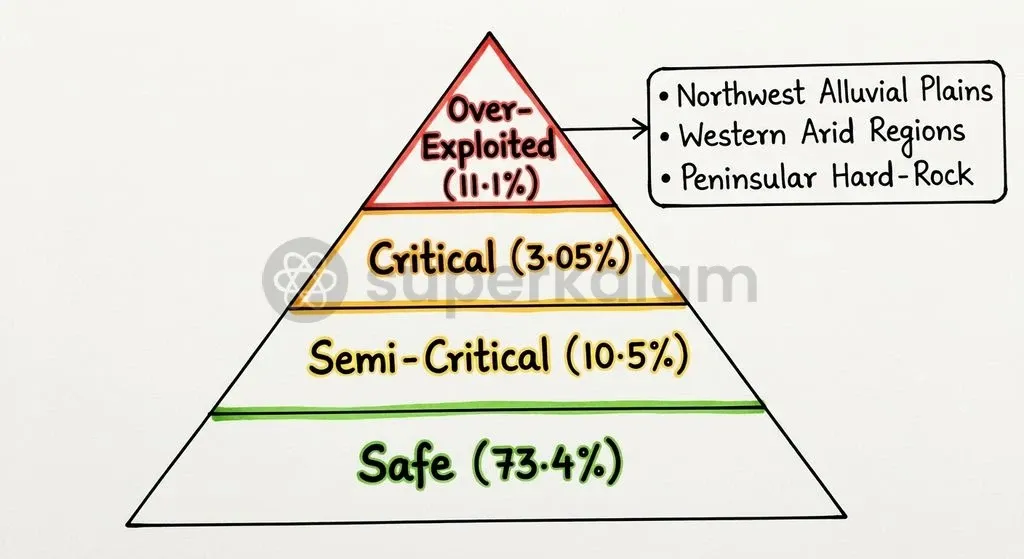
| Safe | 4,951 | 73.4% | Extraction within sustainable recharge limits |
| Semi-critical | 711 | 10.5% | Extraction approaching annual replenishment |
| Critical | 206 | 3.05% | Extraction nearing 100% of extractable reserves |
| Over-exploited | 751 | 11.1% | Extraction exceeds annual replenishable recharge |
As detailed in the Dynamic Ground Water Resources of India 2024 report by the Central Ground Water Board, 751 out of 6,746 assessed administrative units nationwide are classified as Over-exploited, while 206 units are Critical. These distressed blocks are concentrated in specific geographic corridors.
The over-exploited units cluster in three distinct geological zones:
- The alluvial plains of northwest India, including Punjab, Haryana, Delhi, and western Uttar Pradesh, where intensive tubewell irrigation supports mono-cropped cereal rotations.
- The western arid belts of Rajasthan and Gujarat, characterised by low natural precipitation and fragile, slow-recharging aquifers.
- The peninsular crystalline hard-rock aquifers spanning Karnataka, Tamil Nadu, Telangana, and Andhra Pradesh, where limited secondary porosity restricts groundwater storage capacity.
The Turn to the People: How Catch the Rain and Atal Bhujal Yojana Work
Faced with declining water tables, the Union government pivoted toward decentralised, participatory water conservation under the operational banner of Jan Bhagidari (people's participation). The Jal Shakti Abhiyan: Catch the Rain (JSA: CTR) campaign was launched nationwide covering all rural and urban blocks. According to the Ministry of Jal Shakti, the campaign operates under the mandate of capturing rainwater where it falls, when it falls.
To institutionalise local ownership, the Union government launched the Jal Sanchay Jan Bhagidari (JSJB) initiative on 6 September 2024 in Surat, Gujarat. The framework operates on the "3Cs" approach:
- Community: Mobilising local non-governmental organisations and civic action.
- CSR: Deploying corporate social responsibility funds for village water works.
- Cost: Ensuring shared, cost-effective execution of recharge infrastructure.
Under JSJB 1.0, authorities reported over 27 lakh artificial groundwater recharge and storage structures nationwide by May 2025, exceeding the initial benchmark target of 10 lakh structures. Building on this rollout, the Ministry integrated Jal Sanchay Jan Bhagidari with Jal Shakti Abhiyan in June 2026 to create a unified programme designated as JSJB: CTR.
Complementing this infrastructure drive is the Atal Bhujal Yojana (ABY), an institutional demand-management scheme. According to the Ministry of Jal Shakti's operational review, the scheme covers 8,203 water-stressed Gram Panchayats across 80 districts in seven states. Rather than focusing solely on civil construction, Atal Bhujal Yojana incentivises village communities to prepare local water security plans, monitor water levels, and adopt water-efficient farming practices.
Discuss with Superkalam
How does zero-marginal-cost farm power eliminate the economic incentive for cultivators to conserve groundwater?
Ask NowThe Elephant in the Field: Power Subsidies and Water-Guzzling Crops
Community conservation schemes face an insurmountable mathematical challenge in the field. As noted in assessments by NITI Aayog, participatory recharge interventions like Catch the Rain cannot compensate for aquifer overdrafting when macroeconomic incentives favour extraction. Agriculture accounts for approximately 87 percent of total annual groundwater extraction in India.
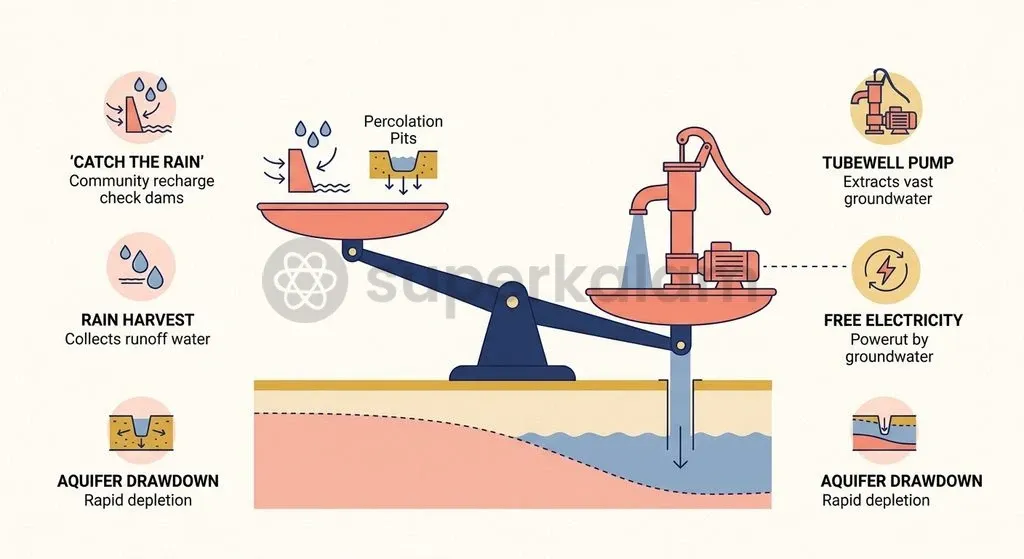
This high extraction rate is driven by two interconnected policy levers: unmetered electricity and crop procurement prices. Flat-rate or free agricultural power policies eliminate the marginal operational cost of pumping water. Because running an electric submersible pump costs the farmer nothing per extra hour, there is no economic signal to limit water drafting.
Simultaneously, open-ended Minimum Support Price (MSP) procurement creates a stable, low-risk market for water-intensive cereals like paddy and cash crops like sugarcane. Farmers are economically incentivised to flood their fields, drawing hundreds of litres of fossil groundwater to produce a single kilogram of grain in semi-arid zones. Check dams and percolation pits cannot replenish aquifers at the rate high-capacity submersible pumps deplete them.
| Dimension | Supply-Side Community Conservation (e.g. JSJB: CTR) | Demand-Side Structural Drivers (Agri-Power Nexus) |
|---|---|---|
| Primary Mechanism | Capturing surface runoff via check dams and percolation pits | Mechanised tubewell drafting via electric pump sets |
| Economic Incentive | Voluntary volunteerism and corporate social responsibility grants | Free farm power and guaranteed crop procurement (MSP) |
| Hydrological Scale | Localised, site-specific, and rainfall-dependent replenishment | Continuous, basin-wide aquifer extraction year-round |
| Policy Leverage | Ministry of Jal Shakti, Panchayati Raj, and local communities | State electricity boards, power departments, and food agencies |
Discuss with Superkalam
If a district achieves 100% target completion in constructing check dams under JSJB, why might its water tables continue to drop during the cropping season?
Ask NowFixing the Institutions: What the Mihir Shah Committee Proposed
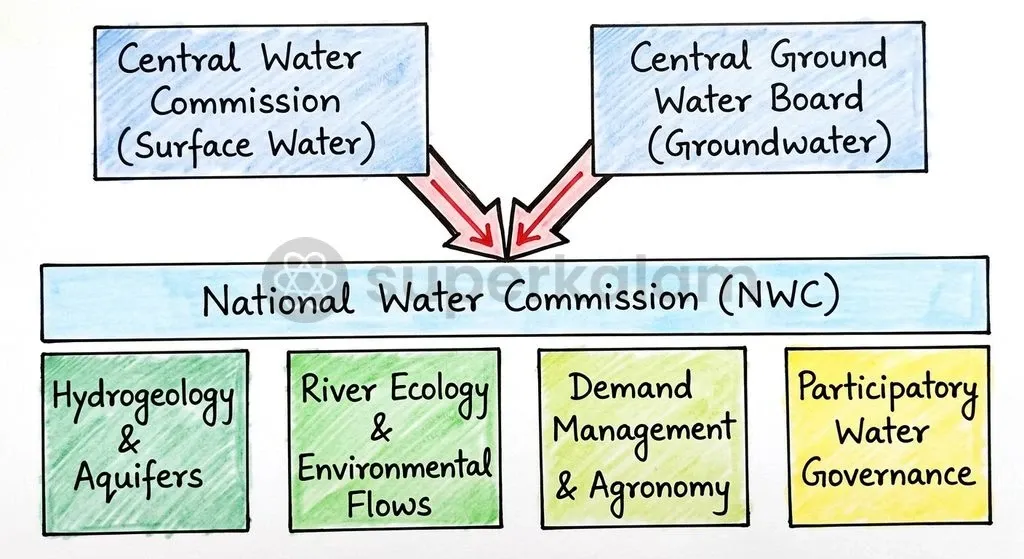
India's water management remains structurally divided between surface water and groundwater agencies. The Committee on Restructuring the Central Water Commission (CWC) and Central Ground Water Board (CGWB), chaired by Dr. Mihir Shah in 2016, diagnosed this institutional fragmentation as a primary barrier to sustainable water governance. Its report, titled A 21st Century Institutional Architecture for India's Water Reforms, called for a complete paradigm shift.
The Mihir Shah Committee recommended merging the CWC and CGWB into a unified National Water Commission (NWC). The restructuring aimed to break down the engineering-centric silo of the CWC and the hydrogeological isolation of the CGWB. The proposed National Water Commission would treat surface water and groundwater as a single, interconnected hydrological system.
The committee urged the state to shift away from large civil engineering projects, such as major dams and lined canals. It recommended three foundational reforms:
- Hydrogeological integration: Managing surface water and aquifers within a unified hydrological framework.
- Multidisciplinary administration: Bringing ecological economists, hydrogeologists, and social scientists into policy leadership.
- Demand-side management: Prioritising participatory aquifer mapping, river environmental flows, and water economics over civil engineering works.
Discuss with Superkalam
In what ways does tying groundwater rights to landownership under the Indian Easements Act of 1882 exacerbate rural socio-economic inequality?
Ask NowWay Forward: Matching People's Action with Real Policy Reform
Ending India's groundwater overdraft requires aligning grassroots community participation with macro-level agricultural and energy reforms. Community-built recharge pits are essential, but they cannot save India's aquifers unless economic incentives to over-extract are dismantled.
Policy reform must advance across three interconnected priorities:
Power tariff decoupling and solar buybacks: States must decouple agricultural power tariffs from unlimited consumption through feeder separation and solar energy reforms. Under Component C of the PM-KUSUM scheme, the Ministry of New and Renewable Energy promotes the solarisation of dedicated agricultural electricity feeders. Solar feeders shift pumping hours to the daytime, improving farmers' working conditions.
However, as highlighted by Prayas (Energy Group), zero-marginal-cost solar power risks accelerating daytime pumping unless paired with net-metering buyback tariffs. When states offer an attractive feed-in tariff, farmers can choose to sell surplus solar power back to the electrical grid, turning unpumped groundwater into a direct financial asset.
Reforming groundwater tenure: State governments must reform the legal framework governing groundwater rights. The Ministry of Water Resources drafted the Model Bill (2017) for the Conservation, Protection, Regulation and Management of Groundwater, which operationalises the Public Trust Doctrine by vesting regulatory authority over local aquifers in Gram Sabhas as public trustees. States should adopt this model to replace the colonial property rights established by Section 7(g) of the Indian Easements Act, 1882.
Restructuring agricultural incentives: Agricultural support policies must reward water conservation over cereal production. State-level grain procurement should be diversified to include climate-resilient, low-water millets and pulses. Linking direct income transfers to crop water budgets will provide smallholder farmers with a sustainable path out of flood irrigation, safeguarding India's aquifers for future generations.
Key Takeaways
- According to the Dynamic Ground Water Resource Assessment Report 2024, India's annual extractable groundwater resource is 406.19 BCM, with an extraction stage of 60.47 percent, yet 11.1 percent of all assessed units remain over-exploited.
- Over-exploited units are concentrated in the northwestern alluvial agricultural belt, western arid regions, and peninsular hard-rock aquifers.
- Agriculture accounts for approximately 87 percent of total annual extraction, driven by zero-marginal-cost tubewell power subsidies and guaranteed procurement for water-intensive paddy and sugarcane.
- Community-led recharge campaigns, including JSJB: CTR and Atal Bhujal Yojana, cannot offset over-extraction without structural demand-side agricultural reforms.
- Section 7(g) of the Indian Easements Act, 1882 treats groundwater as private property tied to landownership, directly conflicting with the Public Trust Doctrine established in M.C. Mehta v. Kamal Nath (1997).
- The Dr. Mihir Shah Committee (2016) recommended merging the Central Water Commission and Central Ground Water Board into a unified National Water Commission focused on hydrogeology and demand management.
Mains Question
'The statutory framework under the Indian Easements Act, 1882 stands in direct contradiction with the Public Trust Doctrine enunciated in M.C. Mehta v. Kamal Nath (1997).' Examine the socio-economic and ecological implications of this legal divergence on India's groundwater governance. (10 Marks)
Evaluate NowMains Question
'Decentralised supply-side interventions like Jal Sanchay Jan Bhagidari cannot mathematically offset the structural over-extraction sustained by the agri-power nexus.' Critically analyse. (15 Marks)
Evaluate NowPractice MCQs
QUESTION 1
With reference to the Dynamic Ground Water Resource Assessment Report 2024, consider the following statements: 1. At the national level, the overall stage of groundwater extraction stands at over eighty percent. 2. More than seventy percent of the total assessed administrative units in the country are categorised as 'Safe'. 3. Over-exploited assessment units are predominantly clustered in the alluvial plains of northwest India, the western arid belts, and peninsular hard-rock terrains. Which of the statements given above is/are correct?
QUESTION 2
Consider the following statements regarding the legal framework governing groundwater in India: 1. Under Illustration (g) of Section 7 of the Indian Easements Act, 1882, landowners have unrestricted rights to collect and dispose of water percolating beneath their land. 2. In M.C. Mehta v. Kamal Nath (1997), the Supreme Court ruled that groundwater is private property tied strictly to surface land title deeds. 3. The current statutory framework enables deeper borewell drilling by capital-endowed landowners, leading to the depletion of shallow dug-wells of marginal farmers. Which of the statements given above is/are correct?
QUESTION 3
Consider the following statements regarding national water management initiatives: 1. The Jal Sanchay Jan Bhagidari (JSJB) framework functions on the '3Cs' approach: Community, CSR, and Cost. 2. The Atal Bhujal Yojana focuses exclusively on civil construction of check dams across all districts of India. 3. Jal Sanchay Jan Bhagidari was integrated with Jal Shakti Abhiyan in June 2026 to form 'JSJB: CTR'. Which of the statements given above is/are correct?
QUESTION 4
According to the Central Ground Water Board (CGWB) water quality monitoring assessments, consider the following statements: 1. Arsenic contamination exceeding permissible limits is predominantly concentrated in the alluvial Ganga-Brahmaputra plain. 2. A higher percentage of monitoring stations exceed permissible limits for nitrate than for fluoride. 3. Geogenic fluoride contamination is observed across arid hard-rock belts in Rajasthan, Andhra Pradesh, and Karnataka. Which of the statements given above is/are correct?
QUESTION 5
Assessments by NITI Aayog and Central Ground Water Board indicate that the agricultural sector accounts for what proportion of total annual groundwater extraction in India?