Great Nicobar Project: Forest Demarcation, FRA Violations, and Strategic Trade-offs
Physical demarcation in Great Nicobar tests whether strategic maritime expansion can override constitutional safeguards for vulnerable indigenous tribes.
Nov, 2026
•13 min read
Overview
The Andaman Public Works Department has initiated physical demarcation for the Great Nicobar Holistic Development Project by floating a 43.4-kilometre forest boundary tender. This move signals rapid on-ground execution. Statutory approvals under the Forest Rights Act, 2006, face active litigation before the Calcutta High Court.
The mega-infrastructure plan establishes an international transshipment terminal, a dual-use military and civilian airport, a power plant, and an integrated township near the Malacca Strait. Building these assets requires diverting over 130 square kilometres of virgin tropical rainforest.
The Tribal Council of Little and Great Nicobar formally withdrew its consent, while procedural irregularities mark the statutory clearances. Consequently, this boundary tender represents a decisive operational push. It converts contested regulatory approvals into tangible island facts before judicial benches reach final verdicts.
Why Great Nicobar Is in the News
A forest-boundary demarcation tender has pushed Great Nicobar back into the national spotlight. The Andaman Public Works Department issued the notice on 26 October 2026 to demarcate a 43.4-kilometre boundary across pristine forest land.
According to the tender notice from the Office of the Executive Engineer, APWD Campbell Bay, the contract mandates erecting reinforced cement concrete (RCC) boundary pillars along the full length of the marked boundary. These pillars will physically cordon off the project zone from the island's reserved forests.
This engineering step sets out the physical layout for the 166.1-square-kilometre project area, including 121.87 square kilometres of forest land. Substantive public interest litigations remain pending before the judiciary.
As of November 2026, the tender has triggered intense legal scrutiny from environmental lawyers and indigenous rights advocates. They contend that initiating physical boundary work bypasses incomplete statutory prerequisites under the Forest (Conservation) Act, 1980.
The core legal flashpoints involve:
- Premature ground demarcation: Laying boundary pillars before securing statutory Stage-II forest clearance.
- Unresolved judicial challenges: Moving forward on the ground while the High Court at Calcutta reviews pending public interest litigations.
- Substantive tribal rights: Testing whether constitutional guarantees protecting indigenous tribal communities must be examined on legal merits before irreversible landscape alterations take place.
What Is the Great Nicobar Holistic Development Project?
The Great Nicobar Holistic Development Project is a ₹72,000 to ₹92,000-crore mega-infrastructure initiative spearheaded by the Andaman and Nicobar Islands Integrated Development Corporation across 166.1 square kilometres. According to a project backgrounder released by the Press Information Bureau, the master plan aims to transform the southernmost island of the Indian territory into a dominant maritime and commercial hub.
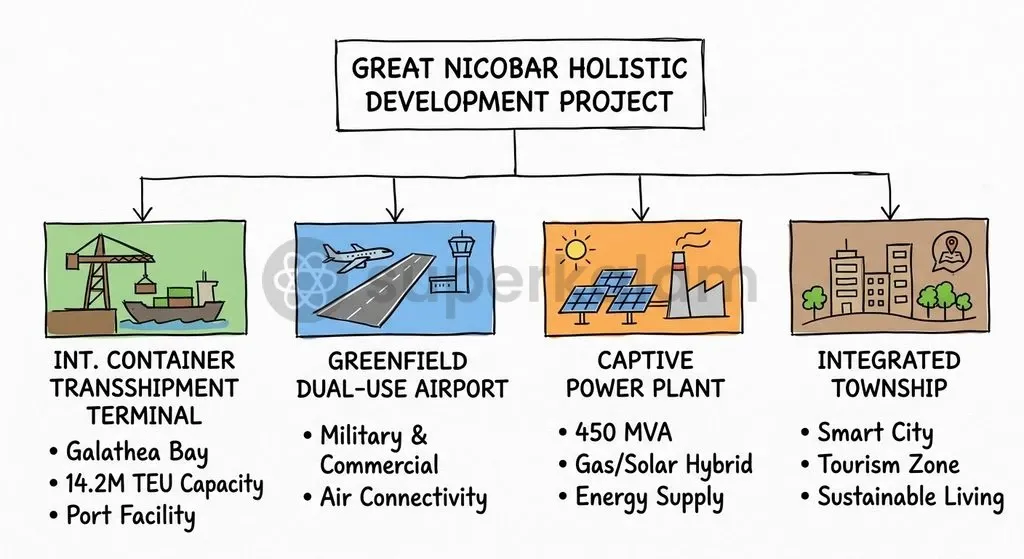
The master plan integrates four core infrastructure pillars designed to reinforce each other:
- International Container Transshipment Terminal (ICTT): A deep-water port at Galathea Bay with an ultimate handling capacity of 14.2 million twenty-foot equivalent units (TEUs), positioned to capture mainline Indian cargo currently transshipped at foreign ports.
- Greenfield Dual-Use International Airport: An aviation facility capable of handling civilian passengers alongside long-range maritime reconnaissance aircraft.
- Captive Power Plant: A 450 MVA gas and solar combined power generation installation to meet projected industrial and municipal baseload energy demands.
- Integrated Township: A planned urban grid spread over pristine forested topography to house port personnel, administrative staff, tourism operators, and defence personnel.
The Union Ministry of Environment, Forest and Climate Change (MoEFCC) granted Stage-I in-principle forest clearance on 27 October 2022 under Section 2(ii) of the Forest (Conservation) Act, 1980. The clearance approved the diversion of forest land across three development phases, covering 130.75 square kilometres. Converting an isolated ecological sanctuary into an international commercial corridor represents the most ambitious infrastructure intervention ever undertaken in India's island territories.
| Core Project Component | Planned Capacity & Scale | Primary Statutory & Environmental Concern |
|---|---|---|
| Transshipment Port (ICTT) | 14.2 million TEUs at Galathea Bay | Critical nesting habitat of the Giant Leatherback Sea Turtle |
| Dual-Use International Airport | Long-range military and civilian runway | Eco-Sensitive Zone boundary reductions to zero metres |
| Integrated Township | Urban housing and commercial infrastructure | Influx into interior zones buffering nomadic tribal reserves |
| Captive Power Plant | 450 MVA gas and solar configuration | Thermal and emissions footprint in a tropical rainforest |
The 43.4 km Forest Boundary Tender: What It Involves
The tender establishes physical borders between designated development pockets and reserved forests. According to the APWD Campbell Bay tender document, the contract encompasses an intensive land survey along a 43.4-kilometre perimeter in Great Nicobar.
The scope of work involves clear operational milestones:
- Pillar erection: Placing reinforced cement concrete pillars along the entire forest boundary line.
- Site cordoning: Carving out 121.87 square kilometres of forested terrain from the surrounding 166.1-square-kilometre project footprint.
- Earthworks prep: Preparing the ground before earthmovers, felling teams, and civil contractors mobilise on site.
The timing of this procurement has sparked legal contention because the project lacks Stage-II Final Forest Clearance under the Forest (Conservation) Act, 1980. Regulatory guidelines issued by the MoEFCC on 3 August 2009 stipulate that Stage-II clearance cannot be granted until all Stage-I conditions are met.
These prerequisites include the complete settlement of customary forest rights and certified Gram Sabha consent. Critics contend that driving concrete boundary markers into the forest floor creates de facto ground possession, pre-empting both administrative reviews and judicial scrutiny.
Discuss with Superkalam
Recall the two statutory clearances required under the Forest (Conservation) Act, 1980, and identify which one the project currently lacks.
Ask NowThe Forest Rights Act Conflict: Why Tribal Consent Is Contested
The Forest Rights Act, 2006 requires prior informed consent from local Gram Sabhas before customary forest lands can be lawfully diverted for infrastructure development. The Scheduled Tribes and Other Traditional Forest Dwellers (Recognition of Forest Rights) Act, 2006 (FRA) decentralises forest governance. It empowers traditional village assemblies to verify community forest resource rights.
Litigation filings highlight four major administrative breakdowns in the project's consent process:
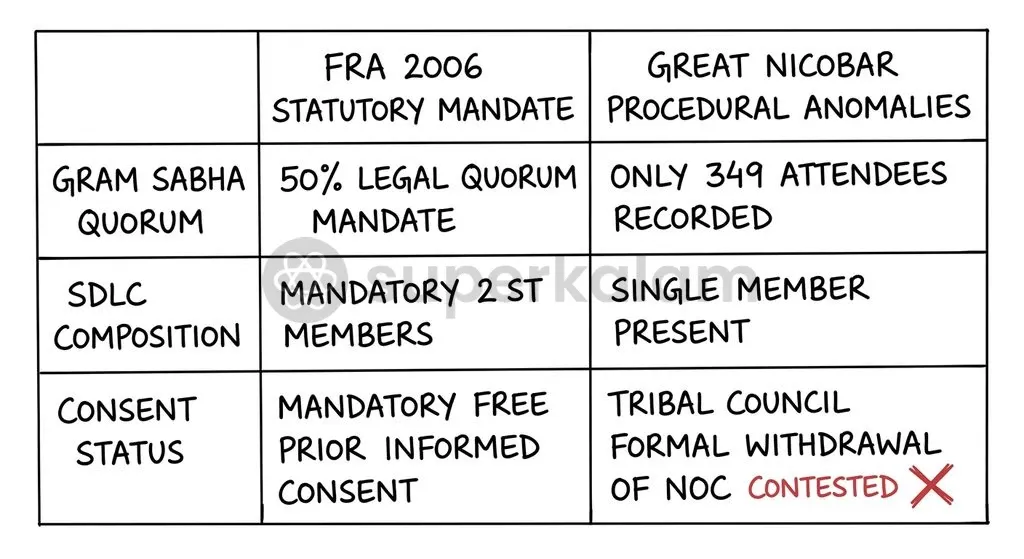
- Quorum shortfalls: Gram Sabhas held on 12 August 2022 in the non-tribal settler panchayats of Campbell Bay, Laxmi Nagar, and Govind Nagar recorded an aggregate attendance of only 349 people, failing the mandatory 50% adult quorum].
- Defective committee composition: The Sub-Divisional Level Committee (SDLC) for Campbell Bay tehsil, which validated the certificates on 16 August 2022, seated only one tribal representative instead of the two Scheduled Tribe members required by statutory Forest Rights Rules.
- Contradictory RoFR claims: On 18 August 2022, the Deputy Commissioner of Nicobar District issued a Recognition of Forest Rights (RoFR) certificate stating all rights were settled. This contradicted published Union Ministry of Tribal Affairs data showing zero FRA claims settled across the Union Territory.
- Withdrawn tribal consent: On 22 November 2022, the Tribal Council of Little and Great Nicobar formally withdrew its No-Objection Certificate. The council stated that land-use maps had been withheld during consultations, concealing overlaps with pre-tsunami ancestral villages along the western coast.
Consent for the nomadic Shompen raises separate statutory challenges. Designated as one of India's 75 Particularly Vulnerable Tribal Groups (PVTGs), their consent was signed by an administrative officer of the Andaman Adim Janjati Vikas Samiti (AAJVS) rather than through direct community consultation.
The Shompen number approximately 200 to 300 individuals and maintain a hunting and foraging subsistence lifestyle in the interior Great Nicobar Tribal Reserve. Under Regulation 3 of the Andaman and Nicobar Islands (Protection of Aboriginal Tribes) Regulation, 1956, tribal reserves remain legally insulated from alienation, creating a direct conflict with master plans proposing to re-notify reserve areas.
Discuss with Superkalam
Explain how issuing a physical demarcation tender can create 'de facto ground possession' before judicial challenges are resolved.
Ask NowForest Clearances and the Calcutta High Court Challenge
The Calcutta High Court Circuit Bench at Port Blair ruled on 6 May 2026 that public interest litigations challenging Great Nicobar environmental clearances must be heard on substantive merits. In Meena Gupta vs Union of India & Ors [WPA(P) 12/2024 with WPA(P) 16/2025 and 17/2025], the bench dismissed preliminary objections raised by the Union Government concerning locus standi and petition maintainability].
The connected petitions raise serious administrative questions regarding environmental governance:
- Eco-Sensitive Zone Reductions: Petitions WPA(P) 16/2025 and 17/2025 challenge Union Environment Ministry notifications issued on 12 March 2021 that slashed the Eco-Sensitive Zones (ESZ) around Campbell Bay National Park and Galathea National Park to zero metres along specific project segments.
- Procedural Bypass of NGT Directives: The National Green Tribunal (NGT) Principal Bench declined to quash the Environmental Clearance on 3 April 2023, opting instead to constitute a High-Powered Committee (HPC) headed by the MoEFCC Secretary to review ecological and tribal concerns]. Litigants argue that administrative bodies proceeded with project milestones before the HPC transparently addressed these systemic defects.
- Irreversible Physical Actions: Petitioners argue that floating tenders and establishing concrete boundary pillars during active litigation creates irreversible physical changes on the ground, altering the status quo before the court can adjudicate FRA validity.
The Union Government appealed the maintainability ruling to the Supreme Court of India via a Special Leave Petition. On 5 October 2026, the Supreme Court dismissed the Union Government's petition and refused to stay the High Court proceedings, ruling that the cultural preservation of indigenous tribes represents a constitutionally protected right under Article 21]. The dismissal cleared the way for the Port Blair Circuit Bench to scrutinise whether administrative approvals complied with statutory environmental and tribal welfare laws.
Discuss with Superkalam
Apply the principles of the Forest Rights Act, 2006, to evaluate the validity of tribal consent signed by an administrative agency on behalf of a PVTG.
Ask NowStrategic Gateway vs. Fragile Ecosystem: The Core Trade-offs
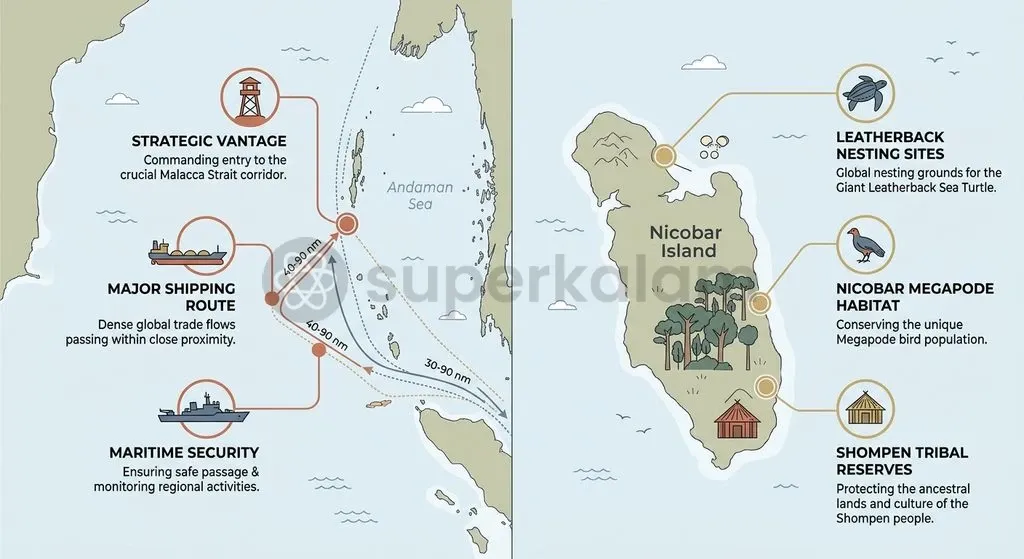
Great Nicobar Island occupies an exceptional geopolitical position within 90 nautical miles of the Malacca Strait, alongside an international shipping corridor carrying nearly 100,000 vessels annually. According to project briefs from the Ministry of Ports, Shipping and Waterways, the island sits between 40 and 90 nautical miles from the northern entrance of the Malacca chokepoint and Banda Aceh in Indonesia.
Developing deep-water transshipment berths and modern runway infrastructure on Great Nicobar provides significant operational advantages for India's national security apparatus. Tri-service installations under the Andaman and Nicobar Command (ANC) will gain forward logistics, radar surveillance, and maritime patrol capabilities. This infrastructure anchors a formidable deterrent posture against expanding foreign naval deployments across the eastern Indian Ocean.
Yet these strategic assets require transforming a pristine insular ecosystem. Great Nicobar was designated a Biosphere Reserve under the UNESCO Man and the Biosphere (MAB) Programme in 2013, encompassing ancient tropical rainforests celebrated for unique evolutionary isolation. Official parliamentary disclosures from the MoEFCC acknowledge that project construction will require felling up to 9.64 lakh (0.964 million) trees across 130.75 square kilometres of rainforest canopy.
| Dimension | Strategic Imperative | Ecological & Social Cost |
|---|---|---|
| Maritime Posture | Intercepts Malacca Strait traffic; provides force-projection for the Andaman and Nicobar Command | Destruction of Galathea Bay, a globally critical nesting site for the Giant Leatherback Turtle |
| Economic Logistics | Recaptures Indian container transshipment transacted through Colombo and Singapore | Felling of up to 9.64 lakh tropical rainforest trees across 130.75 sq km |
| Indigenous Safeguards | Modern communication, air connectivity, and economic integration for the Union Territory | Threatens survival of 200–300 nomadic Shompen (PVTG) and ancestral Nicobarese villages |
| Mitigation Model | Capital allocation for afforestation and ecological monitoring schemes | Compensatory afforestation planned 2,000 km away in Haryana and MP arid zones |
The ecological trade-offs affect species with exceptionally limited geographic ranges. Galathea Bay is one of the world's most critical nesting grounds for the Giant Leatherback Sea Turtle (Dermochelys coriacea), an endangered marine reptile protected under Schedule I of the Wild Life (Protection) Act, 1972. Terrestrial construction also cuts into the micro-habitats of endemic insular species, including the Nicobar Megapode (Megapodius nicobariensis), the Nicobar Tree Shrew (Tupaia nicobarica), and the Nicobar Long-tailed Macaque (Macaca fascicularis umbrosa).
To counterbalance this ecological disruption, the Union Government has proposed a ₹2,220-crore conservation package over 30 years, incorporating coral translocation by the Zoological Survey of India, turtle tracking, and mangrove regeneration, as reported by the Press Information Bureau and MoEFCC on 8 June 2026. However, parliamentary answers reveal that statutory compensatory afforestation for clearing 130.75 square kilometres of dense island rainforest will be carried out over 260 square kilometres in Haryana and Madhya Pradesh. Planting scrub vegetation and dry-deciduous saplings more than 2,000 kilometres away in semi-arid zones cannot replicate the ecological complexity, carbon storage, or endemic fauna of a primary insular tropical rainforest.
Discuss with Superkalam
Analyse the trade-off between securing maritime choke points like the Malacca Strait and preserving internationally significant biodiversity such as the Galathea Bay turtle nesting sites.
Ask NowWay Forward: Balancing National Security with Tribal and Ecological Rights
The Andaman and Nicobar administration must institutionalise transparent statutory reconciliation to resolve friction between Indian Ocean security imperatives and indigenous ecological rights. State agencies must recognise that national defence and constitutional environmental safeguards are complementary responsibilities rather than competing priorities.
Resolving this complex dispute requires several concrete legal and administrative steps:
- Re-initiating Statutory Gram Sabha Consultations: Administrative bodies must rectify procedural omissions by reconvening quorum-compliant Gram Sabhas with the autonomous participation of the Nicobarese community. For the nomadic Shompen, consultations must follow protective protocols established under the 1956 Aboriginal Tribes Regulation rather than relying on proxy administrative endorsements.
- Addressing High-Powered Committee Findings: The Union Ministry of Environment, Forest and Climate Change should place the findings and baseline assessments of the High-Powered Committee ordered by the NGT into the public domain, allowing open scrutiny before granting Stage-II Final Forest Clearance.
- Redesigning Port and Runway Footprints: Engineering agencies should re-examine project alignments to avoid the primary nesting beaches of the Giant Leatherback Sea Turtle at Galathea Bay, adopting offshore structures or alternative anchorages to minimise coastal dredging.
- Aligning Compensatory Ecological Investments: Because mainland afforestation in Haryana and Madhya Pradesh fails to offset island biodiversity loss, regulatory authorities should mandate direct ecological restoration within the Andaman and Nicobar archipelago, including marine sanctuary protections and active coral reef restoration.
Adhering strictly to statutory procedures under the Forest Rights Act and the Forest (Conservation) Act will reinforce the institutional legitimacy of India's strategic assets while safeguarding the constitutional rights of the nation's most vulnerable citizens.
Discuss with Superkalam
Design an institutional mechanism that allows critical national security infrastructure to proceed without compromising the statutory autonomy of Gram Sabhas in island territories.
Ask NowKey Takeaways
The Great Nicobar Project encapsulates the constitutional tension between vital national maritime defence requirements and mandatory statutory safeguards for pristine island ecosystems and indigenous communities. The essential elements of the ongoing dispute include:
- The Andaman Public Works Department issued an on-ground survey and demarcation tender on 26 October 2026 to erect RCC pillars along a 43.4-kilometre forest perimeter, initiating physical project execution before securing Stage-II Final Forest Clearance.
- Stage-I in-principle approval was granted on 27 October 2022 under Section 2(ii) of the Forest (Conservation) Act, 1980, authorising the diversion of 130.75 square kilometres of forest land and leading to the felling of up to 9.64 lakh trees.
- The Tribal Council of Little and Great Nicobar formally withdrew its No-Objection Certificate on 22 November 2022, citing unshared maps and threats to pre-tsunami ancestral villages, while consent for the nomadic Shompen (a PVTG numbering 200–300) was signed by an administrative welfare officer rather than through autonomous tribal assemblies.
- Procedural audits in ongoing litigation reveal that the August 2022 settler Gram Sabhas had only 349 attendees, falling short of statutory quorums, while the tehsil Sub-Divisional Level Committee lacked the mandatory two Scheduled Tribe representatives.
- The Supreme Court of India upheld the Calcutta High Court's jurisdiction on 5 October 2026, affirming that the cultural preservation of indigenous tribes is a constitutionally protected right under Article 21 that requires substantive judicial examination].
Mains Question
"The execution of strategic infrastructure projects often exposes a deep fault line between national security imperatives and statutory mandates protecting indigenous forest rights." In light of the Andaman Public Works Department's forest demarcation tender for the Great Nicobar Project, critically examine the procedural compliance under the Forest Rights Act, 2006, and the Forest (Conservation) Act, 1980. (15 Marks)
Evaluate NowMains Question
The decision to slash Eco-Sensitive Zones (ESZ) around Campbell Bay and Galathea National Parks to zero metres highlights critical dilemmas in ecological governance. Elucidate the statutory and environmental implications of such administrative notifications on fragile island ecosystems. (10 Marks)
Evaluate NowPractice MCQs
QUESTION 1
With reference to the Forest Rights Act (FRA), 2006, and the statutory requirements for diverting forest land under the Forest (Conservation) Act, 1980, consider the following statements:
- MoEFCC circulars stipulate that Stage-II forest clearance requires the prior settlement of customary forest rights and certified Gram Sabha consent.
- Under statutory Forest Rights Rules, the Sub-Divisional Level Committee (SDLC) validating forest rights claims must include at least two Scheduled Tribe members.
- The statutory quorum mandated for Gram Sabha meetings to verify forest rights certificates under FRA compliance is a simple majority of registered voters. Which of the statements given above are correct?
QUESTION 2
Consider the following statements regarding the regulatory framework and tribal safeguards applicable to the Great Nicobar Holistic Development Project:
- The Shompen are designated as a Particularly Vulnerable Tribal Group (PVTG) who reside within the interior Great Nicobar Tribal Reserve.
- Regulation 3 of the Andaman and Nicobar Islands (Protection of Aboriginal Tribes) Regulation, 1956, provides statutory protection insulating tribal reserves from alienation.
- Stage-I in-principle forest clearance granted under Section 2(ii) of the Forest (Conservation) Act, 1980, automatically permits project proponents to carry out permanent boundary demarcations through reinforced cement concrete pillars. Which of the statements given above is/are correct?
QUESTION 3
With reference to the Great Nicobar Holistic Development Project, consider the following infrastructure components and their associated environmental concerns mentioned in the master plan:
- Galathea Bay International Container Transshipment Terminal (ICTT) — Primary nesting beach of the Giant Leatherback Sea Turtle
- Dual-Use International Airport — Reduction of Eco-Sensitive Zones around Campbell Bay and Galathea National Parks to zero metres
- Captive Power Plant — 450 MVA gas and solar combined configuration located in a tropical rainforest Which of the pairs given above are correctly matched?
QUESTION 4
Which of the following bodies is responsible for spearheading the ₹72,000 to ₹92,000-crore Great Nicobar Holistic Development Project across the 166.1-square-kilometre project footprint?
QUESTION 5
Regarding the litigations in the Calcutta High Court Circuit Bench at Port Blair concerning the Great Nicobar Project, consider the following statements:
- The High Court upheld the Union Government's preliminary objections regarding locus standi and dismissed the public interest litigations.
- The petitions challenged notifications issued on 12 March 2021 that reduced Eco-Sensitive Zones around Campbell Bay National Park and Galathea National Park to zero metres. Which of the statements given above is/are correct?