Great Indian Bustard Conservation: Why Landscape Ecology Matters
As clean energy grids collide with critical bustard habitats in Kachchh, isolated micro-sanctuaries must give way to contiguous landscape matrix management.
Sep, 2026
•9 min read
Context
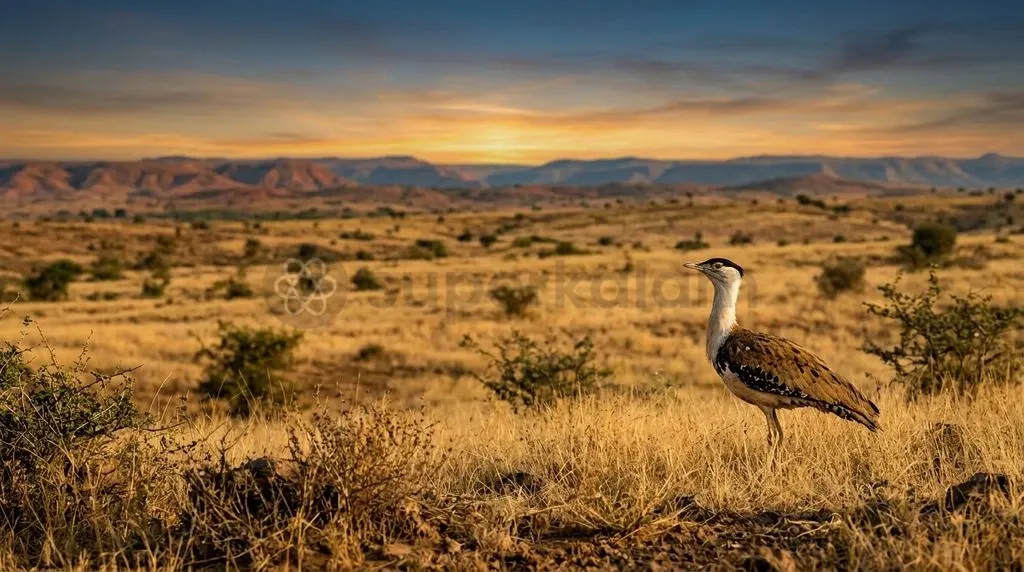
Saving the Great Indian Bustard (Ardeotis nigriceps) from extinction demands an immediate paradigm shift from small, fenced sanctuaries to wide-scale landscape ecology that manages contiguous agro-pastoral matrices alongside renewable energy infrastructure across Gujarat and Rajasthan. Isolated protected reserves cannot support wide-ranging grassland megafauna whose survival depends on unfragmented flight corridors and functional foraging zones. As of September 2026, the Union Environment Ministry has prioritized landscape-level interventions across western India to reconcile green energy expansion with biodiversity protection. This strategy acknowledges that preventing species extinction is essential for achieving true ecological sustainability.
Why in the News? Gujarat's Action Plan for the Great Indian Bustard
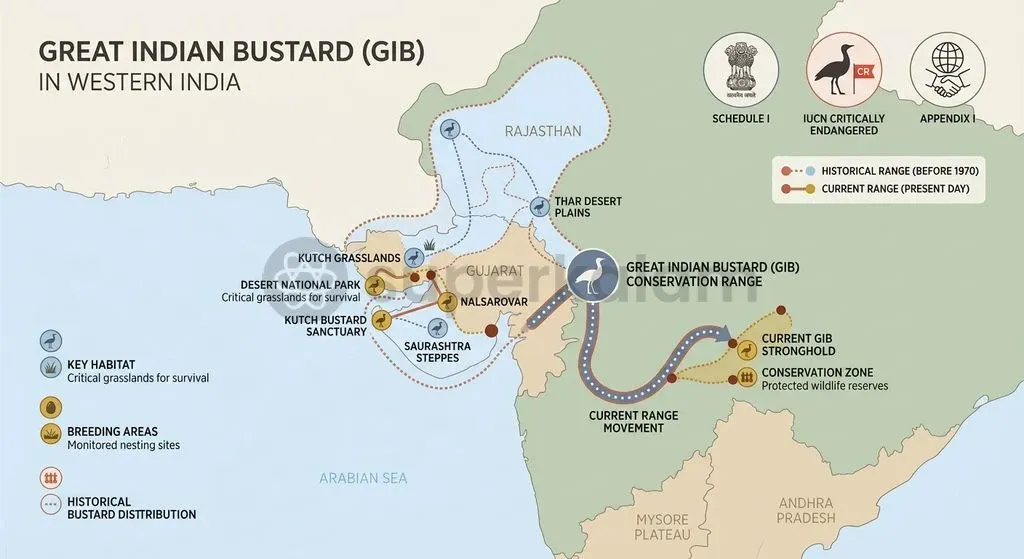
The Union Minister for Environment, Forest and Climate Change released the Gujarat Action Plan for GIB Conservation on 13 September 2026 in Bhuj. As of September 2026, this targeted policy framework aims to establish a minimum viable population of over 30 birds and secure between 200 and 500 square kilometres of safe, contiguous grassland habitat per Press Information Bureau (PIB) Release PRID 2054619.
The immediate implementation focus centers on the approximately 200 square kilometre Lala–Rawa landscape situated in the Abdasa taluka of Kachchh. Conservation teams have restored approximately 11 square kilometres of degraded grassland in Naliya by eradicating the invasive alien species Prosopis juliflora and reviving native open grasslands.
This operational blueprint reflects an administrative acknowledgment that isolated enclosures have failed to prevent regional breeding population collapse. By targeting contiguous habitat mosaics, the initiative seeks to establish functional corridors across Kachchh.
Current Status: Why the Great Indian Bustard is on the Brink
The Great Indian Bustard faces imminent extinction after disappearing from more than 90 percent of its historical range across the Indian subcontinent. According to the Wildlife Institute of India (WII) Technical Report & Status Assessment, fewer than 150 individuals remain in India, with more than 80 percent of the surviving wild population concentrated in the Thar Desert of Rajasthan.
The bird receives the highest degree of statutory and international conservation safeguards available in environmental law:
- IUCN Red List: Classified globally as Critically Endangered due to rapid population declines and extreme range contraction.
- Wild Life (Protection) Act, 1972: Placed in Schedule I, granting absolute statutory protection and mandating the highest penal sanctions for hunting or habitat destruction.
- International Conventions: Listed under Appendix I of both the Convention on International Trade in Endangered Species of Wild Fauna and Flora (CITES) and the Convention on the Conservation of Migratory Species of Wild Animals (CMS).
A combination of slow reproductive rates—females typically lay only a single egg per clutch—and severe habitat fragmentation has pushed the species into an extinction vortex. In Gujarat, the breeding population has dwindled to near extirpation, making emergency habitat securing vital.
Discuss with Superkalam
Recall the legal protection status of the Great Indian Bustard under the Wild Life (Protection) Act, 1972, and the IUCN Red List.
Ask NowThe Limits of Single-Species Conservation in Isolated Pockets
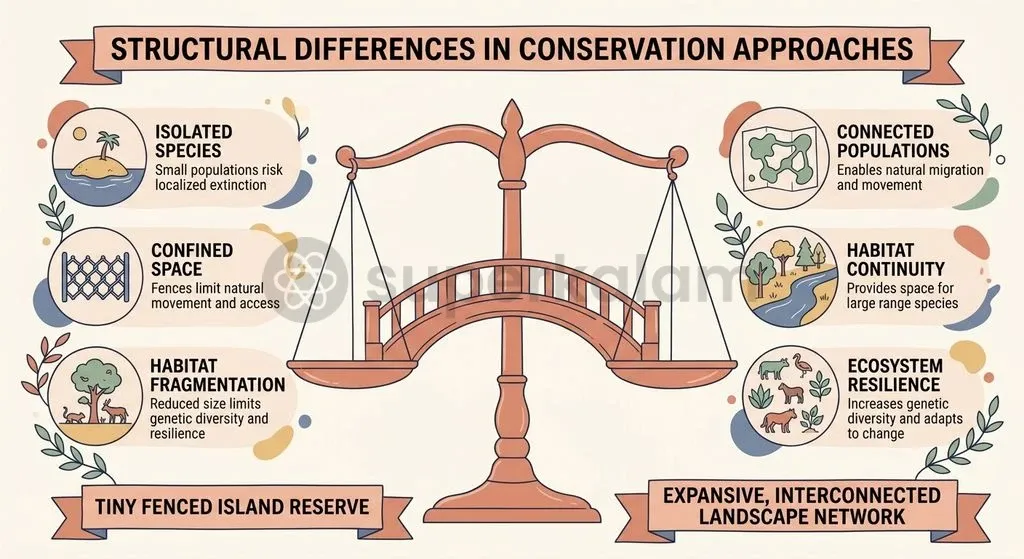
Traditional fortress-conservation strategies relying on enclosed sanctuaries cannot sustain the spatial ecology of wide-ranging terrestrial avifauna like bustards. The Kachchh Bustard Sanctuary (also known as the Lala-Parjau Sanctuary) spans a legally notified area of only 2.02 square kilometres, rendering it one of the smallest wildlife sanctuaries in India according to the Gujarat Forest Department Administrative Records & Sanctuary Notification Data.
Because bustards exhibit extensive home ranges spanning hundreds of square kilometres for seasonal foraging and breeding displays, fencing off a tiny reserve creates an artificial ecological trap:
- Island Biogeography Constraints: Enclosed reserves fail to accommodate seasonal dispersal, isolating birds within fragmented patches where inbreeding and demographic stochasticity accelerate extinction risk.
- Boundary Vulnerability: Birds flying beyond the perimeter of the 2.02-square-kilometre notified area immediately encounter hazards including overhead power lines, agricultural land conversions, and feral dog predation.
- Invasive Monocultures: Neglected enclosures frequently succumb to woody plant encroachment by invasive species like Prosopis juliflora, which chokes the open short-grass swards essential for bustard visibility and display.
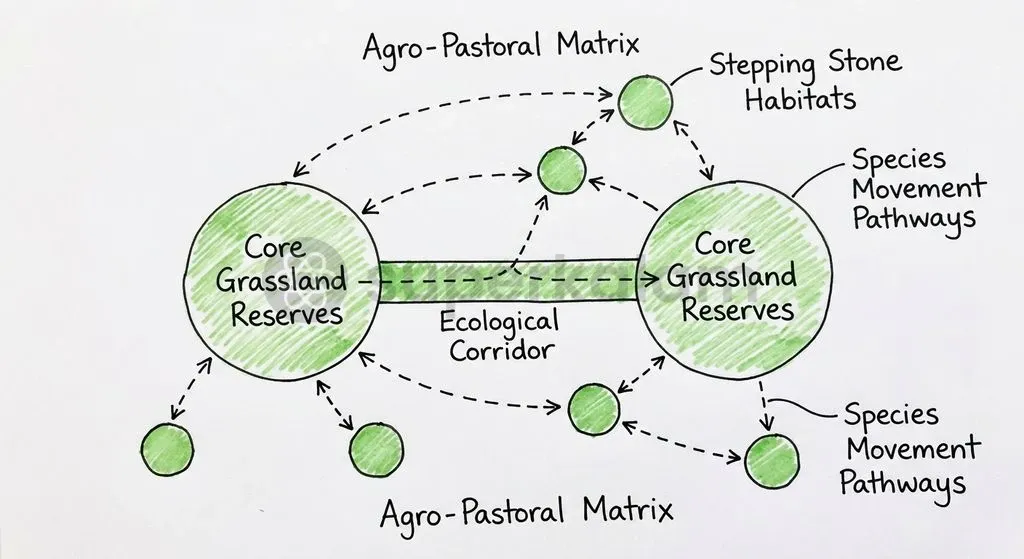
Preserving a viable breeding population requires expanding conservation boundaries beyond the sanctuary fence to encompass the surrounding rural matrix.
Discuss with Superkalam
Explain why isolated wildlife reserves often act as ecological traps for wide-ranging avifauna like the bustard.
Ask NowLandscape Ecology Explained: Corridors, Matrices, and Grasslands
Landscape ecology treats protected grassland patches, agro-pastoral lands, and revenue commons as interconnected functional units rather than isolated island sanctuaries. Under the MoEFCC Landscape Conservation Guidelines & Gujarat Action Plan 2026, conservation focuses on matrix management—improving the permeability of human-modified landscapes to allow wildlife to move safely across diverse land-use categories.
Semi-arid grasslands require continuous ecological processes to retain their open sward structure. Per conservation research by the Gujarat Institute of Desert Ecology and the Gujarat Forest Department (as reported in September 2026), traditional rotational grazing practiced by local pastoralist communities, such as the Maldharis of Kachchh, suppresses woody plant encroachment and maintains optimal short-grass sward structure essential for bustard foraging and lekking display.
A major structural impediment to landscape conservation has been the colonial-era revenue categorisation of semi-arid ecosystems. The Report of the Task Force on Grasslands and Deserts by the Planning Commission documented that classifying grasslands and savanna ecosystems as "wastelands" in official revenue records and Wasteland Atlases led to extensive land diversions for industrial parks and commercial infrastructure. Reclassifying these biomes as productive ecological commons is critical to securing contiguous habitats.
The Green-on-Green Dilemma: Power Lines, Clean Energy, and the Supreme Court
The rapid development of solar and wind generation in western India has generated an acute environmental trade-off between climate change mitigation and biodiversity conservation. According to research by the Wildlife Institute of India, the Great Indian Bustard suffers high mortality from high-voltage transmission lines because its narrow frontal binocular field of vision and habit of scanning ground vegetation in flight prevent it from detecting overhead cables in time.
In M.K. Ranjitsinh & Ors. v. Union of India & Ors. (2024), the Supreme Court of India addressed this tension directly:
- Right to Climate Protection: The Supreme Court recognised the right to be free from the adverse effects of climate change as a distinct fundamental right emanating from Articles 14 and 21 of the Constitution.
- Modification of Blanket Undergrounding: The bench modified its earlier April 2021 blanket order that had mandated undergrounding across 99,000 square kilometres of priority and potential bustard habitat in Rajasthan and Gujarat.
- Expert Technical Committee: The Court appointed an expert committee to determine the technical feasibility of undergrounding on a case-by-case basis, balancing national renewable targets with critical flyway safeguards.
This ruling underscores the necessity of targeted spatial planning rather than sweeping prohibitions, ensuring that transmission grids avoid core breeding zones while maintaining clean energy evacuation.
Discuss with Superkalam
Analyse how historical revenue classifications of grasslands as 'wastelands' contributed to the fragmentation of bustard habitats.
Ask NowProtected Reserves vs Landscape Management: A Side-by-Side Comparison
Managing wide-ranging avifauna requires comparing the structural mechanisms of isolated sanctuary protection against holistic landscape conservation frameworks.
| Dimension | Isolated Sanctuary Protection | Landscape-Level Matrix Management |
|---|---|---|
| Spatial Scope | Limited to legally notified reserves (e.g., Kachchh Sanctuary's 2.02 sq km) | Encompasses broad regional matrices (e.g., 200–500 sq km Lala–Rawa belt) |
| Connectivity | Fragmented islands separated by hostile infrastructure | Connected networks with functional flyway corridors and low-risk zones |
| Community Role | Exclusionary preservation excluding local pastoralists | Integrating traditional pastoralism to maintain natural grass swards |
| Infrastructure Policy | External threats ignored outside reserve borders | Strategic undergrounding of power lines across movement corridors |
| Administrative Framework | Forest department jurisdiction strictly within fenced boundaries | Inter-departmental coordination across revenue lands, energy, and pastures |
Ecological Ethics: Balancing Decarbonisation with Species Extinction
Expanding clean energy generation must not come at the expense of irreversible biodiversity loss. Under Article 48A of the Directive Principles of State Policy, the State is tasked with protecting wildlife, while Article 51A(g) establishes a Fundamental Duty for every citizen to have compassion for living creatures.
Ecological ethics demands an operational framework grounded in intergenerational equity:
- Non-Fungibility of Species: Decarbonisation aims to stabilise the biosphere, but accelerating the extinction of an ancient, endemic avian species invalidates the moral purpose of sustainable development.
- Just Ecological Transition: Energy transitions cannot be considered green if they dismantle vulnerable semi-arid ecosystems under the misnomer of utilizing "wastelands".
- Harmonious Ecological Construction: Reconciling Article 21's climate protections with Article 48A requires strict spatial zoning where critical avian breeding habitats remain inviolate from industrial footprints.
Discuss with Superkalam
Evaluate whether the Supreme Court's modification of the blanket undergrounding order in 2024 achieves an equitable balance between clean energy and species preservation.
Ask NowWay Forward: A Coordinated Roadmap for Grassland Coexistence
Securing the long-term survival of the Great Indian Bustard across western India requires an evidence-based, landscape-level strategy:
- Expedited Transmission Undergrounding: Energy agencies must prioritize undergrounding all high-voltage lines within the 200 square kilometre Lala–Rawa priority landscape and install verified bird flight diverters across secondary corridors.
- Grassland Sward Restoration: The Forest Department should expand the eradication of invasive Prosopis juliflora beyond Naliya, systematically restoring native perennial grasses to secure foraging habitats per Press Information Bureau (PIB) Release PRID 2054619.
- Pastoral Co-Management: Local Maldhari pastoralists should be integrated into community stewardship programmes, using rotational grazing regimes to naturally control woody vegetation while protecting nesting sites.
- Revenue Classification Reform: State revenue departments must eliminate the administrative label of "wasteland" from open natural ecosystems, conferring formal conservation status upon common pastures and grasslands.
- Transboundary Corridor Coordination: Gujarat and Rajasthan must establish a unified interstate monitoring network to oversee captive breeding release programmes and maintain contiguous flyway corridors.
Key Takeaways
- The Great Indian Bustard (Ardeotis nigriceps) is classified as Critically Endangered on the IUCN Red List and listed under Schedule I of the Wild Life (Protection) Act, 1972, with fewer than 150 wild individuals remaining in India.
- The Union Environment Ministry launched the Gujarat Action Plan for GIB Conservation in September 2026, targeting the restoration of 200 to 500 square kilometres across the Lala–Rawa landscape in Kachchh.
- Traditional micro-reserves, such as the 2.02 square kilometre Kachchh Bustard Sanctuary, are insufficient for wide-ranging grassland megafauna, necessitating a shift to landscape ecology and matrix management.
- Overhead transmission lines represent the primary collision threat due to the bustard's narrow frontal vision, leading to Supreme Court interventions in the M.K. Ranjitsinh case that balance climate action with species survival.
- Reforming colonial revenue classifications that label semi-arid grasslands as "wastelands" is essential to prevent indiscriminate infrastructure diversion.
Mains Question
"The rapid expansion of renewable energy infrastructure in western India has generated a 'green-on-green' conflict between decarbonisation and biodiversity conservation." In light of the Supreme Court's ruling in M.K. Ranjitsinh (2024), examine how India can reconcile clean energy targets with the survival of endangered avifauna. (15 Marks)
Evaluate NowMains Question
Highlighting the limitations of isolated, small-enclosure sanctuaries like the Kachchh Bustard Sanctuary, elucidate the importance of landscape-level matrix management for conserving wide-ranging grassland species. (10 Marks)
Evaluate NowPractice MCQs
QUESTION 1
With reference to the Great Indian Bustard (Ardeotis nigriceps), consider the following statements:
- It is classified as Critically Endangered on the IUCN Red List and listed under Schedule I of the Wild Life (Protection) Act, 1972.
- More than 80 percent of its surviving wild population is concentrated in the Thar Desert of Rajasthan.
- Female bustards typically produce multiple clutches of four to six eggs per breeding season.
QUESTION 2
Regarding the Supreme Court of India's ruling in M.K. Ranjitsinh & Ors. v. Union of India & Ors. (2024), consider the following statements:
- The Supreme Court recognised the right to be free from the adverse effects of climate change as a distinct fundamental right emanating from Articles 14 and 21.
- The Court upheld its earlier blanket order requiring universal undergrounding of power lines across all 99,000 square kilometres of bustard habitat.
- An expert technical committee was appointed to determine the feasibility of undergrounding on a case-by-case basis.
QUESTION 3
Consider the following statements regarding grassland ecology and conservation in western India:
- Classifying semi-arid grasslands as 'wastelands' in historical revenue records facilitated large-scale land diversions for infrastructure.
- Traditional rotational grazing by pastoralist communities like the Maldharis aids bustard conservation by suppressing woody plant encroachment.
- The Great Indian Bustard possesses wide binocular frontal vision that easily alerts it to high-tension overhead power lines during flight.
QUESTION 4
With reference to the Gujarat Action Plan for GIB Conservation released in September 2026, consider the following statements:
- It aims to establish a minimum viable population of over 30 birds in Gujarat.
- The immediate operational focus is on securing contiguous habitat across the Lala–Rawa landscape in Kachchh.
- The plan prioritises replacing native open grasslands with plantation monocultures of Prosopis juliflora.
QUESTION 5
Which of the following biological or behavioral traits makes the Great Indian Bustard exceptionally vulnerable to high-voltage transmission lines?