GRAP in Delhi-NCR: Four Stages, AQI Limits and Restrictions
Emergency winter curbs cannot substitute for year-round airshed governance, making CAQM's escalating protocol a crucial case study in environmental regulation.
Oct, 2026
•10 min read
Context
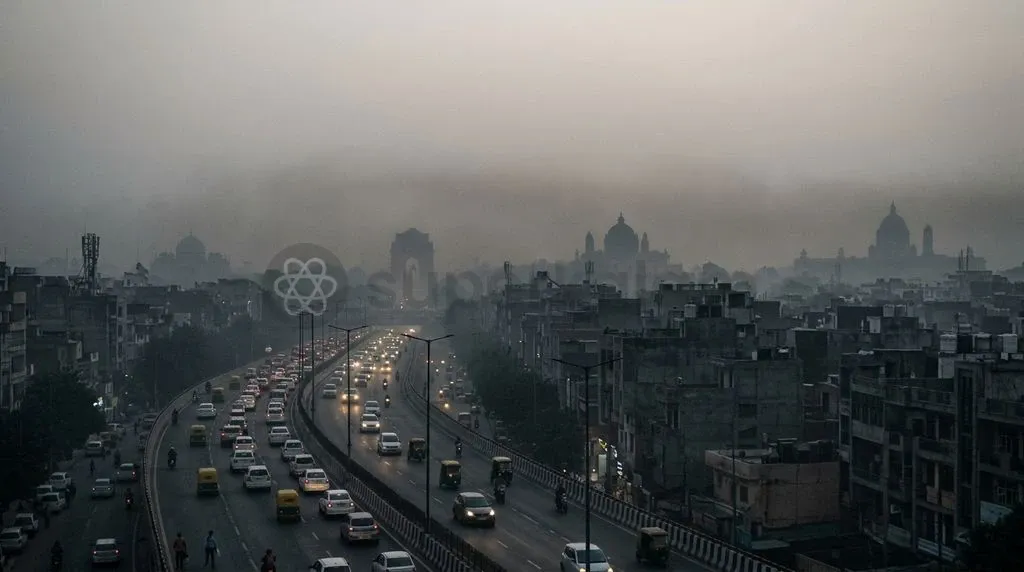
The Graded Response Action Plan is an emergency protocol. It enforces escalating anti-pollution curbs across Delhi-NCR based on real-time and projected ambient air quality thresholds. Under statutory oversight from the Commission for Air Quality Management, the framework institutes graded measures ranging from mechanised road cleaning during moderate pollution to severe transport halts and industrial prohibitions during atmospheric crises.
These measures provide an episodic circuit-breaker during severe winter meteorological inversions. However, emergency curbs cannot compensate for the structural absence of year-round, cross-jurisdictional airshed governance.
Why in the News?
Delhi-NCR enforces the Graded Response Action Plan every winter as regional air quality deteriorates into hazardous territory. As of October 2026, the Commission for Air Quality Management (CAQM) issued Direction No. 104, establishing an updated schedule that tightens emission controls across the National Capital Region.
Two core legal pillars underpin this regulatory intervention:
- Statutory Mandate: The rules draw authority from the CAQM in NCR and Adjoining Areas Act, 2021, which replaced earlier ad-hoc judicial monitoring mechanisms.
- Constitutional Protection: Public health crises during winter months engage Article 21, guaranteeing the fundamental right to clean air as affirmed in landmark jurisprudence stemming from M.C. Mehta v. Union of India.
Why Delhi-NCR Air Quality Demands an Emergency Framework
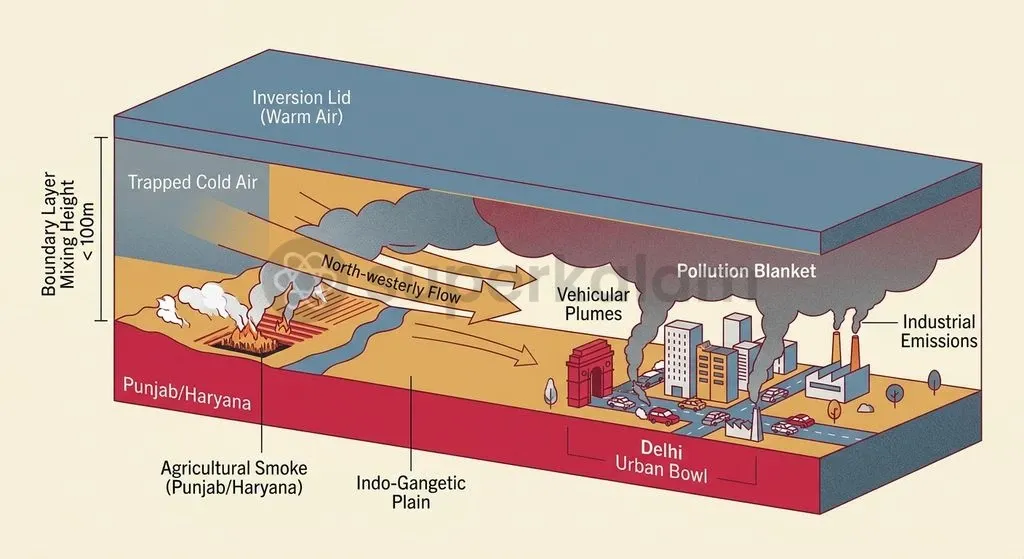
Thermal inversion and geographical entrapment make Delhi-NCR uniquely vulnerable to acute air pollution crises every winter. Delhi and its surrounding satellite cities lie landlocked within the Indo-Gangetic Plain airshed, where distinct geographical constraints prevent pollutants from dispersing naturally.
Three distinct atmospheric mechanisms drive this seasonal collapse:
- Surface Temperature Inversion: Winter weather triggers a sharp surface temperature inversion and a collapsing atmospheric boundary layer. The nocturnal mixing height, which typically exceeds 1,000 metres during summer months, plunges below 100 metres in winter.
- Shallow Atmospheric Compression: This vertical compression traps vehicular exhaust, construction dust, and industrial emissions inside a dense breathing zone near the ground.
- Transboundary Smoke Inflow: Prevailing north-westerly winter wind trajectories compound this localized entrapment. Regional air currents carry particulate matter and volatile precursors from upwind farm fires across Punjab and Haryana directly into the National Capital Region.
Without an emergency containment system, routine emissions and stagnant meteorology cause the Air Quality Index (AQI) to spike rapidly to life-threatening levels.
Discuss with Superkalam
Which specific AQI threshold triggers the transition from Stage II to Stage III under the revised GRAP schedule?
Ask NowUnderstanding GRAP: How the Graded Response Action Plan Works
The Graded Response Action Plan is an emergency response framework designed to prevent ambient air pollution from exceeding critical public health thresholds. Originally conceptualised following Supreme Court directives in the M.C. Mehta proceedings, the operational schedule is now framed and updated by the CAQM.
The revised framework approved in September 2026 contains a cumulative total of 48 targeted measures across four ascending stages. The framework relies on dynamic forecasting inputs supplied by the India Meteorological Department and the Indian Institute of Tropical Meteorology. Predictive modelling allows the CAQM to implement precautionary restrictions up to three days before projected air quality degradation occurs.
| Stage | Air Quality Category | AQI Trigger Threshold | Primary Operational Objective |
|---|---|---|---|
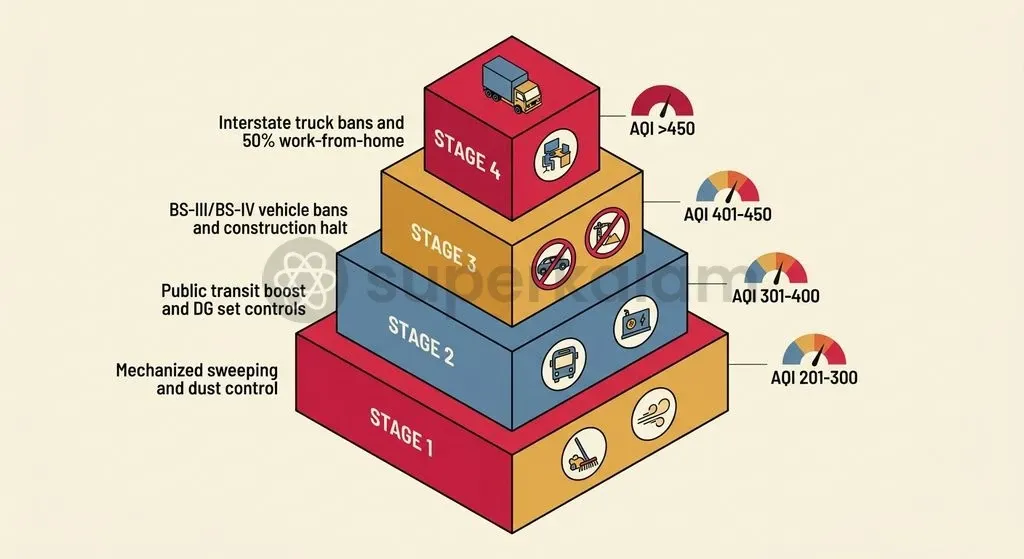
| Stage I | 'Poor' | AQI 201–300 | Baseline dust abatement and proactive emission curbs |
| Stage II | 'Very Poor' | AQI 301–400 | Intensive public transport deployment and diesel substitution |
| Stage III | 'Severe' | AQI 401–450 | Stringent vehicular restrictions and non-essential construction bans |
| Stage IV | 'Severe+' | AQI >450 | Emergency vehicular entry halts, school closures, and remote work |
The measures under each stage operate cumulatively across all NCR territories. When authorities declare a higher stage, agencies must continue enforcing all actions mandated under preceding stages alongside the newly activated curbs.
Stage 1 in Focus: Early Precautionary Actions and Baseline Controls
Stage I activates across Delhi-NCR when the regional AQI enters the 'Poor' category (201–300) or dynamic forecast models predict that deterioration. CAQM Direction No. 104 assigns 25 specific measures to municipal corporations, road-owning agencies, and state transport departments under this baseline stage.
Municipal bodies execute three principal interventions during this phase:
- Mechanised Dust Abatement: Agencies must deploy mechanised road sweeping machines and carry out intensive water sprinkling integrated with dust suppressants across major transit corridors.
- Sanitary Disposal of Silt: Road maintenance agencies must ensure that all collected dust is promptly transferred to designated sanitary landfills rather than left along road shoulders.
- Waste Burning Prohibition: Open burning of municipal solid waste, biomass, and dry leaves is strictly prohibited across all urban and rural administrative wards.
The September 2026 revision introduced structural changes by advancing several curbs into Stage I. Restrictions on running diesel generator sets were advanced from Stage II into Stage I. The prohibition on non-electric, non-CNG, and below-BS-VI interstate buses entering Delhi from NCR states was likewise moved forward into Stage I. Advancing these controls prevents early-season emission accumulation before winter meteorological inversions settle fully over the basin.
Discuss with Superkalam
How does the seasonal reduction in nocturnal mixing height trap pollutants within Delhi-NCR's breathing zone?
Ask NowConstruction Dust Controls: Portal Tracking and Anti-Smog Deployment
Dust from building sites is a primary component of coarse particulate matter across the National Capital Region. Under CAQM Direction Nos. 11–18, all construction and demolition (C&D) projects on plot sizes of 500 square metres or more must register on a dedicated state pollution web portal.
Registered project proponents must install video fencing linked to remote monitoring centres and ensure continuous operation of certified anti-smog guns. Unregistered projects, or sites found operating without mandatory wind-breaking tin sheets and misting cannons, face immediate compounding fines and statutory work-stop orders. Transport of C&D debris requires tarpaulin covers, wheel-washing facilities at vehicle exits, and wet suppression along approach pathways to eliminate fugitive dust generation.
Discuss with Superkalam
If you were a district magistrate in the NCR, how would you operationalize the monitoring of unregistered construction sites larger than 500 sq metres?
Ask NowEmergency Interventions: When and How Stages 3 and 4 Enforce Hard Curbs
Stage III activates when the Air Quality Index enters the 'Severe' bracket (401–450), enforcing 10 targeted emergency actions across transport and industry.
| Emergency Level | Trigger AQI | Critical Transport Bans | Industrial & Civic Directives |
|---|---|---|---|
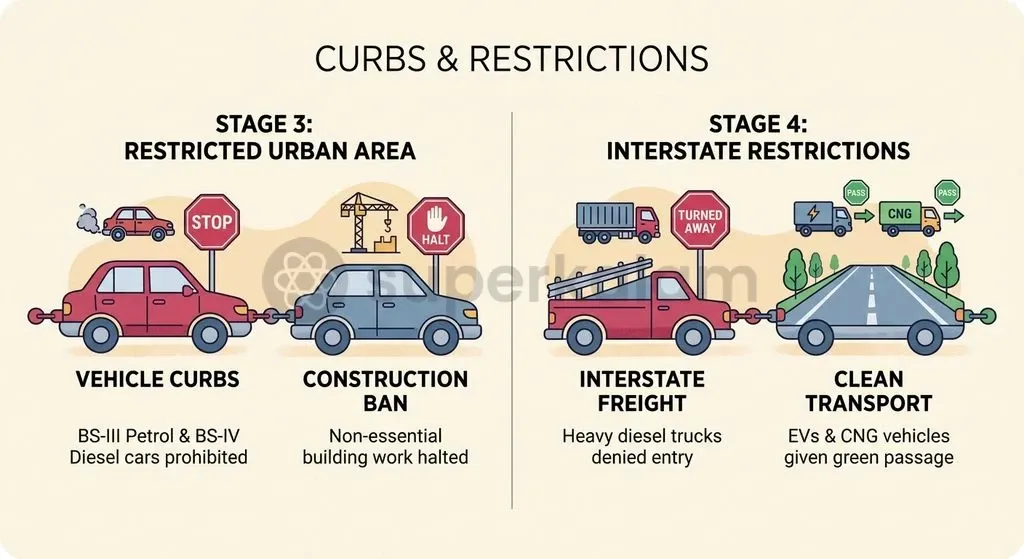
| Stage III | AQI 401–450 | Halts BS-III petrol vehicles and BS-IV diesel vehicles across Delhi and five NCR districts | Bans non-essential C&D work; revokes older BS-IV commercial freight exemptions |
| Stage IV | AQI >450 | Imposes an outright entry ban on non-Delhi heavy goods vehicles (barring clean fuels / BS-VI) | Triggers school closures for primary/middle classes; permits 50% work-from-home mandate |
A central pillar of Stage III is the strict prohibition on plying BS-III petrol vehicles and BS-IV diesel vehicles (Light Motor Vehicles) across Delhi, Gurugram, Faridabad, Ghaziabad, Gautam Budh Nagar, and Sonipat. Simultaneously, Stage III imposes a blanket prohibition on non-essential construction and demolition activities across the entire NCR territory. The revised guidelines strictly protect only essential national security, railway, metro rail, airport, and healthcare facilities from these closures.
Stage IV initiates an absolute emergency protocol once regional AQI surpasses the 450 mark. Non-Delhi registered heavy goods vehicles face an outright entry ban into Delhi, exempting only LNG, CNG, electric, and BS-VI compliant diesel transport trucks. State administrations may also suspend physical school classes and implement a 50% work-from-home mandate to suppress commuter volumes across city borders.
Beyond City Borders: Why Airshed Governance and CAQM Face Regional Limits
Municipal boundaries cannot contain airborne pollution because regional wind patterns govern particulate movement across north-western India. Delhi, Haryana, Uttar Pradesh, and Rajasthan share an interconnected atmospheric shed where local curbs within one territory are easily offset by upwind emissions in an adjoining state.
Parliament established the Commission for Air Quality Management through the CAQM Act, 2021 to address this institutional fragmentation, explicitly replacing the judicial Environment Pollution (Prevention and Control) Authority.
Regional enforcement faces three persistent structural hurdles:
- Statutory Overrides vs Judicial Scrutiny: Under Section 12(1) and Section 28 of the Act, CAQM directions explicitly supersede decisions made by state governments and State Pollution Control Boards across all five northern states. Section 14(1) equips the Commission with punitive powers, prescribing imprisonment up to five years or fines reaching one crore rupees for non-compliance. However, a proviso under Section 14(1) exempts individual farmers from criminal prosecution, restricting stubble burning sanctions to administrative compensation.
- Official Accountability: In M.C. Mehta v. Union of India, the Supreme Court sternly reprimanded the state administrations of Punjab and Haryana for failing to pursue penal actions under Section 14(2) against negligent enforcement officials who failed to curb seasonal farm fires.
- Inter-State Coordination Breakdowns: Per The Indian Express (as reported on 1 October 2026), interstate bus restrictions created logistical gridlock at state borders when diesel roadways fleets managed by neighbouring states faced entry bans into Delhi. Per The Hindu (as reported on 20 November 2025), inter-state coordination meetings often break down as Delhi attributes air spikes to transboundary stubble burning, while neighbouring agrarian states point toward Delhi's domestic vehicular exhaust and unresolved road dust.
Discuss with Superkalam
Compare the effectiveness of episodic transport curbs in Stage IV with baseline dust abatement measures introduced in Stage I.
Ask NowTechnology Limits: The Illusion of Quick-Fix Cloud Seeding
Emergency technological silver bullets such as cloud seeding cannot overcome adverse atmospheric conditions during north Indian winters. A decadal study conducted by IIT Delhi's Centre for Atmospheric Sciences established that artificial rain generation is climatologically unviable across Delhi-NCR during peak winter months.
Cloud seeding requires ambient moisture levels to exceed 75% alongside thick convective cloud decks capable of vertical updraft. Decadal meteorological data from December and January indicates that north-western winter skies are dominated by cold, dry, sub-saturated continental air masses with inadequate liquid water content. Relying on experimental meteorological modification diverts financial resources and policy attention away from structural source reduction.
Reforming Emergency Response: Way Forward for Year-Round Air Governance
Transitioning from reactive winter bans to permanent year-round emission abatement is necessary to reduce baseline air pollution across north-western India. Episodic GRAP curbs impose severe economic losses on daily-wage construction labourers and small transport operators without dismantling the root drivers of regional pollution.
Policy reforms must address long-term systemic sources across agriculture, thermal power generation, and transportation:
- Agricultural Residue Economics: Expand the Central Sector Scheme on Crop Residue Management, which currently offers a 50% capital subsidy for individual farmers and an 80% subsidy for Custom Hiring Centres procuring in-situ equipment like Super Seeders. Creating viable ex-situ supply chains that collect and supply paddy straw directly to bio-energy plants removes economic incentives for burning.
- Thermal Power Plant Compliance: Enforce the Environment (Utilisation of Crop Residue by Thermal Power Plants) Rules, 2023, which require coal plants located within 300 kilometres of Delhi to co-fire a minimum 5% biomass. Regulatory teeth must be maintained; in April 2026, CAQM penalised six delinquent power plants with fines of ₹61.85 crore for missing co-firing quotas.
- Industrial Clean Fuel Migration: Accelerate the enforcement of CAQM Direction No. 65, which mandates all industrial units in approved NCR clusters to operate exclusively on Piped Natural Gas or approved biomass fuels.
- Commercial Transport Decarbonisation: Replicate the Delhi Transport Department's structural regulation that bars non-BS-VI commercial vehicles registered outside Delhi from entering the city, steering long-haul logistics toward electric and CNG corridors.
- Aligning with NCAP Benchmarks: Institutionalise airshed-wide investment strategies under the National Clean Air Programme, which targets a 40% reduction target in PM2.5 and PM10 levels by 2026 compared to 2017 baselines.
Discuss with Superkalam
Given that regional winds ignore state borders, assess whether the CAQM's current institutional design is sufficient to enforce airshed-wide compliance.
Ask NowKey Takeaways
- The Graded Response Action Plan enforces a four-stage emergency protocol based on Delhi's AQI: Stage I ('Poor', 201–300), Stage II ('Very Poor', 301–400), Stage III ('Severe', 401–450), and Stage IV ('Severe+', >450).
- Winter pollution spikes are fundamentally driven by an Indo-Gangetic Plain airshed trap, where temperature inversions lower the atmospheric boundary layer below 100 metres and lock in regional emissions.
- Stage III strictly restricts BS-III petrol and BS-IV diesel LMVs across Delhi, Gurugram, Faridabad, Ghaziabad, Gautam Budh Nagar, and Sonipat, alongside halting non-essential construction work.
- The Commission for Air Quality Management derives statutory supremacy from Section 12 and Section 28 of the CAQM Act, 2021, holding overriding power over NCR state boards.
- Lasting clean air solutions require shifting from episodic winter bans to structural year-round compliance, including mandatory 5% biomass co-firing in coal plants and full industrial migration to Piped Natural Gas.
Mains Question
"Emergency curbs cannot compensate for the structural absence of year-round, cross-jurisdictional airshed governance." In light of the enforcement of the Graded Response Action Plan (GRAP) by the Commission for Air Quality Management, critically examine this statement. (15 Marks)
Evaluate NowMains Question
Detail the statutory framework and graded measures mandated under the Commission for Air Quality Management (CAQM) Direction No. 104. Elucidate how early-stage interventions seek to forestall extreme pollution episodes. (10 Marks)
Evaluate NowPractice MCQs
QUESTION 1
With reference to the Graded Response Action Plan (GRAP) for Delhi-NCR, consider the following statements:
- The measures mandated under each stage operate cumulatively across all NCR territories.
- The operational framework is framed and updated under the statutory mandate of the Commission for Air Quality Management in NCR and Adjoining Areas Act, 2021.
- Dynamic meteorological forecasts allow the implementation of precautionary restrictions up to three days before projected air quality deterioration.
Which of the statements given above are correct?
QUESTION 2
Consider the following statements regarding the regulatory triggers under the Graded Response Action Plan (GRAP):
- Stage I is triggered when the Air Quality Index (AQI) enters the 'Moderate' range (101–200).
- Stage III enforces restrictions on BS-III petrol and BS-IV diesel light motor vehicles when the AQI is within the 'Severe' bracket (401–450).
- Stage IV triggers an absolute entry ban on all non-Delhi registered heavy goods vehicles, without exception.
Which of the statements given above is/are correct?
QUESTION 3
Consider the following pairs of GRAP Stages and their primary operational curbs:
- Stage I: Prohibition on non-electric, non-CNG, and below-BS-VI interstate buses entering Delhi from NCR states
- Stage II: Ban on BS-III petrol and BS-IV diesel light motor vehicles across specified NCR districts
- Stage III: Blanket prohibition on non-essential construction and demolition activities
Which of the pairs given above is/are correctly matched?
QUESTION 4
Regarding the statutory requirements for construction and demolition (C&D) activities under CAQM Directions, consider the following statements:
- All construction and demolition projects on plot sizes of 500 square metres or more must register on a dedicated state pollution web portal.
- Registered projects must mandatorily operate anti-smog guns and maintain video fencing linked to remote monitoring centres.
Which of the statements given above is/are correct?
QUESTION 5
In the context of Delhi-NCR's winter air pollution dynamics, which one of the following factors causes vertical compression of emissions near the ground level?