Globalizing AYUSH: How WHO Norms and Standards Shape India's Health Diplomacy
Bridging ancient holistic healing with modern regulatory rigor is vital as India positions traditional medicine as a formal pillar of global health diplomacy.
Sep, 2026
•9 min read
Overview
India is using multilateral partnerships with the World Health Organization to turn traditional medical heritage into a formal diplomatic instrument. The objective is moving AYUSH systems from peripheral wellness practices into standardised healthcare alternatives recognised across global regulatory frameworks.
Backed by anchors like the World Health Organization Global Centre for Traditional Medicine in Jamnagar and codified diagnostic tools under the International Classification of Diseases, India aims to dismantle non-tariff regulatory barriers across Western markets.
AYUSH exports reached 688.89 million US dollars in fiscal year 2024–25 according to the Ministry of Ayush. Sustaining global adoption requires bridging the divide between classical holistic paradigms and modern clinical validation. This strategy integrates soft power projection, intellectual property defence, and international standard-setting.
Why in the News: The Global Push for Traditional Medicine
India has accelerated efforts to integrate indigenous medical systems into international healthcare governance through structured multilateral agreements.
Key diplomatic and institutional milestones include:
- WHO Bilateral Agreement (May 2025): The Ministry of Ayush expanded India's multilateral reach by signing an agreement with the World Health Organization on May 24, 2025, to develop traditional medicine intervention modules under international health classifications.
- Gujarat Declaration (August 2023): The First WHO Traditional Medicine Global Summit held in Gandhinagar, Gujarat adopted the Gujarat Declaration, reaffirming commitments to integrate evidence-based traditional, complementary, and integrative medicine into national health systems and universal health coverage.
- WHO Global Centre in Jamnagar: The Union Cabinet approved the establishment of the permanent World Health Organization Global Centre for Traditional Medicine (WHO GCTM) in Jamnagar, Gujarat. The centre operates under the Ministry of Ayush pursuant to a Host Country Agreement signed in March 2022, backed by a 250 million US dollar financial commitment from India.
As of January 2026, these diplomatic and institutional channels drive India's efforts to position traditional healthcare alongside conventional biomedicine on the global stage.
Discuss with Superkalam
Recall the major financial commitment made by India for the establishment of the permanent WHO Global Centre for Traditional Medicine in Jamnagar.
Ask NowWhat is Traditional Health Diplomacy and Why Does It Matter for India?
Traditional health diplomacy enables the Ministry of Ayush to project Indian soft power abroad. It embeds indigenous medical systems like Ayurveda, Siddha, Unani, Sowa-Rigpa, and Yoga into bilateral and multilateral healthcare frameworks. This approach combines cultural diplomacy, medical value travel, and international trade expansion.
To facilitate international medical tourism, the Ministry of Home Affairs introduced a dedicated Ayush Visa (AY) category in 2023. This visa serves foreign nationals seeking medical treatment and wellness therapies under Indian traditional systems.
Economic returns from this diplomatic outreach have shown consistent expansion across key foreign markets:
- Export Growth: Exports of AYUSH and herbal products grew by 6.11 percent to reach 688.89 million US dollars in fiscal year 2024–25, rising from 649.20 million US dollars in 2023–24.
- Trade Agreements: Ayurveda and traditional Indian systems have secured formal treaty-level recognition via dedicated annexes on health services and traditional medicine in trade pacts such as the India–Oman CEPA and the India–New Zealand FTA.
- Multilateral Alignment: Strategic cooperation through the World Health Organization establishes a structured mechanism to advocate for traditional medicine within global universal health coverage targets.
The Regulatory Wall: How Western Evidence Rules Classify Ayurveda and Yoga
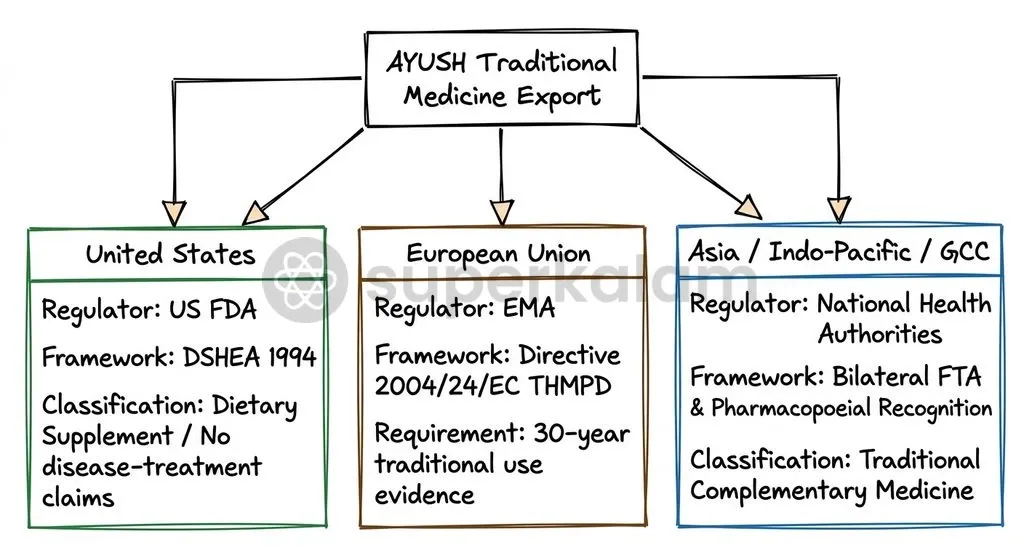
Western regulatory bodies like the United States Food and Drug Administration classify Ayurvedic formulations predominantly as dietary supplements rather than therapeutic medicines. This classification stems from differing clinical proof requirements. It restricts manufacturers from making formal therapeutic claims on product labels in major overseas jurisdictions.
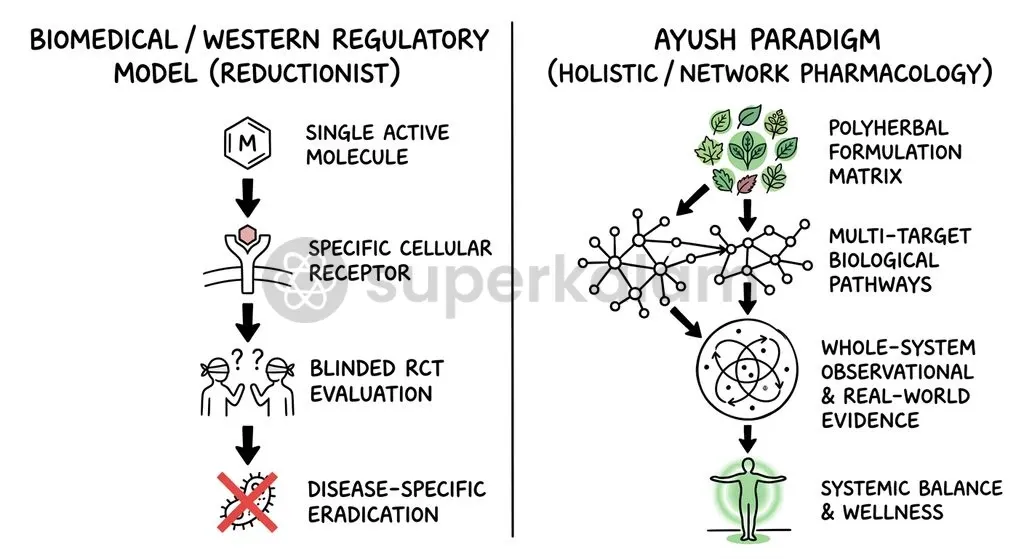
Conventional pharmaceutical evaluation relies on reductionist biomedical models that isolate single active ingredients. These ingredients are then tested through double-blind Randomized Controlled Trials (RCTs). In contrast, traditional systems function on complex polyherbal formulations, individualised treatments, and synergistic biological actions that do not easily fit standard clinical trial designs.
The World Health Organization's 'General Guidelines for Methodologies on Research and Evaluation of Traditional Medicine' explicitly recognise that standard double-blind RCTs face methodological limitations when evaluating holistic, individualised, and polyherbal traditional therapies.
| Feature / Dimension | Conventional Biomedical Paradigm | AYUSH Traditional Medical Paradigm |
|---|---|---|
| Epistemic Model | Reductionist; isolates single active molecules | Holistic; relies on synergistic polyherbal matrix |
| Validation Standard | Double-blind Randomized Controlled Trials (RCTs) | Documented classical use, observational trials, holistic outcomes |
| Treatment Approach | Standardised drug dosing for specific pathologies | Highly individualised therapy based on constitution |
| Western Classification | Prescription drug or over-the-counter therapeutic medicine | Dietary supplement or traditional herbal remedy |
Discuss with Superkalam
Explain how the inclusion of Ayurveda, Siddha, and Unani in WHO's ICD-11 Module 2 helps overcome non-tariff trade and insurance barriers globally.
Ask NowSetting Global Standards: The Role of WHO Benchmarks and ICD-11
The World Health Organization launched the ICD-11 Traditional Medicine Module 2 in January 2024 to standardise disease classification and diagnostic terminology for Ayurveda, Siddha, and Unani systems. This digital diagnostic integration enables hospitals and clinicians worldwide to record traditional diagnoses in electronic health records using globally recognised morbidity codes.
Standardisation extends across clinical practice, professional qualifications, and medical interventions:
- Practice and Training Benchmarks: The World Health Organization published updated WHO Benchmarks for the Training of Ayurveda and WHO Benchmarks for the Practice of Ayurveda in 2022 to establish global minimum reference standards for safety, competency, qualification, and practitioner regulation.
- Intervention Classification: The Ministry of Ayush and the World Health Organization signed an agreement on May 24, 2025, to develop a dedicated Traditional Medicine module under the International Classification of Health Interventions (ICHI).
- Insurance Harmonisation: Standardised classification codes under ICD-11 and ICHI establish the evidentiary base necessary for international health insurance providers to process claims for traditional treatments.
Key Hurdles: Safety Standards, Clinical Trials, and Non-Tariff Barriers
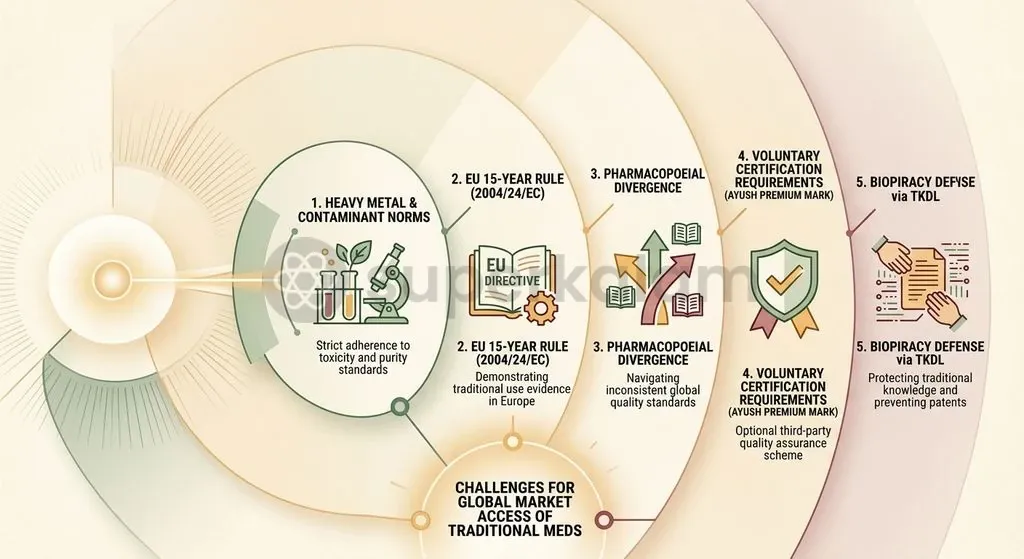
Non-tariff regulatory barriers imposed by foreign trade authorities pose severe challenges to the international commercialisation and export of Indian AYUSH pharmaceutical formulations. These barriers stem from strict domestic pharmaceutical legislation, quality variations, and divergent pharmacopoeial benchmarks.
Major compliance and institutional bottlenecks include:
- Stringent European Directives: The European Union Traditional Herbal Medicinal Products Directive (Directive 2004/24/EC) mandates proof of 30 years of traditional medicinal use, including at least 15 years within the EU, creating a major non-tariff regulatory barrier for Indian proprietary Ayurvedic polyherbal formulations.
- Contaminant Limits: Western import regulators enforce stringent permissible limits on heavy metals (lead, arsenic, mercury, cadmium) and pesticide residues, which frequently restricts export shipments of classical mineral-herb preparations.
- Pharmacopoeial Harmonisation Gaps: The Pharmacopoeia Commission for Indian Medicine & Homoeopathy (PCIM&H) and the Indian Pharmacopoeia Commission (IPC) signed a memorandum of understanding to implement the 'One Herb, One Standard' initiative to harmonise standards across traditional and modern pharmacopoeias.
- Certification Bottlenecks: The Quality Council of India (QCI) in collaboration with the Ministry of Ayush administers the Voluntary Certification Scheme for Ayush Products, offering the Ayush Standard Mark for domestic compliance and the Ayush Premium Mark based on WHO-GMP norms for export markets.
- Biopiracy and Patent Misappropriation: The Traditional Knowledge Digital Library (CSIR-TKDL), established in 2001 jointly by CSIR and the Ministry of Ayush, documents over 5.2 lakh formulations and practices from Ayurveda, Unani, Siddha, Sowa-Rigpa, and Yoga in five international languages to defend against wrongful patent grants. Evidence drawn from the TKDL database has led to more than 375 patent applications worldwide being revoked, cancelled, amended, rejected, or abandoned across international patent offices.
Discuss with Superkalam
Compare the biomedical drug evaluation framework with traditional polyherbal validation standards. Why do conventional double-blind RCTs face limitations when applied to classical AYUSH formulations?
Ask NowHow Global Markets Treat Traditional Systems: US, EU, and Asia Compared
International markets maintain disparate regulatory classifications for traditional medicine. This divergence creates a fragmented landscape for Indian manufacturers seeking global market approval. Operating across these distinct jurisdictions requires tailored commercial and legal compliance strategies.
To facilitate regulatory alignment in North America, the Pharmacopoeia Commission for Indian Medicine & Homoeopathy (PCIM&H) entered into scientific cooperation MoUs with the United States Pharmacopeial Convention (USP) and the American Herbal Pharmacopoeia (AHP). These agreements develop science-based public standards for traditional herbal monographs.
| Region / Jurisdiction | Primary Regulatory Authority | Legal Classification of AYUSH Products | Key Market Access Hurdle |
|---|---|---|---|
| United States | US Food and Drug Administration (US FDA) | Dietary Supplements (DSHEA framework) | Prohibition on making therapeutic or disease-curing claims on labels |
| European Union | European Medicines Agency (EMA) | Traditional Herbal Medicinal Products (Directive 2004/24/EC) | Requirement of 15 years of documented usage within the EU |
| West Asia & Indo-Pacific | National Ministries of Health / Trade Regulators | Complementary Medicine / Bilateral Annex Recognition | Harmonisation of import testing norms and heavy metal residue clearances |
Discuss with Superkalam
Design a policy strategy for the Ministry of Ayush to overcome stringent Western market regulations (such as EU Directive 2004/24/EC) while safeguarding traditional knowledge.
Ask NowWay Forward: Merging Traditional Knowledge with Modern Scientific Validation
Mainstreaming AYUSH globally requires the Ministry of Ayush to pursue scientific validation, mutual recognition agreements, and digital health integration across multilateral forums. Bridging the gap between ancient clinical observation and modern analytical rigor remains essential.
Key strategic imperatives include:
- Standardising Herbal Monographs: Accelerating the 'One Herb, One Standard' initiative while expanding scientific cooperation between PCIM&H, the US Pharmacopeial Convention, and European regulatory authorities to establish mutually recognised botanical quality profiles.
- Expanding Mutual Recognition Agreements (MRAs): Leveraging bilateral trade negotiations to establish mutual recognition of the Ayush Premium Mark and Good Manufacturing Practices (GMP) to bypass redundant import quality testing.
- Promoting Reverse Pharmacology: Utilising modern pharmacological and genomic tools to study documented classical formulations, validating clinical efficacy without compromising traditional holistic concepts.
- Scaling Multilateral Health Coding: Integrating the ICD-11 Traditional Medicine Module 2 and ICHI classifications into national and international electronic health records to facilitate insurance reimbursement.
- Strengthening Intellectual Property Protection: Broadening international patent office access agreements with the CSIR-TKDL while defending indigenous bio-resources under the Nagoya Protocol and domestic biodiversity legislation.
Key Takeaways
- India has anchored its traditional health diplomacy in multilateral institutions, committing 250 million US dollars to establish the WHO Global Centre for Traditional Medicine in Jamnagar, Gujarat.
- AYUSH and herbal exports reached 688.89 million US dollars in fiscal year 2024–25, supported by formal traditional medicine annexes in the India–Oman CEPA and India–New Zealand FTA.
- The launch of the ICD-11 Traditional Medicine Module 2 in January 2024 and the 2025 ICHI partnership standardise diagnostic terminology and intervention coding for Ayurveda, Siddha, and Unani systems globally.
- Major non-tariff barriers persist in Western markets, notably the EU Directive 2004/24/EC requiring 15 years of documented use within the EU and US FDA rules classifying formulations as dietary supplements.
- Defensive intellectual property mechanisms via the CSIR-TKDL database protect over 5.2 lakh traditional formulations, successfully thwarting over 375 wrongful patent claims internationally.
Mains Question
"Non-tariff regulatory barriers and epistemic divergences between holistic traditional formulations and reductionist biomedical trial standards remain the primary bottlenecks in globalizing AYUSH." Critically examine. (150 words) (10 Marks)
Evaluate NowMains Question
India's traditional health diplomacy strategically combines multilateral institutional partnerships, intellectual property safeguards, and standard-setting to project soft power and expand trade. Elucidate with reference to recent initiatives under the Ministry of Ayush and the World Health Organization. (250 words) (15 Marks)
Evaluate NowPractice MCQs
QUESTION 1
With reference to the international standardisation and classification of traditional medicine systems, consider the following statements:
- The ICD-11 Traditional Medicine Module 2 was launched to standardise diagnostic terminology for Ayurveda, Siddha, and Unani systems.
- The European Union Directive 2004/24/EC permits the marketing of traditional herbal medicines based solely on a minimum of 10 years of documented use outside the European Union.
- The Traditional Knowledge Digital Library (CSIR-TKDL) was established jointly by CSIR and the Ministry of Ayush to prevent the grant of erroneous patents on Indian traditional knowledge.
Which of the statements given above are correct?
QUESTION 2
Consider the following statements regarding institutional mechanisms supporting AYUSH globalization:
- The permanent WHO Global Centre for Traditional Medicine (WHO GCTM) is established in Jamnagar, Gujarat.
- The 'One Herb, One Standard' initiative is an MoU between the Pharmacopoeia Commission for Indian Medicine & Homoeopathy (PCIM&H) and the Indian Pharmacopoeia Commission (IPC).
- The Ayush Premium Mark is administered to certify products complying strictly with domestic standards, whereas the Ayush Standard Mark is based on WHO-GMP norms for export markets.
Which of the statements given above is/are correct?
QUESTION 3
With reference to India's traditional health diplomacy and trade integration, consider the following statements:
- Dedicated annexes covering traditional medicine have been incorporated into trade agreements like the India–Oman CEPA.
- The Ministry of Home Affairs introduced the Ayush (AY) Visa category to facilitate foreign nationals seeking traditional medical treatments in India.
- In Western markets such as the United States, Ayurvedic formulations are officially classified as therapeutic prescription drugs rather than dietary supplements.
Which of the statements given above is/are correct?
QUESTION 4
The 'Gujarat Declaration', adopted at the First WHO Traditional Medicine Global Summit in Gandhinagar, primarily focuses on which of the following?
QUESTION 5
Consider the following statements regarding the Traditional Knowledge Digital Library (CSIR-TKDL):
- It documents classical formulations and practices across Ayurveda, Unani, Siddha, Sowa-Rigpa, and Yoga in five international languages.
- Evidence drawn from TKDL has resulted in over 375 patent applications being revoked, cancelled, amended, rejected, or abandoned globally.
Which of the statements given above is/are correct?