Global Bond Yields: Why US Rates Are Surging as China's Yields Plunge
As opposing monetary cycles push US yields above 5% and China to record lows, emerging economies face mounting capital outflow pressures and currency risks.
Oct, 2026
•9 min read

Overview
Sovereign bond markets across the world are experiencing a sharp structural divergence. Benchmark 10-year US Treasury yields surged above 5.0% on persistent inflation and fiscal expansion. Meanwhile, China’s 10-year sovereign bond yield plunged to historic lows of approximately 1.65% to 1.68% amid domestic deflationary pressures and real estate weakness.
This cross-border decoupling reflects two opposing macroeconomic realities. Western central banks tightened liquidity to anchor inflation expectations. Conversely, Chinese authorities are implementing counter-cyclical monetary easing to revive aggregate demand.
The resulting yield differential compresses risk premia across emerging markets. This shift creates capital-outflow friction for economies like India while complicating exchange-rate management and domestic debt servicing.
Why Are Bond Markets Moving in Opposite Directions?
Global sovereign debt markets have fractured because advanced economies and China are operating in opposed macroeconomic cycles. In the United States and Europe, central banks have maintained elevated policy rates to counter sticky core inflation. Conversely, the People's Bank of China faces persistent consumer deflationary pressures and weak domestic aggregate demand, prompting repeated cuts to benchmark lending rates.
This policy divergence has pushed the yield spread between 10-year US Treasuries and 10-year Chinese sovereign bonds to over 340-350 basis points. Two opposing debt and balance-sheet dynamics account for this spread:
- Western debt supply: Governments continue to issue substantial debt volumes to finance widening fiscal deficits, forcing investors to demand a higher term premium to absorb long-dated paper.
- Chinese flight to safety: An acute shortage of safe, high-yielding private assets produced the opposite outcome. Capital flowed into sovereign paper, which lifted bond prices and pushed yields down.
Discuss with Superkalam
Recall the historic low yield range reached by China's benchmark 10-year government bond as mentioned in the article.
Ask NowBond Prices and Yields: How the Seesaw Works
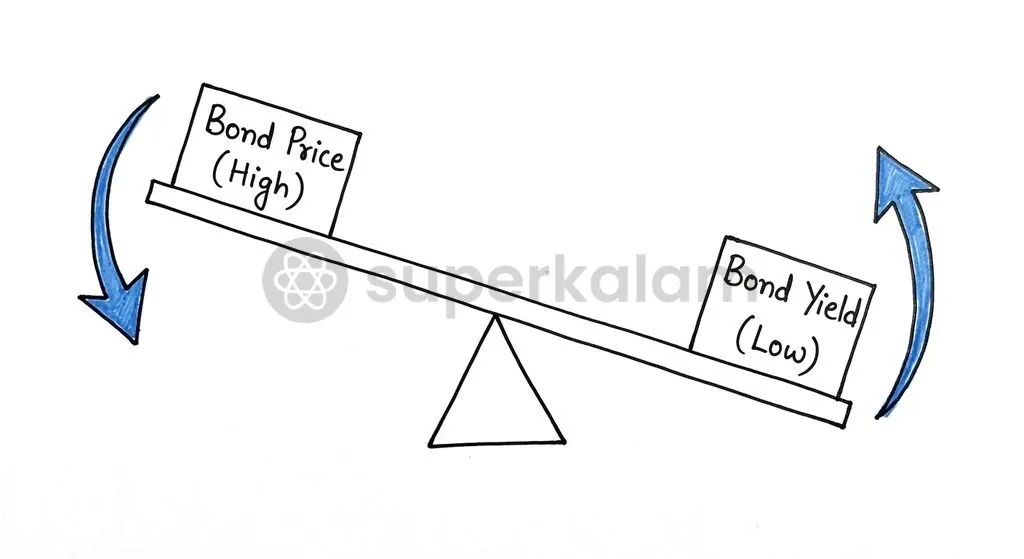
A sovereign bond pays a fixed coupon rate set at issuance. This mechanism establishes an inverse mathematical relationship between its secondary-market trading price and its effective yield. When secondary market demand drives a bond's price above its par value, the effective yield must fall inversely to equalise fixed annual cash flows with prevailing market returns.
| Market Interest Rate Shift | Coupon on New Issuance | Older Bond Secondary Prices | Older Bond Effective Yields |
|---|---|---|---|
| Rates Rise | New bonds offer higher coupons | Older bond prices drop | Effective yields rise to match benchmarks |
| Rates Fall | New bonds offer lower coupons | Older bond prices rise | Effective yields fall to match benchmarks |
(Note: As established by the Reserve Bank of India, this mechanism ensures existing debt remains competitive against new issuances.)
When benchmark interest rates rise, newly issued government debt carries higher coupon payments. Consequently, older bonds bearing lower coupons become less attractive, causing their secondary-market prices to drop until their effective yield matches prevailing benchmarks.
Bonds with longer maturities carry greater duration risk, meaning their market prices fluctuate significantly more in response to interest rate shifts than short-term instruments. When policy rates shift abruptly, institutions holding heavy portfolios of long-dated paper face steep mark-to-market valuation adjustments.
The Global Surge: High Inflation, Rate Hikes, and Tight Money
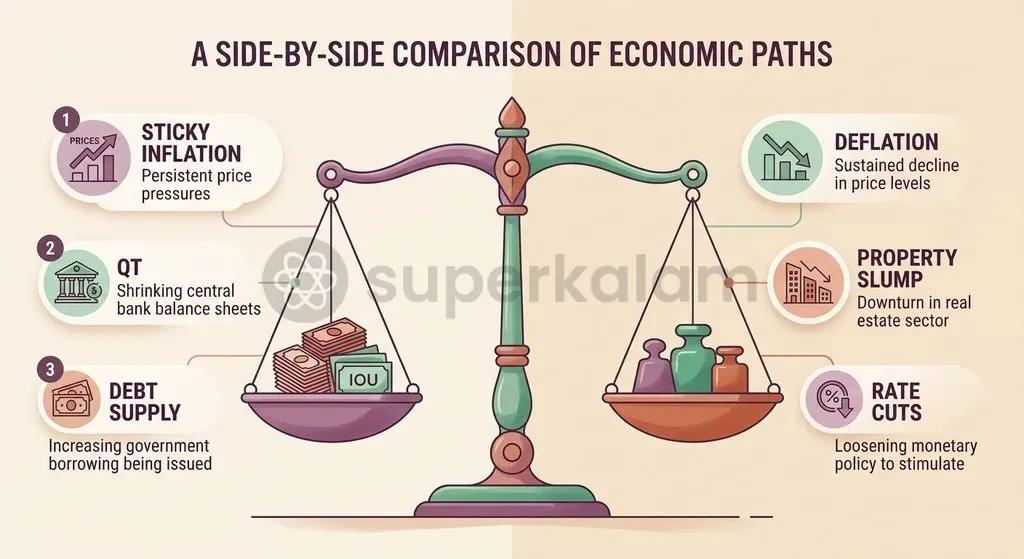
The United States Federal Reserve led advanced-economy central banks through an aggressive monetary tightening cycle to tame post-pandemic consumer inflation. Sticky core inflation and sustained policy rate increases spurred balance sheet runoff, known as Quantitative Tightening. Together, these pressures drove the 10-year US Treasury yield above 5.0%.
Three compounding forces reinforced this sovereign yield spike:
- Elevated policy rates: Central banks kept policy borrowing rates restrictive to anchor inflation expectations.
- Expanding debt supply: Substantial sovereign bond issuance to finance widening federal deficits required institutional buyers to demand a higher term premium before absorbing long-dated Treasuries.
- Quantitative Tightening: With the Federal Reserve shrinking its asset holdings rather than absorbing new issuance, private capital markets have had to clear the supply overhang.
This dynamic has kept global capital costs elevated, raising the risk-free hurdle rate for corporate and sovereign borrowers worldwide.
Discuss with Superkalam
Explain how the mathematical 'seesaw' mechanism equalises the effective yield of an older fixed-coupon bond when market interest rates rise.
Ask NowThe China Exception: Deflation Risks, Property Slump, and Rate Cuts
China’s macroeconomic trajectory has diverged sharply from the West as domestic balance-sheet deleveraging replaced inflationary pressures. China's ongoing property market contraction and debt restructurings across major property developers have depressed domestic real estate investment and eroded consumer household wealth.
Weak domestic aggregate demand and persistent consumer deflationary pressures prompted the People's Bank of China to implement counter-cyclical monetary easing and lower benchmark lending rates. Depressed bank deposit rates and equity market volatility left savers with few high-yielding alternatives. Commercial banks and retail investors consequently channelled massive liquidity into sovereign paper. As of October 2026, China's benchmark 10-year government bond yield dropped to historical lows of approximately 1.65% to 1.68%.
| Economic Indicator / Metric | United States & Western Economies | China |
|---|---|---|
| Dominant Inflationary Dynamic | Sticky core inflation above policy targets | Persistent consumer deflationary pressures |
| Monetary Policy Stance | Elevated policy rates; balance sheet runoff | Counter-cyclical easing; benchmark rate cuts |
| 10-Year Sovereign Yield Range | Exceeded 5.0% during tightening cycle | Dropped to historic lows of 1.65% to 1.68% |
| Primary Debt Driver | Heavy supply to fund widening fiscal deficits | Massive flight to safety into sovereign paper |
| Private Sector Behaviour | Resilient corporate borrowing demand | Real estate contraction and household wealth erosion |
This relentless sovereign bond rally raised operational alarm in Beijing. The People's Bank of China warned that excessively low long-term yields create systemic duration risks for financial institutions. The bank drew explicit parallels to the balance-sheet vulnerabilities that collapsed Silicon Valley Bank. To steepen the yield curve, the central bank initiated secondary-market operations to borrow long-dated government bonds from primary dealers and sell them into the open market.
Side-by-Side: Western Central Banks vs The People's Bank of China
The operational divergence between the US Federal Reserve and the People's Bank of China illustrates the clash between price-stability mandates and balance-sheet repair. Western central banks prioritised anchoring medium-term inflation expectations by restricting banking liquidity. The People's Bank of China, by contrast, focused on lowering real financing costs across a sluggish domestic economy.
These conflicting monetary stances have produced an unprecedented distortion in global cross-border capital flows:
- Widening Yield Spreads: The spread between 10-year US Treasuries and 10-year Chinese government paper expanded beyond 340 to 350 basis points, drawing global capital toward dollar assets.
- Asymmetric Currency Pressures: The US dollar strengthened against major peers, while the PBOC had to balance domestic interest rate cuts against downward pressure on the renminbi.
- Yield Curve Interventions: While the Fed allowed balance-sheet runoff to lift long-term rates, the PBOC stepped into the secondary market as a bond seller to halt runaway yield declines and steepen the yield curve.
Discuss with Superkalam
If the yield spread between Indian G-Secs and US Treasuries narrows further from 228 basis points, how would portfolio managers likely reallocate capital between domestic and US assets?
Ask NowWhat This Divergence Means for India and the Rupee
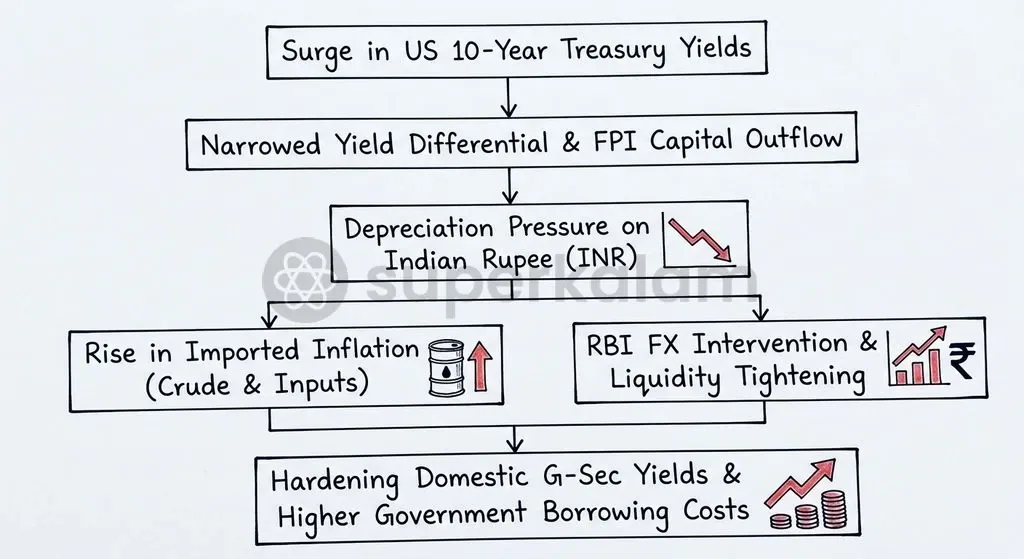
The Reserve Bank of India faces significant monetary transmission and external-sector headwinds generated by elevated US Treasury yields. A surge in risk-free US yields compresses the risk premium of emerging market assets, triggering capital flight by Foreign Portfolio Investors seeking safe dollar returns.
Outflows from Indian equities and debt instruments lift spot demand for US dollars. This shift exerts depreciation pressure on the Indian Rupee and widens India's imported inflation burden. As of October 2026, the yield spread between India's 10-year benchmark Government Security and 10-year US Treasuries narrowed to approximately 228 to 230 basis points, down from historical averages of 350 to 400 basis points.
- US yields rise: Benchmark Treasury yields climb on elevated policy rates and federal debt issuance.
- Risk premium compresses: The yield buffer between Indian G-Secs and US Treasuries narrows sharply.
- FPI outflows accelerate: Foreign portfolio investors reallocate capital toward dollar-denominated assets.
- Rupee faces pressure: Rising spot demand for dollars depreciates the domestic currency.
- Imported inflation widens: Currency depreciation increases landing costs for essential imports like crude oil.
Higher international yields spill directly into domestic debt markets. India's 10-year benchmark sovereign G-Sec yield traded near 7.38% to 7.40% in mid-October 2026 under pressure from elevated global yields and crude oil price risks.
Hardening domestic sovereign bond yields increase borrowing costs for both Central and State governments, expanding debt servicing obligations across the fiscal deficit. Concurrently, elevated G-Sec yields raise the risk-free hurdle rate, driving up commercial bank lending rates for private corporate borrowers.
Managing the Fallout: Policy Options for Emerging Economies
The Reserve Bank of India possesses multiple statutory and operational tools to insulate domestic liquidity and bond yields from external volatility. Under Section 17(8) of the Reserve Bank of India Act, 1934, the central bank is legally empowered to purchase and sell Central and State government securities via Open Market Operations to stabilise sovereign borrowing costs.
To manage yield curve distortions without expanding aggregate money supply, emerging central banks deploy specific liquidity mechanisms:
- Operation Twist Auctions: Under Operation Twist, the central bank simultaneously buys long-term government securities and sells an equivalent volume of short-term paper via open market auctions. This operation flattens the yield curve by lowering long-term borrowing costs for capital investment while keeping the central bank's aggregate balance sheet size unchanged.
- Foreign Exchange Interventions: The RBI conducts net US dollar sales in spot and forward currency markets to curb excessive rupee volatility driven by widening international yield differentials.
- Liquidity Adjustment Facility Calibrations: The central bank deploys Variable Rate Repo and Variable Rate Reverse Repo auctions under the LAF window to align overnight money-market rates with the prevailing policy repo rate.
Discuss with Superkalam
Compare the underlying drivers that caused US central bankers to shrink balance sheets with the factors driving the PBOC to ease monetary policy.
Ask NowKey Takeaways
- An inverse relationship governs bond prices and yields: when market interest rates rise, older lower-coupon bonds drop in price, pushing effective yields up until they match prevailing benchmarks.
- Benchmark 10-year US Treasury yields climbed above 5.0% due to persistent inflation, Quantitative Tightening, and massive federal debt issuance requiring higher term premia.
- In contrast, China's 10-year sovereign bond yield plunged to historical lows of approximately 1.65% to 1.68% as of October 2026, driven by real estate contraction, consumer deflation, and safe-haven buying.
- The monetary divergence widened the yield spread between 10-year US Treasuries and Chinese government bonds to more than 340-350 basis points.
- India's 10-year G-Sec yield traded near 7.38% to 7.40% in mid-October 2026, compressing its spread over US Treasuries to 228-230 basis points and exerting depreciation pressure on the Rupee.
- To counter excessive market volatility, the Reserve Bank of India uses statutory powers under Section 17(8) of the RBI Act, 1934, deploying Open Market Operations, Operation Twist, and targeted foreign exchange sales.
Mains Question
"The structural divergence between Western monetary tightening and Chinese counter-cyclical easing illustrates how domestic balance-sheet conditions dictate sovereign debt yields." Elucidate. (10 Marks)
Evaluate NowMains Question
"A narrowing yield spread between advanced-economy benchmarks and domestic sovereign paper poses severe external-sector vulnerabilities for emerging markets." In light of this statement, critically analyse the macroeconomic implications for India when the US Treasury-G-Sec yield spread compresses. (15 Marks)
Evaluate NowPractice MCQs
QUESTION 1
With reference to the dynamics of sovereign bond markets, consider the following statements:
- A rise in benchmark market interest rates causes secondary-market prices of existing fixed-coupon bonds to fall.
- Bonds with longer maturities carry lower duration risk compared to short-term debt instruments.
- When secondary market demand drives a bond's price above par, its effective yield declines to equalize cash flows with prevailing market returns. Which of the statements given above are correct?
QUESTION 2
Consider the following statements regarding the monetary operations of the People's Bank of China (PBOC):
- To counter deflationary pressures, the PBOC implemented counter-cyclical monetary easing and benchmark lending rate cuts.
- Excessively low long-term yields prompted the PBOC to purchase long-dated government bonds in open market operations to lower borrowing costs further.
- The PBOC initiated operations to borrow long-dated government bonds from primary dealers and sell them to steepen the yield curve. Which of the statements given above is/are correct?
QUESTION 3
With reference to the transmission of global interest rate movements to emerging economies like India, consider the following statements:
- A rise in US Treasury yields compresses the risk premium of emerging market sovereign assets.
- A narrowing yield spread between domestic government securities and US Treasuries typically accelerates Foreign Portfolio Investor (FPI) inflows into domestic debt.
- Currency depreciation resulting from capital outflows exacerbates imported inflation through higher landing costs for essential commodities. Which of the statements given above is/are correct?
QUESTION 4
Which of the following factors contributed to the benchmark 10-year US Treasury yield surging above 5.0%?
- Sustained policy rate hikes to anchor inflation expectations.
- Substantial issuance of sovereign debt to fund widening federal fiscal deficits.
- Quantitative Tightening through Federal Reserve balance sheet runoff. Select the correct answer using the code given below:
QUESTION 5
In the context of sovereign bond markets, what does the term 'duration risk' refer to?