India's GDP Base Year Revision: What Changed and Why
India's GDP revision lowers nominal estimates by 2.7-3.8% for 2022-25 as a new base year, data sources and methods reshape the national accounts.
Sep, 2026
•9 min read

Overview
The Ministry of Statistics and Programme Implementation officially updated India's national accounts series on 27 February 2026. This exercise shifted the Gross Domestic Product base year from 2011–12 to 2022–23 to reflect structural economic transformations.
The 26-member Advisory Committee on National Accounts Statistics, chaired by Prof. Biswanath Goldar, guided this rebasing work. The revision recalibrates economic measurement by embedding direct survey findings and modern tax records.
The 2022–23 base revision represents a statistical recalibration rather than an artificial shift in underlying momentum. It improves sectoral measurement through double deflation and direct database integration. By capturing digital trade, current household consumption, and unincorporated enterprise output, the new series aligns India with UN SNA 2008 standards.
Why in the News? The Shift to Base Year 2022-23
The Ministry of Statistics and Programme Implementation (MoSPI) released the new National Accounts series on 27 February 2026, updating the Gross Domestic Product base year from 2011–12 to 2022–23. This rebasing exercise was guided by the 26-member Advisory Committee on National Accounts Statistics (ACNAS), chaired by Prof. Biswanath Goldar.
As of February 2026, the updated series replaces outdated 2011–12 price benchmarks with current economic realities, according to the PIB Press Release on the New GDP Series. Key background factors include:
- Selection of FY 2022–23: Chosen because it represents a stable post-pandemic year free from major economic shocks.
- Exclusion of FY 2017–18 to FY 2021–22: Deemed unsuitable by statistical authorities due to transitional disruptions from the Goods and Services Tax roll-out and COVID-19 pandemic distortions.
- Growth trajectory under new series: Real GDP grew by 7.2% in FY 2023–24 and 7.1% in FY 2024–25, with FY 2025–26 growth estimated at 7.6%, according to MoSPI provisional estimates.
- On 22 September 2026, MoSPI released the Sources and Methods for Compilation of National Accounts Statistics publication - the consolidated account of concepts, definitions, data sources and compilation practices behind the 2022-23 series. At seven months after the series, it is the fastest such release.
Discuss with Superkalam
Which committee and chairperson recommended the shift to the 2022–23 GDP base year?
Ask NowWhat Is a GDP Base Year and Why Must It Change Regularly?
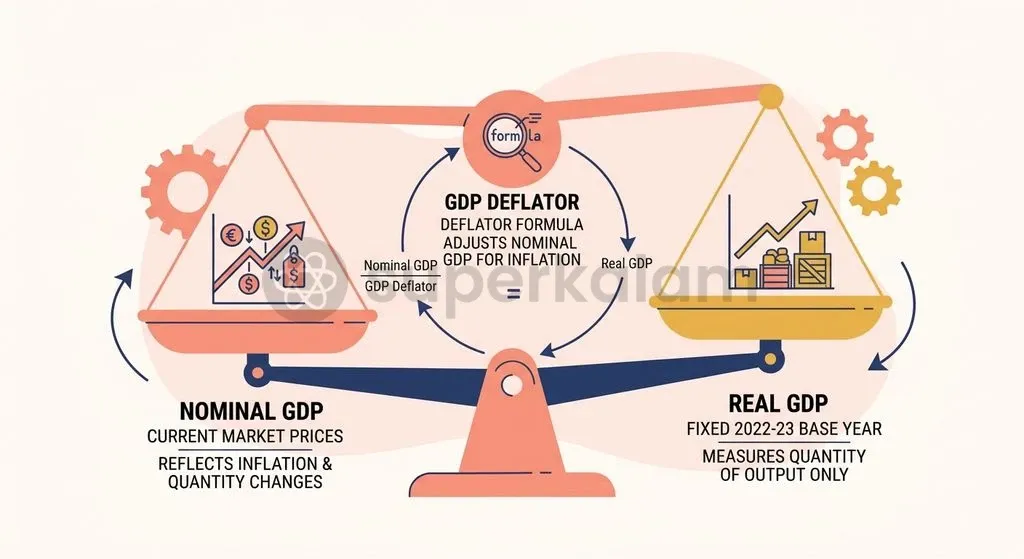
A base year provides a constant price benchmark in national income accounting. It isolates real physical production changes from price inflation. When calculating Gross Domestic Product (GDP), economic output can be valued at current market prices or constant base-period prices.
National statistical systems distinguish between two core measures of economic size, as detailed in the MoSPI FAQ on the New Series of GDP:
- Nominal GDP: Measures total goods and services produced in an economy valued at current market prices, reflecting both volume changes and prevailing price inflation.
- Real GDP: Measures total output valued at fixed base-year prices, stripping out inflation to reflect physical volume expansion.
- GDP Deflator: A comprehensive price index derived as the ratio of Nominal GDP to Real GDP multiplied by 100, measuring economy-wide price level changes across all produced domestic goods and services.
Economic structures evolve quickly as new industries emerge, consumer habits shift, and technology develops. According to the PIB Press Note on National Accounts, the 2011–12 series failed to capture modern economic drivers, including digital platforms, gig work, and renewable energy.
Without periodic rebasing, national accounts assign disproportionate weights to declining sectors. At the same time, they undercount high-growth modern activities.
How India Calculates GDP: Evolution from Factor Cost to Market Prices
India compiles national income estimates using the internationally harmonised System of National Accounts framework developed by the United Nations. In the 2011–12 revision, the Central Statistics Office shifted from reporting GDP at Factor Cost to GDP at Basic Prices and Market Prices. This brought Indian accounting into line with UN SNA 2008 standards.
Understanding the production and market valuation sequence is essential for macroeconomic analysis:
- Gross Value Added (GVA) at Basic Prices: Represents the net output generated by domestic producers, calculated as total gross output value minus intermediate consumption (inputs used in production), plus net production taxes (production taxes minus production subsidies).
- GDP at Market Prices: Measures the final market value of all goods and services, calculated as GVA at Basic Prices plus net product taxes (product taxes such as GST minus product subsidies like food and fertiliser subsidies).
Adherence to the International Monetary Fund's Special Data Dissemination Standard (SDDS) ensures statistical transparency, periodicity, and advance release calendars across these national metrics.
Discuss with Superkalam
Why does single deflation distort real value added when input and output prices diverge?
Ask NowKey Methodological Shifts: Comparing 2011-12 Base with 2022-23 Base
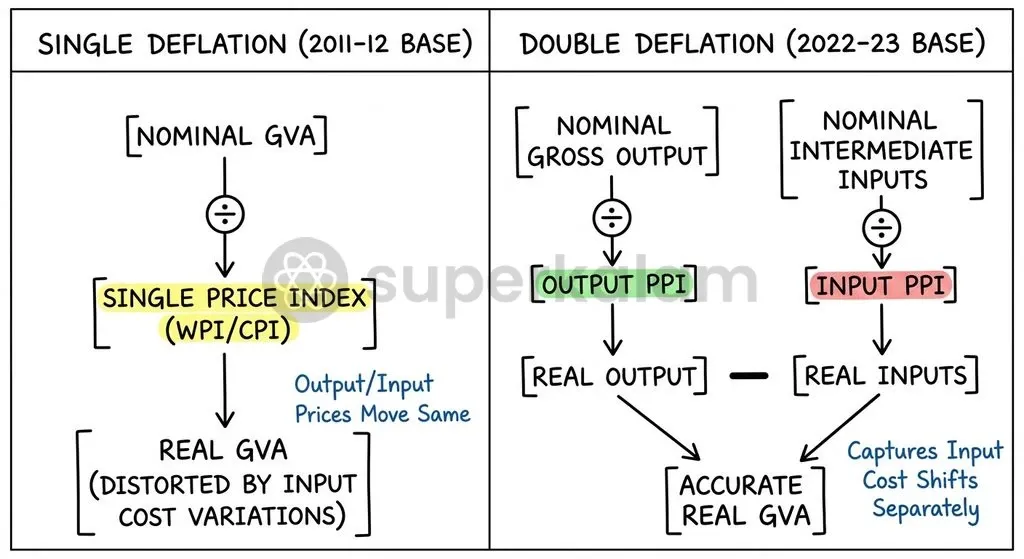
The 2022–23 base series introduces double deflation for manufacturing and agriculture, replacing the single deflation methodology used in the 2011–12 series. In national accounting, single deflation adjusts nominal value added using a single output price index. This distorts real value added when input costs fluctuate independently from output prices.
Double deflation deflates gross output and intermediate inputs separately using specific output and input price indices, as outlined in the PIB Press Release on the New GDP Series. To support this framework, MoSPI developed dedicated Producer Price Indices (PPI) and Banking Services Price Indices (BkSPI) anchored to the 2022–23 base year.
| Accounting Dimension | 2011–12 Base Series | 2022–23 Base Series |
|---|---|---|
| Deflation Method | Single deflation applied across value added | Double deflation in manufacturing and agriculture |
| Deflator Sources | Heavy reliance on aggregate WPI and CPI | Dedicated PPI, BkSPI, and item-group level deflators |
| Informal Sector Data | Fixed historical benchmark extrapolations | Annual Survey of Unincorporated Sector Enterprises (ASUSE) |
| Labour Market Inputs | Decennial Employment-Unemployment Surveys | Annual Periodic Labour Force Survey (PLFS) data |
| Consumption Weights | 2011–12 Consumer Expenditure Survey | Consecutive HCES rounds (2022–23 and 2023–24) |
| Accounting Standard | Initial alignment with UN SNA 2008 | UN SNA 2008 compliant with groundwork for SNA 2025 |
For economic sectors where double deflation cannot yet be fully implemented, the revised compilation framework applies single volume extrapolation or item-group-level CPI and WPI deflators rather than broad aggregate indices.
As of the September 2026 Sources and Methods release, double deflation covers 28 of 30 manufacturing categories; the two remaining, with high imported inputs, do not use it yet. The revision was steered by ACNAS through four sub-committees (new data sources, methodological improvement, constant price estimates and regional accounts), with consultations across academia, experts, government departments, NITI Aayog and the IMF.
Data Sources and Upgrades: Incorporating GST, MCA-21, and HCES Data
The National Statistical Office expanded its direct data infrastructure by integrating corporate filings, electronic tax invoices, and comprehensive household surveys. Historical revisions often relied on static extrapolation ratios. The 2022–23 series replaces these assumptions with dynamic administrative databases and annual surveys.
MoSPI integrated several high-frequency and structural data streams into the compilation pipeline:
- Goods and Services Tax Network (GSTN): Granular electronic tax invoice records provide near real-time transaction tracking across formal supply chains.
- MCA21 Database: Financial balance sheets filed by corporate entities with the Ministry of Corporate Affairs improve organised enterprise measurement.
- Annual Survey of Unincorporated Sector Enterprises (ASUSE): Direct annual survey data captures the economic contribution of unincorporated and informal non-agricultural enterprises, avoiding outdated proxy multipliers.
- Periodic Labour Force Survey (PLFS): Annual employment metrics and workforce distribution matrices directly inform household-sector Gross Value Added calculations.
- Household Consumption Expenditure Survey (HCES): Private Final Consumption Expenditure (PFCE) weights have been recalibrated using consecutive HCES surveys conducted in 2022–23 and 2023–24.
To ensure internal consistency across these varied data inputs, MoSPI embedded the Supply and Use Table (SUT) framework into compilation routines. The SUT framework balances industry production with final product demand, effectively minimising statistical discrepancies between production-side and expenditure-side GDP estimates. Private Final Consumption Expenditure (PFCE) now follows the COICOP 2018 classification framework.
Discuss with Superkalam
If a country's nominal GDP denominator contracts by 3% while sovereign debt remains unchanged, how does this affect its debt-to-GDP ratio?
Ask Now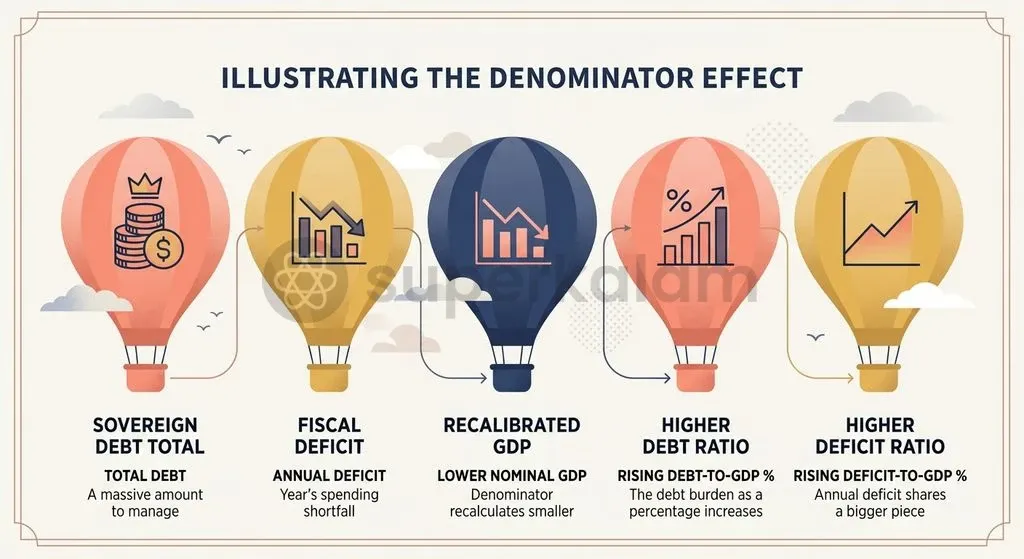
Challenges and Historical Controversies in National Accounting Revisions
National accounts revisions often encounter operational and analytical challenges regarding data continuity and historical comparability. When the 2011–12 series was introduced in 2015, economists debated the divergence between corporate financial data from MCA21 and physical volume indicators like the Index of Industrial Production (IIP).
The transition to the 2022–23 base faces distinct technical and policy hurdles:
- Historical Back-Series Publication: Constructing long-term time series requires rigorous methodology. MoSPI has scheduled the release of the official historical back-series for December 2026, applying revised micro-methodologies back to 2011–12 and statistical splicing techniques back to 1950–51.
- Informal Sector Volatility: Integrating annual ASUSE and PLFS data increases data sensitivity to informal economic cycles, requiring careful seasonal adjustments.
- Fiscal Target Adjustments: Policymakers operating under the Fiscal Responsibility and Budget Management (FRBM) targets must accommodate denominator-induced ratio shifts without tightening fiscal policy unnecessarily.
Discuss with Superkalam
How does integrating direct survey data like ASUSE and PLFS alter the measurement of the informal economy compared to historical proxy extrapolations?
Ask NowWay Forward: Building Robust, Real-Time Statistical Systems
Modernising India's statistical architecture requires institutional independence, high-frequency survey cadences, and full alignment with evolving international accounting standards. Upgrading national income accounting is an ongoing task rather than an isolated decennial event.
To enhance national economic data credibility, policy measures should focus on key institutional reforms:
- Empowering the National Statistical Commission: Strengthening the statutory standing of the National Statistical Commission (NSC) will provide autonomous oversight over statistical methodologies across government ministries.
- Transition to UN SNA 2025: Building institutional capability to implement the upcoming UN SNA 2025 standards will ensure international comparability, particularly regarding digital assets, natural capital accounting, and data value chains.
- Harmonising Administrative and Survey Data: Establishing automated validation protocols between GSTN invoice records, MCA21 filings, and physical production indices will reduce statistical discrepancies.
- Institutionalising Fixed Rebasing Cycles: Adopting a mandatory five-year revision cycle will prevent structural disconnects and eliminate the need for decade-long base updates.
Key Takeaways
- MoSPI officially updated India's GDP base year from 2011–12 to 2022–23 on 27 February 2026, guided by the Advisory Committee on National Accounts Statistics chaired by Prof. Biswanath Goldar.
- Real GDP measures output at constant base prices to isolate physical volume growth, whereas Nominal GDP measures output at current market prices; base year changes represent statistical recalibrations rather than real economic acceleration.
- The 2022–23 series introduces double deflation in manufacturing and agriculture supported by Producer Price Indices (PPI), moving away from aggregate single deflation methods.
- Key data source integrations include direct annual surveys (ASUSE and PLFS), consecutive Household Consumption Expenditure Surveys (HCES 2022–23 and 2023–24), and administrative records from GSTN and MCA21.
- Nominal GDP levels between FY 2022–23 and FY 2024–25 were revised downward by 3 to 4 percent, mathematically elevating key ratios such as the fiscal deficit and debt-to-GDP.
- MoSPI is scheduled to publish the official historical back-series aligned with the 2022–23 base in December 2026.
Mains Question
"The transition from single deflation to double deflation, along with direct administrative database integration, marks a significant recalibration in India's national accounts." In light of the 2022–23 base year revision, elucidate the key methodological enhancements introduced by MoSPI. (10 Marks)
Evaluate NowMains Question
A downward revision in nominal GDP alters key macroeconomic ratios even when underlying fiscal fundamentals remain unchanged. Critically analyse the impact of the 2022–23 base year revision on fiscal deficit, public debt, and macroeconomic assessments. (15 Marks)
Evaluate NowPractice MCQs
QUESTION 1
With reference to the revision of India's GDP base year from 2011–12 to 2022–23, consider the following statements:
- The rebasing exercise was guided by the Advisory Committee on National Accounts Statistics chaired by Prof. Biswanath Goldar.
- The new series introduces the double deflation methodology for both the manufacturing and agriculture sectors.
- The financial year 2020–21 was rejected as a base year due to disruptions caused by the roll-out of the Goods and Services Tax and the COVID-19 pandemic.
Which of the statements given above are correct?
QUESTION 2
Consider the following statements regarding national accounting methodology:
- Under double deflation, gross output and intermediate inputs are deflated separately using dedicated price indices.
- In Indian national accounting, GDP at Market Prices is derived by adding net product taxes to Gross Value Added (GVA) at Basic Prices.
- The GDP deflator is defined as the ratio of Real GDP to Nominal GDP multiplied by 100.
Which of the statements given above is/are correct?
QUESTION 3
Regarding the data sources incorporated in the 2022–23 GDP base revision, consider the following pairs:
- ASUSE : Capturing contribution of unincorporated and informal non-agricultural enterprises
- PLFS : Informing household-sector Gross Value Added calculations
- HCES : Recalibrating Private Final Consumption Expenditure weights
How many of the pairs given above are correctly matched?
QUESTION 4
How does a downward revision in Nominal GDP levels affect key macroeconomic vulnerability indicators, assuming sovereign borrowing levels remain unchanged?
QUESTION 5
Consider the following statements regarding the national accounts compilation framework in India:
- The Supply and Use Table (SUT) framework is embedded to minimise discrepancies between production-side and expenditure-side GDP estimates.
- In the 2022–23 base series, Banking Services Price Indices (BkSPI) and Producer Price Indices (PPI) were introduced to support deflation.
- The 2022–23 base series discontinues compliance with the UN System of National Accounts (SNA) 2008 standards.
Which of the statements given above is/are correct?