FSSAI Tea Pesticide Norms: Small Growers and the Supply Chain Crisis
Tightened chemical safety rules pit public health against farmer survival across India's tea belt, exposing deep cracks in agricultural supply chain governance.
Oct, 2026
•12 min read
Overview
The Food Safety and Standards Authority of India (FSSAI) has tightened Maximum Residue Limits for chemical pesticides in tea. This regulatory shift has triggered a structural supply chain disruption that disproportionately penalises small tea growers, who lack affordable testing infrastructure and approved bio-alternatives.
The regulatory clampdown targets harmful chemical residues to safeguard consumer health and restore international export competitiveness. Smallholders cultivate over half of the national crop, yet operate on narrow margins without institutional technical extension.
Bought Leaf Factories process this raw harvest, but have shifted the entire compliance liability onto unorganised growers by refusing non-certified leaves. The resulting stand-off highlights an administrative misalignment between statutory food safety standards and smallholder agriculture. Resolving this crisis requires state-funded residue testing infrastructure, accelerated bio-pesticide registrations, and targeted financial support during the ecological transition.
Why in the News?
As of October 2026, the Food Safety and Standards Authority of India gazetted draft regulations proposing strict Maximum Residue Limits for chemical pesticides applied to tea crops. The statutory regulator exercises these powers under Sections 16, 18, and 92 of the Food Safety and Standards Act, 2006 to prevent unsafe food distribution:
- Draft Amendment Regulations, 2026: According to a release by the Press Information Bureau (PRID: 2179848), the draft Food Safety and Standards (Contaminants, Toxins and Residues) Amendment Regulations, 2026, set Maximum Residue Limits (MRLs)—the highest level of pesticide chemical residue legally tolerated in food—at 20 milligrams per kilogram for Acetamiprid and 50 milligrams per kilogram for Imidacloprid.
- Interim Orders (April 2023): FSSAI previously issued statutory directions on 27 April 2023 under Section 16(5) to operationalise interim residue limits for five additional formulations, including Quinalphos and Propiconazole.
The central analytical issue is not whether chemical residues must fall, but how regulatory enforcement functions across a fragmented value chain. Compliance burdens have landed directly on marginal cultivators rather than being distributed across processing and retail firms.
The Regulatory Web: FSSAI MRLs and the Plant Protection Code
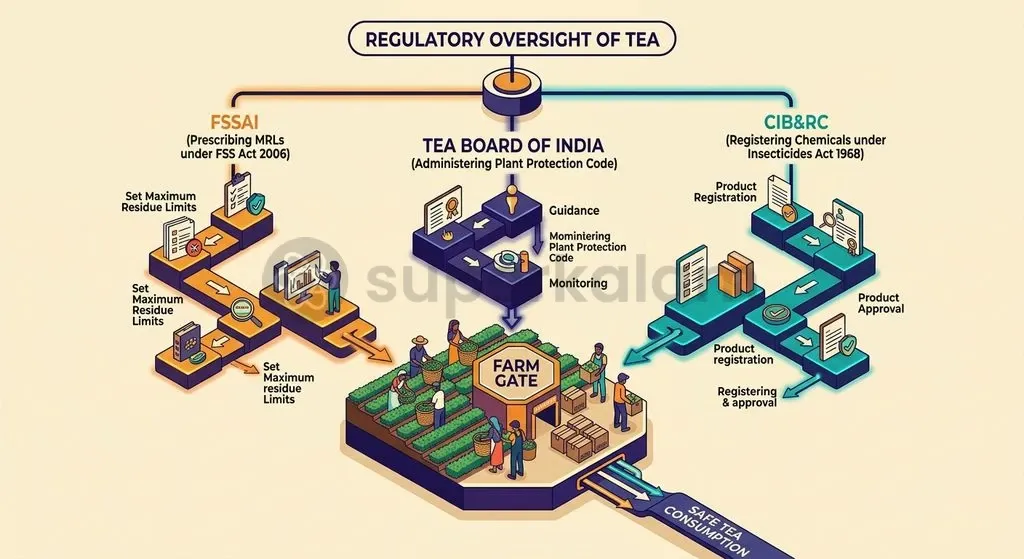
The regulatory framework governing Indian tea operates as a two-tier oversight mechanism split between food safety enforcement and plantation-level monitoring:
- Post-Harvest Food Safety (FSSAI): The Food Safety and Standards Authority of India establishes statutory limits on finished agricultural produce. Under the Food Safety and Standards (Contaminants, Toxins and Residues) Regulations, 2011, any chemical pesticide lacking an explicitly notified MRL defaults to a strict tolerance limit of 0.01 milligrams per kilogram. Applying non-cleared agrochemicals triggers immediate regulatory non-compliance under the Food Safety and Standards Act, 2006. Section 59 of the Act prescribes severe penalties for distributing contaminated food, ranging from fines up to ₹10 lakh to imprisonment up to life if adulteration results in death. FSSAI has also progressively delisted 13 hazardous pesticides with high mammalian toxicity to reduce chemical exposure.
- Field-Level Agricultural Monitoring (Tea Board of India): The Tea Board of India oversees cultivation practices through its Plant Protection Code (PPC). This code mandates that estates and smallholders apply only chemicals registered with the Central Insecticides Board & Registration Committee (CIB&RC) under the Insecticides Act, 1968. The code expressly bans chemical spraying near human settlements, water bodies, and reserve forests. Growers must also submit formal pesticide usage declarations when delivering green leaf to manufacturing units.
Two regional research establishments provide scientific backing for these codes: the Tocklai Tea Research Institute in Assam and the UPASI Tea Research Foundation in Tamil Nadu. These institutes formulate Integrated Pest Management (IPM) protocols and test bio-efficacy. Cultivators struggle to adopt these scientific schedules without accessible extension personnel.
Discuss with Superkalam
Which statutory authorities govern food safety standards and field-level pesticide usage in the Indian tea sector?
Ask NowGlobal Standards vs Domestic Rules: Comparing India, the EU, and Codex
Export quality rejections from major trading partners have accelerated domestic regulatory tightening. Major tea-importing jurisdictions enforce trade barriers using residue limits that reflect differences in domestic dietary exposure and pest profiles.
The draft Indian MRL of 20 parts per million (ppm) for Acetamiprid is stricter than limits in several developed markets. Japan maintains a regulatory ceiling of 30 ppm, while the United States permits up to 50 ppm. The proposed Imidacloprid standard of 50 ppm matches the international baseline established by the Codex Alimentarius Commission, a joint food standards body established by the Food and Agriculture Organization and the World Health Organization.
The European Union adopts a precautionary framework. The EU assigns a default MRL baseline of 0.01 mg/kg to any active pesticide substance that lacks an explicit import tolerance. This ultra-low threshold has led to periodic rejections of Indian tea consignments at European ports.
| Regulatory Parameter | India (FSSAI Draft 2026 / Regulations 2011) | European Union (EC Regulation No 396/2005) | Codex Alimentarius Commission |
|---|---|---|---|
| Acetamiprid MRL | 20 mg/kg (20 ppm) | Substance-specific import tolerance required | Evaluated on global agricultural usage data |
| Imidacloprid MRL | 50 mg/kg (50 ppm) | Default limit applies absent explicit import tolerances | 50 mg/kg (50 ppm) |
| Default Residue Limit | 0.01 mg/kg for unlisted formulations | 0.01 mg/kg for all non-approved molecules | Commodity-specific standards without a uniform default |
| Primary Regulatory Focus | Consumer health, codex alignment, and domestic safety | Precautionary principle and consumer risk minimisation | International trade facilitation and scientific consensus |
| Enforcement Mechanism | Penal provisions under the FSS Act, 2006 | Strict border inspection and import port rejections | Voluntary benchmark adopted into national legislations |
Stringent export standards have triggered a regulatory spillover effect within India's domestic supply chain. Large corporate tea packagers, seeking to insulate brand value, now enforce export-grade residue parameters on domestic suppliers. This policy shift transfers severe commercial pressure down the supply chain to local factories and smallholders.
The Bought Leaf Factory Bottleneck: How the Supply Chain Penalises Small Growers
Small Tea Growers cultivate small holdings but anchor India's commercial beverage economy:
- Smallholder Dominance: The Tea Board of India defines a Small Tea Grower as an agricultural cultivator with tea land up to 10.12 hectares (25 acres). Data from the Ministry of Commerce and Industry shows that India's 2.30 lakh registered smallholders now account for nearly 52% of national production.
- Marginal Holding Sizes: Field studies by the State Innovation & Transformation Aayog (SITA) of Assam reveal that while the statutory threshold is 10.12 hectares, the vast majority of smallholders farm plots under two acres. These growers are concentrated primarily in Assam, North Bengal (the Terai and Dooars regions), and the Nilgiris district of Tamil Nadu.
- Structural Factory Dependency: Smallholders lack internal processing facilities, unlike colonial-era integrated corporate estates that run captive tea gardens alongside on-site factories. Growers depend entirely on Bought Leaf Factories (BLFs), independent industrial processors that purchase harvested green leaf from unorganised cultivators. BLFs process more than half of India's commercial crop, making them the central economic bottleneck between farm-gate harvest and public auction.
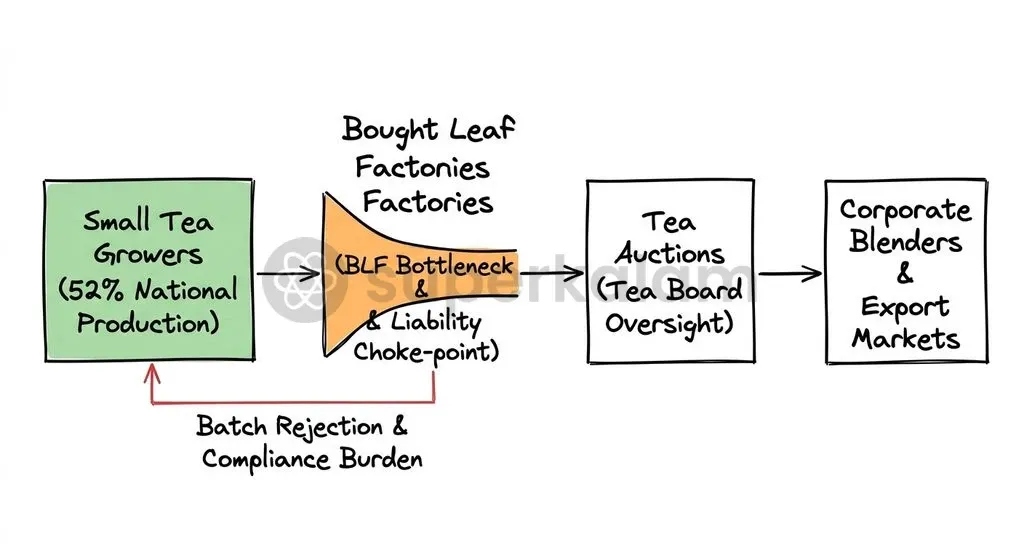
The structural weakness of this system surfaced in July and August 2026. As reported by regional outlets including The Sentinel and The Hans India, approximately 274 Bought Leaf Factories in North Bengal and Assam suspended leaf procurement from smallholders after major blenders demanded verified FSSAI pesticide compliance certificates.
Smallholders cannot sell their harvest directly on national auction platforms. The Tea (Marketing) Control Order, 2003, excludes individual smallholders from direct bidding, leaving them dependent on factory managers and intermediaries.
The Tea Board implements a Price Sharing Formula (PSF) to allocate tea auction revenues between factories and green leaf suppliers in a set ratio. This pricing formula breaks down when factories refuse raw leaf over chemical safety concerns, stranding growers without alternative buyers for perishable harvests.
Discuss with Superkalam
How does the structural reliance on Bought Leaf Factories transfer the burden of regulatory compliance onto small tea growers?
Ask NowThe Cost of Compliance: Pest Attacks, Costly Bio-Inputs, and Missing Labs
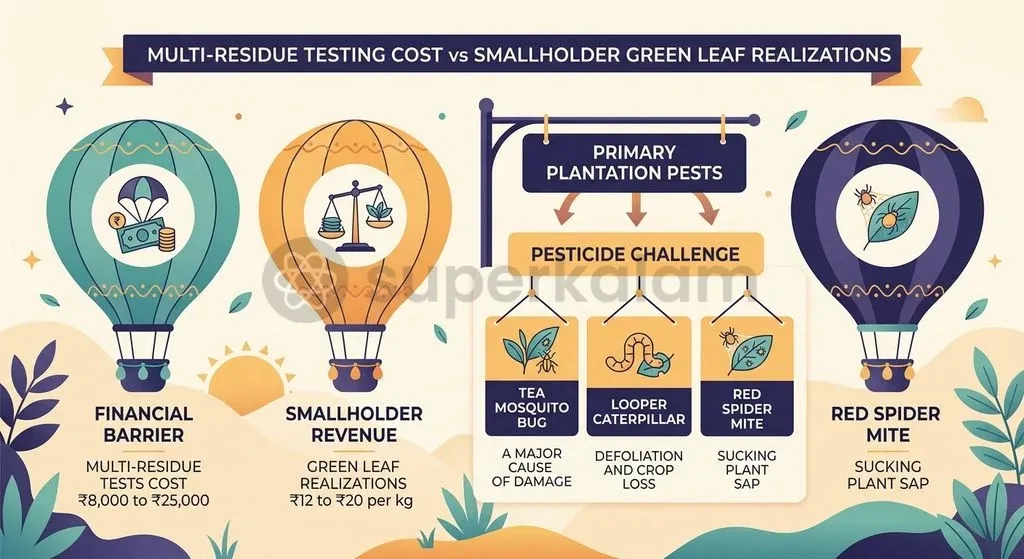
Smallholders face steep structural disadvantages when attempting to meet chemical safety norms. Indian tea plantations face severe agro-climatic stress. Tea Board documentation indicates that plantations lose approximately 30% of annual crop yields to invasive pests, weeds, and pathogens.
Three primary organisms inflict the heaviest damage on tea bushes:
- Tea Mosquito Bug (Helopeltis theivora), which punctures tender shoots and halts fresh leaf development;
- Looper Caterpillar (Hyposidra talaca), a defoliator that strips foliage during peak harvesting cycles;
- Red Spider Mite (Oligonychus coffeae), which infests mature foliage and depresses photosynthetic capacity.
Warmer temperatures and altered rainfall patterns have intensified pest attacks across sub-Himalayan tea belts. Smallholders lack access to formal public agricultural extension services. Cultivators rely instead on local agro-chemical retailers for crop guidance, who often push non-approved chemical formulations when safe alternatives are missing.
Smallholders cannot easily switch to biological alternatives. Registering botanical formulations and microbial biocontrol agents under the Insecticides Act, 1968, requires multi-year field bio-efficacy trials and residue data through the Central Insecticides Board & Registration Committee. This slow approval process restricts the supply of registered, cost-effective bio-pesticides in regional retail markets.
Testing infrastructure remains out of reach for smallholders. As industry submissions to the Tea Board show, commercial multi-residue pesticide tests at accredited private facilities cost between ₹8,000 and ₹25,000 per sample. Passing this cost onto marginal farmers selling green leaf at ₹12 to ₹20 per kilogram creates an insurmountable barrier to compliance.
India's broader agricultural sector operates at a relatively low chemical baseline. National average pesticide consumption remains below 0.5 kilograms per hectare, compared to the global average of 2.38 kilograms per hectare. The tea sector's pesticide challenge stems not from national over-application, but from uncoordinated usage of unapproved chemicals on a vulnerable plantation monoculture.
Discuss with Superkalam
Compare the European Union's precautionary default MRL approach with India's draft regulatory parameters for tea export and domestic safety.
Ask NowPublic Health vs Farmer Survival: The Policy and Ethical Dilemma
The administrative conflict over tea pesticide standards involves competing constitutional duties. The state must balance its obligation to protect public health against its duty to safeguard the livelihoods of marginal producers:
- Public Health Imperative (Articles 21 and 47): The state draws its authority to enforce food safety from Article 21 and Article 47 of the Constitution of India. The Supreme Court has repeatedly interpreted Article 21 (Right to Life) as including access to wholesome, unadulterated food free from toxic contaminants. Article 47 directs the state to raise public nutrition levels and improve health as primary governance duties. The state cannot permit unsafe residues to enter the food supply chain without compromising these foundational responsibilities.
- Economic Livelihood Rights (Articles 21 and 19(1)(g)): This public health mandate conflicts directly with the economic rights of smallholders. Abrupt factory procurement bans threaten the livelihood security guaranteed under Article 21 and restrict the economic freedom under Article 19(1)(g) of more than two lakh farming families. Marginal growers lack the capital reserves needed to absorb crop write-offs or self-finance laboratory certifications.
From an administrative justice perspective, the policy rollout reveals a procedural imbalance. Punishing marginal producers for chemical residues when state extension systems fail to provide affordable bio-inputs or accessible testing facilities creates unfair compliance conditions. Sustainable governance must protect consumer safety without driving vulnerable rural producers out of the formal economy.
Discuss with Superkalam
Propose an institutional framework to support small tea growers during the transition to strict pesticide residue compliance without disrupting rural livelihoods.
Ask NowWay Forward: Subsidised Testing, Bio-Pesticide Clearances, and Transition Relief
Resolving the tea sector's pesticide crisis requires coordinated interventions across regulatory bodies, state agricultural departments, and processing facilities.
Establish Cluster-Level Shared Testing Laboratories: The central government and the Tea Board of India should establish shared, NABL-accredited residue testing facilities in major production districts. Setting up public laboratories in hubs such as Golaghat, Dibrugarh, Jalpaiguri, and Coonoor would decentralise testing beyond distant research hubs like Tocklai. Subsidising test fees from the Tea Development and Promotion Scheme would allow smallholder consignments to be screened without wiping out farmer profits.
Fast-Track Green-Label Bio-Pesticide Approvals: The Ministry of Agriculture and Farmers Welfare must reform CIB&RC registration pathways under the Insecticides Act, 1968. Establishing an expedited regulatory track for microbial inoculants, neem-based botanicals, and bio-control formulations would expand legal alternatives for fighting the Tea Mosquito Bug and Looper Caterpillar.
Strengthen District Oversight and Retail Monitoring: District administrations in North Bengal have piloted District-Level Review Committees to regulate pesticide points-of-sale. Institutionalising these committees across all tea districts—combining agriculture department staff, Tea Board officers, and grower representatives—can curb the sale of banned agrochemicals at the retail level.
Expand Farmer Collectivisation and Extension Support: The Tea Board must use the Tea Development and Promotion Scheme to organise smallholders into Farmer Producer Organisations (FPOs) and Self-Help Groups (SHGs). Collectivisation gives growers the scale needed to purchase compliant bio-inputs, acquire group testing equipment, and negotiate fair terms under the Price Sharing Formula.
Provide Financial Relief During the Ecological Transition: State governments and the central administration should provide targeted input subsidies and floor-price support while smallholders transition from synthetic chemical sprays to Integrated Pest Management protocols.
Key Takeaways
- FSSAI has issued draft regulations under the Food Safety and Standards Act, 2006, proposing tea Maximum Residue Limits of 20 ppm for Acetamiprid and 50 ppm for Imidacloprid to protect consumer health.
- Small Tea Growers contribute nearly 52% of national tea production across 2.30 lakh holdings, but most farm plots of under two acres without public agricultural extension support.
- Bought Leaf Factories process over half of the national harvest and act as a commercial choke-point, halting leaf purchases when corporate packagers demand strict residue compliance.
- Private laboratory residue tests cost between ₹8,000 and ₹25,000 per sample, creating an unviable financial hurdle for smallholders selling green leaf at ₹12 to ₹20 per kilogram.
- Agro-climatic pressures cause annual crop losses of approximately 30% from the Tea Mosquito Bug and Looper Caterpillar, while CIB&RC registrations for alternative bio-pesticides face multi-year procedural delays.
- Resolving the stand-off requires shared NABL testing laboratories, fast-tracked bio-pesticide clearances, and grower collectivisation through Farmer Producer Organisations.
Mains Question
"The tightening of Maximum Residue Limits (MRLs) by the Food Safety and Standards Authority of India (FSSAI) has exposed a deep structural misalignment between post-harvest food safety standards and the realities of smallholder agriculture." Critically examine. (15 Marks)
Evaluate NowMains Question
Evaluate the dual regulatory role of the Food Safety and Standards Authority of India (FSSAI) and the Tea Board's Plant Protection Code in reconciling public health priorities with export competitiveness. (10 Marks)
Evaluate NowPractice MCQs
QUESTION 1
With reference to pesticide regulation and Maximum Residue Limits (MRLs) in Indian tea, consider the following statements:
- The Food Safety and Standards Authority of India (FSSAI) sets statutory MRLs under the Food Safety and Standards Act, 2006.
- Under the Food Safety and Standards (Contaminants, Toxins and Residues) Regulations, 2011, any chemical pesticide lacking an explicitly notified MRL defaults to a tolerance limit of 0.01 mg/kg.
- The Plant Protection Code (PPC) formulated by the Tea Board of India allows growers to use any agrochemical approved by regional tea research institutes regardless of Central Insecticides Board & Registration Committee (CIB&RC) registration.
Which of the statements given above are correct?
QUESTION 2
Consider the following statements regarding the structure of the Indian tea industry and Small Tea Growers (STGs):
- A Small Tea Grower is defined by the Tea Board of India as an agricultural cultivator possessing tea holdings of up to 10.12 hectares.
- Small Tea Growers account for more than half of India's national tea production.
- Under the Tea (Marketing) Control Order, 2003, individual smallholders are directly permitted to participate and bid on national auction platforms.
Which of the statements given above is/are correct?
QUESTION 3
Regarding the comparative regulatory standards for pesticide residues in tea between India, the Codex Alimentarius Commission, and major international jurisdictions, consider the following statements:
- The draft Indian MRL proposed by FSSAI for Acetamiprid is stricter than the ceilings permitted in Japan and the United States.
- The European Union applies a default MRL baseline of 0.01 mg/kg to active pesticide substances lacking an explicit import tolerance.
- The Codex Alimentarius Commission was established jointly by the Food and Agriculture Organization (FAO) and the World Trade Organization (WTO).
Which of the statements given above is/are correct?
QUESTION 4
Consider the following pests and pathogens that affect tea bushes:
- Tea Mosquito Bug (Helopeltis theivora)
- Looper Caterpillar (Hyposidra talaca)
According to the Tea Board of India, approximately what proportion of annual tea crop yields is lost to invasive pests, weeds, and pathogens?
QUESTION 5
With reference to the regulatory enforcement framework under the Food Safety and Standards Act, 2006, consider the following statements:
- Section 59 of the Food Safety and Standards Act, 2006 prescribes penalties that include imprisonment up to life if food adulteration results in death.
- The Price Sharing Formula (PSF) implemented by the Tea Board ensures guaranteed procurement of green leaf regardless of chemical compliance.
Which of the statements given above is/are correct?