FSSAI Notices to Nestle and Zydus: Misleading Food Claims
FSSAI sought scientific support for Lactogen, Nan Excella and Complan claims. Read the notices and food advertising rules for UPSC.
Oct, 2026
•14 min read

Context
India's regulatory framework governing commercial food advertising faces an institutional crisis. Statutory prohibitions against deceptive health claims exist under the Food Safety and Standards Act, 2006 and the Consumer Protection Act, 2019. However, fragmented administrative jurisdiction and prolonged policy delays undermine these laws. Aggressive corporate marketing of ultra-processed foods exploits the resulting enforcement vacuum.
Sector-specific mandates penalise misleading nutritional assertions. Yet institutional friction between food safety authorities and consumer protection watchdogs creates severe enforcement bottlenecks. This regulatory inertia directly compromises consumer autonomy and exacerbates an accelerating non-communicable disease burden across the country. Harmonising administrative enforcement with constitutional protections is essential to balance commercial speech against the fundamental right to health.
Why in the News: The Pushback Against Misleading Health Claims
The Hindu reported on 22 October 2026 that the Food Safety and Standards Authority of India (FSSAI) had issued notices to Nestle India and Zydus Wellness over allegedly misleading claims and non-compliant promotions for specific food products.
For Nestle India's Lactogen Pro 1 Powder, FSSAI sought scientific substantiation for the claim that whey protein is easy to digest. For Nan Excella Pro Stage 1, the regulator questioned the claim that "5 HMOs [human milk oligosaccharides] helps support normal immune system".
The notice to Zydus Wellness concerned Complan claims including "2X Faster Growth", "Supports Concentration and Memory" and "Pro Immunity+ 34 Vital Nutrients". FSSAI asked the company to provide scientific justification for these claims under the Food Safety and Standards (Advertising and Claims) Regulations, 2018.
The immediate issue is whether the advertised claims comply with the rules and have adequate scientific support. The notices are regulatory scrutiny of the claims; the report does not announce a product ban or a final adjudication of liability.
Discuss with Superkalam
Can you recall the specific statutory penalty amount that CCPA can impose on repeat offenders for publishing misleading advertisements?
Ask NowThe Anatomy of a Health Claim: How Deceptive Marketing Works
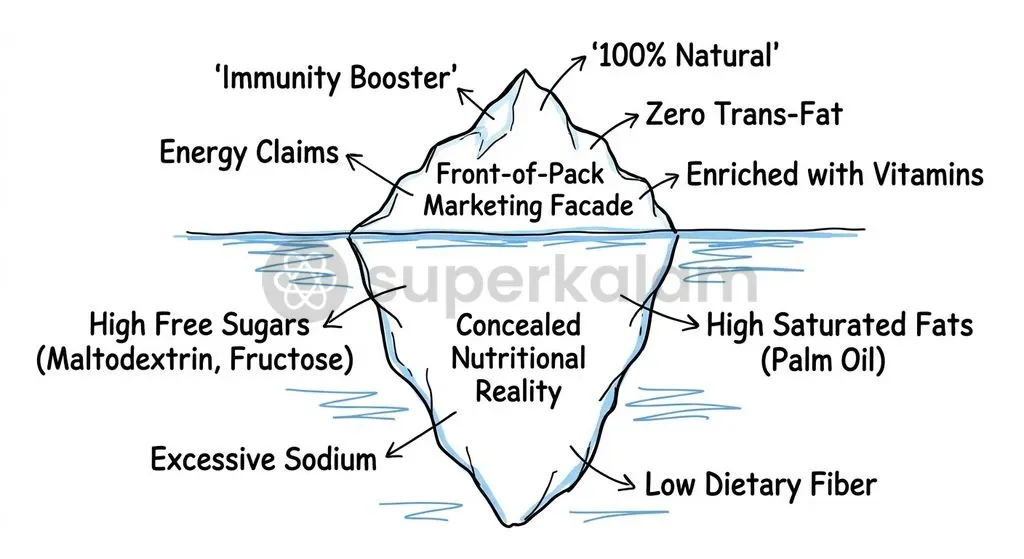
Food Business Operators in India frequently exploit regulatory ambiguities to market ultra-processed products using unsubstantiated health and wellness claims. Misleading advertising in the food industry operates by highlighting isolated micronutrients while deliberately obscuring adverse nutritional elements such as elevated levels of sugar, saturated fat, and sodium.
According to policy analyses by NITI Aayog, deceptive food promotions exploit structural information asymmetry by masking high glycemic loads and synthetic additives behind unregulated buzzwords like 'natural', 'organic', and 'immunity booster'. This marketing dynamic induces market failure by distorting consumer choice.
The statutory boundaries governing food promotion are defined under the Food Safety and Standards Act, 2006. Section 24 of the Food Safety and Standards Act, 2006 expressly prohibits deceptive advertisements and unfair trade practices regarding the quality, standard, composition, or nutritional efficacy of any food article. Furthermore, the Food Safety and Standards (Advertising and Claims) Regulations, 2018 mandate that every nutritional claim must be supported by sound scientific substantiation. These regulations explicitly bar packaging labels from claiming that an article of food is 'recommended by medical professionals' without explicit regulatory approval.
Deceptive techniques commonly deployed across packaged food categories include:
- Nutrient Profiling Concealment: Highlighting added vitamins or minerals in malt-based powders while concealing sugar contents that frequently exceed 30 percent of product weight.
- Surrogate Health Positioning: Categorising confectionery and high-fat items under pseudo-health categories such as 'energy foods' or 'digestive snacks' without clinical backing.
- Unverified Therapeutic Claims: Asserting clinical outcomes such as enhanced cognitive growth, height expansion, or immunity enhancement without clearance from the Food Safety and Standards Authority of India (FSSAI).
Who Polices Food Ads in India? A Web of Overlapping Regulators
The Food Safety and Standards Authority of India enforces technical food composition rules while the Central Consumer Protection Authority targets deceptive marketing through broad horizontal consumer safeguards. India does not rely on a single advertising tribunal. Instead, statutory oversight is divided across dedicated technical regulators, broad consumer watchdogs, and a non-statutory self-regulatory organisation.
The Food Safety and Standards Authority of India (FSSAI) functions under the Ministry of Health and Family Welfare pursuant to the Food Safety and Standards Act, 2006. Section 53 of the Act penalises any entity publishing or participating in the publication of a false or misleading advertisement with a fine extending up to ten lakh rupees. Under Regulation 15 of the FSSAI (Advertising and Claims) Regulations, 2018, the authority can also order an offending Food Business Operator to publish a corrective advertisement within 30 days to neutralise misleading claims.
The Central Consumer Protection Authority (CCPA), established under Section 10 of the Consumer Protection Act, 2019, is an overarching consumer watchdog. Under Section 21 of the Consumer Protection Act, 2019, the CCPA possesses broad powers to order the modification or discontinuation of misleading advertisements, levy penalties of up to ten lakh rupees, and impose fines reaching fifty lakh rupees for repeat violations. In June 2022, the CCPA notified the Guidelines for Prevention of Misleading Advertisements and Endorsements for Misleading Advertisements under Section 18 of the Consumer Protection Act, 2019, creating enforceable rules against deceptive child-targeted advertisements and surrogate marketing.
The Advertising Standards Council of India (ASCI) provides voluntary self-regulation. Established in 1985, ASCI investigates advertising infractions against its self-regulatory code, but it lacks direct statutory penal powers. When non-compliant commercial brands refuse to modify misleading advertisements, ASCI must escalate complaints to statutory regulators such as the CCPA or FSSAI for formal prosecution.
| Dimension | Food Safety and Standards Authority of India (FSSAI) | Central Consumer Protection Authority (CCPA) | Advertising Standards Council of India (ASCI) |
|---|---|---|---|
| Statutory Foundation | Food Safety and Standards Act, 2006 | Consumer Protection Act, 2019 | Non-statutory (Registered Society, est. 1985) |
| Parent Ministry | Ministry of Health and Family Welfare | Ministry of Consumer Affairs, Food and Public Distribution | None (Voluntary industry self-regulatory body) |
| Jurisdictional Remit | Sector-specific technical standards, food labels, and nutritional claims | Horizontal cross-sector jurisdiction over unfair trade and deceptive advertising | Voluntary monitoring of industry advertising ethical codes |
| Statutory Penalties | Penalties up to ₹10 lakh under Section 53; corrective ads under Regulation 15 | Penalties from ₹10 lakh up to ₹50 lakh under Section 21; endorser bans | No penal powers; issues recommendations and refers cases to state agencies |
| Core Operational Limitation | Protracted adjudication mechanisms and limited proactive post-market surveillance | Resource constraints and heavy reliance on inter-agency referrals | Lacks statutory enforcement mechanisms against non-member advertisers |
Discuss with Superkalam
How does the technique of nutrient profiling concealment lead to market failure and distorted consumer choice?
Ask NowThe Enforcement Bottleneck: Why Fragmented Jurisdiction Lets Brands Escape
The Department of Consumer Affairs faces operational friction with technical regulators because overlapping jurisdictions create parallel inquiries and administrative delays. According to parliamentary reviews, institutional friction between the product-specific technical mandate of FSSAI and the broad market powers of CCPA frequently delays enforcement against misleading food branding. When consumer complaints emerge, questions regarding whether an infraction constitutes a technical labelling violation under FSSAI or an unfair trade practice under CCPA often stall enforcement.
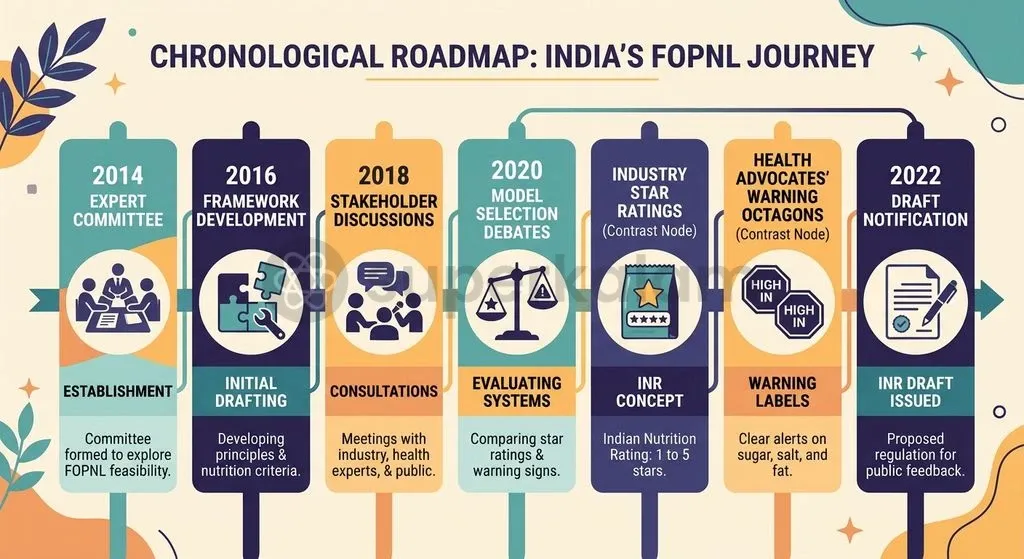
Regulatory inertia is visible in India's delayed implementation of Front-of-Pack Nutritional Labelling (FOPNL). FSSAI initiated policy deliberations on front-of-pack labels by appointing an expert committee in 2014, issuing preliminary draft amendments in 2018 and 2019.
On 13 September 2022, FSSAI notified the draft Food Safety and Standards (Labelling and Display) Amendment Regulations, 2022, officially proposing the Indian Nutrition Rating (INR). The proposed system scores packaged foods using a star-rating scale ranging from 0.5 stars for the least healthy products to 5 stars for the healthiest choices.
Public health advocates and food industry lobbies remain divided over the design of front-of-pack labelling:
- Industry Lobby Resistance: Major trade bodies, including the Confederation of Indian Industry (CII) and the Federation of Indian Chambers of Commerce and Industry (FICCI), endorse the voluntary Indian Nutrition Rating star-rating system, supported by studies from the Indian Institute of Management Ahmedabad.
- Public Health Counter-Advocacy: Medical specialists from the All India Institute of Medical Sciences (AIIMS) and independent public health groups argue that star ratings generate a 'health halo' over junk foods, demanding clear mandatory warning labels such as Chile's black octagonal warnings.
- Extended Voluntary Windows: Section 1(2) of the draft 2022 amendment proposed an initial 48-month voluntary transition period before compliance becomes mandatory for packaged food manufacturers.
The Parliamentary Standing Committee on Consumer Affairs expressed deep concern regarding FSSAI's prolonged delays in finalising mandatory front-of-pack labelling rules, urging the Union Government to prioritise consumer health over food manufacturing pressures.
Constitutional and Legal Dimensions: Commercial Speech Versus Right to Health
Article 19(1)(a) of the Constitution protects commercial speech only when marketing communications convey truthful information that serves the public interest. While corporate entities invoke the right to commercial speech, judicial precedent establishes that misleading advertisements fall outside constitutional protection.
In Hamdard Dawakhana v. Union of India (1960), a Constitution Bench of the Supreme Court ruled that commercial advertisements promoting drugs or goods do not enjoy fundamental rights protection under Article 19(1)(a) if they involve deceptive or harmful trade practices. The Court affirmed that advertisements linked primarily to commerce and trade can be subjected to reasonable restrictions under Article 19(2) when public health is implicated.
The Supreme Court refined this constitutional doctrine in Tata Press Ltd. v. Mahanagar Telephone Nigam Ltd. (1995). The Court held that commercial speech forms an integral facet of the freedom of speech and expression under Article 19(1)(a) because it facilitates the public's right to receive information. However, the bench made an explicit distinction: commercial speech that is false, deceptive, or misleading receives zero constitutional protection and can be restricted by the state through valid law.
| Constitutional Provision | Scope in Food Advertising | Operational Effect |
|---|---|---|
| Article 19(1)(a) | Commercial speech protecting truthful consumer information | Enables informed economic choices and transparent product marketing |
| Article 19(2) & Article 21 | State duty to protect public health and the right to life | Excludes deceptive claims from fundamental rights protection |
The Supreme Court has expanded the scope of Article 21 of the Constitution (the Right to Life) to incorporate the right to health and informed consumer choice. Deceptive food packaging directly violates Article 21 by denying citizens accurate knowledge about nutritional content, skewing dietary habits toward chronic disease. Statutory restrictions imposed under Section 24 of the FSS Act, 2006, the Drugs and Magic Remedies (Objectionable Advertisements) Act, 1954, and the Consumer Protection Act, 2019 form valid legislative curbs protecting public health.
Discuss with Superkalam
If a packaged beverage brand claims its product makes children grow taller without FSSAI approval, how would CCPA and FSSAI invoke their respective statutes to act against it?
Ask NowEthical Fallout: Corporate Deception in an Era of Lifestyle Diseases
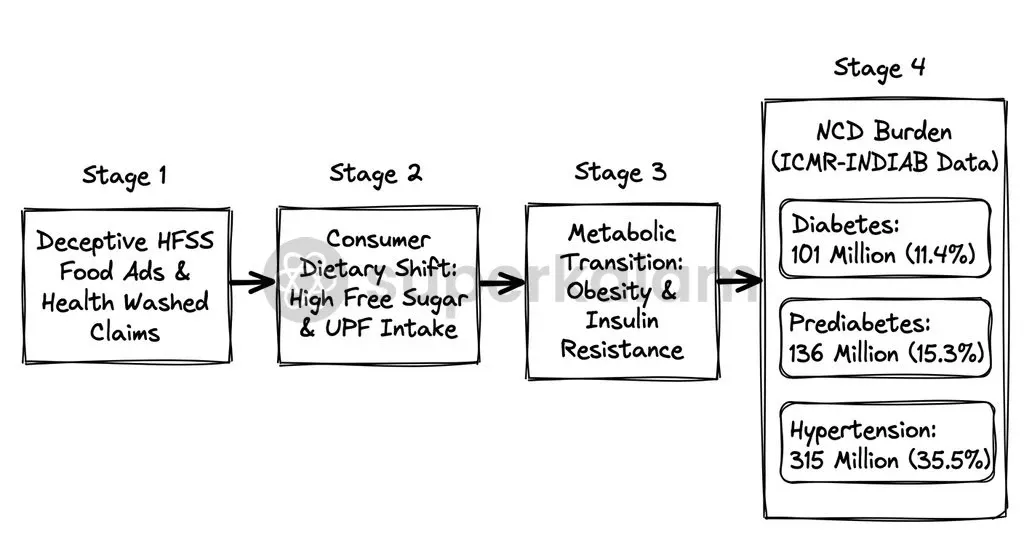
The Indian Council of Medical Research documented a steep escalation in chronic lifestyle conditions linked directly to changing dietary patterns across both urban and rural demographics. Findings from the ICMR-INDIAB national study published in The Lancet Diabetes & Endocrinology in 2023 estimated that 101 million people in India live with diabetes, 136 million with prediabetes, and 315 million with hypertension. The World Health Organization estimates that non-communicable diseases (NCDs) account for roughly 63 percent of all deaths in India, with high intake of fat, sugar, and salt operating as primary dietary drivers.
Corporate food marketing often exploits consumer vulnerabilities in several ethically contested ways:
- Weaponisation of Health Anxieties: Commercial campaigns target parental aspirations by suggesting that ultra-processed malt drinks enhance physical stature and cognitive ability, manipulating emotional vulnerabilities.
- Predatory Marketing to Minors: Packaged food brands deploy cartoon mascots, bright packaging, and gamified promotions to attract children. Clause 8 of the CCPA 2022 Misleading Advertisement Guidelines explicitly prohibits food promotions targeting children from exaggerating nutritional benefits or presenting junk foods as substitutes for regular meals.
- Abdication of Endorser Responsibility: High-profile sports figures and celebrities promote ultra-processed foods rich in sugar and trans-fats, obscuring nutritional risks. Under Section 21(5) of the Consumer Protection Act, 2019, celebrity endorsers face statutory liabilities and fines up to fifty lakh rupees unless they establish that they conducted rigorous due diligence to verify product claims.
Corporate manipulation of nutritional information constitutes an ethical breach that distorts consumer autonomy, shifting the healthcare costs of lifestyle diseases onto vulnerable families and the public healthcare system.
Global Lessons: How Other Nations Prevent Misleading Nutritional Claims
Chile transformed international food labelling policy by adopting mandatory front-of-pack warning labels using black stop-sign octagons to curb the consumption of foods high in fat, sugar, and sodium. The Chilean approach departs from promotional star ratings by deploying black octagonal stop signs that bluntly state 'High in Sugar', 'High in Saturated Fat', or 'High in Sodium'. Academic evaluations demonstrate that clear warning labels alter consumer purchasing behaviour much more effectively than complex numerical rating systems.
Front-of-pack warning labels bypass literacy barriers and reduce the time required to assess a product's nutritional profile:
- Direct Hazard Identification: Interpretive warning labels highlight unhealthy ingredients directly, rather than obscuring negative metrics.
- Eliminating Health Halos: Unlike star-rating systems where manufacturers offset high sugar levels by adding synthetic fibre or protein to raise scores, warning seals cannot be averaged out.
.
Public health organisations in India argue that implementing clear warning systems, like those used in Chile, is vital for the domestic market, where nutritional literacy remains uneven and time-pressed shoppers rarely review back-of-pack nutritional tables.
Discuss with Superkalam
Contrast the voluntary self-regulatory approach of ASCI with the statutory enforcement mechanism of CCPA in curbing deceptive claims.
Ask NowFixing the Gridlock: A Roadmap for Coordinated and Deterrent Enforcement
The Parliamentary Standing Committee on Consumer Affairs recommended establishing institutional convergence between food authorities and consumer bodies to eliminate enforcement delays. Ending the regulatory impasse requires structured reforms across statutory coordination, labelling systems, and judicial oversight.
Key operational interventions must include:
- Formal Institutional Convergence: Establishing a permanent Joint Enforcement Taskforce linking FSSAI and CCPA through a binding Memorandum of Understanding. This framework should route technical claim verifications through expedited FSSAI scientific panels while deploying the CCPA's enforcement machinery under Section 21 of the Consumer Protection Act, 2019 to issue market-wide recall orders.
- Transitioning to Mandatory Warning Labels: Discarding the industry-favoured star-rating model and truncating the draft 2022 regulation's 48-month voluntary period. FSSAI should implement clear front-of-pack warning labels on all High in Fat, Sugar, and Salt (HFSS) products.
- Consistent Use of Corrective Advertising: Exercising Regulation 15 of the FSSAI (Advertising and Claims) Regulations, 2018 routinely. Regulators should require repeat offenders to dedicate equal commercial airtime and print space to corrective statements explaining past nutritional misstatements.
- Enforcing Celebrity Due Diligence: The CCPA must consistently enforce Section 21(5) of the Consumer Protection Act, 2019, holding prominent brand ambassadors financially liable when they promote unsubstantiated health assertions without documented verification.
- Universal Digital Scrutiny: Extending the Supreme Court-mandated Self-Declaration Certificate mechanism across the Ministry of Information and Broadcasting's Broadcast Seva and Press Council portals, backed by automated post-market audits to catch non-compliant claims.
Discuss with Superkalam
Should India adopt the voluntary Indian Nutrition Rating star system favoured by industry bodies, or implement mandatory warning labels as advocated by public health experts?
Ask NowKey Takeaways
- Commercial advertising of food products is governed primarily by Section 24 and Section 53 of the Food Safety and Standards Act, 2006, alongside Section 18 and Section 21 of the Consumer Protection Act, 2019.
- The Supreme Court confirmed in Hamdard Dawakhana (1960) and Tata Press (1995) that deceptive or misleading commercial speech enjoys no constitutional protection under Article 19(1)(a) and can be restricted under Article 19(2) to safeguard the Article 21 Right to Health.
- In May 2024, the Supreme Court mandated in Indian Medical Association v. Union of India that all advertisers must submit a prior Self-Declaration Certificate before broadcasting or publishing promotional campaigns.
- Regulatory fragmentation between FSSAI's technical remit and CCPA's consumer protection mandate, combined with a proposed 48-month voluntary transition for front-of-pack labelling, delays market enforcement.
- .
Mains Question
"Institutional friction between sector-specific technical regulators and overarching consumer protection watchdogs creates severe enforcement bottlenecks against deceptive marketing." In light of this statement, critically analyse the enforcement architecture governing misleading food advertisements in India. (15 Marks)
Evaluate NowMains Question
Highlighting the Supreme Court's directives in Indian Medical Association v. Union of India (2024), examine how judicial interventions seek to balance commercial speech with the fundamental right to health. (10 Marks)
Evaluate NowPractice MCQs
QUESTION 1
With reference to the regulatory framework governing food advertisements in India, consider the following statements:
- The Food Safety and Standards Act, 2006 explicitly defines and regulates the category of 'health drinks'.
- Section 53 of the Food Safety and Standards Act, 2006 empowers authorities to impose penalties up to ten lakh rupees for publishing false or misleading advertisements.
- The Central Consumer Protection Authority (CCPA) was established under the Food Safety and Standards (Advertising and Claims) Regulations, 2018.
Which of the statements given above is/are correct?
QUESTION 2
Consider the following statements regarding the regulatory powers and guidelines concerning misleading advertisements in India:
- Under the Food Safety and Standards (Advertising and Claims) Regulations, 2018, packaging labels are prohibited from claiming that an article of food is recommended by medical professionals without explicit regulatory approval.
- The Central Consumer Protection Authority has the statutory power to impose penalties up to fifty lakh rupees on repeat offenders for misleading advertisements.
- The Advertising Standards Council of India (ASCI) has statutory penal powers to levy fines directly on non-member commercial advertisers.
Which of the statements given above is/are correct?
QUESTION 3
Regarding recent regulatory actions and judicial interventions on commercial advertisements in India, consider the following statements:
- In Indian Medical Association v. Union of India (May 2024), the Supreme Court mandated advertisers and advertising agencies to submit a prior Self-Declaration Certificate before publishing promotional material.
- To operationalise the Supreme Court's mandate, digital portals were set up on Broadcast Seva for broadcast media and the Press Council of India portal for print and digital channels.
- The National Commission for Protection of Child Rights conducted an inquiry under Section 14 of the Commission for Protection of Child Rights Act, 2005, regarding added sugar levels in malt-based beverages.
Which of the statements given above are correct?
QUESTION 4
With reference to Front-of-Pack Nutritional Labelling (FOPNL) proposed in India, consider the following statements:
- The Indian Nutrition Rating (INR) proposed by FSSAI scores packaged foods on a star-rating scale ranging from 0.5 stars to 5 stars.
- The draft Food Safety and Standards (Labelling and Display) Amendment Regulations, 2022 proposed the adoption of the Indian Nutrition Rating system.
Which of the statements given above is/are correct?
QUESTION 5
Under Regulation 15 of the Food Safety and Standards (Advertising and Claims) Regulations, 2018, which specific corrective measure can the Food Safety and Standards Authority of India (FSSAI) issue against an offending Food Business Operator?