FSSAI Infant Food Rules: Why Added Sugar Escapes the Ban
While global guidelines demand zero added sugar for toddlers, India's regulatory carve-out leaves complementary infant cereals vulnerable to corporate sugar.
Oct, 2026
•10 min read

Context
Commercial infant cereals sold in India continue to contain added industrial sugars because the Food Safety and Standards Authority of India limits its proposed prohibitions to products targeting infants up to six months of age, leaving complementary weaning foods for older infants governed by permissive legacy standards. This statutory carve-out allows manufacturers to legally incorporate sucrose into complementary food formulations, even though global health benchmarks recommend zero added sugar for children under two years. As of October 2026, the central regulatory failure is structural: India's technical thresholds treat complementary infant foods as general processed commodities rather than strictly protected nutritional inputs. This policy gap directly conflicts with national pediatric dietary guidelines and perpetuates double standards in global food manufacturing.
Why Infant Food Rules Are Under Scrutiny
On 16 October 2026, the Food Safety and Standards Authority of India published the draft Food Safety and Standards (Foods for Infant Nutrition) Amendment Regulations, 2026, seeking to prohibit added sucrose and fructose in foods for infants up to six months old. The Ministry of Health and Family Welfare opened this draft amendment for public objections and suggestions for a period of 60 days starting from 16 October 2026, as notified by the Gazette of India.
The regulatory trigger followed investigative disclosures by Swiss organisation Public Eye and the International Baby Food Action Network. Their laboratory investigation revealed that all Cerelac baby cereal products sold by Nestlé in India contained added sugar averaging nearly 3 grams per serving, whereas identical wheat-based products sold in Germany, the United Kingdom, and Switzerland contained zero added sugar.
This regulatory scrutiny intersects with foundational constitutional obligations. While Article 47 of the Constitution of India directs the State to regard the raising of the level of nutrition and the improvement of public health as among its primary duties, this Directive Principle of State Policy is non-justiciable and cannot be directly enforced through courts. The legal right to health, however, remains firmly anchored as an enforceable fundamental right under Article 21 (Right to Life), driving growing public pressure on statutory regulators.
Discuss with Superkalam
Recall the maximum percentage of total carbohydrates that can legally come from added sucrose and fructose under FSSAI's 2020 infant nutrition regulations.
Ask NowDefining Sugar: FSSAI Categorization vs WHO Nutrition Benchmarks
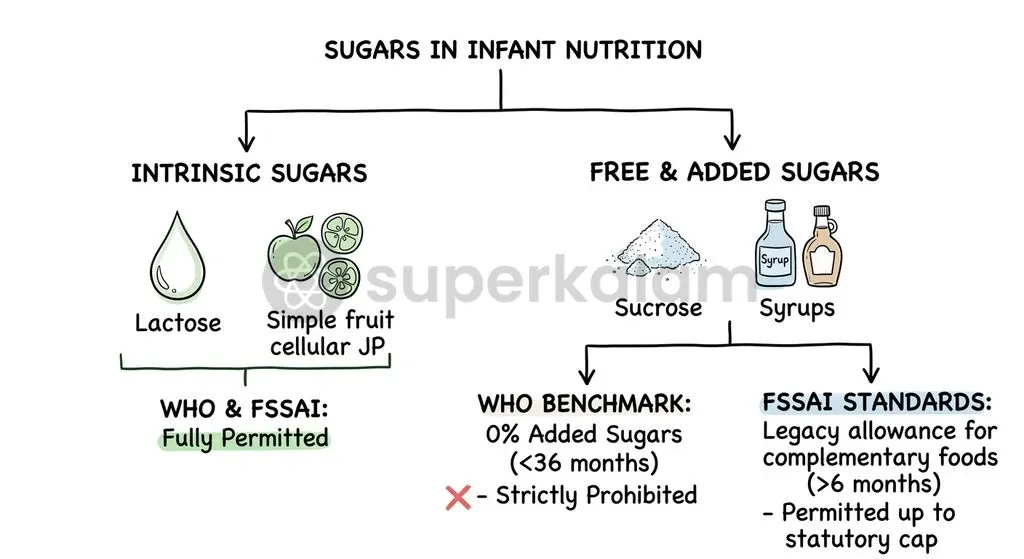
The Food Safety and Standards Authority of India categorises infant carbohydrate sources under Regulation 3(6) of the Food Safety and Standards (Foods for Infant Nutrition) Regulations, 2020. Under these provisions, lactose and glucose polymers serve as preferred carbohydrates, but manufacturers are legally permitted to add sucrose and fructose, provided their combined quantity does not exceed 20 percent of total carbohydrates.
This domestic framework diverges sharply from international guidelines issued by the World Health Organization. The WHO Regional Office for Europe Nutrient and Promotion Profile Model establishes a mandatory standard of zero added sugars, free sugars, and industrial sweetening agents for all commercially produced complementary foods marketed to infants and young children aged 6 to 36 months.
Technical definitions explain why this regulatory divergence occurs:
- Intrinsically Occurring Sugars: Naturally present within intact cellular structures of foods, such as lactose in unadulterated mammalian milk or fructose within intact fruits.
- Free Sugars: Monosaccharides and disaccharides added to foods and beverages by manufacturers, cooks, or consumers, alongside sugars naturally present in honey, syrups, and fruit juices.
- Added Sugars: Industrial sucrose, fructose, invert sugar, or corn syrups incorporated during processing to enhance palatability and energy density.
The Indian Council of Medical Research–National Institute of Nutrition reaffirmed the international stance in its 2024 Dietary Guidelines for Indians. The guidelines advise that no added sugar should be fed to infants and children under two years of age, highlighting that early exposure compromises long-term metabolic health.
Side-by-Side: FSSAI Thresholds Compared with EU and WHO Standards
European regulatory bodies maintain significantly more restrictive thresholds for early-life nutrition compared to Indian statutory standards. Under European Union Commission Delegated Regulation (EU) 2016/127, sucrose may only be added to infant formula manufactured from protein hydrolysates up to 20 percent of total carbohydrates to mask bitter peptide tastes, while standard cow's milk-based or goat's milk-based infant formulas prohibit added sucrose and fructose entirely.
The table below contrasts the regulatory boundaries governing infant nutrition across jurisdictions:
| Parameter | FSSAI Regulations (India) | European Union (EFSA Rules) | WHO Regional Profile (NPPM) |
|---|---|---|---|
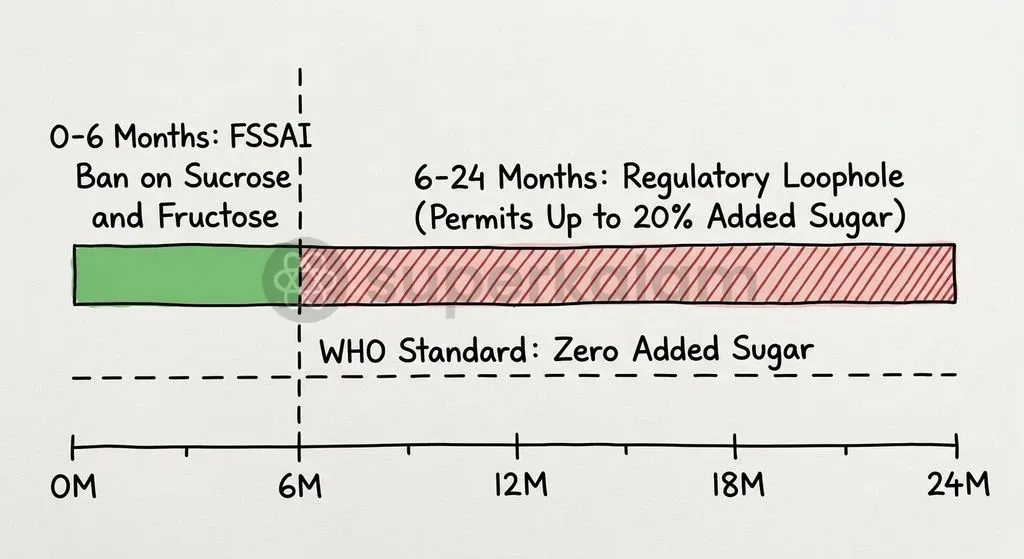
| Infant Formula (0–6 Months) | Draft 2026 amendment proposes ban on sucrose and fructose; 2020 rules permit up to 20% total carbs. | Strict prohibition on sucrose/fructose; allowed only in hydrolysed protein formulas. | Zero added sucrose or free sugars permitted across all liquid formulas. |
| Complementary Foods (6–24 Months) | Permitted up to 20% of total carbohydrates as added sucrose/fructose. | Heavily restricted; product compositions guided by strict upper energy caps. | Total prohibition on all added sugars, free sugars, and fruit concentrates. |
| Total Carbohydrate Ceilings | Allows up to 55 grams of carbohydrates per 100 grams in complementary cereals. | Regulated strictly by total energy density ratios rather than bulk volume. | Restricted to prevent displacement of breast milk and natural dietary staples. |
| Sweetening Agent Inclusions | Sucrose, fructose, and dextrose legally recognised as carbohydrate sources. | Non-sugar sweeteners and free industrial sugars banned in infant products. | Complete exclusion of artificial sweeteners, honey, syrups, and sweetening agents. |
Discuss with Superkalam
Explain the distinction between 'intrinsically occurring sugars', 'free sugars', and 'added sugars' as defined in food science frameworks.
Ask NowLoopholes in Practice: Permitted Sweeteners vs 'No Added Sugar' Claims
Commercial baby cereal formulations in India routinely exploit the distinction between statutory infant foods and complementary weaning cereals. While the draft amendment announced by the Ministry of Health and Family Welfare bans added sucrose for infants up to six months, complementary weaning foods are legally marketed for children aged six months and older.
Under the Foods for Infant Nutrition Regulations, 2020, processed cereal-based foods are permitted to contain up to 55 grams of carbohydrates per 100 grams of finished product. This high upper threshold enables manufacturers to legally introduce substantial quantities of sucrose within the allowable 20 percent carbohydrate limit, transforming basic grain porridges into sugar-dense preparations.
Regulatory enforcement is further undermined by laboratory testing constraints. The Parliamentary Standing Committee on Consumer Affairs, Food and Public Distribution reported that verification of sugar caps relies primarily on manufacturer recipe records and paper self-declarations, because standard chemical laboratory tests cannot reliably distinguish added sucrose from sugars naturally occurring in milk powder.
Statutory gaps also exist between advertising restrictions and nutritional standards:
- The IMS Act Scope: Section 3 of the Infant Milk Substitutes, Feeding Bottles and Infant Foods (Regulation of Production, Supply and Distribution) Act, 1992 prohibits commercial advertising, promotions, and inducements for infant foods.
- Statutory Division: Section 2(f) of the Infant Milk Substitutes Act, 1992 (as amended in 2003) defines infant food as any food marketed to meet nutritional needs from six months up to two years. However, the Act regulates marketing practices rather than setting quantitative biochemical ceilings for sugars.
- FSSAI Mandate: Formulation limits, carbohydrate allowances, and nutritional tolerances are governed separately under FSSAI product standards, preventing marketing enforcement bodies from penalising high-sugar recipes that comply with FSSAI limits.
The Double Standard: Why Formulations Differ Between India and the West
Multinational infant food manufacturers maintain distinct regional recipes based on statutory minimums rather than consistent global nutritional baselines. While European regulations strictly constrain formulation profiles, emerging economies operate under older standards that allow companies to optimize commercial formulations for palatability and shelf stability.
The Public Eye investigation demonstrated this stark geographical divergence in industrial recipes. Nestlé's baby cereal products contained up to 6 grams of added sugar per serving in Thailand, 5.2 grams in Ethiopia, and 4 grams in South Africa, while identical lines in the United Kingdom and Germany contained no added sugar.
Economic and supply-chain incentives explain this persistent corporate divergence:
- Palatability and Repeat Consumption: Added sugars heighten product taste appeal, accelerating repeat purchases among price-sensitive consumer segments.
- Processing Costs: Incorporating refined sucrose costs less than using high-grade whole milk solids, demineralised whey powders, or enzymatic carbohydrate conversion.
- Regulatory Arbitrage: Multinationals reformulate products only when forced by domestic statutory bans, relying on local compliance to defend lower-standard products in developing markets.
Discuss with Superkalam
If a manufacturer formulates an infant cereal with 50g of total carbohydrates per 100g of product, calculate how much sucrose could legally be added under FSSAI rules and assess whether it complies with ICMR-NIN guidelines.
Ask NowPublic Health and Ethics: Early Childhood Diabetes vs Corporate Accountability
Early exposure to free sugars alters normal metabolic programming during the critical developmental window of complementary feeding. Clinical research indicates that introducing added sucrose and fructose to infants imprints lifelong neurobiological preferences for sweet taste, reducing the subsequent acceptance of nutrient-dense, bitter, and vegetable flavors.
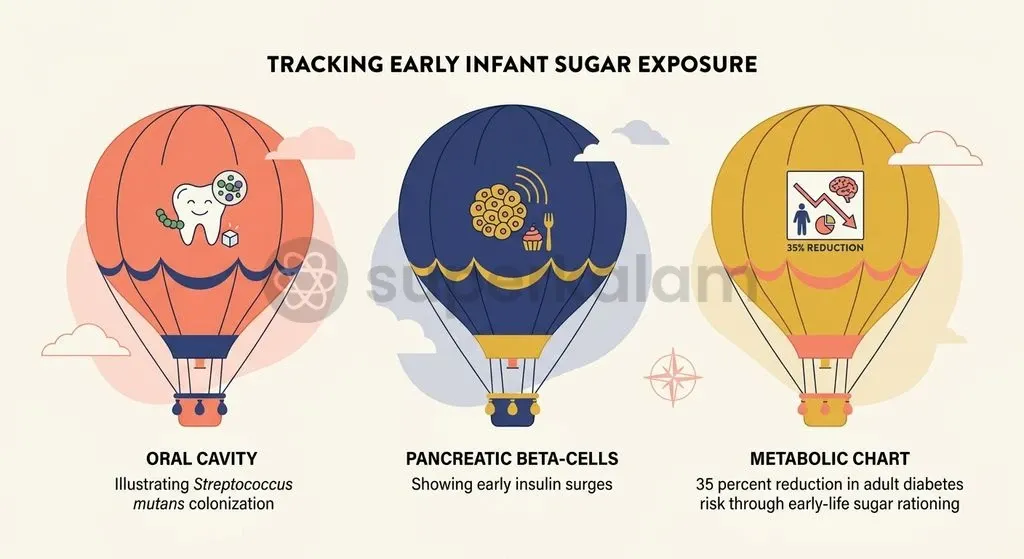
Long-term epidemiological research underscores the severity of early sugar consumption. A landmark study published in the journal Science demonstrated that rationing sugar during the first 1,000 days of life from conception reduces adult type-2 diabetes risk by approximately 35 percent and adult hypertension risk by 20 percent.
Pediatric physiological damage occurs across multiple bodily systems:
- Oral Microbiome Alteration: Early intake of free sugars accelerates colonization by acid-producing Streptococcus mutans, driving early childhood dental caries that permanently damages primary teeth.
- Pancreatic Stress: Repeated spikes in blood glucose place early strain on immature infant beta-cells, predisposing children to childhood obesity and early metabolic syndrome.
From an administrative and corporate ethics perspective, regional recipe variations raise profound questions of nutritional justice. Marketing sugar-free infant cereals in high-income European nations while distributing sugar-laden variants across Asia and Africa illustrates a clear failure of corporate accountability. Furthermore, Section 9 of India's IMS Act, 1992 explicitly prohibits infant food manufacturers from offering gifts, research grants, or sponsorships to healthcare workers, recognising that institutional capture undermines objective public health advocacy.
Way Forward: Closing Regulatory Loopholes and Harmonizing Indian Standards
Public health experts and pediatric advocacy bodies have called on Indian regulators to remove the statutory discrepancy between formula and weaning foods. As reported by The Times of India on 18 October 2026, public health researchers and consumer advocacy groups have formally petitioned FSSAI to extend the prohibition on added sucrose and fructose to cover all commercial foods for infants and toddlers up to 24 months of age, directly aligning statutory rules with the ICMR-NIN dietary guidelines.
Reforming India's infant nutrition landscape requires three concrete policy interventions:
- Harmonise the Prohibitory Age Scope: The Ministry of Health and Family Welfare must expand draft Regulation 3(6) amendments beyond the six-month threshold, establishing a strict zero-added-sugar ceiling across all commercial foods marketed for children up to two years.
- Reform Front-of-Pack Nutrition Labeling (FOPNL): FSSAI's proposed Indian Nutrition Rating (INR) star system must be reformed. Public health advocates point out that the current draft star system allows ultra-processed foods to mask high free-sugar levels through positive score offsets like synthetic protein or dietary fibre fortification. Infant and toddler foods should instead carry clear, mandatory front-of-pack warning labels.
- Upgrade Analytical Testing and Market Surveillance: Regulators must move beyond self-declared manufacturer affidavits. Establishing isotope-ratio mass spectrometry testing infrastructure within national laboratories will enable authorities to empirically differentiate added industrial cane sugars from endogenous dairy lactose.
Discuss with Superkalam
Analyse the structural reasons why multinational food companies adopt zero-sugar formulations in Europe but retain added sugar in products sold in emerging economies like India.
Ask NowKey Takeaways
- FSSAI's draft 2026 amendment restricts added sucrose and fructose exclusively in foods intended for infants up to six months of age, leaving commercial weaning cereals for older infants legally permitted to contain added sugar.
- Under the Food Safety and Standards (Foods for Infant Nutrition) Regulations, 2020, added sucrose and fructose remain lawful up to 20 percent of total carbohydrates, allowing products to pack substantial free sugars within allowable limits.
- Independent testing documented an international double standard, showing Indian Cerelac variants containing nearly 3 grams of added sugar per serving, while identical lines in Germany and the UK contained zero added sugar.
- The IMS Act, 1992 strictly bans advertising and institutional sponsorships under Sections 3 and 9, but nutritional limits and recipe standards fall entirely under FSSAI's statutory mandate.
- Long-term epidemiological evidence shows that limiting sugar exposure in the first 1,000 days of life lowers adult type-2 diabetes risk by approximately 35 percent and adult hypertension risk by 20 percent.
- Public health advocacy groups have petitioned FSSAI to align national standards with ICMR-NIN guidelines by establishing a universal zero-added-sugar rule for all infant foods up to 24 months.
Mains Question
"Statutory compartmentalisation between marketing regulation under the IMS Act, 1992 and nutritional formulation standards under FSSAI has created enforcement loopholes in regulating complementary infant foods." Examine. (10 Marks)
Evaluate NowMains Question
Investigative reports on infant cereals reveal a sharp geographical divergence in corporate formulations, with zero added sugar in European markets contrasted against significant added sugar in developing countries like India. In this context, critically analyse the regulatory architecture of FSSAI and evaluate the state's constitutional obligations under Article 21 and Article 47. (15 Marks)
Evaluate NowPractice MCQs
QUESTION 1
With reference to the Food Safety and Standards (Foods for Infant Nutrition) Regulations, 2020, consider the following statements:
- Sucrose and fructose are entirely prohibited in all infant carbohydrate formulations.
- Sucrose and fructose are legally permitted provided their combined quantity does not exceed 20 percent of total carbohydrates.
- Processed cereal-based foods are permitted to contain up to 55 grams of carbohydrates per 100 grams of finished product. Which of the statements given above is/are correct?
QUESTION 2
Consider the following statements regarding the regulatory framework for infant nutrition in India:
- The Infant Milk Substitutes (IMS) Act, 1992 sets quantitative biochemical ceilings for sugars in commercial complementary foods.
- The draft Food Safety and Standards (Foods for Infant Nutrition) Amendment Regulations, 2026 seek to prohibit added sucrose and fructose in foods for infants up to six months old.
- The Indian Council of Medical Research–National Institute of Nutrition (ICMR-NIN) 2024 guidelines recommend zero added sugar for children under two years of age. Which of the statements given above are correct?
QUESTION 3
With reference to international and European standards on infant nutrition, consider the following statements:
- Under European Union Commission Delegated Regulation (EU) 2016/127, standard cow's milk-based infant formulas prohibit added sucrose and fructose.
- The WHO Regional Office for Europe Nutrient and Promotion Profile Model allows added industrial sugars in complementary foods up to 10 percent of total energy.
- European Union regulations permit sucrose addition only to infant formulas manufactured from protein hydrolysates to mask bitter peptide tastes. Which of the statements given above is/are correct?
QUESTION 4
According to the Report of the Parliamentary Standing Committee on Consumer Affairs, Food and Public Distribution cited in the context of baby products, what constitutes a primary obstacle in enforcing statutory sugar caps in infant cereals?
QUESTION 5
Regarding the constitutional and legal provisions governing public health and infant nutrition in India, consider the following statements:
- Article 47 directs the State to improve public health and raise nutrition levels as an enforceable fundamental right.
- The enforceable legal right to health has been interpreted by courts as anchored under Article 21. Which of the statements given above is/are correct?