Free Bus Travel for Women: Welfare Burden or Economic Multiplier?
Balancing constitutional affirmative action with transit solvency reveals why zero-fare mobility is an economic multiplier rather than an unbacked handout.
Oct, 2026
•11 min read
Overview
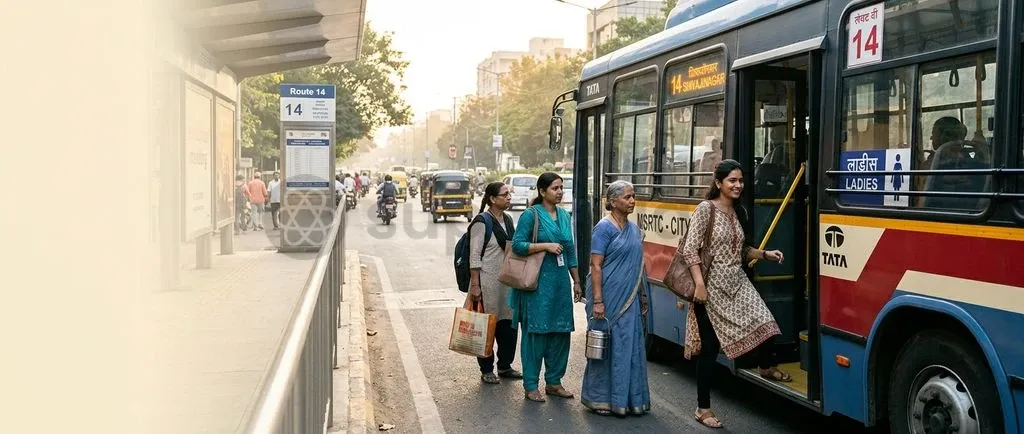
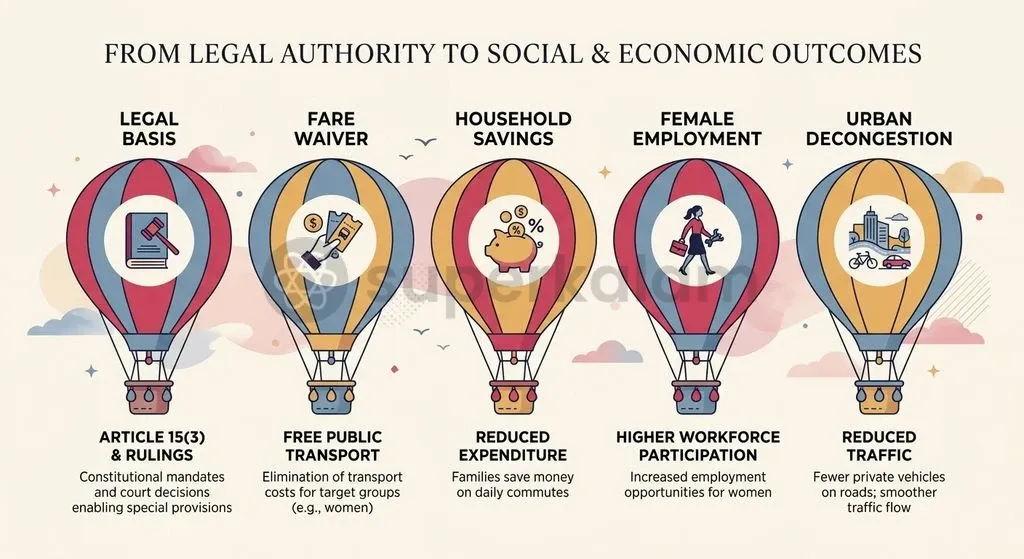
State-funded zero-fare bus travel for women is not an unproductive concession. Grounded in Article 15(3) of the Constitution, it operates as a high-return merit subsidy. It converts foregone farebox revenue into measurable household savings, expanding female labour force participation across Indian cities.
Empirical evidence shows that easing transit barriers integrates informal workers into wider urban job markets. This shift generates clear developmental spillovers.
Yet the policy strains State Transport Undertakings when government reimbursements lag behind operating costs. Reconciling this trade-off demands ring-fenced budgetary transfers and fleet capitalisation, rather than treating public transport as an uncompensated welfare conduit.
Why Free Bus Travel for Women Dominates State Policy Debates
The debate over free bus transit for women reflects a sharp clash between social equity under Article 15(3) of the Constitution and state-level fiscal discipline. As of March 2025, major regional economies—including Delhi, Karnataka, and Tamil Nadu—run universal fare-free schemes for female commuters. These policies turn public mobility into a frontline economic lever.
Constitutional jurisprudence anchors these welfare interventions firmly:
- Constitutional mandate: Article 15(3) creates an explicit exception to non-discrimination. It empowers the State to craft special provisions for women and children.
- P.B. Vijayakumar (1995): The Supreme Court held that Article 15(3) covers both affirmative action and positive discrimination. Governments can deploy targeted measures to redress historical socio-economic disadvantages.
- STA Operators Ekta Manch (2020): The Delhi High Court ruled that zero-fare bus travel falls squarely within Article 15(3). It cannot be struck down merely because it imposes a fiscal burden on the exchequer.
- Ramesh Kamal v. State of H.P. (2022): The Himachal Pradesh High Court upheld a 50% fare concession to women on state buses to promote socio-economic mobility.
- Muhammed Firdouz v. The State of Kerala (June 2026): The Kerala High Court heard public interest litigation examining whether Article 15(3) authorises blanket fare waivers without means-testing or specific class identification.
Comparing the Core Economic Theses: Consumption Subsidy vs Productive Investment
Public finance experts disagree on whether zero-fare transit is an unviable handout or an essential merit good with positive macroeconomic spillovers.
Critics view fare waivers as electoral populism that deepens sub-national deficits. In its 2022 risk analysis of state finances, the Reserve Bank of India warned that surging expenditure on non-merit freebies inflates debt and risks crowding out capital expenditure.
Supporters counter that public transit delivers wide societal returns. Working papers from the National Institute of Public Finance and Policy (NIPFP) classify transit subsidies as merit transfers or quasi-public goods. They drive urban traffic de-congestion, curb carbon emissions, and expand female economic inclusion.
Economic philosophy reinforces this perspective:
- Sen's Capability Approach: Physical mobility is an instrumental capability. It unlocks substantive freedoms, from formal employment and schooling to timely healthcare access.
- Rawls's Difference Principle: Universal fare waivers satisfy distributive justice by arranging public resources to provide the maximum advantage to disadvantaged groups.
| Analytical Dimension | Consumption Subsidy Thesis (Fiscal Risk) | Productive Investment Thesis (Externalities) |
|---|---|---|
| Public Finance Classification | Non-merit transfer or unbacked electoral freebie | Merit subsidy / public quasi-good |
| Primary Economic Focus | Preserving transport corporation revenue and fiscal discipline | Unlocking female labour and positive societal spillovers |
| Targeting Mechanism | Favours targeted vouchers with strict means-testing | Favours universal access to eliminate exclusion errors |
| Macroeconomic Impact | Risks breaching state FRBM targets and debt sustainability | Boosts aggregate demand through reallocated household savings |
| Transit Asset Effect | Starves corporations of capital needed for fleet expansion | Increases transit asset utilisation and modal shift away from private transit |
Discuss with Superkalam
What benchmark does the Ministry of Housing and Urban Affairs prescribe for public bus availability per lakh population?
Ask NowDirect Fiscal Cost: State Transport Undertaking Losses vs Household Savings
State Road Transport Undertakings across India face chronic financial distress. Operational reviews from the Ministry of Road Transport and Highways (MoRTH) show that over 80% of reporting undertakings suffer net financial losses. Committed outlays on staff and fuel swallow 60% to 80% of operating revenue.
Budgetary delays worsen these structural deficits:
- Reimbursement shortfalls: In Karnataka, legislative records showed that as of March 2025, the state had disbursed ₹7,796 crore out of a ₹9,978 crore allocation for 2024-25 under the Shakti scheme. This left ₹2,182 crore in pending dues.
- Accumulated operating deficits: The four Karnataka road transport corporations ran an aggregate deficit above ₹5,200 crore between 2019 and 2025, hit by fuel inflation, wage revisions, and reimbursement arrears.
At the household level, fare waivers deliver immediate microeconomic relief:
- Direct household savings: A comprehensive evaluation by the Tamil Nadu State Planning Commission found that the Zero-Ticket Bus Travel Scheme saves women commuters an average of ₹888 per month. This saving equals 8% to 12% of total monthly household income.
- Repurposed family budgets: Survey data in that evaluation shows women channel these savings into household food purchases, children's schooling, and out-of-pocket medical care.
The policy thus converts operational transit revenue into decentralised human capital investments.
Employment Trade-off: Immediate Revenue Deficits vs Long-Term Female Labour Gains
India's low urban female labour participation shows how transit costs stop women from seeking paid work. Data from the Periodic Labour Force Survey (PLFS) 2023-24 indicates that while India's overall Female Labour Force Participation Rate reached 41.7%, urban female participation remained stagnant at 25.2%.
Mobility constraints distort female employment choices in several distinct ways:
- The 'mobility tax': The World Bank's urban mobility toolkit observed that Indian women face an onerous 'mobility tax' driven by personal safety risks and trip chaining, where women combine commutes with domestic care chores.
- Constrained job searches: Without cheap transit, women restrict their job searches to informal, low-wage work within walking distance of home.
- Spatial radius expansion: Eliminating bus fares broadens a woman's commute horizon. Informal workers, including domestic staff and daily-wage vendors, can reach higher-productivity urban centres where wages are higher, directly lifting net take-home pay.
- Fiscal feedback loops: Broader labour market integration widens the municipal tax base over time. This dynamic yields long-run revenue gains that offset initial farebox losses.
Discuss with Superkalam
How does the 'mobility tax' uniquely restrict an informal female worker's employment radius in urban India?
Ask NowUrban Transit Impact: Fleet Strains and Crowding vs Safety and Public Space Access
Urban bus fleets run by municipal transit agencies suffer from chronic undersupply. Ministry of Housing and Urban Affairs (MoHUA) benchmarks prescribe 60 public buses per lakh population. Yet most Indian metropolitan cities operate with just 20 to 40 buses per 100,000 citizens.
Universal fare waivers trigger two opposing operational effects across city networks:
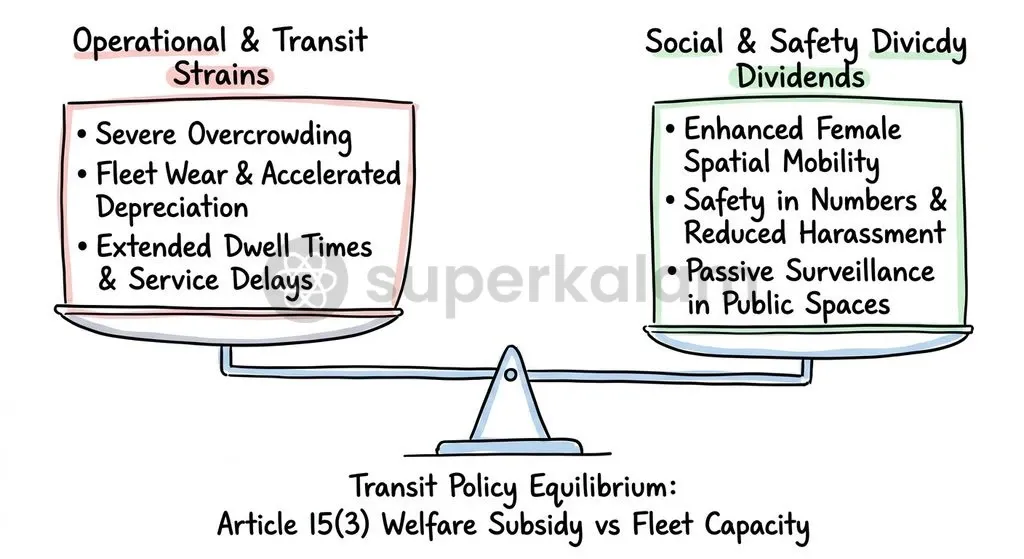
- Induced crowding and modal defection: Surging passenger volumes without fleet expansion cause longer boarding dwell times, erratic schedules, and maintenance breakdowns. This often prompts fare-paying passengers to shift toward private vehicles or informal shared three-wheelers.
- 'Safety in numbers' dynamics: Guidance briefs from the World Bank emphasise that higher female ridership creates a 'safety in numbers' dynamic. Dense female presence establishes continuous passive surveillance on buses and around transit stops, reducing sexual harassment and encouraging women to occupy urban public spaces after dark.
Cross-State Comparison: How Delhi, Karnataka, and Tamil Nadu Fare on Cost and Ridership
State governments in Delhi, Karnataka, and Tamil Nadu run three distinct operational models. Each reveals the friction of funding gender-targeted mobility through existing State Transport Undertakings (STUs):
- Tamil Nadu (Vidiyal Payana Thittam): The state recorded the largest sustained shift in modal split. According to its 2025-26 Budget, the proportion of women among total bus commuters rose from 40% to 65%, logging over 642 crore cumulative trips since inception. The state curtails fiscal strain by restricting free travel to designated ordinary non-AC white-board services.
- Delhi (Pink Ticket Scheme): Delhi relies on single-journey ₹10 physical pink tickets to track ridership and reimburse operators. Data from the Delhi Transport Department shows pink tickets accounted for 46% of all tickets sold across Delhi Transport Corporation (DTC) and cluster bus fleets in 2023-24, up from 25% in 2020-21.
- Karnataka (Shakti Scheme): Karnataka has seen rapid ridership growth alongside fiscal strain. The state expanded its annual budget allocation to ₹5,300 crore in 2025-26. Yet mounting arrears have left transport corporations struggling to service fleet maintenance and fuel bills on time.
| State Model | Implementation Mechanism | Ridership Trajectory | Fiscal Allocation & Scale | Primary Systemic Challenge |
|---|---|---|---|---|
| Tamil Nadu (Vidiyal Payana Thittam) | Zero-ticket issuances on designated ordinary non-AC white-board town buses | Women's share of ridership expanded from 40% to 65% (over 642 crore trips) | Annual budgetary subsidy allocations to state transport corporations | Segregation of services leads to severe overcrowding on eligible ordinary buses |
| Delhi (Pink Ticket Scheme) | Single-journey ₹10 physical pink tickets issued to women; state reimburses operators | Share of pink tickets rose from 25% (2020-21) to 46% of total sales (2023-24) | Per-ticket reimbursement out of GNCTD general transport budget | Heavy reliance on private cluster concessionaires and ageing DTC bus fleets |
| Karnataka (Shakti Scheme) | Domicile-based free travel on non-premium intra-state buses across four RTCs | Rapid expansion in daily female passenger volume across rural and urban routes | Budget outlay expanded to ₹5,300 crore in 2025-26 | Large pending dues (₹2,182 crore arrears) accelerating corporation operating deficits |
Discuss with Superkalam
If an Indian metropolitan transit agency faces high peak-hour crowding, how might it adapt Tamil Nadu's differentiated service model to manage costs?
Ask NowUniversal Free Rides vs Targeted Fare Vouchers: Evaluating Policy Alternatives
The Observer Research Foundation frames the clash between universal zero-fare transit and targeted vouchers around vertical versus horizontal equity. Universal schemes treat all women identically regardless of economic standing.
Under universal rules, public funds subsidise affluent female professionals. Meanwhile, low-income male informal labourers, apprentices, and elderly workers continue to pay full fares. This design advances gender-based horizontal equity, yet it overlooks vertical income disparities within urban commuter populations.
Targeted assistance presents distinct implementation trade-offs:
- Means-Tested Smart Mobility Cards: Smart cards linked to income ceilings protect state finances and target relief to low-income workers. However, means-testing brings bureaucratic red tape, document fraud, and large exclusion errors among informal women lacking formal income certificates.
- Direct Benefit Transfer (DBT) Vouchers: Depositing mobility cash straight into bank accounts lets beneficiaries choose their travel mode. Yet cash transfers dilute the incentive to board public buses, failing to spark a modal shift away from personal two-wheelers.
- Universal Zero-Fare Passes: Universal access eliminates administrative gatekeeping, removes onboard fare disputes, and achieves rapid scale. The drawback is an open-ended subsidy bill that leaves operators vulnerable whenever state finance departments delay releases.
Discuss with Superkalam
Compare the fiscal and operational trade-offs of Delhi's physical Pink Ticket reimbursement model against Karnataka's domicile-based Shakti model.
Ask NowThe Way Forward: Balancing Gender Mobility with Transit Solvency
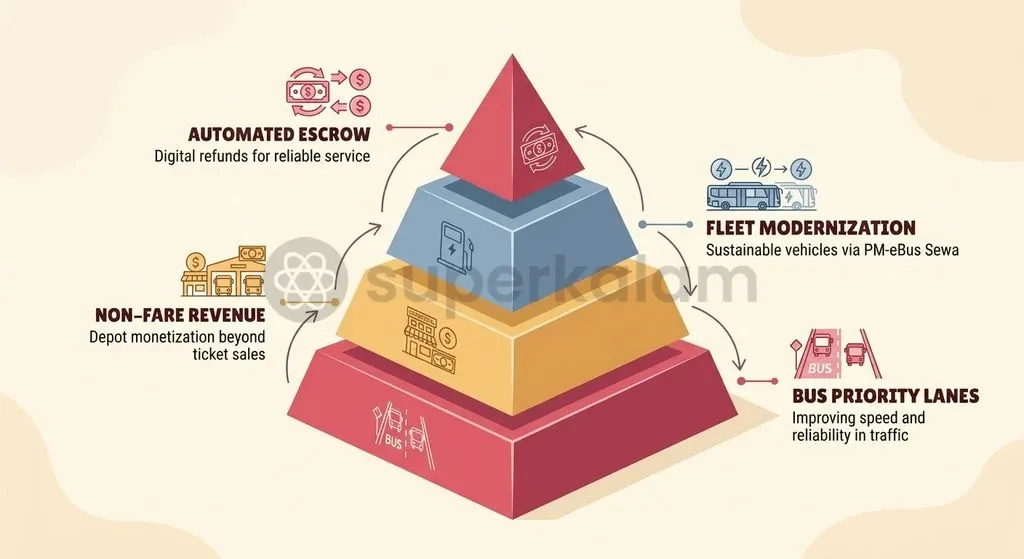
Sustaining female mobility requires state governments to separate social welfare commitments from the operational balance sheets of transit corporations. Mandating zero-fare travel under Article 15(3) requires predictable, escrow-backed reimbursements linked to audited ridership figures.
Transit agencies must pair fare subsidies with aggressive capital augmentation:
- Fleet augmentation via PM-eBus Sewa: States should tap national fleet programmes such as PM-eBus Sewa. The scheme mobilises ₹57,613 crore (including ₹20,000 crore in central viability gap funding) to deploy 10,000 electric buses on a PPP model across 169 eligible cities.
- Diversified non-farebox revenue streams: Transport authorities must unlock non-farebox revenue streams. Key avenues include transit-oriented real estate development at central depots, outdoor digital advertising, and carbon credit monetisation.
- Operational efficiencies: Automated route rationalisation and dedicated bus corridors reduce vehicle turnaround times. This ensures that expanding women's right to mobility does not bankrupt the transit systems they rely upon.
Key Takeaways
- Zero-fare bus travel for women reconciles affirmative action under Article 15(3) of the Constitution with long-term female workforce productivity.
- High Court and Supreme Court jurisprudence consistently upholds transport subsidies as legitimate affirmative action that cannot be invalidated solely by operational fiscal costs.
- The microeconomic dividend is substantial, with state evaluations documenting monthly savings of ₹888 per woman commuter, which households redirect into nutrition, education, and healthcare.
- Urban female labour participation remains constrained at 25.2% (PLFS 2023-24); fare waivers mitigate the structural 'mobility tax' that confines women to low-wage local jobs.
- The primary systemic risk lies in State Transport Undertaking insolvency, where fuel and staff costs consume 60% to 80% of revenue, and delayed state reimbursements exacerbate deficits.
- Long-term policy success requires pairing fare waivers with fleet modernisation via PM-eBus Sewa and protecting transport finances through escrow-backed compensation.
Mains Question
'Zero-fare bus travel for women operates as a high-return merit subsidy rather than an unviable handout, yet its sustainability is threatened by lagging fiscal reimbursements to State Transport Undertakings.' Critically examine. (15 Marks)
Evaluate NowMains Question
In light of Sen's Capability Approach and Rawlsian distributive justice, evaluate how zero-fare public transit policies reshape gender mobility and public space access in Indian cities. (10 Marks)
Evaluate NowPractice MCQs
QUESTION 1
With reference to the constitutional jurisprudence governing gender-targeted welfare schemes in India, consider the following statements:
- In P.B. Vijayakumar (1995), the Supreme Court ruled that Article 15(3) encompasses affirmative action and positive discrimination.
- In STA Operators Ekta Manch (2020), the Delhi High Court held that zero-fare bus travel for women is invalid if it imposes an unbudgeted fiscal burden on the exchequer.
- In Ramesh Kamal v. State of H.P. (2022), a 50% bus fare concession to women was upheld to foster socio-economic mobility.
Which of the statements given above are correct?
QUESTION 2
Consider the following statements regarding the economic impacts and operational parameters of urban bus transit schemes for women:
- According to the Periodic Labour Force Survey (PLFS) 2023-24, urban female labour force participation remained at 25.2% despite higher overall national rates.
- In Tamil Nadu's Vidiyal Payana Thittam, free travel is permitted across all categories of public transit including air-conditioned express buses.
- Ministry of Housing and Urban Affairs (MoHUA) benchmarks recommend 60 public buses per lakh population, whereas most Indian metropolitan cities operate with 20 to 40 buses per lakh population.
Which of the statements given above is/are correct?
QUESTION 3
In the context of the economic arguments surrounding zero-fare public transit for women, consider the following statements:
- Under Amartya Sen's Capability Approach, physical mobility is classified as an instrumental capability that unlocks substantive freedoms.
- Working papers from the National Institute of Public Finance and Policy (NIPFP) classify transit subsidies strictly as non-merit transfers that crowd out capital expenditure.
- John Rawls's Difference Principle supports universal fare waivers by directing public resources to provide the maximum advantage to disadvantaged groups.
Which of the statements given above is/are correct?
QUESTION 4
Regarding the financial health and operational dynamics of State Transport Undertakings (STUs) highlighted in the article, consider the following statements:
- According to operational reviews from the Ministry of Road Transport and Highways (MoRTH), committed outlays on staff and fuel consume 60% to 80% of operating revenue in reporting undertakings.
- Over 80% of reporting STUs suffer net financial losses.
- Increased female ridership in buses induces a 'safety in numbers' dynamic by providing passive surveillance, even as fleet deficits cause boarding congestion.
Which of the statements given above are correct?
QUESTION 5
An evaluation of the Zero-Ticket Bus Travel Scheme by the Tamil Nadu State Planning Commission revealed which of the following microeconomic outcomes?