Female Labour Force Participation in India: Trend and Reality
Headline gains in women's work disguise a rise in unpaid rural family labour, highlighting why employment quality must guide India's growth trajectory.
Oct, 2026
•11 min read
Overview
India's female labour force participation rate has expanded sharply according to the Periodic Labour Force Survey 2025, yet this statistical surge represents a survival-driven expansion into unpaid rural family labour rather than transformative economic mobility. Between 2019-20 and 2024-25, rural female participation jumped from 33.0% to 45.9%, while urban participation showed a modest rise from 23.3% to 27.7%. This structural dichotomy underscores how macroeconomic distress and agricultural absorption are inflating headline figures, even as educated urban women remain excluded from formal regular wage employment.
Why the Sudden Reversal in India's Female Labour Numbers Matters
The Ministry of Statistics and Programme Implementation reported a substantial structural rebound in women's work participation across the country in the Periodic Labour Force Survey 2025. For nearly two decades, economists tracked a secular decline in Indian female labour force participation, often termed the "India puzzle".
The recent data marks a reversal of that historic dip. Headline participation rates have climbed across rural geographies, shifting national socio-economic debates from measuring withdrawal to interrogating employment quality.
This statistical expansion carries direct implications for India's macroeconomic targets and demographic dividend. Female economic inclusion links directly to Directive Principles of State Policy under the Constitution of India. Specifically, Article 39(d) directs the State to secure equal pay for equal work, while Article 42 mandates just and humane working conditions alongside maternity relief.
Because Directive Principles are non-justiciable under Part IV, their realisation relies on legislative enactments and fiscal commitment rather than direct constitutional enforcement. When rising numbers mask subsistence work, evaluating women's labour becomes essential to separate genuine gender empowerment from household distress absorption.
Unpacking the PLFS Numbers: What the Data Actually Measures
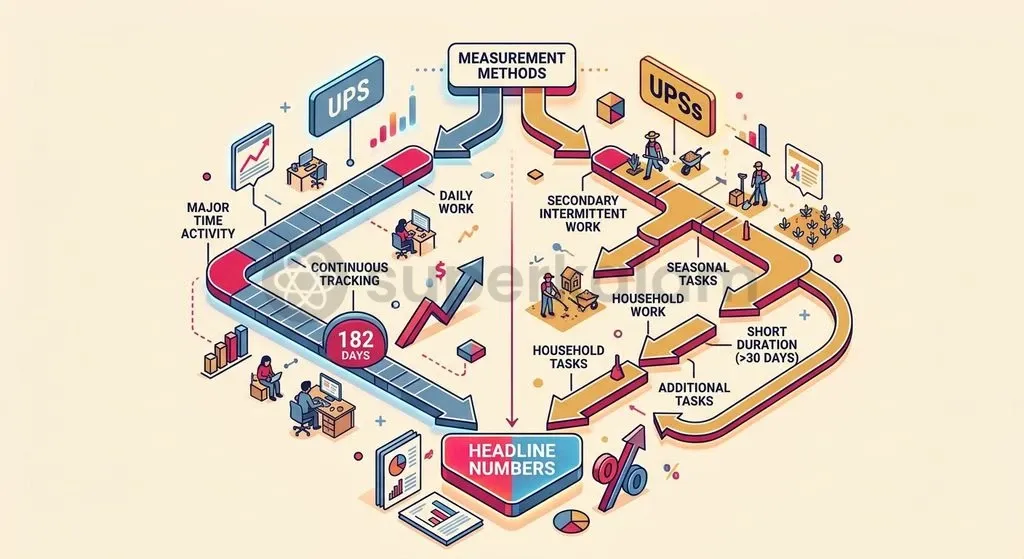
The National Sample Survey Office calculates labour indicators using two primary approaches: Usual Principal Status and Usual Principal and Subsidiary Status. Understanding the difference between these metrics prevents analytical errors in evaluating female participation trends.
Usual Principal Status records an individual's primary activity over the 365 days preceding the survey date. An individual qualifies under this measure only if they spent the relatively longer part of the year engaged in economic work or seeking it.
Usual Principal and Subsidiary Status offers a broader definition. This metric counts any person who performed economic activity for at least 30 days during the reference year, even if their principal status was non-economic household duties.
| Measurement Dimension | Usual Principal Status (UPS) | Usual Principal and Subsidiary Status (UPSS) |
|---|---|---|
| Reference Period | Major activity over the preceding 365 days | Economic activity of at least 30 days in the year |
| Activity Threshold | Majority-time criterion (over 182 days) | Short-duration threshold (30 days minimum) |
| Capture of Intermittent Work | Excludes seasonal, marginal, or episodic tasks | Fully captures seasonal and intermittent work |
| Impact on Female LFPR | Reflects lower, more rigid participation rates | Shows significantly higher headline participation |
| Analytical Utility | Measures primary economic attachment and stability | Highlights secondary, informal household coping work |
Rural women frequently move between unpaid domestic duties and seasonal farming or home-based manufacturing. The UPSS measure captures these short economic spells, driving much of the statistical increase recorded by the Periodic Labour Force Survey 2025.
Discuss with Superkalam
Recall the two main measurement approaches used by the NSSO to compute labour participation and identify the minimum days required for each.
Ask NowState-Level Variations: Leaders, Laggards, and Regional Divides
State-level trajectories from the Periodic Labour Force Survey 2025 demonstrate that national averages obscure stark regional disparities. The national Average Annual Percentage Point increase stood at 2.58 in rural areas and 0.88 in urban regions.
North-Eastern states and Union Territories registered higher female participation rates compared to the national baseline. Arunachal Pradesh recorded the highest Average Annual Percentage Point increase nationwide, logging gains of +8.28 in rural areas and +5.24 in urban areas.
Nagaland and Meghalaya maintained consistently high female participation, supported by local agrarian systems, matrilineal traditions, and informal community markets. Assam and Tripura recorded swift improvements from historically lower baselines, demonstrating dynamic rural mobilisation across the eastern region.
Geographic variations reflect contrasting socio-economic conditions:
- The North-Eastern Outliers: States such as Arunachal Pradesh, Nagaland, and Meghalaya show that agrarian self-employment and community work traditions sustain female labour attachment.
- Rapid Catch-Up States: Assam and Tripura achieved accelerated growth by absorbing women into rural cottage industries and self-help collectives.
- Urban and Island Declines: The National Capital Territory of Delhi and the Union Territory of Lakshadweep recorded contractions in female participation. Lakshadweep registered the lowest rural Average Annual Percentage Point change at -2.34.
These geographical divides show that economic growth alone does not guarantee female labour inclusion. Regional social norms, local industrial profiles, and spatial safety dictate whether women enter or exit local labour markets.
Distress or Mobility? Breaking Down the Quality of New Women's Jobs
The Periodic Labour Force Survey 2025 documents that rural female employment expansion remains concentrated in informal self-employment and agriculture. While female participation grew, the distribution across employment statuses highlights structural vulnerability.
Self-employment accounts for the bulk of newly added rural working women. Within this category, a critical share consists of unpaid family helpers working on household farms or artisanal enterprises without independent wages. Regular wage or salaried jobs, which provide steady income and statutory protection, remain largely inaccessible to rural female entrants.
A structural comparison reveals persistent inequalities across employment categories:
- Unpaid Family Labour: High concentration in rural areas, zero direct remuneration, and lack of individual financial agency.
- Own-Account Workers: Comprises petty retail or micro-enterprises with minimal capital investment and volatile returns.
- Casual Labour: Subject to daily wage fluctuations, seasonal unemployment, and an absence of written contracts or safety nets.
- Regular Salaried Employment: Accounts for a stagnant minority of rural women, reflecting barriers to formal enterprise creation.
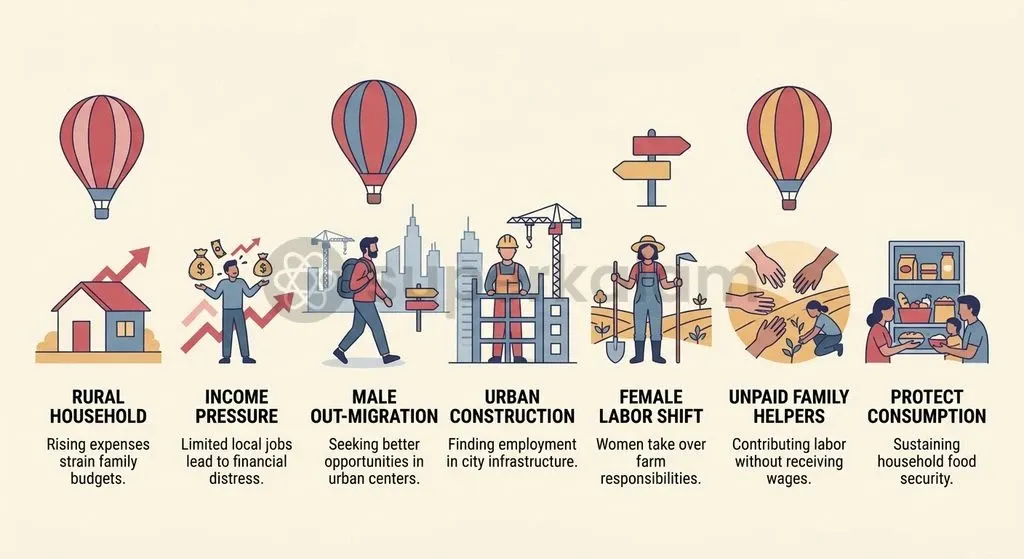
Because the headline increase is anchored in unpaid family assistance, the expansion represents household risk mitigation rather than female economic liberation. When rural male earnings face stress, female household members take up manual tasks to maintain aggregate household consumption.
Discuss with Superkalam
Explain how the U-shaped female labour supply framework explains the stagnation of urban women's workforce participation despite rising educational levels.
Ask NowThe Rural Paradox: Why Rising Participation Is Driven by Unpaid Family Work
The Deendayal Antyodaya Yojana - National Rural Livelihoods Mission has mobilised millions of women into Self-Help Groups across rural districts. This institutional platform provides financial access and informal social safety nets across agrarian pockets.
Agrarian Distress continues to drive women into farm operations. Mechanisation and shifting land-use patterns have pushed male workers toward urban construction and transport sectors, leaving women to shoulder subsistence agricultural chores.
This process reflects the "feminisation of agriculture." Women perform labour-intensive manual tasks such as weeding, sowing, and harvesting, yet institutional credit, land titles, and technical training remain tied to male ownership.
The influx of rural women into unpaid economic activity functions as an economic buffer. Rather than signalling expanding formal opportunities, rural participation spikes when rural real wages soften, compelling households to draw upon women's unpaid labour to sustain farm yields.
The Urban Freeze: Why Educated Women Are Not Entering the Formal Workforce
Economist Claudia Goldin conceptualised the female labour supply curve as a U-shaped dynamic that shifts over the course of economic development. In subsistence agrarian economies, female participation is high because women work within household farms and cottage trades.
As household incomes increase and manufacturing expands, female participation tends to decline. Cultural restrictions, rising male wages, and the physical separation of the workplace from the home drive this initial withdrawal.
Indian urban labour trends mirror this dynamic. Between 2019-20 and 2024-25, urban female participation grew slowly from 23.3% to 27.7%, contrasting sharply with rural expansion.
Secondary and tertiary education among urban Indian women has risen, but formal job opportunities have not expanded at an equivalent pace:
- The "White-Collar" Bottleneck: Educated women face limited clerical, administrative, and mid-skill formal service jobs suited to their qualifications.
- The Stigma of Manual Work: Urban families with rising incomes often pull educated women out of low-prestige informal manual work.
- Commute Safety and Spatial Friction: Long transit times and safety deficits in metropolitan corridors restrict female mobility to nearby neighbourhoods.
- Gender Wage Gaps: The persistence of pay disparity undercuts the financial incentive for women to seek formal entry-level roles .
The result is a persistent urban freeze where rising educational attainment coexists with modest workforce participation.
Discuss with Superkalam
If a district experiences a fall in rural male agricultural wages, how might that immediately impact the local female UPSS labour force participation rate?
Ask NowThe Care Burden and the Missing Infrastructure of Work
The Time Use Survey published by the Ministry of Statistics and Programme Implementation provides quantitative proof of the domestic burden borne by Indian women. Time-use metrics demonstrate that women spend a disproportionate share of daily hours on unpaid caregiving, cleaning, cooking, and water collection.
This domestic allocation operates as a non-monetary structural tax on female economic activity. Men allocate minimal time to domestic and caregiving duties, leaving women with a persistent "double burden" when they attempt market work.
The absence of public care infrastructure compounds this friction:
- Institutional Crèche Shortages: Working-class mothers lack affordable childcare facilities near industrial belts and residential clusters.
- Elderly Care Deficits: Demographic ageing across states shifts home-based geriatric care onto working-age women.
- Deficits in Basic Amenities: Incomplete piped drinking water and clean cooking fuel access consume rural and semi-urban female working hours.
Without dedicated public investments in care infrastructure, women remain restricted to home-based or flexible informal work, preventing long-term career progression.
Discuss with Superkalam
Compare the quality of employment generated through unpaid family assistance with that of regular salaried employment in terms of worker financial agency and social security.
Ask NowPolicy Interventions and Legislative Gaps: From Maternity Benefits to Labour Codes
The Parliament of India passed the Maternity Benefit (Amendment) Act, 2017 to expand statutory protections for working mothers. The statute increased paid maternity leave from 12 weeks to 26 weeks for establishments employing 10 or more individuals.
The 2017 amendment mandated that establishments with 50 or more employees provide crèche facilities within prescribed distances. The law made employers solely responsible for financing this benefit, creating an unintended disincentive against hiring women in small and medium-sized enterprises.
The Code on Wages, 2019 and the Code on Social Security, 2020 consolidated central labour laws to modernise workplace protections. These codes contain explicit provisions targeting gender parity and workplace equity:
- Wage Non-Discrimination: The Code on Wages, 2019 prohibits gender discrimination in wages and recruitment under Chapter II, reinforcing Article 39(d) directives.
- Social Security for Informal Workers: The Code on Social Security, 2020 introduces statutory frameworks to extend healthcare and disability coverage to gig, platform, and unorganised workers.
- Night Shift Regularisation: The Occupational Safety, Health and Working Conditions Code, 2020 permits women to work night shifts across all establishments, subject to employer-provided security and transport safeguards.
Implementation bottlenecks dilute these progressive frameworks. The vast majority of working women operate within the informal economy, placing them outside the practical enforcement of statutory safety nets.
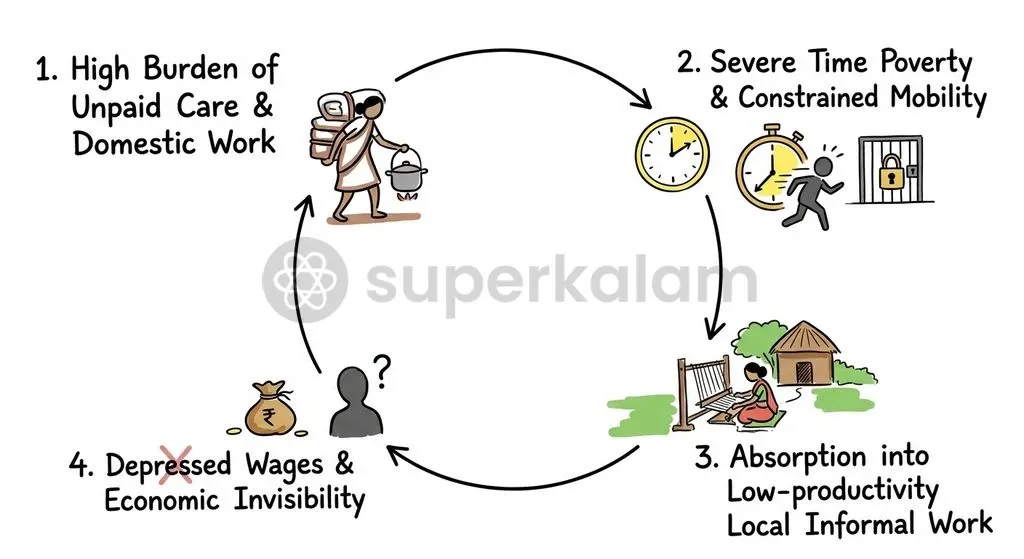
The Ethical Dimension: Economic Invisibility and the Burden of Gendered Survival
The classical economic framing of labour supply routinely categorises unpaid household work as non-economic inactivity. This analytical convention reflects an ethical blind spot that obscures structural exploitation and economic dependence.
From an ethical perspective, denying economic recognition to reproductive and domestic labour violates the principle of individual self-determination. When women work on family farms without independent compensation, their labour subsidises market production while denying them asset ownership, financial agency, or bargaining power.
This economic invisibility reinforces patriarchal authority within household hierarchies. Amartya Sen's cooperative-conflict model highlights that a person's bargaining power within a household depends directly on their perceived economic contribution and fallback position.
Treating distress-driven agricultural work as empowering female inclusion distorts the moral purpose of development. True economic freedom requires autonomous choices, fair financial compensation, and freedom from forced survival tasks.
Discuss with Superkalam
Do non-justiciable constitutional provisions like Articles 39(d) and 42 provide sufficient impetus for female labour formalisation, or are binding statutory labour mandates indispensable?
Ask NowWay Forward: Building Pathways from Subsistence Labour to Genuine Economic Agency
Transforming India's female labour expansion into sustainable economic agency requires deliberate state action across social, fiscal, and regulatory domains. The state must address structural bottlenecks that trap women in unpaid or subsistence labour.
First, India must formalise the care economy as an independent, productive sector. The central and state governments should co-finance institutional crèches and eldercare centres, relieving small enterprises of direct financial burdens while generating formal, paid care jobs.
Second, legal protections require structural alignment:
- Direct Maternity Support: Transition from employer-funded maternity benefits toward social insurance models, sharing financing between the state, employers, and employees.
- Rural Enterprise Scaling: Upgrade Deendayal Antyodaya Yojana - National Rural Livelihoods Mission self-help collectives into formal producer companies with direct market links and institutional credit.
- Dedicated Urban Transit: Expand secure, subsidised public transportation corridors connecting peripheral suburbs to metropolitan industrial and commercial zones.
- Targeted Digital and Technical Skilling: Establish district-level vocational pipelines preparing educated rural and semi-urban women for formal services, technology, and manufacturing roles.
These coordinated measures can transform women's labour from a distress-driven household survival mechanism into an engine of sustainable economic growth.
Key Takeaways
- India's headline female labour force participation rose significantly in the Periodic Labour Force Survey 2025, driven by rural gains from 33.0% to 45.9% since 2019-20, while urban participation grew from 23.3% to 27.7%.
- The national Average Annual Percentage Point increase reached 2.58 in rural areas and 0.88 in urban regions, masking severe state-level divergence.
- Arunachal Pradesh registered the highest rural (+8.28) and urban (+5.24) Average Annual Percentage Point gains, while Delhi and Lakshadweep (-2.34 rural) saw contractions.
- Rural expansion is concentrated in unpaid family labour and agricultural self-employment, reflecting household economic distress and male out-migration rather than quality job creation.
- Urban participation remains constrained by the care burden documented in Time Use Surveys, inadequate public crèche infrastructure, commute safety deficits, and the Claudia Goldin U-shaped curve.
- Constitutional commitments under Article 39(d) for equal pay and Article 42 for humane work and maternity relief require shifting from employer-mandated maternity liability to state-backed social insurance models.
- .
Mains Question
"The sharp rise in rural female labour force participation reported by the Periodic Labour Force Survey (PLFS) 2025 reflects household distress absorption rather than genuine economic empowerment." Critically analyse. (15 Marks)
Evaluate NowMains Question
Discuss the structural factors contributing to the 'urban freeze' in India's female labour force participation despite expanding educational attainment among women. (10 Marks)
Evaluate NowPractice MCQs
QUESTION 1
With reference to the measurement of labour indicators by the National Sample Survey Office (NSSO), consider the following statements:
- The Usual Principal Status (UPS) approach classifies an individual as employed only if they were engaged in economic activity for the majority of the preceding 365 days.
- The Usual Principal and Subsidiary Status (UPSS) approach requires an individual to perform economic activity for at least 182 days during the reference year.
- The capture of intermittent and seasonal economic activity under the UPSS approach contributes to a higher recorded female labour force participation rate compared to UPS.
Which of the statements given above are correct?
QUESTION 2
Consider the following statements regarding female labour force participation trends documented in the Periodic Labour Force Survey (PLFS) 2025:
- Between 2019-20 and 2024-25, rural female participation expanded at a higher rate than urban female participation.
- Arunachal Pradesh recorded the highest rural Average Annual Percentage Point increase in female labour force participation among all states.
- The Union Territory of Lakshadweep recorded a negative rural Average Annual Percentage Point change in female labour force participation.
Which of the statements given above is/are correct?
QUESTION 3
Regarding the constitutional provisions linked to female economic participation in India, consider the following statements:
- Article 39(d) of the Constitution directs the State to ensure equal pay for equal work for both men and women.
- Article 42 directs the State to make provision for securing just and humane conditions of work and for maternity relief.
- Being placed under Part IV of the Constitution, these provisions are directly justiciable and enforceable by the courts.
Which of the statements given above is/are correct?
QUESTION 4
Which of the following economic frameworks conceptualises female labour supply as declining initially when household incomes and industrial employment rise, before recovering at higher stages of economic development?
QUESTION 5
In the context of rural female employment trends highlighted by the Periodic Labour Force Survey 2025, the process of 'feminisation of agriculture' is predominantly driven by: