Ex-Post Facto Environmental Clearance & Retrospective Regularisation - UPSC Notes
Unpacking the Supreme Court's verdict on retrospective regularisation and why ex-post facto environmental clearance threatens ecological integrity.
Aug, 2026
•10 min read
Context

Fig: The statutory framework under Indian environmental law requires prior ecological assessment to balance industrial expansion with the Precautionary Principle.
Ex-post facto environmental clearance undermines statutory regulatory frameworks by permitting industrial projects to initiate construction without prior ecological appraisal. This practice effectively substitutes the mandatory Precautionary Principle under Section 20 of the National Green Tribunal Act, 2010 with a retrospective monetary penalty regime. According to the Supreme Court judgment in Vanashakti v. Union of India, administrative Office Memorandums cannot override statutory delegated legislation like the Environmental Impact Assessment Notification, 2006.
On July 29, 2026, a three-judge Bench quashed the Ministry of Environment, Forest and Climate Change's July 7, 2021 Office Memorandum, which had established a Standard Operating Procedure to regularise unapproved projects. This ruling enforces the principle that prior assessment is mandatory under Section 3 of the Environment (Protection) Act, 1986, ensuring that economic development does not bypass statutory environmental safeguards.
The Genesis of the Controversy: A Landmark Case of Retrospective Regularisation
The Supreme Court of India quashed the administrative framework for retrospective environmental clearances on July 29, 2026, invalidating executive mechanisms that bypassed prior environmental appraisal.
In Vanashakti v. Union of India, a three-judge Bench evaluated the legality of executive attempts to regularise non-compliant industrial operations. The Ministry of Environment, Forest and Climate Change (MoEFCC) had issued an Office Memorandum on July 7, 2021, establishing a Standard Operating Procedure (SOP) to grant ex-post facto environmental clearance (EC) to projects operating without prior appraisal. According to the Supreme Court judgment in Vanashakti v. Union of India, an administrative Office Memorandum cannot supplant delegated legislation like the EIA Notification, 2006 to create a perpetual retrospective clearance framework.
The Court quashed the 2021 Office Memorandum with prospective effect, holding that executive instructions cannot dilute statutory rules. However, the Bench clarified two critical legal provisions to maintain balance:
- Statutory Amnesties: The Central Government retains statutory power under Section 3 of the Environment (Protection) Act, 1986 to frame narrowly tailored amnesty schemes for non-compliant projects under supervening public interest.
- Plenary Powers: The ruling does not limit the Supreme Court's own plenary powers under Article 142 of the Constitution to grant ex-post facto environmental clearance in exceptional cases to do complete justice.
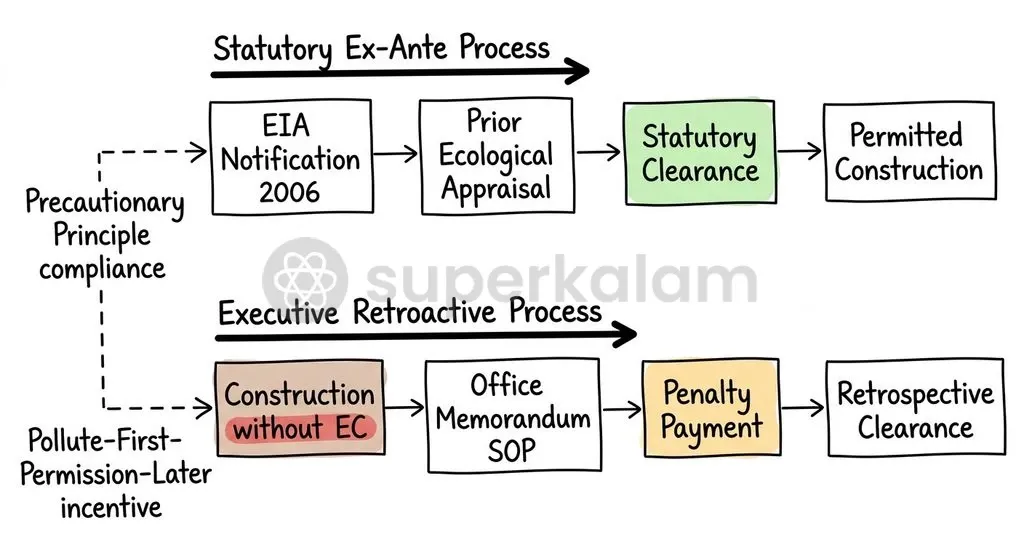
Fig: Administrative Office Memorandums attempted to establish parallel retrospective regularisation routes alongside statutory EIA rules.
Discuss with Superkalam
How do monetary penalties instead of prior environmental appraisal affect developers' decisions?
Ask NowWhat Is Ex-Post Facto Environmental Clearance and How Did We Get Here?
The Environment Protection Act, 1986 mandates under Section 3 that designated infrastructure and industrial projects secure prior environmental clearance before initiating construction activities.
Under the statutory architecture of the EIA Notification, 2006 (issued under Section 3 of the EPA, 1986), any entity planning a project listed in its schedule must undergo an ex-ante evaluation. Paragraph 7 of the Notification outlines four mandatory stages designed to evaluate ecological risks before land preparation begins:
- Screening: Determining whether a Project Category 'B' initiative requires an Environmental Impact Assessment report based on spatial scale and site sensitivity.
- Scoping: Establishing precise Terms of Reference (ToR) for assessing environmental baseline parameters and potential degradation vectors.
- Public Consultation: Engaging local communities and affected stakeholders through public hearings to gather context-specific ecological concerns.
- Appraisal: Scrutinising the final assessment report by an Expert Appraisal Committee (EAC) to recommend approval or rejection.
Ex-post facto clearance disrupts this sequential framework by allowing proponents to execute construction first and seek regularisation later. Over the last decade, executive relaxations repeatedly institutionalised this workaround:
- Notification S.O. 804(E) (March 14, 2017): The MoEFCC provided a six-month regularisation window for projects operating without prior clearance.
- Office Memorandum (July 7, 2021): The Ministry established an open-ended Standard Operating Procedure to process ex-post facto EC applications upon payment of penalty fees.
| Governance Dimension | Statutory Ex-Ante Clearance (EIA 2006) | Ex-Post Facto Regularisation Framework |
Timing of Appraisal | Conducted prior to land clearing or construction | Conducted after construction or operation has commenced |
Ecological Strategy | Enforces the Precautionary Principle to avert harm | Uses damage assessment and monetary compensation |
Public Participation | Mandatory public hearings under Paragraph 7 | Structurally ineffective due to completed construction |
Legal Status | Statutory delegated legislation under EPA 1986 | Created via executive Office Memorandums |
The Legal Clash: Defying the Precautionary Principle and Supreme Court Rulings
The National Green Tribunal Act, 2010 codifies the Precautionary Principle under Section 20, requiring statutory authorities to anticipate and prevent ecological harm before project execution.
The Supreme Court has consistently held that retrospective environmental regularisation directly violates statutory mandates. In Common Cause v. Union of India (2017), the Court ruled that an ex-post facto environmental clearance is anathema to environmental law and inconsistent with Section 3 of the Environment (Protection) Act, 1986. This principle was reaffirmed in Alembic Pharmaceuticals Ltd. v. Rohit Prajapati (2020), where the Court established that retrospective clearance is alien to environmental jurisprudence and contrary to the Precautionary Principle.
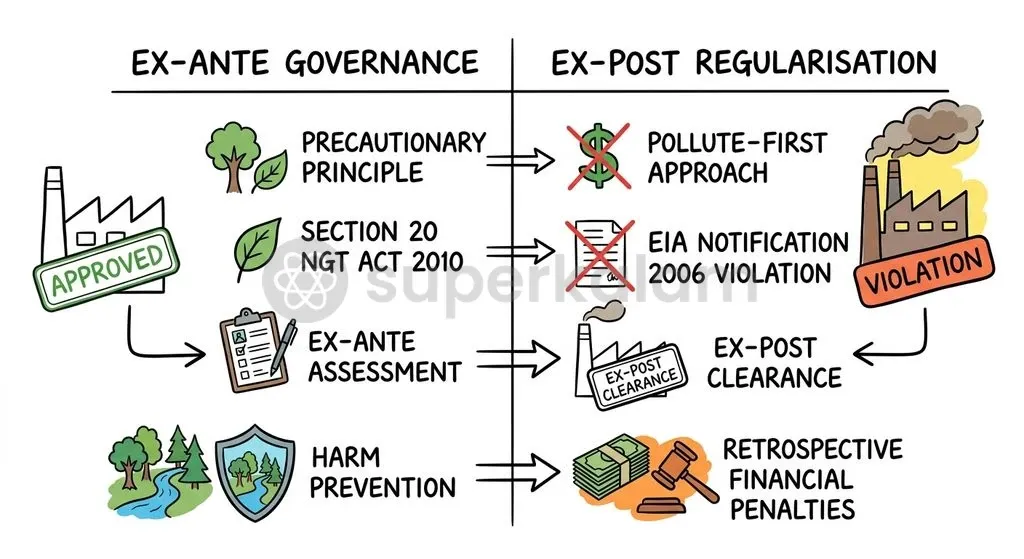
Fig: The Precautionary Principle under Section 20 of the NGT Act requires prior assessment to prevent irreversible environmental harm.
However, legal ambiguity emerged in subsequent judgments, leading to operational friction within regulatory bodies:
- The Contradictory View: In Pahwa Plastics Pvt. Ltd. v. Dastak NGO (2022), a two-judge Bench held that the Environment (Protection) Act, 1986 does not explicitly prohibit ex-post facto clearances for compliant, economically productive industrial units.
- The 2026 Quashing: The three-judge Bench in Vanashakti v. Union of India (July 2026) resolved this divergence by quashing the 2021 SOP Office Memorandum, ruling that administrative instruments cannot create a perpetual retrospective regularisation mechanism.
Discuss with Superkalam
How can the government address public interest without enabling retrospective environmental clearances?
Ask NowWhere the System Breaks: The Dangerous Incentive for Pollute-First, Seek-Permission-Later
The Jan Vishwas Act, 2023 amended Section 15 of the Environment Protection Act, 1986, replacing custodial penal sentences with civil monetary penalties.
This legislative decriminalisation, combined with administrative regularisation procedures, alters the economic calculations of project developers. According to judicial analysis in Alembic Pharmaceuticals (2020) and Vanashakti (2026), substituting prior clearance with monetary fines generates a severe moral hazard. Project proponents treat environmental penalties merely as a regular cost of doing business, embedding a "pollute first, pay fine later" approach into project development.
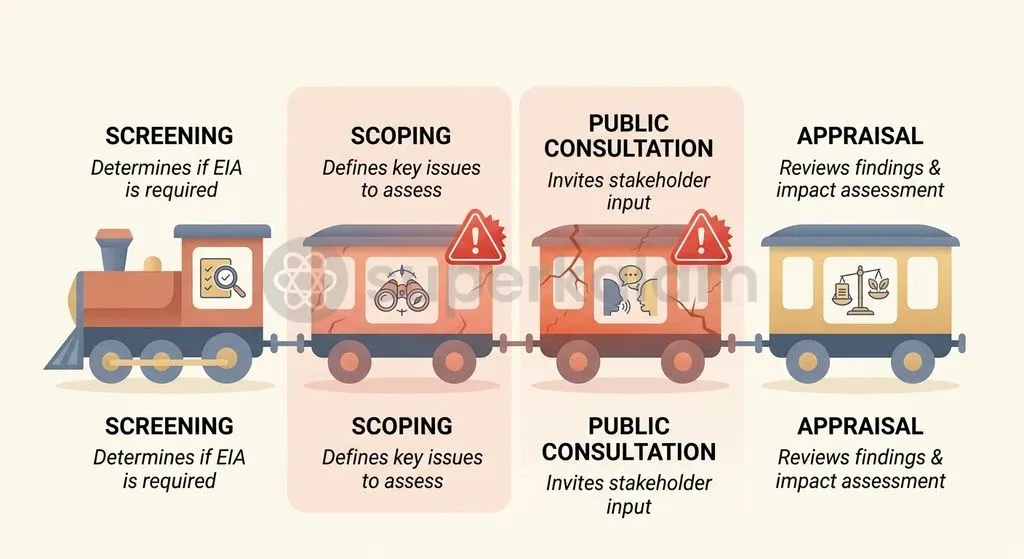
Fig: Executing construction before securing environmental clearance bypasses screening, scoping, and public consultation stages.
Retrospective regularisation fundamentally breaks the four-stage EIA process under Paragraph 7 of the 2006 Notification:
- Irreversible Baseline Alteration: Soil excavation, hydrology disruption, and tree felling occur before baseline ecological data can be documented, rendering scoping exercises meaningless.
- Neutralised Public Consultation: Local communities lose the ability to oppose project siting or demand mitigation measures during public hearings when physical structures are already constructed.
- Compromised EAC Appraisal: Expert Appraisal Committees face fait accompli scenarios, where rejecting clearance would mean ordering the demolition of fully constructed, capital-intensive infrastructure.
The Way Forward: Restoring Ex-Ante Integrity in Environmental Governance
Rebuilding statutory environmental governance requires the Ministry of Environment, Forest and Climate Change to strictly enforce ex-ante appraisals while limiting executive amnesties.
To align national industrial expansion with environmental law, reform efforts must focus on three core governance measures:
- Strict Statutory Compliance: The MoEFCC must restrict clearance procedures to delegated legislation under Section 3 of the Environment (Protection) Act, 1986, abandoning the practice of using administrative Office Memorandums to grant procedural exemptions.
- Narrowly Tailored Amnesties: As permitted in the Vanashakti ruling, any future regularisation scheme must be framed strictly via statutory rules for exceptional cases involving supervening public interest, rather than functioning as an open-ended SOP.
- Judicial Restraint and Oversight: The Supreme Court's plenary power under Article 142 should be exercised sparingly to prevent judicial regularisation from becoming an informal alternative to statutory ex-ante appraisals.
Key Takeaways
- Statutory Requirement: Section 3 of the Environment (Protection) Act, 1986 and the EIA Notification, 2006 mandate prior environmental clearance before any site construction begins.
- Executive SOP Quashed: On July 29, 2026, the Supreme Court quashed the MoEFCC's July 7, 2021 Office Memorandum in Vanashakti v. Union of India, ruling that executive memorandums cannot override statutory rules.
- Jurisprudential Barrier: In Common Cause (2017) and Alembic Pharmaceuticals (2020), the Supreme Court ruled that ex-post facto clearances violate the Precautionary Principle codified under Section 20 of the National Green Tribunal Act, 2010.
- Systemic Breakdown: Retrospective regularisations turn public hearings and scoping under Paragraph 7 of the EIA Notification into ineffective exercises, encouraging a "pollute first, pay fine later" approach.
- Limited Exceptions: Central Government retains authority to issue statutory amnesties under Section 3 of the EPA, 1986 in supervening public interest, alongside the Supreme Court's Article 142 plenary powers.
Mains Question
"Administrative Office Memorandums cannot supplant delegated legislation like the EIA Notification, 2006 to create a perpetual retrospective clearance framework." In light of the Supreme Court judgment in Vanashakti v. Union of India (2026), critically examine how retrospective environmental clearances undermine statutory environmental governance in India. (15 Marks)
Evaluate NowMultiple Choice Questions
QUESTION 1
Q1. Consider the following statements regarding the legal architecture of Environmental Impact Assessment (EIA) in India:
- Section 3 of the Environment (Protection) Act, 1986 mandates prior environmental clearance for designated industrial and infrastructure projects.
- Paragraph 7 of the EIA Notification, 2006 outlines four mandatory stages, beginning with Scoping followed by Screening, Public Consultation, and Appraisal.
- Section 20 of the National Green Tribunal Act, 2010 explicitly codifies the Precautionary Principle.
Which of the statements given above are correct?
QUESTION 2
Q2. How did the Jan Vishwas Act, 2023 alter the legislative penalty framework under Section 15 of the Environment (Protection) Act, 1986?
QUESTION 3
Q3. Consider the following statements regarding the operational disruptions caused by ex-post facto clearances on the EIA framework:
- Pre-existing excavation and site development render scoping exercises meaningless by altering baseline ecological data.
- Public consultation hearings retain full institutional efficacy because completed construction allows local communities to inspect physical structures.
- Expert Appraisal Committees are forced into fait accompli scenarios where rejecting clearance would require ordering the demolition of completed infrastructure.
Which of the statements given above is/are correct?