EVM Totaliser: Balancing Voter Secrecy and Booth Profiling
As the Supreme Court revisits EVM totalisers, the tension between booth-level data tracking and constitutional ballot secrecy returns to the legal spotlight.
Sep, 2026
•12 min read
Overview
An EVM totaliser is an auxiliary hardware interface designed to connect up to 14 Electronic Voting Machine Control Units simultaneously, consolidating votes across multiple polling stations before tallying to prevent booth-wise profiling and protect the constitutional secrecy of individual ballots. Under current counting rules, votes are tabulated machine by machine, exposing neighbourhood-level political preferences to candidates and political parties. While the Election Commission of India and the Law Commission of India have advocated for totalisers since 2008, the reform remains stalled due to statutory constraints under the Representation of the People Act, 1951. As of September 2026, judicial scrutiny has revived the debate, weighing voter protection against operational challenges like VVPAT slip reconciliation and the government's preference for booth-level developmental feedback.
Why the EVM Totaliser Is Back in the News
As of September 2026, the Supreme Court of India directed the Union Government to submit a comprehensive affidavit detailing the legal and administrative impediments to introducing an EVM vote-mixing mechanism. The direction came from a three-judge bench comprising Chief Justice of India Surya Kant, Justice Joymalya Bagchi, and Justice V. Mohana during hearings on public interest petitions seeking voter secrecy safeguards.
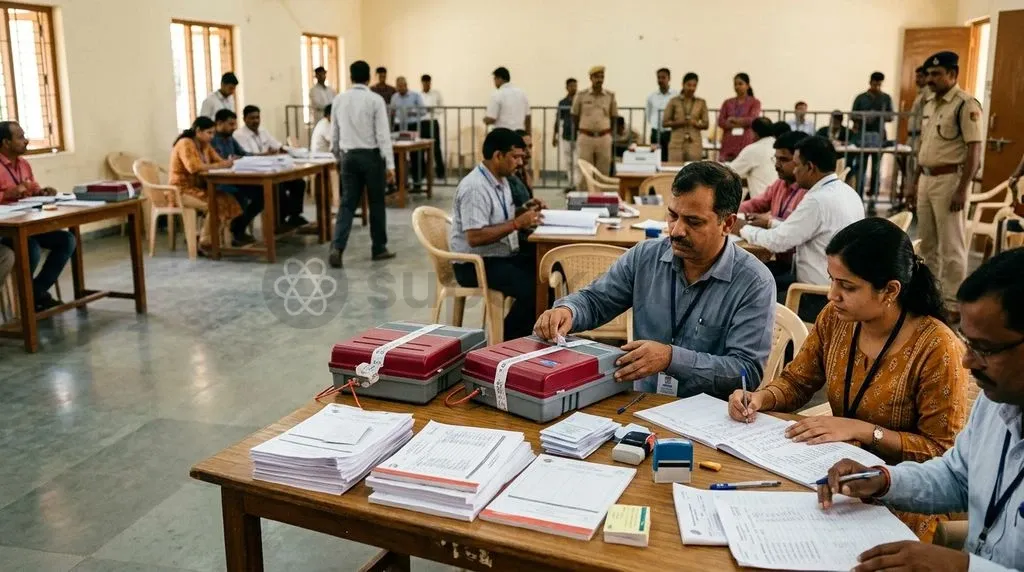
The core of the dispute lies in the transition from paper ballots to electronic voting. When paper ballots were in use, ballot papers from multiple polling booths could be physically mixed before counting to mask local voting trends. The current electronic counting process instead reads each polling station's machine individually. This practice generates granular booth-level data, allowing political actors to identify exact support patterns down to a few hundred households.
The Election Commission of India (ECI) has long maintained that masking booth-level patterns is vital to prevent voter intimidation. However, because the power to amend election conduct rules rests with the Union Government, administrative proposals to deploy totalisers have remained in limbo for nearly two decades.
What Is an EVM Totaliser and How Does It Work?
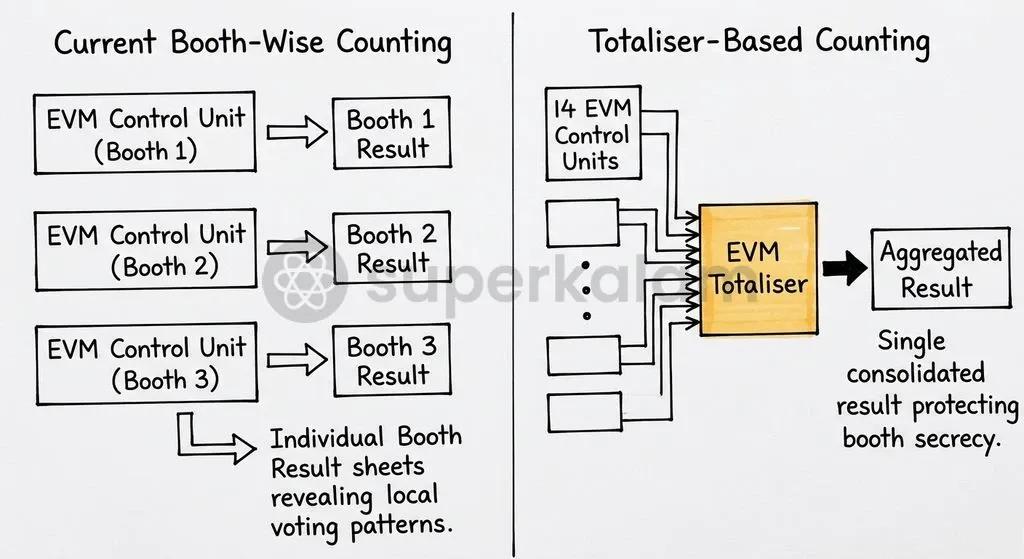
The EVM totaliser operates as an auxiliary hardware unit that connects up to 14 Control Units simultaneously to aggregate election votes without revealing booth-specific polling results.
Under the existing counting protocol governed by Rule 66A of the Conduct of Elections Rules, 1961, counting staff activate each Control Unit sequentially. The machine displays the candidate-wise vote count for that specific polling station, which is then recorded in Part II of Form 17C. This generates an official, public booth-by-booth breakdown of every candidate's performance across the constituency.
When a totaliser is attached, cables connect the individual Control Units to the central totaliser unit. Instead of reading individual tallies, election officials press the counting button on the totaliser itself. The device queries all connected Control Units in parallel and displays only the consolidated candidate totals for that combined cluster of up to 14 polling stations.
This electronic aggregation mirrors the paper-mixing mechanism previously enabled under Rule 59A of the Conduct of Elections Rules, 1961. However, as noted in Chapter XIII of the Law Commission's 255th Report, the shift to electronic voting rendered Rule 59A technically inoperative because Parliament and the Central Government never enacted a corresponding electronic vote-mixing provision under Rule 66A.
Discuss with Superkalam
Recall the specific rule in the Conduct of Elections Rules, 1961 that previously enabled the physical mixing of paper ballots.
Ask NowThe Risk of Booth-Wise Profiling: Why Voter Secrecy Matters
Booth-wise vote counting under the Conduct of Elections Rules, 1961 exposes small demographic pockets to political profiling, selective development, and post-poll retribution. A standard polling booth in India covers approximately 700 to 1,500 electors, often corresponding directly to a specific village, hamlet, housing society, or urban slum pocket.
When election results reveal how a specific booth voted, political parties can accurately map which neighbourhoods supported them and which backed their opponents. According to the Law Commission of India Report No. 255 on Electoral Reforms, this transparency exposes small geographic and demographic clusters to post-poll harassment, economic discrimination, and the selective deprivation of basic amenities by victorious candidates.
This dynamic alters the relationship between elected representatives and citizens:
- Targeted Neglect: Elected officials can channel local area development funds, roads, and water supply exclusively to high-yield voting pockets while starving non-supportive booths.
- Pre-Poll Intimidation: Dominant local groups can threaten vulnerable communities with post-election consequences, knowing that betrayal will be visible on the Form 17C result sheet.
- Social Cohesion Fractures: Micro-level voting data sharpens caste, religious, and class cleavages within local administrative wards.
While individual ballot secrecy inside the voting booth is preserved, collective voter privacy at the community level is entirely compromised by sequential Control Unit counting.
Discuss with Superkalam
Explain how sequential EVM counting under Rule 66A differs from the aggregation mechanism provided by an EVM totaliser.
Ask NowThe Legal Bottleneck: Article 324 Powers vs Central Rule-Making
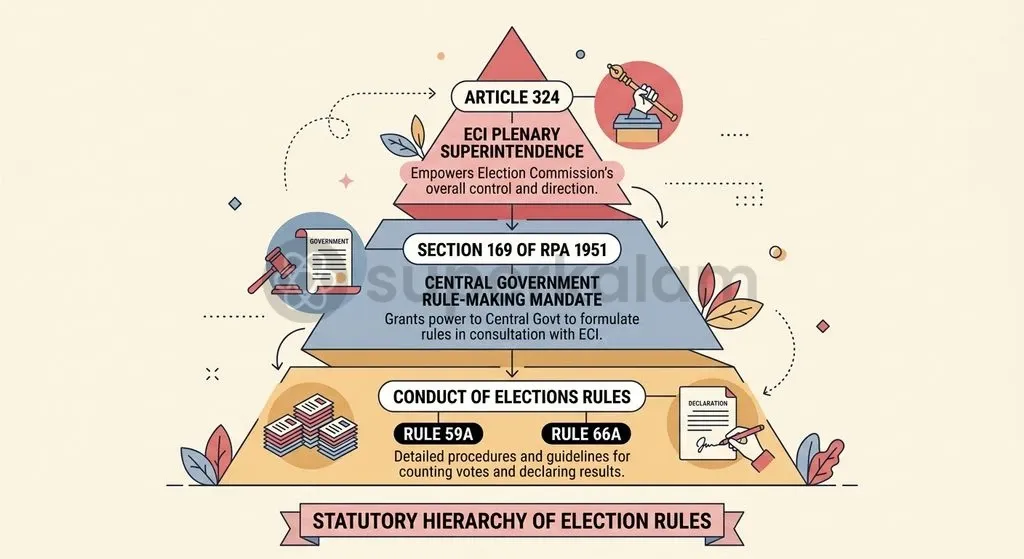
The constitutional tension between the Election Commission of India under Article 324 and the Central Government under Section 169 of the Representation of the People Act, 1951 defines the totaliser impasse.
Under Article 324(1) of the Constitution, the ECI holds the plenary powers of superintendence, direction, and control over all parliamentary and state assembly elections. However, the Supreme Court has established that plenary constitutional powers operate only in areas where statutory provisions are silent.
Under Section 169 of the Representation of the People Act, 1951, the authority to frame and amend rules for conducting elections rests exclusively with the Central Government, exercisable only after consulting the ECI. Because Rule 66A explicitly mandates booth-by-booth recording on Form 17C, the ECI cannot deploy totalisers through executive orders without the Union Ministry of Law and Justice officially amending the subordinate legislation.
Section 128 of the Representation of the People Act, 1951 reinforces the legal duty of election personnel to maintain secrecy under threat of imprisonment or fine. The ECI has argued that permitting booth-wise data publication undermines the legislative intent of Section 128, yet the statutory lock on Rule 66A prevents unilateral reform.
Arguments For and Against Introducing Totalisers
The debate over EVM totalisers pits the imperative of individual ballot confidentiality against the administrative feasibility of VVPAT reconciliation and grassroots political feedback.
The Case for Totalisers
- Shielding Vulnerable Voters: Aggregating 14 polling stations into a single block of roughly 10,000 to 14,000 votes dilutes demographic clusters, making it impossible to penalise specific hamlets.
- Reinforcing Free Franchise: Electors can exercise their franchise without fear of economic coercion or post-election civic neglect.
- Curbing Discriminatory Spending: Depriving elected officials of booth-level breakdowns compels them to distribute constituency development funds uniformly rather than rewarding loyal pockets.
The Case Against Totalisers
- Granular Feedback for Development: A Group of Ministers (GoM) constituted in 2016 opposed totalisers, arguing that booth-level voting patterns assist political parties in identifying local developmental deficits and gauging governance satisfaction.
- VVPAT Reconciliation Hurdles: Submissions to the Supreme Court highlight operational friction when reconciling pooled electronic tallies against mandatory Voter Verifiable Paper Audit Trail (VVPAT) paper slip counts, which are conducted on an individual booth basis.
- Dispute Resolution Complications: If an election petition challenges the integrity of a specific polling station's machine, isolating that booth's tally from an aggregated totaliser pool introduces procedural complexities.
Discuss with Superkalam
How might booth-level voting data influence an elected representative's allocation of local development funds in a constituency?
Ask NowWhat Law Panels and Courts Have Recommended
The Law Commission of India and the Supreme Court of India have repeatedly affirmed that ballot secrecy constitutes an indispensable pillar of free and fair elections.
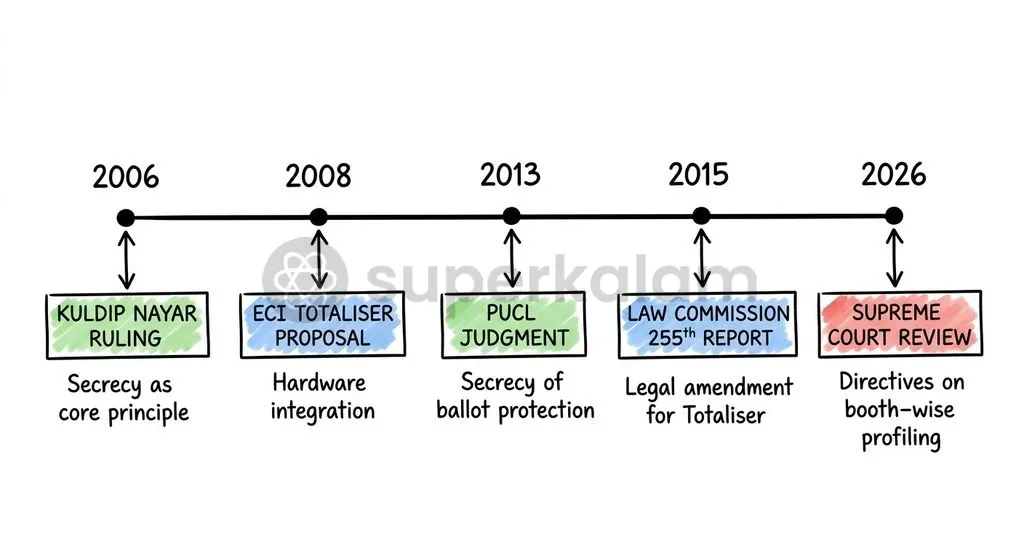
On November 21, 2008, the Election Commission of India formally submitted a proposal to the Union Ministry of Law and Justice recommending the introduction of totaliser machines for EVM counting. The ECI reiterated that technological safeguards must keep pace with democratic protections that existed under the paper ballot regime.
In PUCL v. Union of India (2013), the Supreme Court ruled that ballot secrecy is an essential facet of free and fair elections and forms an integral component of the freedom of expression guaranteed under Article 19(1)(a). The Court observed that democracy thrives only when an elector casts their vote without fear of reprisal.
This doctrine built upon Kuldip Nayar v. Union of India (2006), where the Supreme Court held that while secrecy may be modified in indirect legislative council elections, it remains fundamental in general elections to insulate citizens from coercion.
Following these precedents, the Law Commission's 255th Report (2015) recommended amending Rule 66A of the Conduct of Elections Rules, 1961. The Commission urged empowering the ECI to deploy totalisers in constituencies where voter intimidation or harassment was apprehended.
Discuss with Superkalam
Analyse the legal tension between the ECI's plenary powers under Article 324 and the Union Government's authority under Section 169 of the RPA, 1951.
Ask NowEthical Dimension: Fear-Free Franchise and Democratic Accountability
The ethical foundation of universal adult suffrage rests on the state's duty to guarantee a fear-free franchise under the umbrella of constitutional morality.
When voting secrecy is compromised at the community level, the democratic mandate suffers from three structural ethical distortions:
- Compromised Autonomy: True moral agency requires freedom from external coercion. If a voter knows their entire village's choice will be transparent, the vote becomes an act of collective self-preservation rather than genuine political expression.
- Transactional Clientelism: Booth-level transparency reduces governance to a transactional calculation. Representatives treat public infrastructure as private patronage distributed solely to loyal booths rather than an entitlement of citizenship.
- Erosion of Civic Trust: When marginalised groups face intimidation or post-election neglect, their trust in the integrity of representative institutions erodes, undermining democratic legitimacy.
Preserving voter secrecy at the booth level is therefore not merely an administrative choice; it is an ethical imperative essential to maintaining democratic integrity and constitutional morality.
Discuss with Superkalam
Evaluate whether protecting collective voter secrecy through totalisers outweighs the administrative need for booth-level VVPAT reconciliation.
Ask NowWay Forward: Reconciling Granular Feedback with Voter Protection
Reconciling democratic accountability with ballot secrecy requires targeted statutory amendments and phased administrative deployment of totaliser technology across vulnerable constituencies.
To resolve the impasse, policymakers and election administrators should consider the following measures:
- Statutory Amendment to Rule 66A: The Central Government should enact the Law Commission's recommendation to amend Rule 66A of the Conduct of Elections Rules, 1961, formally authorising the ECI to use totalisers where booth intimidation is a concern.
- Phased Pilot Deployment: The ECI could introduce totalisers on a pilot basis in historically sensitive constituencies with documented records of post-poll violence or demographic polarisation.
- Integrated VVPAT Audit Framework: The ECI's technical expert committee should establish a standard operating procedure to reconcile totaliser hardware counts with random VVPAT paper slip verification without exposing individual booth tallies.
- Consensus Building via All-Party Consultation: The Union Government should convene an all-party meeting alongside the ECI to address party concerns regarding developmental feedback, establishing alternative mechanisms for citizen grievance redressal.
Key Takeaways
- An EVM totaliser connects up to 14 Control Units simultaneously to calculate consolidated candidate totals, preventing the disclosure of booth-specific voting patterns.
- Sequential counting under Rule 66A of the Conduct of Elections Rules, 1961 produces granular booth data that exposes small voter pockets to political profiling, intimidation, and selective developmental neglect.
- While the Election Commission of India proposed totalisers in 2008 and the Law Commission endorsed them in Report No. 255 (2015), implementation requires the Central Government to amend Rule 66A under Section 169 of the RPA, 1951.
- In PUCL v. Union of India (2013), the Supreme Court ruled that ballot secrecy is an essential facet of free and fair elections and a protected dimension of Article 19(1)(a).
- Key implementation challenges include resolving administrative friction during mandatory VVPAT slip verification and political party concerns regarding local governance feedback.
Mains Question
"While individual ballot secrecy inside the voting compartment is maintained, sequential booth-wise counting compromises collective voter privacy and fuels post-poll victimisation." In light of the Law Commission of India's 255th Report, examine the need for introducing EVM totalisers. (10 Marks)
Evaluate NowMains Question
"The administrative stalemate over EVM totalisers highlights the constitutional friction between the Election Commission's plenary mandate under Article 324 and the Central Government's statutory rule-making authority under Section 169 of the Representation of the People Act, 1951." Critically analyse. (15 Marks)
Evaluate NowPractice MCQs
QUESTION 1
With reference to the Conduct of Elections Rules, 1961, consider the following statements:
- Rule 59A provided for the physical mixing of ballot papers from multiple polling booths before counting during paper ballot elections.
- Rule 66A governs the sequential tallying of individual EVM Control Units, recording booth-wise candidate performance in Part II of Form 17C.
- The Election Commission of India has plenary powers under Article 324 to amend Rule 66A without consulting or requiring approval from the Central Government.
Which of the statements given above are correct?
QUESTION 2
Regarding the technical and operational functioning of an EVM Totaliser, consider the following statements:
- It serves as an auxiliary hardware interface capable of connecting up to 14 Control Units simultaneously.
- It enables parallel querying of connected Control Units to display consolidated candidate totals without revealing booth-specific results.
- It was formally incorporated into the Conduct of Elections Rules, 1961 through an amendment under Section 169 in 2008.
Which of the statements given above is/are correct?
QUESTION 3
Under the statutory framework of elections in India, Section 128 of the Representation of the People Act, 1951 deals specifically with:
QUESTION 4
Consider the following statements regarding the Law Commission of India Report No. 255 on Electoral Reforms:
- It highlighted that sequential counting under Rule 66A exposes small demographic pockets to post-poll victimisation and selective developmental deprivation.
- It noted that the transition to electronic voting rendered Rule 59A technically inoperative due to the absence of a corresponding electronic mixing provision.
- It recommended discontinuing individual ballot secrecy in favour of complete transparency for local developmental audits.
Which of the statements given above are correct?
QUESTION 5
Consider the following statements regarding the legal bottleneck in deploying EVM totalisers:
- The Supreme Court has held that plenary powers of the ECI under Article 324(1) operate only when statutory provisions or framed rules are silent.
- Amending the Conduct of Elections Rules, 1961 requires the Union Ministry of Law and Justice to exercise subordinate legislative powers under Section 169 of the Representation of the People Act, 1951.
Which of the statements given above is/are correct?