EV Retrofitment in India: Policy Framework, AIS-123 Rules, and Key Challenges
As statutory vehicle bans loom, converting legacy chassis into electric platforms balances circular economy gains against steep certification bottlenecks.
Oct, 2026
•11 min read
Context
Electric vehicle retrofitment offers India a transitional pathway to decarbonise internal combustion engine fleets. It replaces conventional mechanical powertrains with electric motors and certified battery packs under the Central Motor Vehicles Rules. This process extends vehicle lifespans while avoiding premature vehicular scrappage.
Technical execution follows the Automotive Industry Standard (AIS-123), with certification overseen by bodies like the Automotive Research Association of India. Conversion kits bridge the gap between expensive new electric models and statutory retirements. As of March 2025, regulatory and financial friction points limit widespread commercial adoption. These include steep prototype homologation expenses, exclusion from central purchase subsidies like the PM E-DRIVE Scheme, and safety concerns over thermal runaway. Resolving these hurdles can unlock a decentralised circular automotive economy, upskilling local technicians and generating green employment across Indian states.
Why EV Retrofitment Is Gaining Momentum in India
The National Green Tribunal accelerated clean mobility shifts by enforcing strict operational ceilings on fossil-fuel vehicles in the National Capital Region. In line with judicial directives on urban air pollution, authorities mandate the de-registration of diesel vehicles older than 10 years and petrol vehicles older than 15 years.
Vehicle owners face a steep economic penalty when forced to discard roadworthy chassis at arbitrary chronological cut-offs. The Ministry of Road Transport and Highways responded by introducing formal provisions under the Central Motor Vehicles Rules, 1989, establishing an alternative to outright disposal.
Several structural pressures now converge to drive fleet conversion:
- Prohibitive Capital Costs: Factory-fresh commercial electric vehicles remain unaffordable for small operators, even with demand incentives under the PM E-DRIVE Scheme.
- Foreign Exchange Drain: Rapid vehicular growth worsens urban air pollution and strains currency reserves through crude petroleum imports.
- Embodied Energy Preservation: Building a new vehicle consumes substantial raw steel, aluminium, and rare earths. Powertrain replacement maximises the embedded material energy of existing chassis.
Consequently, retrofitment has shifted from a hobbyist experiment into a viable vehicle life-extension policy.
What Is EV Retrofitment and How Does the Conversion Work?
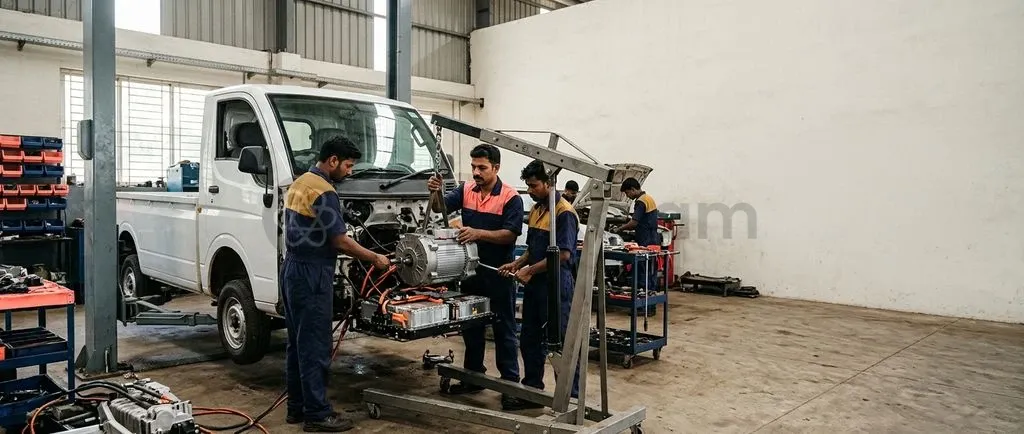
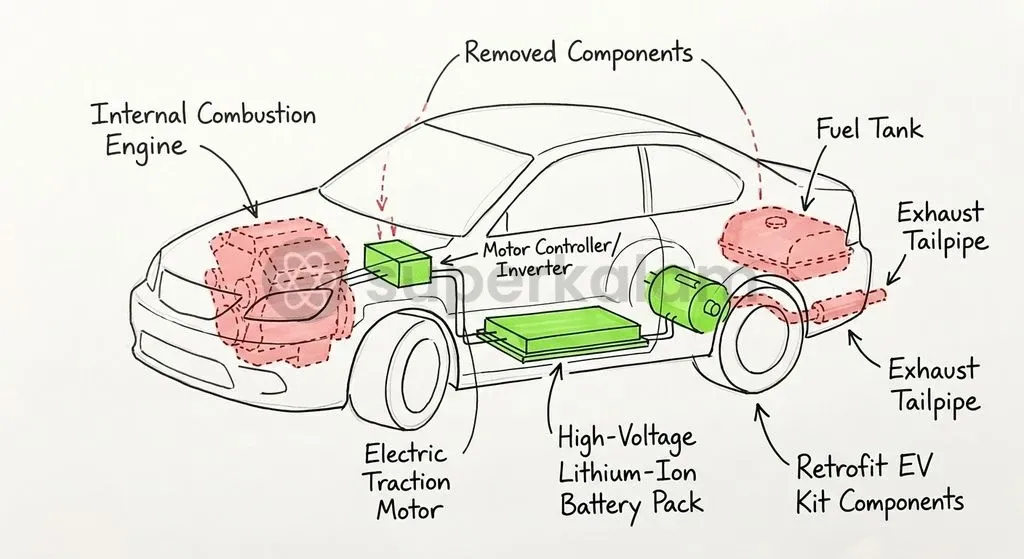
Electric vehicle retrofitment systematically removes the internal combustion engine and fossil-fuel components to install an electric powertrain conversion into an existing vehicle glider. Technicians dismantle the engine block, exhaust assembly, fuel tank, and mechanical transmission systems. They retain the structural chassis, suspension, steering assembly, and body panels.
Engineers then install an engineered kit comprising a traction motor, an inverter, a motor controller, a high-voltage wiring harness, and a lithium-ion battery pack with an integrated battery management system. The motor controller is the central processing unit, regulating electrical current between the traction battery and the electric motor based on throttle inputs.
Technicians calibrate regenerative braking mechanisms and install dedicated power converters to maintain auxiliary systems. These auxiliaries include power steering, vacuum-assisted braking, and air conditioning. Strict adherence to weight distribution guidelines prevents hazardous shifts in the vehicle's structural centre of gravity.
| Technical Dimension | Conventional ICE Vehicle | Factory-Built Electric Vehicle | Retrofitted Electric Vehicle |
|---|---|---|---|
| Powertrain Mechanism | Internal combustion engine, gearbox, fuel injection, exhaust | Dedicated electric skateboard platform, integrated e-axle | Electric motor and controller adapted to legacy mechanical chassis |
| Capital Acquisition Cost | Depreciated historical investment | High initial purchase price requiring substantial capital | Moderate kit and installation cost preserving original chassis |
| Chassis Optimisation | Tuned strictly for engine weight and mechanical vibration | Aerodynamically optimised for battery weight distribution | Constrained by original donor vehicle layout and suspension limits |
| Embodied Carbon Impact | High ongoing tailpipe emissions throughout lifecycle | High upfront manufacturing footprint offset over time | Lowest incremental manufacturing footprint by reusing rolling chassis |
| Regulatory Status | Subject to 10/15-year statutory retirement mandates | Standard 15-year registration renewable under CMVR | Valid for extended operational life post-endorsement under AIS-123 |
Discuss with Superkalam
Which parts of the Automotive Industry Standard 123 (AIS-123) apply respectively to two-wheelers, four-wheelers, and heavy commercial vehicles?
Ask NowScrapping Versus Retrofitting: The Economic and Resource Choice
The Voluntary Vehicle Fleet Modernisation Programme encourages the scientific disposal of inefficient, polluting vehicles through authorised scrappage facilities. While scrappage fragments structural components for secondary raw materials, retrofitment champions asset life extension by preserving the resource-intensive glider.
Scrapping an otherwise sound commercial carrier discards thousands of kilograms of formed structural steel and functional sub-assemblies. Smelting, pressing, and assembly operations in replacement manufacturing release significant greenhouse gas emissions. Retrofitment reduces this embodied carbon debt by restricting new industrial production strictly to electrical powertrain components.
The economic contrast breaks down along clear operational lines:
- Upfront Outlay: Sourcing a new electric light commercial vehicle requires substantial capital. Retrofitting an existing diesel chassis can reduce capital expenditure by roughly half .
- Balance Sheet Protection: Fleet owners who electrify existing chassis avoid debt-heavy expansions during volatile interest rate cycles.
- Operational Payback: Lower running costs per kilometre accelerate amortisation, making commercial conversions viable where high daily mileage offsets initial kit expenses.
Discuss with Superkalam
How does EV retrofitment reduce the embodied carbon footprint compared to purchasing a newly manufactured electric vehicle?
Ask NowThe Regulatory Framework: Motor Vehicle Rules and Safety Approvals
The Central Motor Vehicles Rules, 1989 regulate vehicular alterations to guarantee that technical modifications do not compromise public safety on national roadways. Retrofitment operations require formal statutory compliance under Rule 115A and Rule 125L of the CMVR, which govern electric kit installation and certification processes.
Engineering standards for electric powertrain conversions are codified under the Automotive Industry Standard 123 (AIS-123). This standard establishes testing protocols for electrical safety, electromagnetic compatibility, battery functional safety, and mechanical integration across three distinct vehicle categories:
- AIS-123 (Part 1): Specifies conversion requirements for two-wheelers and three-wheelers, setting baseline motor performance, braking efficiency, and insulation resistance parameters.
- AIS-123 (Part 2): Governs four-wheeled light commercial and passenger transport platforms, focusing on structural stability, weight distribution ceilings, and crash compatibility.
- AIS-123 (Part 3): Mandates stringent structural integrity and high-voltage safety benchmarks for heavy commercial vehicles and public transit buses.
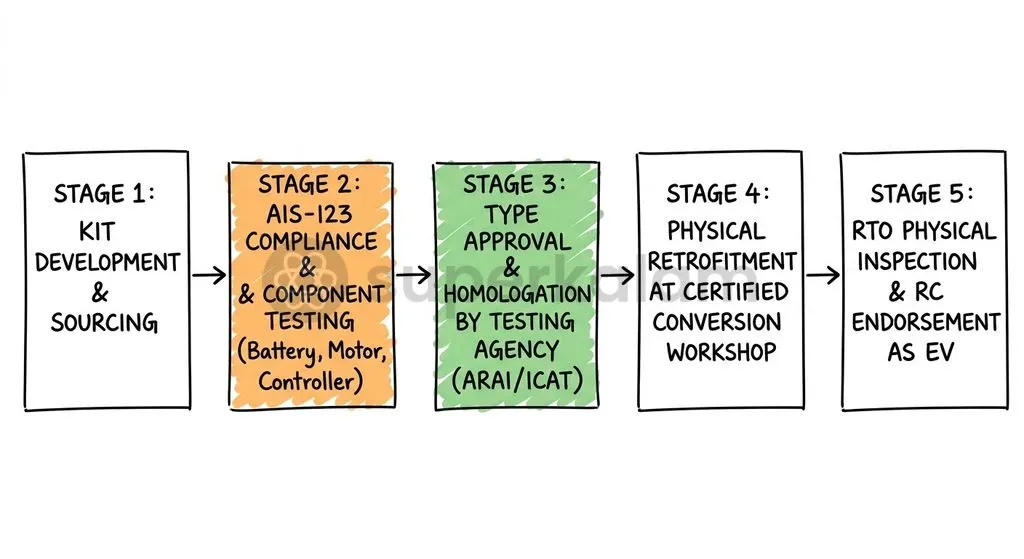
The Automotive Research Association of India and the International Centre for Automotive Technology execute mandatory type-approval and homologation testing for kit manufacturers. Accredited workshops must submit prototype conversions to rigorous environmental, thermal, and dynamic brake testing before commercial release.
Following kit certification, individual conversions undergo vehicle-level inspection at designated Regional Transport Offices. Authorised transport officers verify kit serial numbers, test insulation safety, and update the official Registration Certificate to reflect the altered fuel designation from fossil fuel to battery electric.
Discuss with Superkalam
If a logistics company faces mandatory de-registration of its 10-year-old diesel delivery fleet under NGT rules, how should it evaluate retrofitting versus purchasing new commercial EVs?
Ask NowKey Hurdles: High Testing Costs, Safety Risks, and Financing Gaps
Commercial adoption of retrofit kits faces several regulatory and commercial bottlenecks:
- Disproportionate Homologation Fees: ARAI requires individual type-approval certifications for each specific vehicle make, model, and engine variant. Prototype testing fees can reach tens of lakhs of rupees per variant, pricing micro and small enterprises out of formal certification pathways.
- Thermal Runaway Hazards: Conventional vehicle compartments lack purpose-built battery pack channels, raising risks of physical puncture, improper heat dissipation, or water ingress during heavy monsoons. Substandard cell chemistries and inferior wiring looms compromise electrical isolation, triggering fire hazards.
- Reluctant Lending Frameworks: Commercial lenders lack clear valuation metrics for depreciated donor gliders housing expensive electrical drivetrains. Unlike conventional vehicle purchases where the asset is liquid collateral, banks hesitate to underwrite kit financing.
- Underwriter Conservatism: Insurers struggle to price actuarial risk models for modified chassis, leading to steep premiums or outright refusals of comprehensive coverage.
- Subsidy Exclusion: The PM E-DRIVE Scheme allocates fiscal support exclusively to newly manufactured electric platforms, denying retrofitment kits the capital subsidies that lower initial adoption barriers.
Discuss with Superkalam
Break down the structural trade-offs between homologation safety requirements under ARAI and the commercial viability of MSME retrofit kit developers.
Ask NowStrategic Framing: India’s Next Mobility Revolution and the Global South
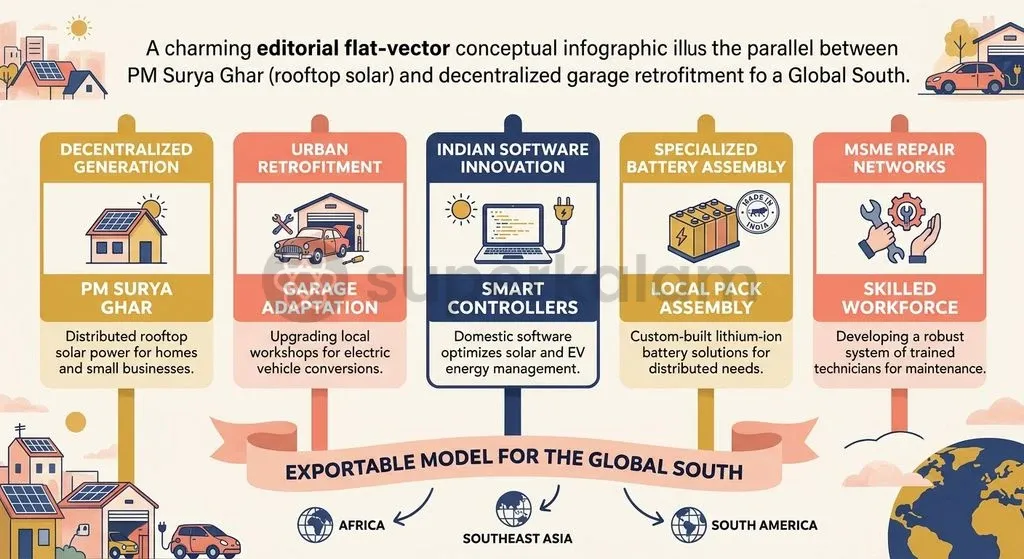
India possesses the industrial capability to position vehicle retrofitment as its next domestic mobility revolution by coupling frugal engineering with mass manufacturing scale. The structural decentralisation of a national retrofitment ecosystem mirrors the operational architecture of the PM Surya Ghar: Muft Bijli Yojana, which decentralised power generation across millions of individual residential rooftops.
Just as rooftop solar converted passive domestic consumers into distributed clean energy producers, a nationwide network of certified conversion workshops can transform traditional automotive repair centres into clean-tech integration nodes. Rather than concentrating vehicular manufacturing within capital-intensive original equipment manufacturing facilities, retrofitting distributes economic value across thousands of regional garage clusters.
India maintains an established track record of re-engineering complex global technologies into accessible, cost-effective delivery frameworks. This domestic technological capability has systematically created novel implementation paradigms across foundational sectors:
- Generic Pharmaceuticals: Indian drug manufacturers radically reduced global antiretroviral and chronic care costs through advanced chemical process re-engineering, securing domestic supply lines and transforming international healthcare delivery.
- Telecommunications Infrastructure: Domestic network providers lowered capital deployment costs by optimising operational towers and network unbundling, democratising data access to establish the lowest global cost per gigabyte.
- Unified Payments Interface (UPI): Public digital infrastructure transformed private payment architectures, enabling interoperable, zero-cost retail micro-transactions at population scale.
Deploying this frugal engineering capability to automotive conversion provides the Global South with an exportable template for rapid decarbonisation. Emerging developing nations across Africa, Latin America, and Southeast Asia face severe fiscal constraints, preventing them from retiring massive fleets of older vehicles or financing total electric transitions.
By re-engineering powertrains instead of purchasing imported electric vehicles, developing countries can reduce reliance on foreign petroleum and preserve foreign exchange reserves. Implementing this global model requires sound domestic testing diagnostics, vehicle-specific battery pack configurations, and specialised software calibration. India's deep automotive component supply chains, extensive engineering talent base, and established software services sector provide the ideal foundational ecosystem to lead this transition.
The Circular Economy Advantage and Local Green Jobs
Expanding the vehicle conversion market directly reinforces national circular economy roadmaps by curtailing industrial scrap generation and extending industrial product lifespans. Reusing structural vehicle steel, safety glass, seating, and mechanical axles lowers aggregate primary iron ore consumption and energy-intensive manufacturing cycles.
The shift unlocks tangible operational and economic dividends:
- Vocational Reskilling: Millions of regional mechanics and electricians face technological obsolescence as internal combustion engines phase out. Conversion programmes offer a clear path to upskill technicians under the Skill India Mission.
- High-Voltage Technical Mastery: Mechanics learn to handle high-voltage architecture, power inverter calibration, regenerative braking systems, and digital diagnostic tools.
- Spurring Localised Supply Chains: Decentralised conversion facilities generate steady local demand for mounting brackets, thermal insulation, customised wiring harnesses, and battery enclosure fabrications.
- Equitable Wealth Distribution: Dispersed fabrication and assembly work prevents geographic concentration of capital, spreading economic value across domestic industrial clusters.
Way Forward: Steps Needed to Build a Viable Retrofitment Market
Accelerating electric retrofitment requires harmonising contradictory statutory frameworks, lowering testing burdens, and establishing accessible consumer credit structures. Policymakers must align Central Motor Vehicles Rules with local municipal air quality guidelines to provide regulatory certainty.
- Rationalise Homologation Standards: The Ministry of Road Transport and Highways should transition from strict vehicle-model testing to modular kit certification. Approving conversion kits based on broad vehicle weight and power classes, rather than individual engine variants, will substantially reduce compliance costs for small engineering enterprises.
- Extend Fiscal Subsidies: The Ministry of Heavy Industries should expand clean mobility programmes like the PM E-DRIVE Scheme to provide targeted capital vouchers for certified conversion kits installed on commercial vehicles.
- Mandate Priority Sector Lending: The Reserve Bank of India should incorporate commercial vehicle electrification and kit conversions into formal Priority Sector Lending guidelines, compelling commercial lenders to offer affordable credit lines.
- Standardise Battery Swapping Systems: Standardising mechanical dimensions and electrical connectors for retrofitted battery packs will enable converted vehicles to utilise public battery-swapping networks, reducing upfront battery acquisition costs.
- Establish Quality Accreditation Hubs: Establishing regional training centres under the Automotive Skills Development Council will certify local garages, ensuring converted vehicles meet uniform fire-safety and wiring insulation standards.
Discuss with Superkalam
Weigh the arguments for and against extending central subsidy support under the PM E-DRIVE Scheme to aftermarket EV retrofitment kits.
Ask NowKey Takeaways
- Electric vehicle retrofitment replaces internal combustion engine mechanical powertrains with electric motors and certified battery packs, preserving the structural chassis to minimise vehicle scrappage.
- Legal operation requires strict compliance with Central Motor Vehicles Rules (CMVR) 1989 and safety certification under the Automotive Industry Standard (AIS-123 Parts 1, 2, and 3) by bodies such as ARAI and ICAT.
- The conversion model provides a cost-effective alternative for vehicle owners facing statutory operational limits, such as the National Green Tribunal's 10-year diesel and 15-year petrol restrictions in Delhi-NCR.
- High model-by-model homologation expenses, thermal runaway safety risks, absence of formal bank financing, and exclusion from subsidies like the PM E-DRIVE Scheme restrict wider commercial scaling.
- Frugal re-engineering mirrors previous Indian successes in generic drugs, telecommunications, and UPI, positioning retrofitment as an exportable decarbonisation template for the Global South.
Mains Question
'While the Voluntary Vehicle Fleet Modernisation Programme relies on structural scrappage, electric vehicle retrofitment preserves embodied material energy and protects commercial balance sheets.' In this context, examine the technical, regulatory, and financial barriers hindering large-scale EV retrofitment in India. (15 Marks)
Evaluate NowMains Question
Exclusion from demand incentives under the PM E-DRIVE Scheme and stringent type-approval protocols pose significant viability challenges to India's retrofitment sector. Discuss. (10 Marks)
Evaluate NowPractice MCQs
QUESTION 1
With reference to the Automotive Industry Standard (AIS-123) for electric vehicle retrofitment in India, consider the following statements:
- AIS-123 (Part 1) lays down conversion standards specifically for two-wheelers and three-wheelers.
- AIS-123 (Part 2) regulates light commercial and passenger transport platforms, focusing on structural stability and crash compatibility.
- AIS-123 (Part 3) establishes safety parameters for heavy commercial vehicles and public transit buses. Which of the statements given above are correct?
QUESTION 2
Under the Central Motor Vehicles Rules (CMVR), 1989, which of the following rules specifically govern the certification and statutory compliance for electric vehicle retrofitment kits in India?
QUESTION 3
Consider the following statements regarding the regulatory and economic aspects of electric vehicle retrofitment in India:
- Vehicle retrofitment preserves the embedded material energy of the vehicle glider while avoiding premature scrappage.
- Conversion kits for retrofitting commercial vehicles receive direct demand-side purchase subsidies under the PM E-DRIVE Scheme.
- The Automotive Research Association of India (ARAI) grants universal type-approval that applies across all vehicle models and engine variants using a single certification. Which of the statements given above is/are correct?
QUESTION 4
Consider the following statements regarding the technical conversion process in electric vehicle retrofitment:
- The original transmission, fuel injection, and internal combustion engine block are completely replaced, while retaining the body panels, steering assembly, and suspension.
- The motor controller regulates electrical current between the traction battery pack and electric motor according to throttle inputs.
- Dedicated power converters are integrated to sustain auxiliary mechanisms such as vacuum-assisted braking and power steering. Which of the statements given above are correct?
QUESTION 5
Which of the following testing agencies are cited as executing mandatory type-approval and homologation certifications for EV retrofitment kits in India?
- Automotive Research Association of India (ARAI)
- International Centre for Automotive Technology (ICAT)
- Bureau of Indian Standards (BIS) Select the correct answer using the code given below: